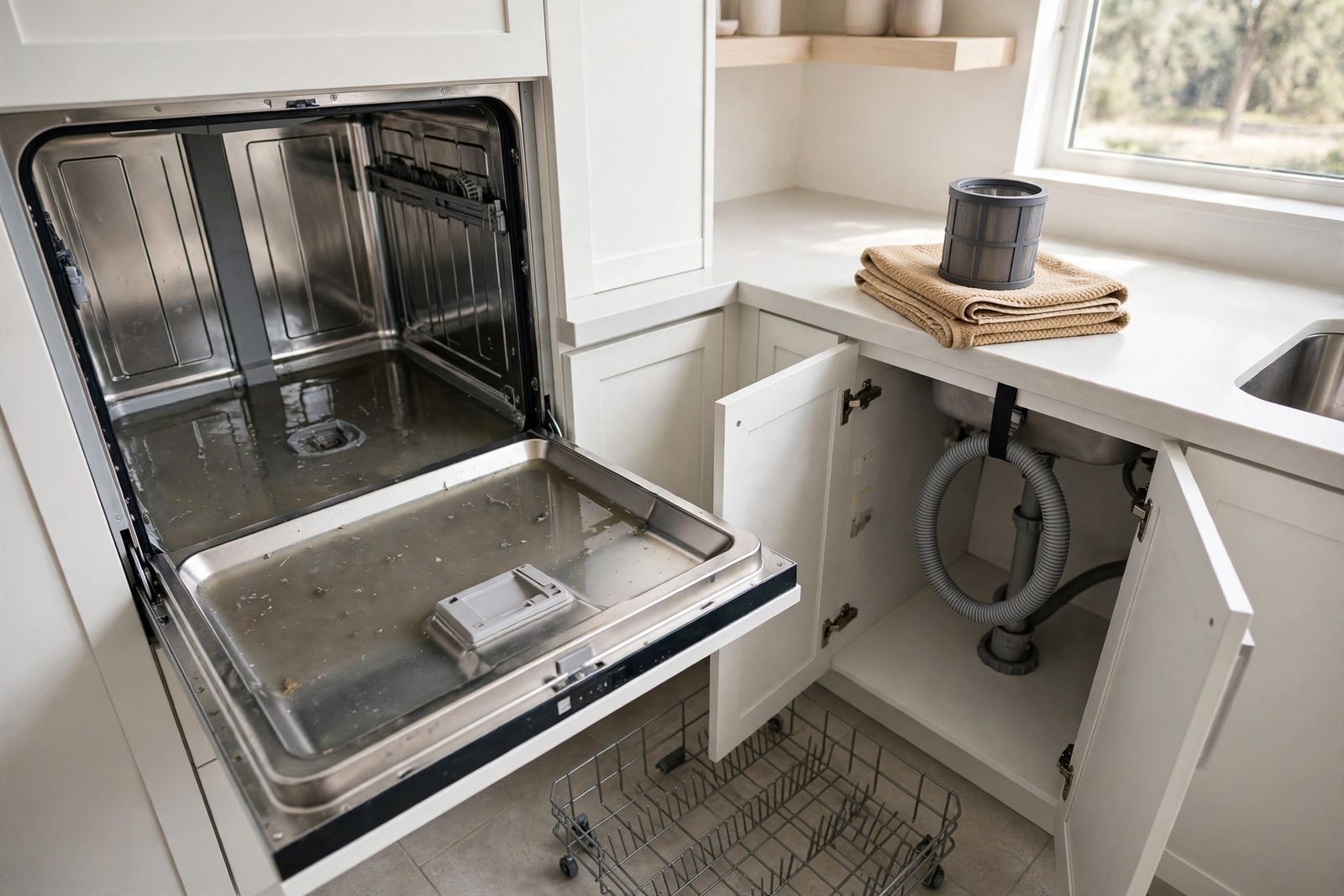
A dishwasher that is not draining has almost always failed at one link of a single short chain, and the fix is to work that chain in order instead of guessing: filter → air gap → the knock-out plug in a new garbage disposal → the high loop in the drain hose → the drain pump. Clean the filter first, because it is the most common cause by a wide margin. If your sink has an air gap, clear it next. If a garbage disposal was recently fitted, check that its knock-out plug was actually removed — a dishwasher draining into a sealed disposal inlet will never drain, on any cycle. Then check that the drain hose rises in a proper high loop and is not kinked. Only when all four links are clear does the pump itself become the suspect. Each link below carries the one sign that names it, so you can stop at the link that matches your machine instead of working the whole list blind.
First, the boundary and the calibration. Water standing in the tub after a finished cycle, with a dry floor, is a drain fault — this article. Water on the floor is a leak, a different fault with a different diagnosis, covered in dishwasher leaking: do not run drain tests on a machine that is putting water on the floor. And a small amount of water in the tub is not a fault at all. GE Appliances states that on models without an Ultra Fine filter, one to two cups of clean water covering the bottom of the tub is normal, and on models with that filter, water in the sump area is normal as long as it does not cover the tub floor. Manufacturers leave that water there on purpose — it keeps the pump seals from drying out. What is not normal is dirty water, water deep enough to cover the floor of the tub after a completed cycle, or water that is still there hours later.
Before you start: safety and setup
- Turn the power off at the breaker. A dishwasher full of standing water still has power to its pump, heater and controls. Whirlpool’s drain guide is explicit: turn off power at the circuit breaker and do not rely on the control panel alone.
- Shut off the water supply valve under the sink if you plan to disconnect the hose.
- Bail the standing water out with a cup, then finish with towels or a sponge. You cannot inspect the filter or sump through a puddle. Gloves are worth wearing: broken glass collects in sumps.
- Never pour chemical drain cleaner into a dishwasher. GE warns against it directly: it damages seals and plastic parts and leaves residue where your dishes go. Whatever is blocking the drain comes out by hand or not at all.
Two quick tests before the chain, because they can end the job here. Run a cancel/drain cycle: if the last cycle was interrupted — door opened, power blip — the machine may simply have stopped before its final drain. Latch the door fully (a door that is not latched will not run or finish a cycle, as GE’s factory service guidance notes), press Cancel/Drain or hold Start/Reset as your model’s manual directs, and let it run. If the tub empties, the problem was the interruption. Run the kitchen sink for about 30 seconds: Samsung’s support guidance uses the same test — if the sink itself drains slowly, the blockage is in the shared drain path beyond the dishwasher, and no dishwasher part will fix it. Work the sink side with the methods in how to unclog a drain; a line that stays blocked past the sink is a plumber’s job.
The standing-water decision chain
Work the links in this order. At each link, look for its naming sign first — if the sign is present, you have your cause and you can stop; if the link is clean and its sign is absent, move to the next link without replacing anything.
| Link | Check it like this | The sign that names this link | If it is clear |
|---|---|---|---|
| 1. Filter and sump | Bottom rack out, twist or lift the filter out, rinse it, and clear the sump underneath it by hand | Filter mesh coated or blocked with food, labels or grease — or debris sitting in the sump. The commonest cause, and it is not close | Refit and lock the filter, move to link 2 |
| 2. Air gap (if your sink has one) | Pop the chrome cover off the small cylinder on the sink deck, remove the inner cap, pull out whatever has collected inside | Debris packed under the cap — or water spilling out of the air gap onto the sink during a drain. Spilling means the blockage is at the gap or downstream of it | Reassemble, move to link 3. No air gap? Your installation uses link 4’s high loop instead — go straight there after link 3 |
| 3. Knock-out plug (only if a disposal was recently installed or replaced) | Power to the disposal off, drain hose off its inlet, look into the inlet port | A solid plastic disk sealing the inlet — the dishwasher has never drained since the disposal went in. That history is the sign; no other cause produces it | Run the disposal for 30 seconds with cold water to clear food waste, then move to link 4 |
| 4. High loop and drain hose | Trace the corrugated hose under the sink: it must rise and be fastened to the underside of the countertop before dropping to its connection, with no kinks or crushed sections | The loop has fallen or was never fitted, the hose is kinked or creased flat, or water that drained comes back into the tub later — the signature of sink water returning down a loop-less hose | Straighten or flush the hose, refasten the loop, move to link 5 |
| 5. Drain pump | Run a cancel/drain cycle and listen at the base of the machine | A steady hum with no water moving (something is jammed in the impeller), grinding (hard debris in the pump), or silence (no power reaching the pump, or the pump has failed) | If all five links are clear and the sounds are normal, the fault is electrical or in the control — see the stopping rules below |
These five checks belong in this order, as one decision chain with a naming sign per link. Split across separate pages, the same checks lose their order — hose before air gap, pump disassembly before the disposal plug — which sends readers under the machine before they have checked the one installation part that makes draining impossible. The chain is the article; the sections below are each link explained.
Link 1: Clean the filter and clear the sump
Food particles, jar labels, seeds and grease collect in the filter assembly at the bottom of the tub until water can no longer pass through it at the rate the pump pushes. Work it like this:
- Remove the bottom rack.
- Lift or twist out the filter assembly — most modern machines (Whirlpool, GE, Bosch, Samsung) use a removable cylindrical or flat filter that comes out by hand.
- Rinse it under warm water and scrub gently with a soft brush. Whirlpool’s own guidance is specific: a soft brush like an old toothbrush, nothing abrasive, because a torn mesh lets debris through to the pump.
- With the filter out, look into the sump — the recess underneath it. Fish out anything sitting there: broken glass, bones, olive pits, paper labels off jars. This is the debris that jams drain pump impellers and creates link 5.
- Refit the filter properly. Whirlpool’s product help stresses that the filter must seat and lock fully — an improperly seated filter both washes badly and lets the next clog reach the pump.
On older machines with a self-cleaning filter or a hard-food disposer built in, there may be no removable filter; clear the sump area and move on. Make the filter a habit rather than an emergency: rinsed monthly, it rarely loads up enough to stop a drain; left for a year in a household that does not scrape plates, it is the most predictable cause of standing water there is. The same neglected filter is also the first suspect when the machine drains fine but the load comes out gritty — dishwasher not cleaning dishes works that fault as its own chain, routed by which rack stayed dirty.
Link 2: Clear the air gap
Homes in many jurisdictions have a small chrome cylinder on the sink deck next to the faucet: the air gap, a backflow preventer in the dishwasher’s drain line. In practice it is also a strainer — food debris collects under its cap and chokes the drain, and GE’s own drain page lists cleaning it among the standard checks: remove the cap and clean out any build-up of debris. Pop or unscrew the cover, remove the inner cap, and pull out whatever has collected there, then check the short hose that runs from the air gap down to the disposal or drain for a clog of its own.
The air gap also gives you information. Water backing up out of the air gap during a drain means the blockage is downstream of it — in that short hose or the sink plumbing — not in the dishwasher; Whirlpool’s troubleshooting snapshot records the same clue. If your home has no air gap, there is nothing here to clean: your installation depends on the high loop at link 4 instead, and one or the other must be present.
Link 3: The knock-out plug — the famous forgotten step
If your dishwasher drains into a garbage disposal, the two appliances share one drain path, and every new disposal ships with a solid plastic plug sealing the port where the dishwasher hose connects. The plug exists for homes with no dishwasher. If the installer connected the hose without knocking that plug out, the dishwasher has been trying to drain through a sealed wall ever since.
This is not folklore; it is in the disposal makers’ own installation instructions. InSinkErator’s installation guidance makes removing the dishwasher knock-out plug a numbered installation step — lay the disposal on its side, tap the plug out with a screwdriver and hammer, and remove the loose plug from inside the disposal — and its Badger-series manual states the consequence plainly: if the dishwasher connection is made without removing the plug, the dishwasher may overflow. GE’s drain page carries the same check from the dishwasher side: if a disposer was recently installed or replaced, make sure the drain plug inside the disposer was removed.
The diagnosis is the history. A dishwasher that has not drained once since a disposal change is this plug until proven otherwise — no clog forms that completely, that suddenly, on that exact day. The check itself: disposal power off at the breaker, hose off the inlet, look into the port. A solid disk is the answer. Knock it through into the disposal body as the manual directs and — the step people skip — retrieve the loose plug piece from inside the disposal before reconnecting, so it cannot jam the grinder. If the plug is already gone, run the disposal for about 30 seconds with cold water: a disposal full of food waste blocks the same outlet from the other side, and GE and Whirlpool both put that check near the top of their lists.
Link 4: The drain hose and its high loop
The corrugated hose running from the dishwasher to the disposal or sink drain fails in three ways:
- Kinks and crushes. The hose gets pushed flat when the machine is shoved back into its cabinet, or pinched under bins and bottles stored beneath the sink. Straighten it; a hose that has taken a permanent crease should be replaced.
- Internal clogging. Grease and food sludge narrow the hose over years. Disconnect it over a bucket (power off, water off, towels down) and flush it through.
- A missing or fallen high loop. Unless the hose connects through an air gap, it must rise in a loop and be fastened to the underside of the countertop before dropping to its connection. GE requires the loop, and its guidance puts the loop at least 32 inches above the floor — but treat that figure as GE’s, not a universal one: the makers’ published heights genuinely differ (KitchenAid’s drain-loop guidance starts at 20 inches from the floor, with an air gap required below that), so your machine’s installation manual is the authority for your kitchen. The principle does not vary: without the loop, dirty sink water can flow or siphon back into the dishwasher, which produces the confusing symptom of a machine that drains and then has water in it again later.
That last symptom deserves its own sentence, because it is a different fault from not draining. If the dishwasher drains but water comes back, the pump is working; something downstream is returning the water — a missing high loop, or a stuck or failed check valve, the one-way flap that stops drained water flowing back. Links 2 to 4 cover the loop and the air gap; a check valve that has failed is a replaceable part, but on most models it sits at the pump outlet and the replacement is a service job.
Link 5: Listen to the drain pump
Run a cancel/drain cycle and listen at the base of the machine. Whirlpool’s guide reads the sounds the same way:
- A steady hum, but no water moving: the pump is trying to run and something is jammed in it — typically glass, a seed or a label that got past the filter into the impeller. Power off, and check the pump inlet from the sump if your model allows access from inside the tub. On a Bosch, this is the territory of its E25 code — the maker’s own page for error code E24 ties that code to a blocked drain filter, and E25 to a blocked pump or a loose pump cover under the filter, which is why the code on the display belongs to a link, not to a guess.
- A normal sloshing, gurgling drain sound, but slow: a partial restriction — go back to links 1, 2 and 4 rather than condemning the pump.
- Silence: the pump is getting no power or has failed electrically. Beyond confirming the machine has power and the door is latched, this is no longer a cleaning problem. Samsung’s drain codes make the same point from the display side — 5C and 5E are its drain errors, the control reporting that the water level did not fall.
One cause that is not a blockage: the wrong detergent
If every link of the chain is clear and the dishwasher is still not draining well, look at what went into it. GE Appliances lists detergent type and amount as its own cause: the wrong detergent, or too much of the right one, can over-suds the machine, and a tub full of foam does not drain properly. Hand dish soap in the dispenser is the classic version of this mistake. Let the suds die down, run a rinse, and use only dishwasher detergent, in the amount the packet directs, on the next cycle.
When to stop and call a professional
Call for service when you reach any of these: all five links of the chain are clear and the machine still will not drain; the pump is silent with power confirmed; you can smell overheated wiring; a drain error code returns immediately after a full cleaning; or there is water leaking under the machine — a separate problem from draining, which can damage the floor while you troubleshoot and has its own diagnosis in dishwasher leaking, where the place the water appears names the part. At that point the likely causes — a dead drain pump, a failed drain valve on older models, or a control board not sending power to the pump — all involve parts and testing rather than cleaning.
On repair or replace: a pump on an otherwise sound machine is normally worth fitting. On a machine well into its second decade, or one with other faults queueing behind this one, price a replacement before paying for parts and labour that approach half the cost of a comparable new machine. The judgement is the same one the laundry room asks for — washing machine leaking works through which of its water faults are cheap parts and which end the machine, and a washer not draining is the laundry room’s version of this article’s own fault, a filter-to-hose-to-pump chain worked in that order — and it is the opposite boundary from the microwave’s: a microwave not heating seals its dangerous parts inside a cabinet you must never open, while everything in the chain above is designed to be reached by hand.
Frequently asked questions
How much standing water in a dishwasher is normal? About one to two cups of clean water in the sump area, per GE Appliances. Water covering the whole tub floor, dirty water, or water that smells is not normal, whatever the depth.
Can I use baking soda and vinegar instead? No — and this is where several popular guides mislead. Home Depot’s drain guide and American Home Shield’s fix list both present a baking soda and vinegar pour as a way to unclog the drain. It cannot clear a physical blockage — a plug of food waste, a jar label, a kinked hose, a sealed disposal inlet — and the manufacturers’ own pages treat every one of those causes as something you remove by hand. Baking soda and vinegar are harmless for freshening a working dishwasher, but a machine full of standing water needs the filter, not a fizz. Chemical drain cleaner is worse than useless here: GE says not to use it, because it damages seals and parts.
Why did this start right after a new garbage disposal was fitted? Almost certainly the knock-out plug — link 3 of the chain. New disposals ship with the dishwasher inlet sealed; if nobody removed the plug, the dishwasher cannot drain at all. It is the first thing to check on any machine that has never drained since a disposal change, ahead of the filter.
My dishwasher is not draining, but there is no blockage anywhere. What then? Then the blockage hunt is over and the fault is mechanical or electrical: a drain pump whose impeller turns but no longer pushes water, a failed drain valve on older models, or a control that never sends the drain signal. Link 5’s sounds are the test — a hum with no movement, or silence with power confirmed, both point there. Those are parts-and-testing jobs, on the service side of the line above.
The dishwasher drains slowly but does drain. Is that the same problem? It is the early stage of it — a partial restriction, usually filter loading, an air gap filling up or a hose narrowing. Work the same chain in the same order; partial clogs do not clear themselves.
This article is general home-maintenance information based on the manufacturers’ published guidance linked above (GE Appliances, Whirlpool, Bosch, Samsung and InSinkErator). Models differ — your owner’s manual is the authority for your machine’s filter design, controls and drain requirements, including its high-loop height. If you are not comfortable working around electrical connections or plumbing, have a qualified appliance technician do the work.