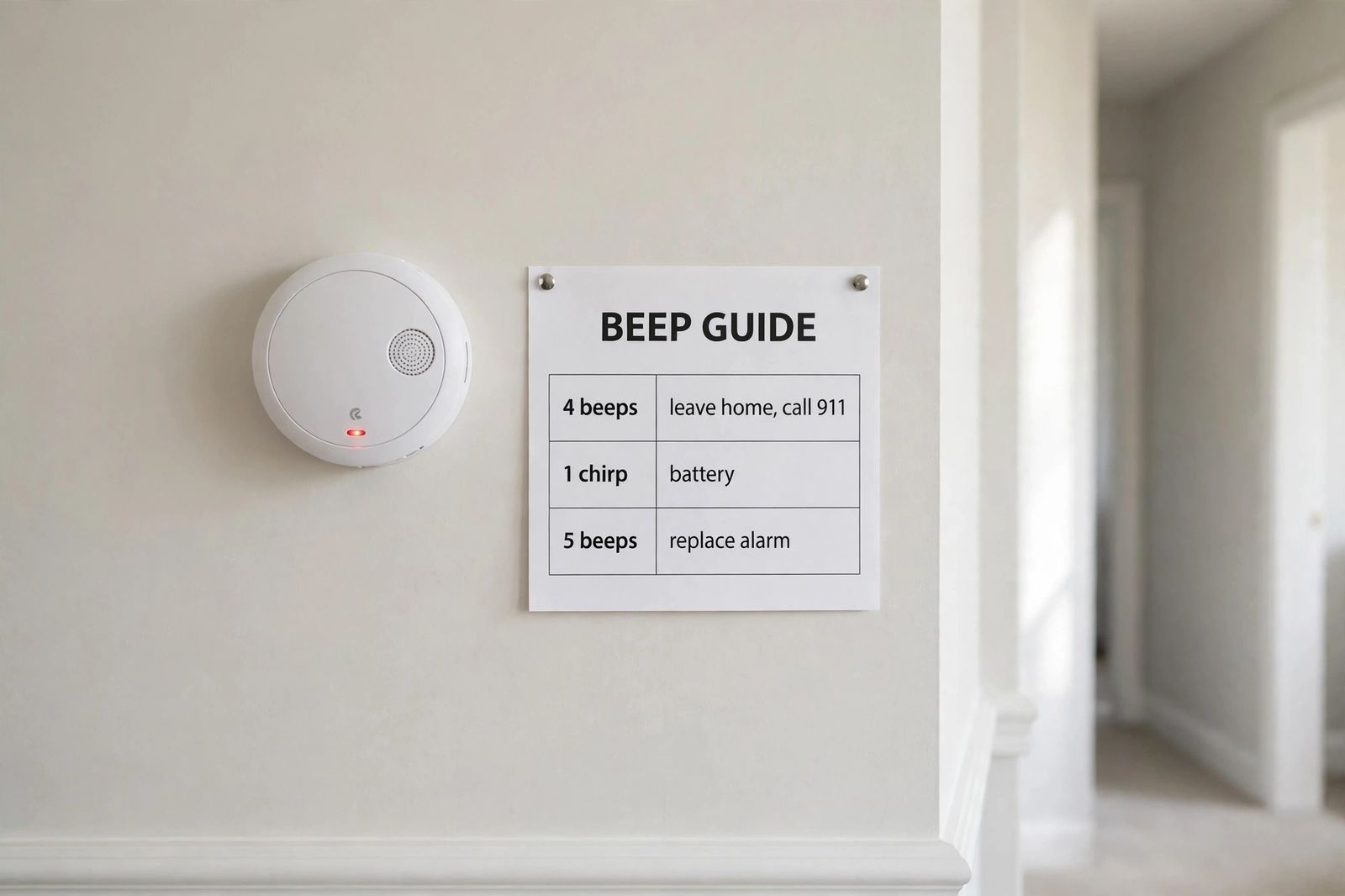
If your carbon monoxide detector is beeping in a loud, repeating pattern of four beeps, a pause, then four beeps again, leave the home now and call 911 — or your local emergency number — from outside: on both Kidde and First Alert alarms that pattern means carbon monoxide has been detected, and it is the only pattern in this article you should act on before you read another line. Get everyone — children, older relatives and pets — into fresh air, do a head count outside, and do not go back in until emergency responders say it is safe. A single quiet chirp spaced about a minute apart is different: that is a maintenance signal, usually a low battery, and the rest of this article decodes every chirp pattern brand by brand. If you cannot tell which sound you are hearing, treat it as the four-beep alarm.
First: the four-beep alarm — leave, then call
Do not troubleshoot this pattern. Do not open windows first, do not hunt for the furnace switch, do not silence the alarm and wait to see if it stops, and do not try to find the source of the gas yourself. The U.S. Consumer Product Safety Commission (CPSC) guidance for a sounding CO alarm is to move outside to fresh air immediately, call emergency services from outside, account for everyone, and stay out until responders give permission to return. The National Fire Protection Association (NFPA) gives the same sequence: move at once to a fresh-air location outdoors, make sure everyone inside is accounted for, call for help from that fresh-air location, and stay there until emergency personnel say it is safe.
There are three reasons for that order, and they matter. Carbon monoxide has no colour, no smell and no taste, so your senses cannot confirm or clear it. Its early symptoms — headache, dizziness, weakness, nausea, confusion — look like flu, and they also impair the judgement you would need to investigate, which is why people who stay inside “to check” are the ones who get hurt. And a CO alarm is exposure-based: under the UL 2034 standard it sounds after a concentration has persisted for a set time, not on a passing whiff, so by the time the four-beep pattern starts the alarm has already measured a sustained, dangerous build-up.
Two details from the manuals are worth knowing once you are safely outside. On battery power only, some Kidde models reduce the alarm after the first four minutes to one cycle a minute to conserve the battery — a quieter alarm is not a cleared house. And if anyone in the home has symptoms, say so on the call and seek medical care promptly, telling the clinician you suspect carbon monoxide: responders and poison control (1-800-222-1222 in the U.S.) treat suspected exposure as time-sensitive even when people feel better in fresh air. Feeling better outside is expected with CO — it is not evidence the house is safe.
Only when the sound is a single, spaced chirp — and nobody has symptoms, and there is no loud repeating pattern — should you work through the diagnosis below. The same rule covers a combination smoke and CO unit sounding three beeps: that is the smoke pattern, covered in smoke detector keeps beeping, and it is also a leave-first pattern.
The beep-pattern table by brand — verified against the manuals
Most guides give one generic table for all brands. That is where the dangerous mistakes creep in, because the maintenance chirps are not standardised: Kidde and First Alert use different intervals for end of life and malfunction, even though they agree exactly on the emergency pattern. Every row below traces to the manufacturer’s own support page or manual listed beside it. Your model’s manual and the label on the back of your alarm outrank any general table, including this one.
| What you hear | Kidde — what it means | First Alert — what it means | What to do |
|---|---|---|---|
| 4 loud beeps, pause, repeating (Kidde specifies 5 seconds of silence between cycles) | Carbon monoxide detected | Carbon monoxide detected — “move to fresh air and call 9-1-1” | Leave the home now. Call 911 from outside. Stay out until cleared. |
| 1 chirp every 60 seconds (about once a minute) | Low battery | Low battery — 1 beep every minute | Replace the batteries with the exact type in the manual; test the alarm. Sealed-battery model: see end-of-life row — there is no battery to change. |
| 1 chirp every 30 seconds | End of life or malfunction/error — Kidde’s support page lists both for this interval, and notes an ERR display on digital models | Not First Alert’s standard low-battery or end-of-life interval — check your manual; do not assume it is “just the battery” | Check the date on the back first. Past its rated life: replace the whole alarm. In-date and still chirping after fresh batteries: treat as a malfunction — replace it, and contact Kidde support (1-800-880-6788) if you need the model confirmed. |
| 5 beeps/chirps every minute | Not Kidde’s documented end-of-life pattern | End of life — time to replace the carbon monoxide alarm | Replace the entire alarm now. A new battery will not stop an end-of-life signal. |
| 3 chirps every minute | Not Kidde’s documented pattern in the sources checked | Malfunction — the alarm requires service/replacement (First Alert CO alarm manuals and the SC5 specification) | Replace the alarm. A unit signalling a malfunction cannot be relied on to detect CO. |
| Random chirps, no regular interval | Kidde lists intermittent chirping causes including a loose or unplugged unit and power issues; a long continuous squeal can be its tamper-resist warning when a plug-in unit comes loose from the outlet | Check power, seating and battery fit against the manual | Reseat the unit, check the outlet/bracket and backup battery. If random chirping persists with good power and fresh batteries, replace the alarm rather than living with an unreliable one. |
| No sound, display shows a number, “Lb”, “ERR” or “END” (digital models) | A steady CO reading with the four-beep pattern is the alarm condition; “Lb” is Kidde’s low-battery display; “ERR” is an error — look it up in your model’s manual | Display codes are model-specific — the manual is the decoder | Any number alongside the four-beep alarm: leave and call. “Lb”: change the batteries today. “ERR”/“END”: replace the alarm. Never decode a display code by guessing from another brand’s chart. |
Two corrections belong in plain sight, because they appear in widely read guides for this exact search:
- “Three to four beeps every five to fifteen minutes means a malfunction” is not in either manufacturer’s documentation checked for this article. Kidde documents end of life and malfunction as a chirp every 30 seconds; First Alert documents malfunction as 3 chirps every minute and end of life as 5 chirps every minute. A guide that moves those signals to a five-to-fifteen-minute interval risks a household ignoring a timed-out sensor for days.
- “A single chirp always just means the battery” is incomplete. Once a minute, yes — both brands call that low battery. Every 30 seconds on a Kidde alarm, the same-sounding chirp can mean the sensor’s life is over and, in Kidde’s own words on its support page, the alarm cannot detect carbon monoxide in end-of-life mode. The interval is the message; count it.
Fix 1: the low-battery chirp — one chirp a minute
This is the common night-time chirp, and there is a physical reason it starts at 3 a.m.: a weakening battery delivers slightly less voltage as the room cools overnight, so a battery that held on all day crosses the low threshold in the small hours — the same reason a smoke detector keeps beeping always seems to choose the night. Treat a night-only chirp as a battery that has already given its warning.
Replace the batteries with the exact type and size printed in the manual or inside the battery compartment — AA, AAA or 9-volt depending on the model — seat them firmly, and press the test button afterwards. Hardwired and plug-in alarms are not exempt: they carry backup batteries for power cuts, and it is the backup that chirps. If your alarm is a sealed 10-year battery model, there is nothing to replace inside it: a low-battery-style warning on a sealed unit near its date means the whole alarm is replaced, which is Fix 2. Never solve a chirp by removing the battery or unplugging the alarm and leaving it that way — a silenced, unpowered CO alarm is the same as no CO alarm, in a house where the gas gives no warning of its own.
If a fresh, correctly fitted battery does not stop a once-a-minute chirp within a short settling period, do not keep swapping batteries. Move to the date check: the alarm is telling you the next thing on its list.
Fix 2: check the date — end of life is a different signal per brand
Turn the alarm over. The manufacture date — and on many models a printed replace-by date — is on the back, and CO sensors wear out on a schedule batteries cannot fix. This is where the brands genuinely diverge, and where generic “replace every five to seven years” advice undersells newer alarms and oversells older ones:
- First Alert: the end-of-life signal is 5 beeps every minute. First Alert’s own guidance puts most of its CO alarms at a 5- to 7-year life and advises replacement by that age; its 10-year sealed-battery models run a full decade, and signal the same way at the end.
- Kidde: the end-of-life signal is a chirp every 30 seconds that a battery change will not stop. Kidde’s support page describes CO alarms reaching end of life seven years after initial power-up for the models it covers, while many Kidde alarms made since 2013 are rated for 10 years — the date and rating printed on your unit decide which applies to yours. In end-of-life mode the unit no longer detects CO, so a chirping-expired alarm left on the wall is decoration, not protection.
The working rule that covers both brands: if the alarm has passed the life printed on it — or you cannot read a date on it at all — replace the whole alarm now, even if its test button still beeps. The test button checks the horn and circuitry; it does not certify that an aged sensor still measures carbon monoxide accurately. When you fit the new alarm, write its replacement year on it in marker. The next decision, years from now at 3 a.m., becomes a glance instead of a guess.
Fix 3: malfunction and error chirps — when the alarm itself has failed
A malfunction signal means the alarm has run its self-diagnostics and found a fault. First Alert’s pattern is 3 chirps every minute; Kidde folds malfunction into its chirp every 30 seconds, alongside end of life, and directs owners to its product support line. Digital Kidde models may show ERR instead of, or alongside, the sound. The response is the same for both: the alarm gets replaced, not repaired — there are no user-serviceable sensor parts inside a CO alarm, and opening one voids its listing.
Use the date to tell the two Kidde causes apart: a 30-second chirp on an alarm past its printed life is end of life until proven otherwise; the same chirp on a young alarm with fresh batteries is a malfunction. Either way the destination is a new alarm — the distinction only matters for a warranty claim, so keep the receipt and the old unit until the replacement is up.
One more sound belongs here: a long, continuous squeal from a plug-in Kidde unit is documented as a tamper-resist warning — the alarm has been unplugged or has worked loose from the outlet. Push it firmly back in and confirm its power light. A squeal from a battery-only unit, or one that survives reseating, is not in the manuals checked: treat the alarm as failed and replace it.
Why alarms chirp randomly — and the power checks that settle it
A chirp with no steady rhythm is the hardest to pin down, because several small faults share it: a backup battery that is nearly — but not quite — at the low threshold, a plug-in alarm sitting loosely in its outlet, a hardwired unit reacting to power interruptions, or, on an interconnected system, a fault in a different unit echoing through the set. Work it in order: confirm the unit is fully seated on its bracket or fully in its outlet, fit a known-fresh backup battery, and then stand with the alarm through several minutes and time what you actually hear. Most “random” chirps resolve, on timing, into one of the regular patterns in the table — usually the 30-second or 60-second interval heard through walls and sleep. If it truly has no pattern and survives good power and fresh batteries, replace the alarm: intermittent faults do not heal, and this is the device whose only job is to be trustworthy on the worst night.
Interconnected alarms add one wrinkle: when one sounds, all sound, by design. The initiating unit is the one whose light or display changes with the sound — find it room by room, fix that unit, and the rest will quiet. A chirp that survives battery changes in several interconnected units points away from batteries entirely, at the shared wiring or power supply — the same category of fault as a circuit breaker that keeps tripping on that circuit, and a job for an electrician rather than another box of batteries.
What actually produces carbon monoxide in a home
A CO alarm event is not the end of the job; once responders clear the house, the source has to be found and fixed by a qualified technician before the appliance is used again. The U.S. fire and public-health sources agree on the usual list: furnaces and boilers, gas water heaters, gas stoves and ovens, fireplaces and wood stoves, kerosene and gas space heaters, cars idling in an attached garage, and — the deadliest source in outages — portable generators run indoors, in a garage, or too close to windows. Generators belong outdoors, well away from the house (the CDC and CPSC put it at more than 20 feet, exhaust facing away), never in a garage even with the door open.
That list is why a CO alarm that sounds alongside heating trouble deserves a joined-up look rather than two separate fixes: a furnace that keeps shutting down, or no hot water in the house from a gas water heater that will not stay lit, can share a flue or venting problem with the alarm event. Blocked or reversed venting is a classic CO mechanism — combustion gases that should leave through the flue spill into the house instead. A water heater leaking at its base is a different fault, but any gas appliance showing corrosion, soot streaks or a lazy yellow flame alongside a CO alarm belongs in the technician’s brief, in writing, before it runs again. Annual servicing of fuel-burning appliances and chimneys is the prevention the fire services repeat most, because it catches the cracked heat exchanger and the blocked flue in autumn instead of at 3 a.m. in January.
Placement and upkeep: keeping a working alarm working
The NFPA and CPSC placement baseline is consistent: a CO alarm on every level of the home and in a central location outside each separate sleeping area, installed per the manufacturer’s instructions, with interconnected alarms preferred so that when one sounds, they all sound. Alarms go where the manual says for height — CO mixes with air rather than pooling high or low, so follow the model’s stated wall or ceiling position instead of folklore — and not inside a garage, not in the furnace room, and not so close to a fuel-burning appliance or a steamy bathroom that ordinary use triggers nuisance events. Local codes and landlord rules in many states add requirements on top of that baseline; the manual plus your local code is the full rule.
Upkeep is short. Test monthly with the test button. Replace replaceable batteries when the alarm chirps — and proactively on the maker’s schedule rather than waiting for the night chirp; sealed 10-year alarms skip battery changes entirely and are replaced whole. Vacuum the vents gently when you do any battery change; dust is a smoke-alarm problem more than a CO one, but a clean alarm is a checked alarm. Replace the whole unit at its printed end of life — 5–7 years for many First Alert models, 7 or 10 years for Kidde models depending on the unit — and write the next replacement year on the new unit the day it goes up.
Frequently asked questions
My carbon monoxide detector beeps 4 times, then stops, then beeps again. Is that an emergency? Yes. Four beeps, a pause, and a repeat is the CO alarm pattern on both Kidde (four short beeps, five seconds of silence, repeating) and First Alert alarms. Leave the home, call 911 from outside, and stay out until responders clear it — even if the pattern later spaces out, which battery-powered models can do after the first minutes to save power.
Why does my CO detector chirp once every minute? That is the low-battery warning on both major brands — First Alert states it as one beep every minute, and Kidde lists a chirp every 60 seconds for low battery. Replace the batteries with the exact type specified, then test. On a sealed 10-year alarm there is no battery to change: the warning means the unit itself is at or near the end of its life.
My detector chirps every 30 seconds and a new battery did not stop it. What now? On a Kidde alarm, a 30-second chirp is the documented end-of-life or malfunction signal — and end of life is the likely reading if the unit is at or past the life printed on its back (seven years on the models Kidde’s support page describes; ten on many made since 2013). The sensor no longer detects CO reliably in that state. Replace the whole alarm; do not keep resetting it.
What does 5 beeps every minute mean? On a First Alert alarm, five beeps every minute is the end-of-life signal: the alarm has reached the end of its service life and must be replaced with a new one. It is not an emergency pattern — no evacuation is needed for that signal alone — but the home is unprotected until the replacement is installed, so treat it as same-day, not someday.
Can I unplug the detector or take the battery out to stop the noise tonight? For a maintenance chirp, use the silence/hush feature if your model has one and fix the cause in the morning — battery or replacement alarm. Never disable an alarm that is sounding the four-beep pattern, and never leave a detector unpowered as a permanent answer to a chirp: with CO, the alarm is the only sense you have for a gas you cannot see or smell.
Is a carbon monoxide detector the same as a smoke detector? No. A standard smoke alarm does not detect carbon monoxide, and a CO alarm does not detect smoke, unless the unit is explicitly a combination smoke/CO alarm. Combination units use different patterns for each threat — three beeps for smoke, four for CO — which is why the smoke detector beeping patterns are worth learning alongside these.
This article is general information based on the manufacturer and fire-safety sources linked above — Kidde’s and First Alert’s official support pages and manuals, the CPSC, the NFPA and the CDC — checked in November 2026. Beep patterns vary by model; where your alarm’s manual gives a different meaning for a pattern, the manual is right. If a pattern could mean carbon monoxide, or anyone in the home has symptoms, treat it as the emergency until professionals say otherwise.