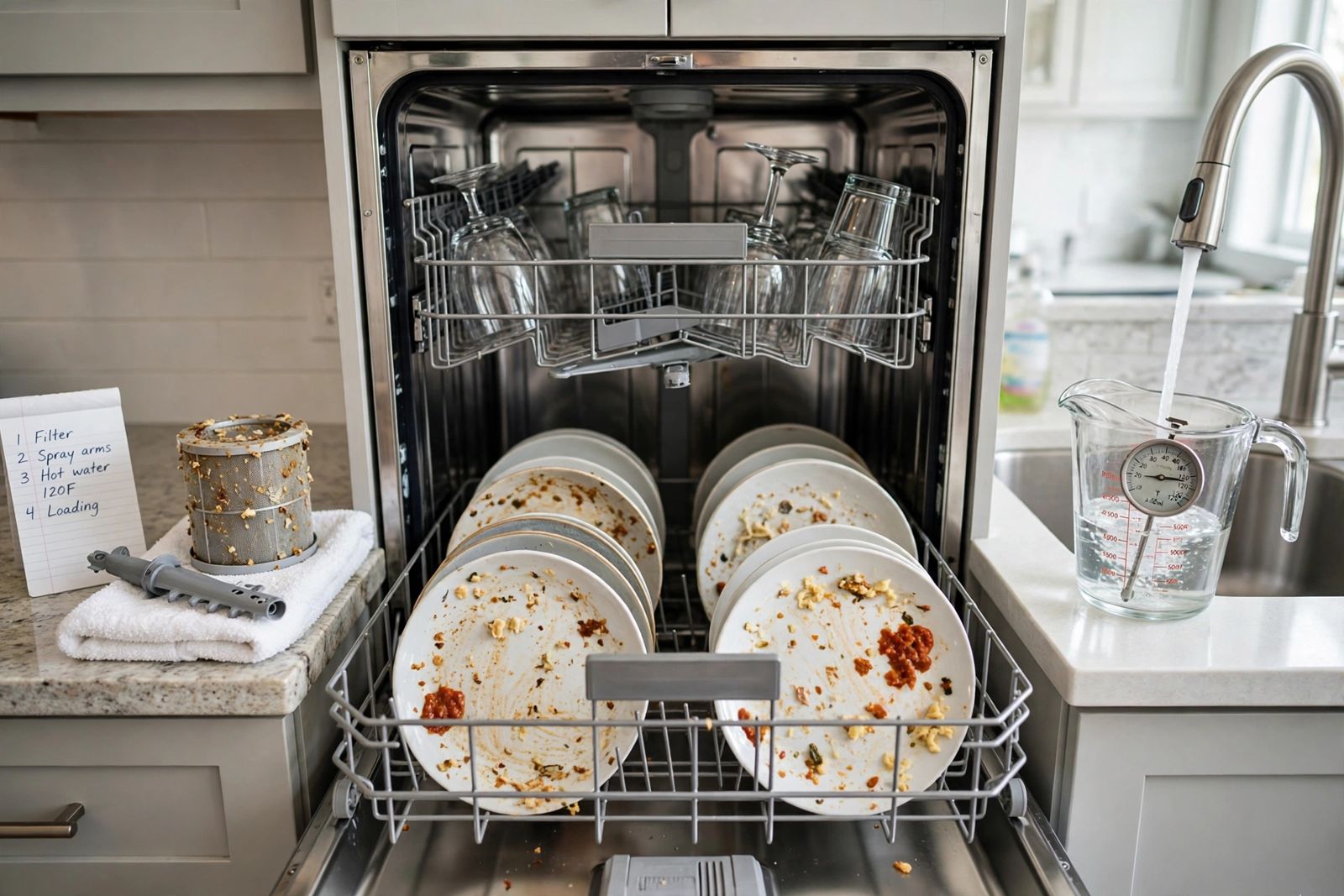
A dishwasher that runs a full cycle and still leaves dishes dirty has almost always failed at one link of a single cleaning chain, and the fix is to work that chain in order instead of changing everything at once: filter → spray-arm holes and spin → incoming water temperature and pressure → loading pattern. Start with the filter, because a clogged filter makes the machine wash your dishes in its own trapped dirt. Then clear every spray-arm hole and confirm each arm spins freely. Then check the water the machine is actually given — it should arrive at about 120°F, hot enough to dissolve and activate the detergent — and only then judge how the load was stacked. Where the dirt is left tells you which link to suspect first: the table below routes you by rack before you touch a single part, so a top-rack-only problem does not send you under the machine, and an everything-dirty problem does not send you chasing one spray arm.
First, two boundaries, because three different dishwasher faults get confused at the door. Dishes dirty but the tub empty of standing water at the end of the cycle — this article. Dirty water standing in the tub after the cycle is a drain fault, not a cleaning fault, and dishwasher not draining works that chain in its own order — a machine that cannot empty properly can also wash the next load in leftover dirty water, so if you have standing water, fix that first. Water on the floor is a leak, and dishwasher leaking diagnoses it by where the water appears. And one calibration before you start: grit and food left on dishes is a cleaning failure, but faint spots and a white film on glasses are usually a different, smaller problem — hard-water deposits and rinse aid — covered inside the water section below, not a sign that the wash itself has failed.
Start here: which rack is still dirty?
Do not start cleaning parts yet. Open the door and read the load — the pattern of what stayed dirty is the fastest diagnosis this fault offers, and almost no guide turns it into a routing table. Match your load to one row, then work the chain in the order that row gives you.
| What stayed dirty | Start at this link | Why that link, in one line | Then work |
|---|---|---|---|
| Top rack only — glasses, cups and bowls up top are gritty or filmed, bottom rack came out clean | Link 2, the upper / middle spray arm | The top rack is washed by the arm under it (and a top arm, where fitted); if that arm’s holes are clogged with food or scale, or the arm cannot spin, the bottom rack — fed by its own arm — still cleans normally | Then link 1 (filter) if the dirt up top is grit rather than a dry, untouched look, then link 4: check nothing tall in the bottom rack is blocking the upper arm’s spin, and that cups are not nested |
| Bottom rack only — plates and pans still carry food, top rack is clean | Link 2, the lower spray arm, and link 4 together | The lower arm does the heavy work and is the one most often stopped — a utensil dropped through the rack, a tall pan or board overhanging it — and the bottom rack is also where nesting and face-the-wrong-way loading hide spray from plates | Clear and spin-test the lower arm, then reload test: plates spaced, facing the centre, nothing overhanging the arm’s path; then link 1 if the residue is gritty |
| Everything still dirty — both racks, evenly, as if the wash barely happened | Link 1, the filter, then link 3, the water | An even, everywhere failure is a whole-machine input problem, not one arm: either the wash water itself is dirty (filter) or it arrived too cold, too low in volume, or without working detergent | Work the full chain in order — filter → arms → temperature and pressure → detergent and cycle → loading — and do not skip to parts replacement |
Two patterns sit outside the table because they name themselves. Detergent still in the dispenser, or a tablet only half-dissolved at the end of the cycle: the wash ran without its cleaning agent — go straight to the detergent section below. One or two items dirty, everything around them clean: that is a loading shadow, link 4, not a machine fault at all — something stood between those items and the spray.
The cleaning chain, in order
Work the links in this order inside whichever route the table gave you. At each link, do the check, fix what you find, and retest with a normal load before moving on — changing three things at once leaves you not knowing which one worked, and the next failure undiagnosed.
| Link | Check it like this | The sign that names this link |
|---|---|---|
| 1. Filter | Bottom rack out, twist or lift the filter assembly out of the tub floor, rinse it and scrub the mesh gently | Mesh coated with grease, food, seeds or softened labels — and dishes that come out gritty, because the machine has been spraying its own trapped dirt back over them |
| 2. Spray-arm holes and spin | Spin each arm by hand; remove each arm, hold it to the light, clear every blocked hole with a cocktail stick or toothpick, rinse it through | An arm that will not spin freely, holes visibly plugged with food or white scale — and a section of one rack dirty while the rest of that rack is clean |
| 3. Incoming water: temperature and pressure | Run the hot tap nearest the dishwasher until it runs fully hot before starting; check the tub actually fills; note whether glasses carry a white hard-water film | Greasy, filmy residue everywhere and detergent not dissolving (too cold), a tub that fills weakly or slowly (too little water), or white film that wipes off with vinegar on a cloth (hard water, not dirt) |
| 4. Loading pattern | Reload one test load exactly as the loading section below describes — spacing, angles, arm clearance, dispenser clearance — and run it | The same items, or items in the same positions, dirty load after load while their neighbours clean: the machine is fine, the spray never reached them |
This ordered chain belongs together with the rack-routing table above it. The manufacturer pages list the same causes as separate checks — Bosch’s support page runs tablet, spray arms, filter, loading and programme as five unconnected items, and Maytag’s guide lists filter, detergent, loading, cycle and water temperature the same way — and the repair blogs order their lists by what is easiest to write, which is how loading, the commonest everyday cause of a patterned dirty load, ends up fifth. The chain plus the routing table is the article; the sections below are each link explained.
Link 1: Clean the filter — and lock it back properly
The filter assembly in the floor of the tub traps the food that washes off your dishes so the pump does not spray it straight back over them. As it loads up with grease, seeds, softened jar labels and fine food sludge, two things happen at once: water flow through it is disrupted, and the dirt it holds is redeposited on the load. Bosch states both halves of that plainly — a clogged filter disrupts the appliance’s water flow, and in some cases the dirt may be redeposited on the dishes. Maytag’s version of the same sign is the texture: if your dishwasher is leaving food residue or your dishes feel gritty, the cause could be a dirty or clogged filter, found at the bottom centre of the tub on most of its models.
Work it like this:
- Remove the bottom rack.
- Unlock the filter unit at the base of the tub and lift it out; on most modern machines it separates into a cylindrical filter and a flat filter plate underneath, and both need cleaning, not just the cylinder.
- Rinse both parts under the tap and scrub gently with a small soft brush. Bosch is specific: nothing abrasive, because a damaged mesh lets debris through to the pump and the spray arms — which is how a link 1 problem manufactures a link 2 problem.
- Reassemble, refit, and lock it back until it is fully seated — Bosch’s instruction is to twist it until the alignment marks line up. A filter left unlocked or unseated is worse than a dirty one: it lets the debris it caught bypass it entirely.
Then make it a habit rather than an emergency. Bosch’s care guidance is to give the filter a good clean every two weeks in regular use, and the repair guides that cover heavy, no-scrape households land in the same place: a filter rinsed regularly almost never loads up enough to wreck a wash, and one left for months is the most predictable cause of a machine that has gradually got worse — that word, gradually, is the filter’s signature. A machine that stopped cleaning suddenly, overnight, is rarely the filter alone; keep working the chain.
Link 2: Spray-arm holes, and whether the arms can spin at all
The spray arms are hollow arms turned by the water jetting out of their own angled holes: the jets are both the cleaning tool and the motor. That gives this link two separate failures that look alike from the doorway:
- Blocked holes. Food particles and hard-water scale plug the small outlet nozzles until whole stretches of a rack stop receiving spray. Bosch’s check is that the arms should rotate freely with no sign of blockage across the nozzles, cleared with tweezers or a cocktail stick; Frigidaire’s manuals say the same with a toothpick. Remove each arm as your manual directs — the upper arm usually unscrews, the lower lifts or clips off — clear every hole, rinse water through the arm’s centre opening to flush loosened debris out, and refit it firmly. Bosch adds the link most guides miss: blocked spray arms also prevent the dishwasher tablet from dissolving properly, because the tablet is dissolved by spray, not by soaking.
- An arm that cannot spin. Clean holes do nothing for an arm held still by the load: a serving spoon dropped through the rack, a tall pan, a cutting board overhanging the rack’s edge. Spin every arm by hand after loading, before you close the door — that ten-second test is the whole check. Bosch’s loading guidance makes the same point from the other side: serving plates and chopping boards go to the side of the lower basket precisely because large items easily obstruct the spray arms and block the water flow.
Use the routing table to aim this link. Top rack only dirty points at the upper or middle arm and its feed; bottom rack only at the lower arm; a dirty corner of one rack at the holes along one stretch of that rack’s arm. And if an arm is cracked or split along its seam, cleaning will not restore it — a split arm leaks its pressure out of the crack instead of the holes and is replaced as a part.
Link 3: The water the machine is given — temperature, fill and hardness
A dishwasher can only clean with the water it receives, and this link is three separate checks that share one section because they share one symptom family: an even, everywhere mediocrity, greasy film, or detergent that never quite dissolved.
Temperature: about 120°F at the machine. Maytag states the figure directly: for best results, water should be about 120°F as it enters the dishwasher, because hot water dissolves and activates the detergent and helps dissolve grease; too low, and the load keeps its residue. Frigidaire’s manuals set the same floor — incoming water should be at least 120°F (49°C) — and Frigidaire’s own cleaning tips put the ideal water-heater setting at 120–125°F. Two practical consequences. First, run the hot tap at the sink nearest the dishwasher until it runs fully hot before you start the cycle: the first fill otherwise arrives as the cold water that was sitting in the pipe, and on a short cycle that cold start is a large share of the whole wash. All three makers recommend exactly this habit. Second, Maytag adds the ceiling nobody mentions: water that is too hot can also hurt — some food particles become harder to remove and certain detergent ingredients may not function — so the answer is the 120°F neighbourhood, not the heater turned to maximum.
Fill and pressure: enough water, arriving properly. Too little water in the tub means weak spray everywhere, however clean the arms are. Frigidaire’s manual for food soils left on dishes names the supply figure: home water pressure may be too low — it should be 20 to 120 psi. Treat that range as Frigidaire’s published figure, as with any maker’s number, but the principle is general. The household-level checks are simple ones: the dishwasher’s supply valve under the sink fully open, and a tub that visibly fills at the start of the cycle rather than barely wetting its floor. A machine that fills weakly despite an open valve and normal pressure at the taps has an inlet-valve or inlet-screen problem, which sits on the service side of the line below. One related check from Maytag’s Canadian guide: if only the bottom rack is washing and your machine has a Top Rack Only style option, confirm that option is not selected — it is designed for a small load placed exclusively in the top rack, and a full load run on it is a settings error, not a fault.
Hardness: film is not dirt. In hard-water areas, dissolved minerals leave a white, chalky film on glasses and scale inside the machine — including in the spray-arm holes, which is how hard water quietly manufactures a link 2 problem over months. Maytag’s guidance is that rinse aid helps reduce the build-up of hard-water mineral deposits, and that hard water generally requires extra detergent; Frigidaire’s manual goes one step further for extremely hard water and says a water softener may be necessary. The test that separates film from a failed wash: a glass that comes out white but wipes or rinses clean by hand was filmed, not left dirty — work the rinse-aid and detergent-dose side of this link, not the filter.
Link 4: Loading — the pattern that repeats is the diagnosis
Loading is the last link in the chain and the first cause of a patterned failure: the same positions dirty, load after load. The makers’ rules agree with each other, and Bosch’s loading guidance is the most complete single version:
- Top rack: cups, glasses and small bowls, spaced so items do not touch, plastics up here away from the heat. Heavily soiled items do not belong up top — the spray there is gentler.
- Bottom rack: plates, pots and pans — and heavily soiled pans specifically in the lower basket, where Bosch notes the spray jet is more intense and there is more space.
- Face the dirt toward the spray. Plates face inward toward the centre; bowls, mugs and glasses go open-side down or angled, so they are sprayed inside and drain instead of arriving at the end of the cycle holding a cup of dirty water. Maytag’s version is the same rule: items loaded at an angle, concave items face-down, no overlapping.
- Nothing nested. Two bowls or spoons fitted together present one surface to the spray and hide the other completely. Nested items are the single-item dirty result in the routing table.
- Keep the dispenser’s swing clear. A tray, board or large plate standing directly in front of the detergent dispenser stops its lid opening fully — Bosch warns that utensils placed above the tablet collecting tray can block the dispenser lid and prevent the tablet dissolving, and Maytag’s loading check is identical in substance: be sure no items are blocking the detergent dispenser when the door is closed.
- Scrape, do not pre-rinse. Every maker here says the same thing: scrape off large chunks — they are what block the filter — and let the machine do the rest. Bosch: there is no need to pre-rinse. Maytag adds the mechanism: on a machine with a soil sensor, pre-rinsed dishes give the sensor nothing to sense, and it runs a lighter cycle than the load in front of it actually needed once the spray redistributes what was left.
Retest loading honestly: one load, loaded by these rules, on a normal cycle. If the pattern vanishes, the machine never had a fault — and that result is worth knowing before any part is ordered.
Detergent and cycle: the wash’s other two inputs
Two inputs sit alongside the chain because they can mimic any link in it:
- Detergent — right type, fresh, enough of it. Only automatic dishwasher detergent, ever: Maytag is blunt that dish soap must never go in a dishwasher, because it creates a thick sudsy foam that can overflow through the door — and a tub of suds washes as badly as it leaks, which makes it the one detergent error that can also send you to dishwasher leaking by mistake. Beyond type: Maytag directs never less than a tablespoon, fresh detergent stored tightly closed in a cool, dry place (powder and gel that have taken on moisture lose their strength and clump), and notes that pre-measured tablets and pacs have been proven to reduce filming compared with powder, liquid or gel — while Bosch, from the other direction, notes that if a tablet has not dissolved, switching to loose dishwasher detergent instead of tabs may solve that specific issue. The two are not in conflict: tablets that dissolve properly are the reliable default; a tablet found intact or half-dissolved after the cycle is evidence about the spray and the dispenser (links 2 and 4) before it is evidence about the tablet.
- Cycle — matched to the soil. A quick or eco cycle is a shorter, cooler wash built for light soil; run a load of baked-on pans on it and the result is this article’s symptom with nothing broken at all. Maytag’s rule is to use the cycle that describes your most heavily soiled dishes, with a high-temperature option for loads needing extra attention, and Bosch’s is the same: for dirtier dishes with stubborn burnt-on remnants, select a programme with a higher temperature setting. Judge any fix in this article on a normal or heavy cycle — testing a repair on the eco cycle can make a fixed machine look broken.
Two claims in the popular guides to retire
Because both claims are widely repeated, and both send readers in wrong directions:
- “Cleaning the filter resolves over 50% of cases.” Nick’s Appliance Repair’s guide puts that figure in its quick diagnosis and repeats it in its FAQ — “this resolves the issue in over 50% of cases” — without naming any source for it. No maker page states it, and it cannot be checked. The filter is the right first link — Bosch and Maytag both put it at the front of their own lists — but it earns that place from how the machine works, not from an invented percentage. Treat any precise success rate for any single fix in this fault as marketing unless a source is named.
- “A worn door gasket lowers the pressure inside the dishwasher, so it cleans badly.” The same guide lists a worn door gasket as a cleaning cause on that reasoning. It does not survive contact with how the machine works: the tub is not a sealed pressure vessel — spray pressure is generated by the wash pump and lost through blocked holes, a split arm or too little water, and no maker page (Bosch, Maytag or Frigidaire) lists the gasket among cleaning causes at all. A gasket that is actually failing announces itself as water at the door — a leak, diagnosed in dishwasher leaking. Replacing a door seal to fix dirty dishes spends money on the wrong fault.
When to stop and call a professional
Call for service when you reach any of these: the full chain is clean and correct — filter, arms, water, loading, detergent, cycle — and a normal load still comes out evenly dirty; the tub fills weakly with the supply valve open and good pressure at the taps (inlet valve territory); the spray stays weak with clean arms and a clean filter, the wash sounds quiet or hums without real spray, or the arms are not turning during the wash (wash pump territory); or the water never gets hot despite a correct supply, which points at the machine’s own heating. Those are parts-and-testing faults — pump, inlet valve, heater, control — not cleaning faults, and they are diagnosed, not scrubbed.
On repair or replace, the arithmetic is the same as the rest of the kitchen: a single part on an otherwise sound machine that washes well when it works is normally worth fitting; repeated faults on a machine well into its second decade argue for pricing a replacement first. And note the honest limit of the whole chain — it assumes the machine completes its cycle. A machine that stops mid-cycle, or leaves the tub full, is not failing to clean; it is failing to finish or to drain, and dishwasher not draining is where that diagnosis starts.
Frequently asked questions
Why is only the top rack not getting clean? Because the top rack is served by its own spray arm — the middle arm under the top rack, plus a top arm on some models. If that arm’s holes are clogged or it cannot spin, the top rack fails alone while the bottom rack, fed by the lower arm, cleans normally. Work link 2 aimed at the upper arm first, then check that nothing tall in the bottom rack is stopping it turning, and that no cycle option for top-rack-only washing is confusing the result in reverse. The routing table at the top of this article works through the pattern in full.
Why are my dishes gritty after the dishwasher runs? Grit is redeposited dirt, and its usual source is the filter: a mesh loaded with food and grease lets the wash water carry that debris back over the load. Maytag names exactly this pairing — gritty-feeling dishes, suspect the filter. Clean and properly lock the filter (link 1) before suspecting anything else; grit with a clean, locked filter points next at spray arms flushing debris out of their own interiors, which the rinse-through in link 2 clears.
Do I need to rinse dishes before loading them? Scrape, do not rinse. All three makers behind this article say the same: large chunks come off — they are filter food — and the machine handles the rest. Heavy pre-rinsing is not merely wasted effort on a soil-sensor machine; Maytag notes the sensor reads the dishes it is given, and near-clean dishes earn a lighter cycle than the load ends up needing.
My detergent tablet is still there, half-dissolved, after the cycle. What failed? Work it as evidence, in this order: something blocked the dispenser lid from opening fully (link 4 — a tray or utensils in its swing); the spray that should dissolve the tablet never arrived at strength (link 2 — blocked arms, which Bosch explicitly ties to tablets not dissolving); or the water was too cold to dissolve it (link 3). A fresh tablet in a dry, unblocked dispenser, on a normal cycle, separates them.
Can hard water alone make a dishwasher stop cleaning? It can make it look stopped, and then slowly make it true. The white film on glasses is a mineral deposit, not unwashed dirt — rinse aid, enough detergent for hard water, and in extremely hard water a softener are Frigidaire’s and Maytag’s answers. Left alone, the same minerals narrow the spray-arm holes and coat the machine’s insides until the wash itself genuinely weakens. Film first, spray second: the vinegar-wipe test on one glass tells you which stage you are at.
This article is general home-maintenance information based on the manufacturers’ published guidance linked above (Bosch, Maytag and Frigidaire). Models differ in filter design, spray-arm layout, cycle names and water requirements — your owner’s manual is the authority for your machine. Work involving the inlet valve, wash pump, heater or controls belongs to a qualified appliance technician.