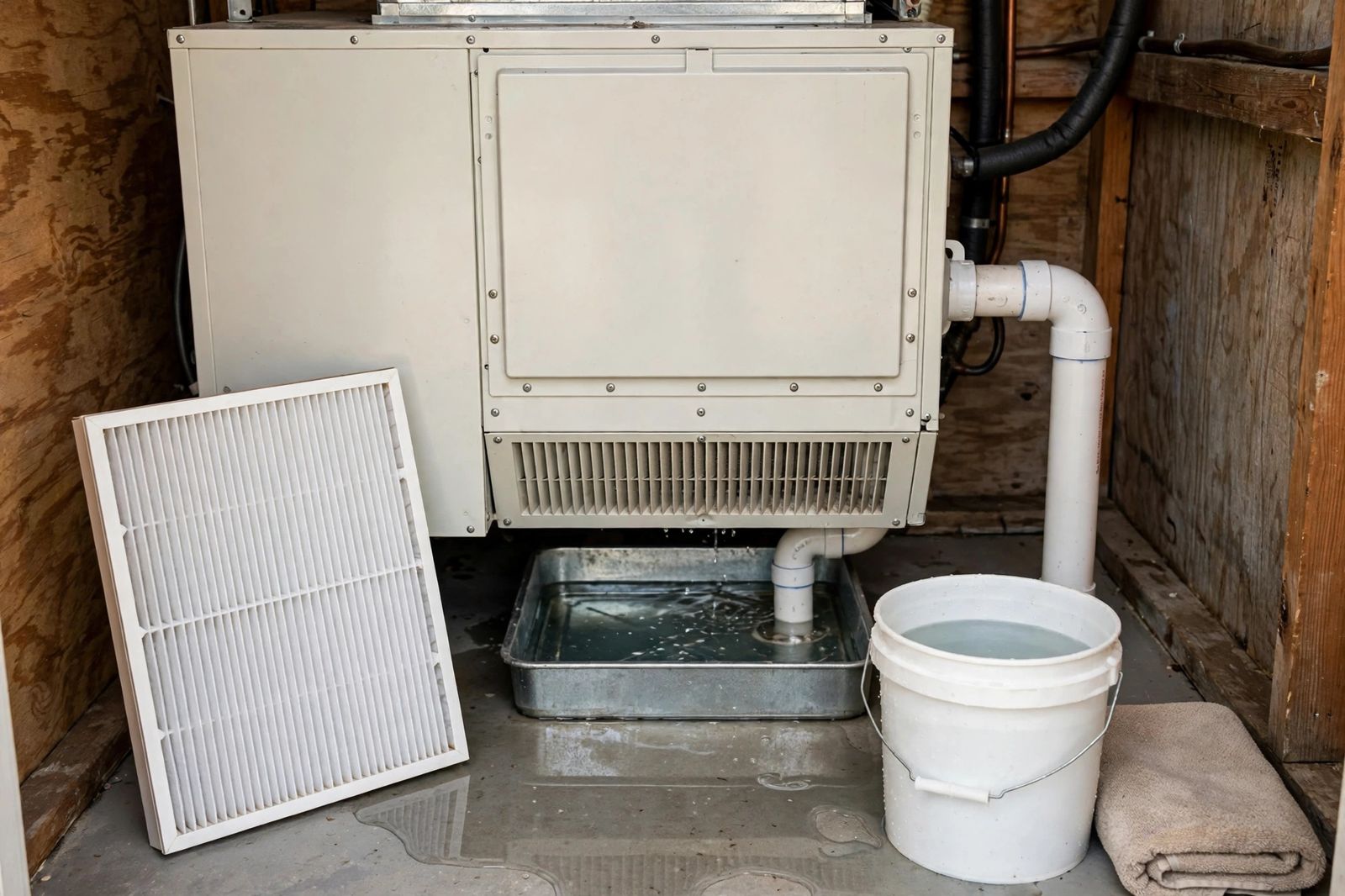
If your AC is leaking water inside, turn it off first, contain the water, and read the leak by where it appears: water under the indoor unit most often means a clogged condensate drain line or a cracked, overflowed drain pan; a steady drip at the outdoor drain end is usually normal; and a ceiling stain below an attic unit means the pan or its overflow protection has already been overwhelmed. Then work the checks in order — filter, drain line, drain pan, frozen coil — because a dirty filter can freeze the coil, and melting ice can flood a pan that was draining fine yesterday. Water itself is normal for an AC. Water in the wrong place is the fault.
Safety first. Turn the system off at the thermostat before you check anything, and turn power off at the breaker or disconnect before you open a panel or work near a wet unit. If water is near an outlet, the electrical panel or a disconnect you cannot reach safely on a dry floor, stop and call a technician. Never chip ice off a coil. Refrigerant work is licensed work — under the U.S. Environmental Protection Agency’s Section 608 rules, certification is required for anyone whose work could open the refrigerant circuit, so this article gives no DIY refrigerant instructions. If the ceiling below the unit is bulging or sagging, keep people out from under it and call promptly.
Start with the location — it is the diagnosis
Most leak guides give you a flat list of six or ten causes and leave you to guess which one is yours. The water’s location does most of that guessing for you, because each place points to a different part of the same drainage path: coil, pan, drain line, out of the house.
Leak-source diagnosis by location (the original asset of this article)
Find your row first. Then work the check order in the next section — do not start with the row’s last cause.
| Where the water appears | What it usually means | Likely cause, in order to check | First check |
|---|---|---|---|
| Under / around the indoor unit (air handler, furnace closet, basement floor) | Condensate made it to the pan but could not leave, or could not be held | 1. Clogged condensate drain line — pan fills and overflows. 2. Cracked, rusted or overflowed drain pan. 3. Melting frozen coil sending more water than the pan can handle at once | Pan first: full of standing water points downstream to the drain line; pan leaking through its base points to the pan itself |
| At the outdoor unit | Two different things share this location — separate them before you worry | 1. Normal: a steady drip or small puddle at the end of the condensate drain pipe while the system runs on a humid day — that is the indoor water leaving correctly. 2. Not normal: water pouring from the cabinet base itself, a large growing puddle, or dripping that continues long after the system stops | Watch where it exits: from the drain pipe’s end = normal drainage; from under the condenser cabinet = investigate, starting indoors at the pan and drain |
| Ceiling stain / drip below the unit (attic air handler) | The primary pan overflowed and the secondary protection — overflow pan, secondary drain or float switch — did not stop it, or also failed | 1. Clogged condensate drain (same first cause, found late). 2. Failed or missing float switch / blocked secondary drain. 3. Cracked primary pan | System off and leave it off. Check the attic pan and float switch if you can reach them safely on dry footing; ceiling damage already present usually makes this a technician call, not a weekend project |
| From a vent, or the system shut itself off and the pan is wet | The float switch did its job, or meltwater is travelling where it should not | 1. Clogged drain tripping the float switch — the shutdown is protection, not a separate fault. 2. Frozen coil melting into the duct/pan area | Do not bypass or tape down the float switch. Clear the drain cause, thaw any ice fully, then restart |
Two corrections the top results need, stated plainly. First, a damaged outdoor condenser is not a normal cause of an indoor water leak, and the most common cause should not be buried in an FAQ. Carrier’s own leaking-water page lists a frozen coil, a leaky drain pan and a “damaged condenser” as its three main causes — yet the condenser sits outdoors, holds no condensate pan for indoor air, and does not collect the water that drips off your indoor coil. In that same page’s FAQ, Carrier itself gives the fuller answer for a unit leaking from the bottom: a clogged condensate drain line, frozen coils, a damaged or full pan, or improper installation. That clogged drain — the cause Bryant and Trane both put at or near the top — is where this article starts, because it is where most indoor leaks start. Second, water at the outdoor unit is not automatically a leak. A steady drip from the condensate drain termination outside while the system runs is the system working. Treating normal drainage as a fault sends people hunting outdoors for a problem that, when there is one, is almost always indoors at the pan and line.
The check order, after the system is off
Work top to bottom, in the spirit of Bryant’s 3-check starting point — filter, drain line, coil — expanded here with the pan and the safety switch that sit between them.
1. Contain, then look at the pan
Towels and a bucket under the drip, belongings moved, and standing water mopped or wet-vacuumed — Trane gives the same first steps: shut the system off, mop up the water, then diagnose. Then look at the drain pan under the indoor coil, with a torch:
- Pan full, water clean, no crack visible: the water arrived and could not leave. Your problem is downstream — the drain line, step 3.
- Pan rusted, cracked, or dripping through its base while not full: the pan itself is the leak. A primary pan is usually not a simple homeowner swap — it sits under the coil — so note it and call; an overflow (secondary) pan under an attic unit is easier to inspect.
- Pan full and the system had shut itself off: the float switch probably tripped on purpose. That is the protection working. Clear the cause; never bypass the switch. If that shutdown is your only symptom — no leak found, just a system that will not start — work it as link 3 of the no-start chain in AC not turning on.
2. The air filter — two minutes, and the parent of the frozen coil
Pull the filter and hold it to a light. Grey, matted, or no light through it means replace it — same size, arrow toward the air handler. Bryant and Carrier both put the filter early for the same reason: a clogged filter restricts airflow across the evaporator coil, the coil gets too cold and freezes, and when that ice melts it delivers a surge of water the pan was never asked to hold in a normal hour. Both makers give the same replacement rhythm: roughly every one to three months, depending on the filter, the system and the home.
If the filter was filthy and there is ice (step 4), the filter may be the whole story — but only after a full thaw and a re-test. A clean filter that was already clean tells you to keep moving down this list, not to stop.
3. The condensate drain line — clear it from outside
This line — usually a white PVC pipe leaving the indoor unit — carries the pan’s water out of the house. Algae, mould, dust and debris build up inside it until the pan has nowhere to drain. Bryant allows one homeowner move here, with its own caution attached: a wet/dry vacuum may be used to clear a minor clog only if you can safely identify the line and understand how it is connected — and Bryant’s dealer guidance warns against homeowners doing drain treatment incorrectly, because it can damage the equipment.
- Find the drain’s outdoor end — a small PVC pipe near the outdoor unit or through an exterior wall.
- Seal a wet/dry vacuum around that end with a rag or tape and run it briefly to pull the blockage out toward you.
- From the indoor access point (a capped T-fitting near the air handler, on many systems), pour in a little clean water and confirm it appears outside and flows freely.
- Skip the forum favourites: do not pour household drain cleaner or strong bleach solutions into the line on a forum’s say-so. Those chemicals belong in plumbing drains, not in a condensate system attached to your coil and pan, and they are not in Carrier, Bryant or Trane’s guidance linked here.
If water flows freely now and the pan drains, restart and watch the pan over the next cooling run. If nothing moves, or the line is disconnected, damaged, or you cannot identify it confidently, that is the end of the homeowner part of this step.
4. A frozen coil — thaw it completely, then judge
Frost or ice on the insulated copper line, on the coil itself, or a filter that is wet from dripping meltwater — Trane names that wet-filter pattern directly — points to a freeze. Bryant’s instruction is simple: let frozen coils thaw completely with the system turned off; it may take several hours; do not chip or scrape the ice.
- Cooling OFF. You can set the fan to ON to move room air across the ice and help it melt, with towels ready — a thaw produces a lot of water, which is the leak you are already dealing with, only faster.
- Fit the clean filter before you restart.
- Restart only when the ice is fully gone. If the system then runs, cools and stays leak-free, restricted airflow was the likely cause.
- If ice returns within a day or two with a clean filter and clear vents, the remaining usual cause is low refrigerant — which means a leak in a sealed circuit, found and repaired by a certified technician, in that order. If your symptom is broader than a leak — weak or warm air even without ice — work the ordered checks in AC not cooling as well; the two faults share the filter-and-freeze root.
5. The parts after the pan: pump, slope and installation
Three causes remain, and they explain leaks that survive a clear drain, a clean filter and a full thaw:
- Condensate pump failure. Systems that cannot drain by gravity — a basement air handler below the drain, for example — use a small pump. If it has lost power, clogged or failed, water backs up and overflows, as Bryant lists. A silent pump in a full reservoir is the clue. Check its power supply if it is plainly a plug; the pump itself is a technician or confident-replacement job, not a first DIY.
- Disconnected or damaged drain line. Bryant lists this separately from a clog: the line can come loose or crack and spill water along its run instead of at the unit. Follow the wet trail; water partway along a wall or ceiling line is this pattern, not a pan pattern.
- Improper installation — a unit or pan not level. If a system has leaked since it was installed, or since work was done on it, level and drain slope belong in the diagnosis. A pan that cannot drain toward its outlet will overflow from its low side forever, however clean the line is. That history is itself the finding to hand to the installer or a technician.
Water outside, in detail — normal vs not
Because this location causes the most false alarms, it is worth one short section of its own:
- Normal: drips or a modest puddle at the outdoor end of the condensate drain while the system is running, especially in humid weather; water that stops when the system stops and dries afterwards. No action.
- Worth a look: no drip at all from that outlet during a long, humid cooling run while water appears indoors — the drainage is going somewhere else, which is the indoor problem above wearing outdoor clothes.
- Not normal: water streaming from the condenser cabinet itself, a puddle that keeps growing, or leakage paired with ice on the lines, weak cooling or a system that shut itself off. Work the indoor checks in order; do not open the outdoor unit’s electrical panel.
When to stop and call
Call a technician — and leave the system off — if any of these is true: a ceiling is stained, bulging or dripping; the pan is cracked or rusted through; ice returns within a day or two of a full thaw with a clean filter; the drain will not clear with the vacuum method or you cannot identify the line safely; a condensate pump is dead; you suspect refrigerant at all (hissing, oily residue on a line, ice with a clean filter); water is near electrics you cannot keep dry; or the leak simply continues after the checks above. Tell the technician where the water appeared, whether the pan was full, what the filter looked like, and whether there was ice — that location report is the fastest diagnostic you can hand over, and it is the reason this article starts there.
Prevention is unglamorous and matches what all three makers advise: change the filter on its one-to-three-month rhythm, keep the drain line clear with regular maintenance, and have the system serviced professionally on a regular cycle — Carrier stresses annual maintenance — so the pan, drain and coil are inspected before a summer overflow inspects your ceiling for you. A float switch, if your system lacks one, is the cheap backstop Trane recommends discussing with a technician: it turns the next overflow into a no-cooling call instead of water damage.
Frequently asked questions
Why is my AC leaking water inside the house? Most often because condensate cannot drain: a clogged condensate drain line backs water up until the drain pan overflows. The next causes, in check order, are a cracked or rusted drain pan and a frozen coil — usually from a dirty filter — melting more water than the pan can handle at once.
Should I turn my AC off if it is leaking water? Yes. Carrier, Bryant and Trane all say to shut a leaking system off first. Running it makes more condensate every minute, worsens water damage, and strains the system if ice is involved. Contain the water, then diagnose.
Is water dripping from the outdoor unit normal? A steady drip from the end of the condensate drain pipe outside, while the system runs, is normal — it is your indoor condensate leaving correctly. Water pouring from the outdoor cabinet itself, a large growing puddle, or dripping long after shutdown is not.
Can I clear a clogged AC drain line myself? Sometimes, with one method: a wet/dry vacuum sealed around the outdoor end of the line to pull the clog out — Bryant allows it if you can safely identify the line and how it connects. Do not use household drain cleaner. If the clog does not clear, or you are unsure which pipe is the drain, call a technician.
Why is there a stain on the ceiling under my AC? With an attic air handler, a stain means the primary pan overflowed and the water reached the ceiling — because the drain clogged, the pan cracked, or the secondary pan/float-switch protection failed or was absent. Leave the system off and have it inspected; the ceiling has already told you the overflow protection did not hold.
How long does a frozen coil take to thaw? Hours, not minutes — Bryant says a complete thaw may take several hours with the system off. Restarting against remaining ice re-freezes the coil and can strain the compressor. Never chip the ice off.
This article is general information based on the manufacturer guidance linked above, checked in November 2026. Drain layouts, access points and pan designs vary by model — follow your manual, and leave refrigerant, live-wiring and primary-pan replacement work to a qualified technician.