If your AC will not turn on, follow one chain in order before you call anyone: breaker and fuse first, then a proper thermostat call test, then the float switch on the drain line, then the capacitor hum test — listening only, never opening the outdoor unit. That order is not random. Power has to reach the system before a call for cooling can matter, a call has to reach the outdoor unit before a safety switch can be blamed, and a safety switch has to be cleared before a humming outdoor unit means a failed part. Which link is broken also depends on what still runs, so name your pattern first in the split below: indoor fan running with a dead outdoor unit, absolutely nothing running, and a system that clicks then dies are three different faults wearing the same name.
Safety first. Reset a tripped breaker once only — fully off, then on — and leave it off if it trips again. Never open the outdoor unit’s electrical panel: capacitors can hold a charge even with the power off, and Carrier, Bryant and Trane all treat capacitor, contactor and refrigerant work as professional work. Never tape down or bypass a float switch, and never push a contactor in by hand to force a start. If you smell burning, see scorched wiring, or a breaker trips a second time, stop and call a technician.
Name your pattern first — it routes the chain
Do not work a flat list of causes. Stand in the house for one minute and sort what you have into one of these three patterns. Each one enters the chain at a different link.
- Indoor fan runs, outdoor unit is dead. Air moves at the vents, but outside there is no fan, no compressor, no hum. The indoor half has power and is answering the thermostat. Your break is outdoors or on the way there: the outdoor breaker or disconnect, a float switch wired to cut only the outdoor call on some systems, or the capacitor and contactor. Start at link 1 for the outdoor circuit specifically, skip quickly through link 2, and expect link 4.
- Absolutely nothing runs. No indoor fan, no outdoor sound, often a blank or unresponsive thermostat. The break is early: whole-system power, a control fuse, thermostat power, or a float switch that cuts the whole control circuit. Work links 1 to 3 in full and in order — link 4 is almost never your answer, because a capacitor fault does not blank a thermostat.
- The system clicks, hums briefly, then dies. The thermostat is calling and something outside is trying and failing to start. That is the capacitor-and-contactor pattern until proven otherwise, with one exception: if it clicks, starts, and the breaker then trips, stop resetting and treat it as an electrical fault. Confirm links 1 to 3 are clean, then link 4 is a listen-and-call, not a repair.
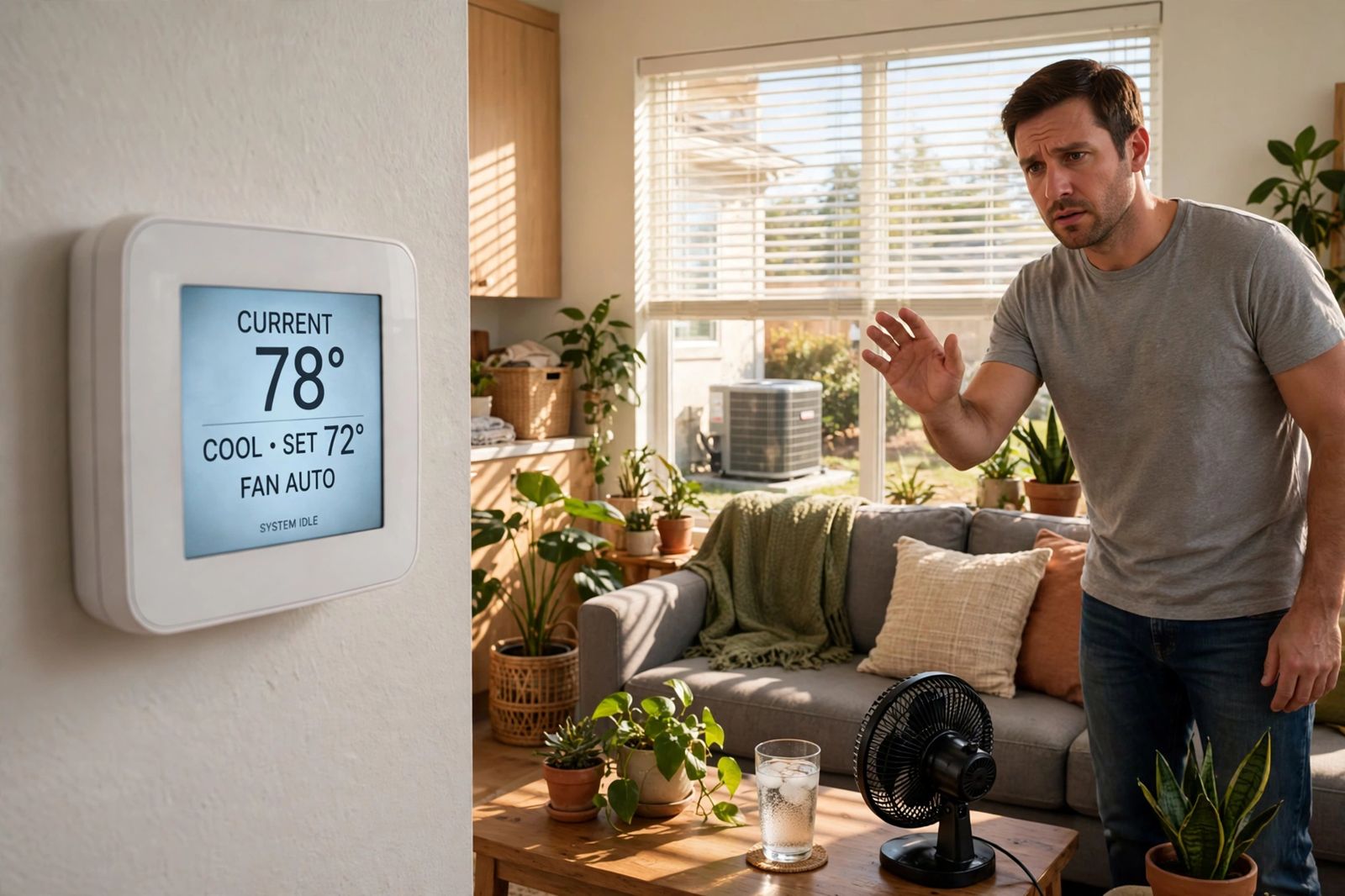
A worked example, the one in this article’s photo: the thermostat reads CURRENT 78°, COOL • SET 72°, FAN AUTO, and the system sits idle. The settings are already right and the display is alive, so a dead battery or a wrong mode is not the story. That reading sends you to the chain — power first — not to a new thermostat.
The no-start chain (the original asset of this article)
Work top to bottom. Do not jump to the capacitor because it is famous; it is link 4 for a reason, and links 1 to 3 are free, safe, and more common.
| Link | Check, in order | How to do it | What each pattern should expect | Owner or tech? |
|---|---|---|---|---|
| 1 | Breaker and fuse | Find the AC breakers in the main panel — a central system usually has separate indoor and outdoor circuits. A tripped breaker sits midway or off: push it fully OFF, then ON, once. Confirm the outdoor disconnect beside the condenser is fully seated, and the indoor shutoff switch near the air handler or furnace is ON. A blown fuse in the outdoor disconnect, or a small control-board fuse, cuts power just as completely — note it, do not uprate it | Nothing-runs: this is your most likely link. Indoor-runs/outdoor-dead: check the outdoor breaker and disconnect specifically — the indoor one is proven by the running fan. Clicks-then-dies: a breaker that trips as it tries to start ends the chain here | Owner for one reset and a visual check; tech if it trips again, a fuse has blown twice, or wiring looks scorched |
| 2 | Thermostat call test | Mode COOL, fan AUTO, set point a few degrees below the room temperature the thermostat itself shows — 72° against a room reading of 78°, for example. Then wait a full 5 minutes: a flashing “Cool On” or “Waiting” message is a built-in compressor-protection delay, not a fault. Listen for a faint click at the thermostat as the call is made, and set the fan to ON for ten seconds as a test — if the indoor fan runs on ON, the blower and its power are alive and the break is in the cooling call or outdoors | Nothing-runs with a blank display: batteries or lost control power — the full diagnosis is in thermostat not working. Indoor-runs: the call is reaching at least the indoor half, so a settings fault is unlikely. No click and no response at all: the call is not being sent or not arriving | Owner for settings, batteries and the wait; tech for wiring, control board or a proven-dead thermostat |
| 3 | Float switch on the drain line | Find the indoor drain pan and the drain line leaving it. Standing water in the pan, or a small float lifted in its cup or tee on the line, means the switch has shut the system down on purpose because the condensate drain is clogged. Clear the line from its outdoor end with a wet/dry vacuum, mop the pan, and re-test. Never bypass the switch to “test” the system | Nothing-runs: a common, missed cause — the switch opens the control circuit, so everything goes quiet together. Indoor-runs/outdoor-dead: possible on systems wired to cut only the outdoor call. Clicks-then-dies: unlikely — a tripped float switch does not click and retry | Owner to look, mop and vacuum an accessible line; tech if the drain will not clear or water has already escaped — diagnose that by location in AC leaking water |
| 4 | Capacitor hum test — ears only | Stand outside while someone sets the thermostat to call for cooling. Listen, and look at the fan through the grille without touching anything. A hum with a still fan, a click followed by a brief hum then silence, or repeated hard starting is the pattern. Then switch the system OFF at the thermostat so a struggling compressor does not sit humming and overheating, and call | Clicks-then-dies: this is your link. Indoor-runs/outdoor-dead with a hum: same answer. Total silence outside with links 1–3 proven: the contactor, control wiring or the compressor itself — also a call, described the same way | Tech only. The test is listening. There is no homeowner step inside the panel — see the correction box below |
| — | Anything past this link | Contactor, compressor, blower motor, control board, transformer, refrigerant pressure switches | — | Tech only |
Two corrections the top results need, stated plainly. First, you do not test or replace a capacitor yourself — not with a multimeter, not by “discharging it with a screwdriver.” Several high-ranking guides walk a homeowner through opening the outdoor panel and reading the capacitor’s microfarad value, or discharging it by hand. The makers say the opposite, in writing: Bryant cautions homeowners against working on capacitors and contactors at all, Trane’s capacitor guidance reserves testing, discharging and replacement for a trained professional, and the Sears/Lennox symptom guidance states it in one line — capacitors store electricity even when the power is off; do not open the outdoor unit or touch the capacitor. A capacitor that passes a DIY test can still be the wrong part fitted the wrong way, and a charged one does not care that the breaker is off. The homeowner capacitor test is the hum in link 4: hear it, switch off, describe it, call. Second, ignore any guide that gives you exact percentages for why your AC will not start. One top result assigns the causes neat shares — thermostat about 35%, breaker about 25%, filter about 15%, capacitor about 12%, drain about 8% — with no study, call data or source behind any of them. Precise numbers that sum conveniently and cite nothing are decoration, not evidence, and no maker linked on this page publishes such a split. Your house has one fault, and the chain above finds it faster than a borrowed statistic does.
Link 1 in full: breaker, disconnect, and the two fuses people miss
Carrier puts a tripped breaker and a blown fuse at the very top of its no-start list, ahead of the thermostat, and Bryant’s diagnostic pairs the breaker with the outdoor disconnect in the same step. Three details decide whether this link actually gets checked:
- There are usually two circuits, not one. The indoor air handler and the outdoor condenser are commonly on separate breakers. That is exactly how you get a running indoor fan over a dead outdoor unit: one circuit tripped, the other did not. Check both, labelled or not — and if breakers trip repeatedly across the house, that wider pattern belongs in circuit breaker keeps tripping, not in an AC part swap. The same one-reset rule governs any other dead appliance on that panel — it is the order used for a ceiling fan not working as well.
- One reset is the check; the second trip is the answer. On this point the makers split, and the split is worth naming: Trane’s page tells readers with a tripped breaker not to flip it and to call a professional, while Carrier and Bryant both describe one careful reset — fully off, then on — with a professional call if it trips again. This article follows Carrier and Bryant, because a single reset that holds is how a one-off surge trip is distinguished from a real fault, and a single reset that re-trips has told you the fault is real. What no maker endorses is resetting again and again.
- Fuses cut power silently. A blown fuse in the outdoor disconnect leaves the condenser dead with every breaker looking fine, which is the outdoor-dead pattern’s quietest cause. A small low-voltage fuse on the indoor control board leaves everything dead, thermostat included. Carrier’s rule for any replacement fuse is exact: same amperage as specified, never a higher rating as a workaround — and a fuse that blows a second time has a cause a technician needs to find, as Bryant’s FAQ also states.
After any reset, wait. Systems hold the compressor off for several minutes after power returns, so judge link 1 only after the 5-minute wait in link 2, not in the first silent sixty seconds.
Link 2 in full: prove the thermostat is actually calling
A lit thermostat proves it has power. It does not prove a cooling call is leaving it, arriving at the air handler, or reaching the outdoor unit. Trane starts its no-start list here: blank screen first (batteries, or lost power from the system), then COOL mode with the fan on AUTO and the set temperature below the indoor temperature. Lennox’s outdoor-unit guidance adds the size of the gap: set the thermostat at least 3–5 degrees below room temperature for an unambiguous call.
- The fan-ON test is the split in one move. Set the fan from AUTO to ON. If indoor air now blows, the blower, its circuit and the thermostat’s fan call all work — your fault is in the cooling call or the outdoor half, and links 3 and 4 matter most. If nothing blows even on ON, go back to link 1 and the control-power end of link 3; the system is not being powered or not being allowed to run at all.
- Fan AUTO is not a detail. Left on ON permanently, a blower can also mask a dead outdoor unit for hours — the vents feel alive while no cooling is happening at all. That warm-air version of the problem is worked in full in AC not cooling.
- Schedules and holds imitate faults. A programme holding a warm setback, an “away” routine, or a temporary hold set by someone else in the house will sit silent through a correct-looking display. Clear the hold, set a plain call, then wait out the protection delay before concluding anything.
Link 3 in full: the float switch — the shutdown that is doing its job
Cooling pulls water out of indoor air all day. That water drips into a pan and leaves through the condensate drain line. When the line clogs with algae and debris, the pan fills — and on most modern systems a float switch rises with the water and opens the control circuit, shutting the system down before the pan overflows through a ceiling or into a closet. Bryant’s dealer commentary calls this the overlooked reason an AC will not turn on, and its diagnostic gives the pattern its own row: will not start, with water in the drain pan.
- What you will find. Standing water in the indoor pan, a float sitting high in its cup, and a system that went quiet all at once — indoors and out — rather than fading. On some wiring arrangements the switch cuts only the outdoor call, which is why this link stays in the chain for the indoor-runs pattern too.
- What you can do. System off. Mop the pan, then clear the line from outside: seal a wet/dry vacuum around the drain’s outdoor end and pull the clog out toward you, then confirm water poured at the indoor access point flows freely outside. Restart and watch the pan through the next cooling run.
- What you must not do. Never tape the float down, lift it permanently, or jumper the switch “just to get cooling tonight.” The water it is holding back does not disappear; it goes into the house. If the pan has already overflowed — a puddle at the indoor unit or a stain on the ceiling below — work that damage pattern in AC leaking water before restarting at all.
A filter note belongs here, because the makers all raise it on this symptom even though it is not a chain link of its own: a severely clogged filter can overheat or freeze a system into a shutdown, as Carrier and Bryant both note. If your filter is grey and matted, replace it while you work the chain — same size, arrow toward the air handler — but do not let a filter change replace the chain; a clean filter on a system with a full drain pan still will not start.
Link 4 in full: hear the capacitor fail, then stop
The capacitor is the part that gives the compressor and the outdoor fan motor the push to start and helps them keep running; the contactor is the switch that delivers power to them when the thermostat calls. Carrier lists a faulty capacitor or contactor among its main no-start causes and notes capacitors typically last about 10–20 years, with heat and heavy use shortening that life. Lennox makes the same pairing: a failed capacitor or contactor can prevent startup even with a cooling call present.
Your whole job at this link is recognition:
- Hum, still fan. The outdoor unit hums but the fan on top does not spin and the compressor does not settle into a run. Classic capacitor pattern.
- Click, brief hum, silence — repeated. The contactor pulls in, the motors try, and the start fails. Capacitor, contactor, or a compressor that can no longer start.
- Fan spins, compressor silent, or the reverse. One motor starting without the other points to the dual capacitor’s failed half or that motor itself.
- Silence, with links 1–3 proven. No hum at all leans away from the capacitor and toward the contactor coil, control wiring, a pressure-switch lockout, or the compressor — a technician’s meter work, in that territory from the first minute.
In every case: thermostat OFF once you have heard the pattern, and leave it off. A compressor left humming without starting overheats, and repeatedly re-calling a hard-starting system turns a small electrical part into the expensive end of the range Trane quotes for AC repair — from $100 to more than $3,000 depending on the fault. Tell the technician which pattern you heard and which chain links you already cleared; “new filter is not the story — breaker holds, thermostat calls, pan is dry, outdoor unit hums and the fan never spins” is a diagnosis half-finished before the van arrives.
A window unit that will not turn on, briefly
A window or wall unit has no chain to split — one cabinet, one plug, one control panel — so its no-start checks are shorter: confirm the outlet has power (test it with a lamp, and check for a tripped plug or breaker on the unit’s own cord), confirm the mode is COOL rather than Fan or Off with the set temperature below room temperature, and clean the mesh filter behind the front grille, because a choked unit can shut itself down. If the panel is alive and the unit still will not start, its sealed system, capacitor or board has failed inside a cabinet that is not a homeowner repair — on an older, inexpensive unit that is usually a replacement decision, the same conclusion as in the window-unit section of AC not cooling.
When to stop and call
Call a technician — and leave the system off — if any of these is true: the breaker trips a second time, or a replacement fuse blows again; the outdoor unit hums without starting, clicks and dies repeatedly, or stays silent with links 1–3 proven; the drain will not clear, or the float switch trips again within days; you smell burning, see scorched or frayed wiring, or hear grinding; the thermostat is proven to be calling and nothing anywhere responds; or there is no cooling in dangerous heat with anyone vulnerable in the house — treat that as urgent and call straight away, chain unfinished.
If the system is under warranty, call sooner rather than later for anything past links 1–3: Trane notes plainly that DIY repairs can void warranty coverage, which is one more reason the chain ends at listening.
Frequently asked questions
Why is my AC not turning on at all — no fan, no sound, nothing? Work the chain from link 1. Total silence, especially with a blank thermostat, is early-chain: a tripped breaker or blown control fuse, a disconnect or indoor switch left off, lost thermostat power, or a float switch that has opened the whole control circuit on a full drain pan. A capacitor fault does not produce this pattern.
The indoor fan runs but the outdoor unit will not turn on. What is it? The indoor circuit is proven, so look outdoors: the separate outdoor breaker or its disconnect fuse, then the float switch if your system cuts only the outdoor call, then the capacitor and contactor — the outdoor unit’s starting parts. Lennox and Carrier both put that pairing first for this exact pattern.
Why does my AC click and hum but not start? The thermostat is calling and the outdoor motors are trying to start and failing. That is most often a failed capacitor, next a worn contactor, and occasionally a compressor that can no longer start. Switch it off so it does not sit humming and overheating, and call — there is no safe homeowner step inside the outdoor panel.
Can a clogged drain really stop an AC from turning on? Yes — deliberately. When the condensate drain clogs, the pan fills, and a float switch shuts the system down to prevent an overflow. Clear the line, mop the pan, and the system is allowed to start again. Never bypass the switch.
Should I reset the breaker if my AC will not turn on? Once, properly: fully off, then on — Carrier and Bryant both describe that single reset, with a professional call if it trips again. A second trip is the fault announcing itself; leave the breaker off. Then wait several minutes before judging, because the system holds the compressor off briefly after power returns.
Can I replace the AC capacitor myself to save the call-out? No — not safely, and the makers say so directly. A capacitor can hold a dangerous charge with the power off, and testing, discharging or replacing it is reserved for a trained professional in Bryant’s, Trane’s and Lennox’s guidance alike. Your test is the hum in link 4 of the chain. A capacitor is among the cheaper professional repairs; a compressor damaged by a forced start is not.
This article is general information based on the manufacturer guidance linked above, checked in November 2026. Breaker layouts, switch locations and drain arrangements vary by system — follow your manual, and leave capacitor, contactor, refrigerant and live-wiring work to a qualified technician.