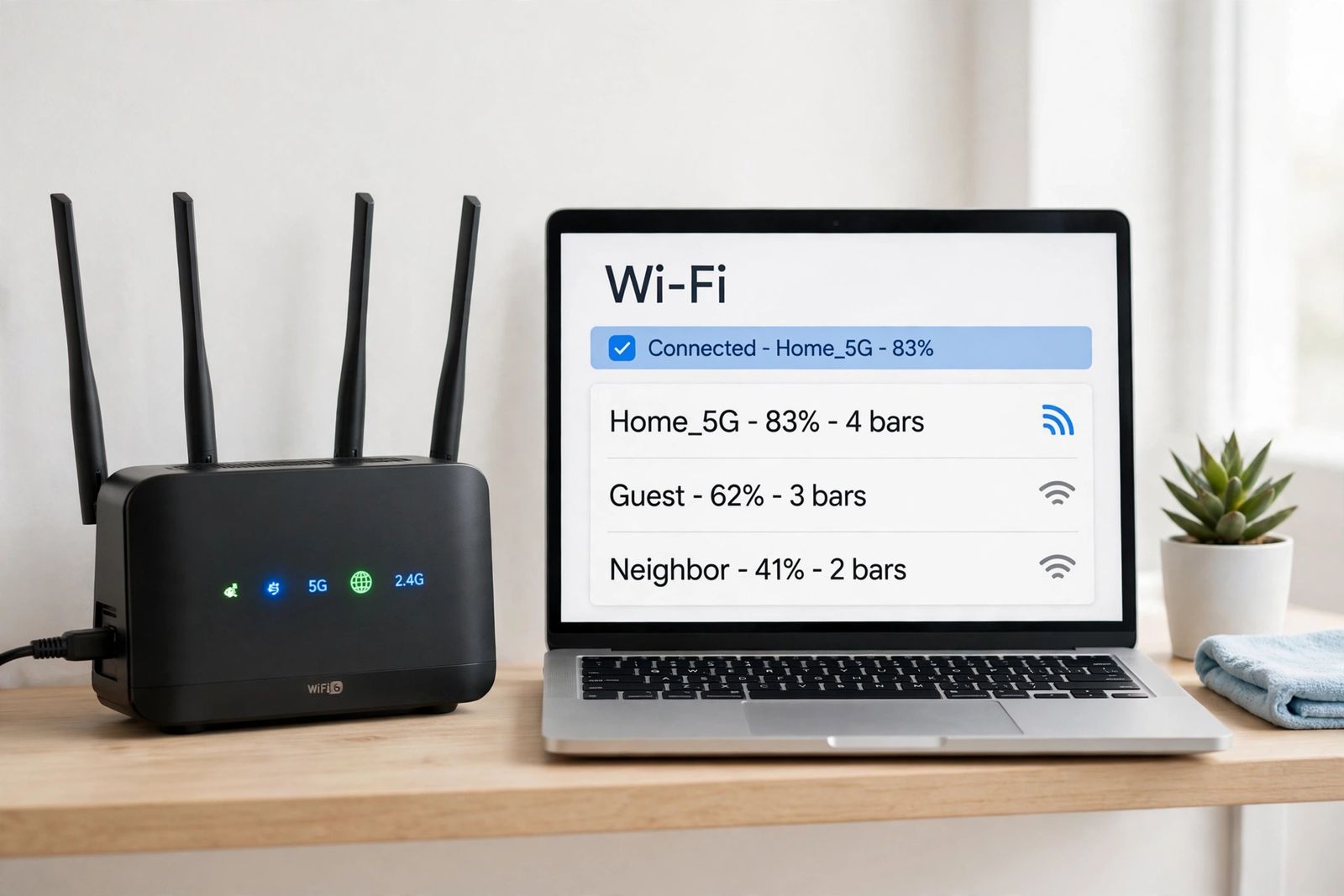
If your WiFi keeps disconnecting, the fault is in one of three places — the device that drops, the router, or the line coming into your home — and one quick test tells you which: check whether other devices drop at the same moment. If every device loses WiFi together, work on the router and the line, not on your laptop or phone. If only one device drops while the rest stay connected, work on that device: forget the network and rejoin it, restart it, and update its software and WiFi driver. Work through the sections below in that order and you will fix most cases of WiFi disconnecting randomly without changing any setting you did not need to touch.
First, work out what is actually dropping
Before changing anything, watch one disconnect happen and answer three questions.
Does everything drop, or just one device? When the WiFi drops, pick up a second device straight away. If it has also lost the connection, the router or the internet line is the problem, and no setting on your laptop will fix it. If the second device is fine, the problem lives in the device in your hand. This single split — all devices versus just one device — decides which half of this article you need.
Does the WiFi itself drop, or only the internet behind it? Look at the WiFi icon when it fails. If the icon shows you still connected to your network but pages will not load, the wireless link is holding and the fault is further up — router, modem or provider. If the icon shows the network gone entirely, the wireless link itself is breaking, which points at signal, interference or the device’s WiFi hardware and driver. A wired test settles it: TP-Link’s unstable Wi-Fi guide is built on exactly this split — if wired devices stay connected while wireless ones drop, the problem is wireless-specific; if wired devices drop too, it is not.
Is there a pattern? Drops at the same time each day suggest a router restart schedule, a provider fault, or interference from something that switches on then — a microwave is the classic example on the 2.4 GHz band. Drops in one room suggest weak signal; drops after the laptop wakes suggest a power or driver problem on that laptop. Note the pattern down — if you call your provider, it is the most useful thing you can give them, and on Windows, how to screenshot on Windows covers capturing the exact error message to send with it.
The split, in one table
| What you see when it drops | The fault is most likely in | Go to |
|---|---|---|
| Only one device drops; the rest stay connected | That device — saved network, driver, power settings, or a VPN/security app on it | The one-device fixes below |
| Every device drops at the same moment, and a wired device drops too | The router, the modem, or the provider’s line | The router fixes below, then the provider section |
| Every wireless device drops, but a wired device stays online | The router’s wireless side — channel interference, channel width, band steering, or firmware | The channel and firmware section below |
| Devices drop only in one far room | Coverage — weak signal, or a device at the edge of the 5 GHz band falling off it | The placement section below |
| One device drops after sleep or idle | That device’s power saving, or the router giving up on a sleeping device | The one-device fixes, power check |
That table is this article’s whole method. Everything after it is the worked steps for the row you landed on.
One separation worth making before you start: a machine that is slow at everything, including programs that never touch the internet, does not have a WiFi problem at all — why is my computer so slow works through that diagnosis in order. This article is only for a connection that actually drops. A different separation again: a Roku voice remote that keeps losing its link to the player is not your home WiFi dropping, even though both are wireless — the remote talks to the Roku directly, and Roku remote not working works through its restart and re-pairing sequence by remote type.
Fixes when only one device keeps disconnecting
Work through these on the dropping device only, in order. Stop when the connection holds.
Restart the device, then forget and rejoin the network
A plain restart clears more of these faults than people expect. On a Mac, Apple’s own WiFi guide puts restarting near the top of its list, partly because the Mac renews the internet address the router gave it when it restarts.
If the drops continue, make the device forget the network and join it fresh. Forgetting deletes the saved copy of the network — including an old password or settings left over from before a router change — and the rejoin rebuilds it cleanly.
- Windows: Settings > Network & internet > Wi-Fi > Manage known networks, select your network, select Forget, then reconnect from the WiFi list and enter the password. This is step 3 in Microsoft’s Fix Wi-Fi connection issues in Windows guide.
- Mac: System Settings > Wi-Fi, find the network, remove it from the known networks list, then rejoin and re-enter the password. Apple also advises checking the Wi-Fi menu for a Wi-Fi Recommendations item — if your Mac has detected a specific problem, it says so there.
- iPhone: Settings > Wi-Fi, tap the info button next to your network, then tap Forget This Network, as described in Apple’s iPhone Wi-Fi settings guide. Rejoin and enter the password again.
- Android: Settings menus differ by maker, but the route is generally Settings > Network & internet (or Connections) > Wi-Fi, open the saved network, and choose Forget, then rejoin. Because Android menus genuinely differ between Samsung, Pixel and other phones, follow the wording on your own phone rather than any single written path.
You need the WiFi password before you forget the network. If you do not have it, get it first — from the router label, from another device already connected, or from whoever manages the network.
Run the built-in troubleshooter and diagnostics
On Windows 11, Microsoft’s first instruction is to run the automated Network and Internet troubleshooter in the Get Help app; it checks the adapter, the driver and the connection settings, and fixes some faults itself. On a Mac, hold the Option key, click the WiFi icon, and open Wireless Diagnostics — Apple’s built-in tool for exactly this kind of repeated drop. Neither tool fixes everything, but both are free, quick, and can name the fault instead of leaving you guessing.
Update the system and the WiFi driver
Out-of-date software is a steady cause of one-device drops, especially drops that started right after — or right before — a system update. Install pending system updates first. On Windows, if the problem survives, Microsoft’s guide gives a stronger step (step 8 in its sequence): uninstall the network adapter driver in Device Manager and restart, after which Windows reinstalls the driver automatically. Two cautions from that same guide matter. Download the latest driver from your PC maker’s website first and keep it as a backup — if the PC has no internet, download it on another device and copy it across on a USB drive. And treat driver uninstalling as a later step, not a first one: try everything above it first. Some guides go further and claim a drop that started after an update is “almost certainly” the driver; Microsoft’s own wording is more careful — consider the reinstall if your connection stopped working properly after a recent update — and the forget-and-rejoin and troubleshooter steps still come first in its order.
Power settings deserve one check on a laptop that drops after sleep. Some laptops reduce power to the wireless adapter to save battery, and the adapter does not always recover cleanly on waking. If your drops line up with waking the machine, that setting — usually in the adapter’s properties or the maker’s power app — is worth reviewing. Makers place it differently, so check your own model’s support page rather than following a path written for a different brand. If, instead, only websites fail in one browser while apps and other browsers work fine, the WiFi is probably innocent — a stale browser store is a likelier cause, and how to clear cache covers that separate fix.
WiFi keeps disconnecting on a phone
On a phone, work through the same order: restart the phone, forget and rejoin the network, install system updates. Then check the settings that make a phone leave WiFi on purpose. Phones have features that switch to mobile data when WiFi looks weak — on an iPhone this appears in Wi-Fi settings as an assist option, and Android phones have similar “switch to mobile data” behaviour under different names. If your phone drops WiFi whenever the signal dips for a second, that feature may be doing exactly what it was designed to do, in a home where the signal has genuine weak spots. The real fix is then the weak spot itself — see the router placement section below — rather than the phone.
One more phone-specific check: a VPN app or security app that reconnects badly can look exactly like WiFi dropping. If the drops started when such an app was installed, turn it off for a day and compare.
Fixes when every device disconnects: the router
If all your devices drop together, leave their settings alone. The problem is the router, the modem, or the line.
Restart the router properly
Turn the router off, unplug it, wait at least 30 seconds, and plug it back in. If you have a separate modem, restart that first, let it come fully online, then restart the router. A proper restart clears the router’s temporary faults and forces every device to reconnect fresh. Wait several minutes after the restart before judging it — routers take longer to settle than the lights suggest. A restart is not a factory reset: it keeps your network name, password and settings, and it should always come before any reset is even considered.
Check placement and interference
WiFi weakens through walls and floors, and it competes with other signals. TP-Link’s unstable Wi-Fi guide lists the usual interference sources by name: microwave ovens, Bluetooth devices and other nearby appliances, alongside weak signal from placement and channel congestion from neighbouring networks. A router shut in a cupboard, sitting on the floor, or placed behind a television starts at a disadvantage. Move it higher, out in the open, and as central in the home as the cable allows. Keep it away from thick masonry, large metal objects, and the microwave. If drops happen mainly in one far room, you have a coverage problem, not a fault: the honest fixes are moving the router, adding a mesh node or access point for that area, or using the 2.4 GHz band in that room — it reaches further than 5 GHz, at lower speed. The 5 GHz band is faster but shorter-ranged, so a device at its edge drops and reconnects repeatedly as it hunts between bands — a common cause of “random” drops in a single room.
Channel interference and firmware: the two router fixes guides rush past
If restarts help only briefly and every wireless device drops while a wired one holds, the cause is usually sitting in two router settings: the channel and the firmware. These deserve more than the one line most guides give them.
Channels. Your router broadcasts on one channel inside each band, and every neighbour’s router does the same. When several networks share one channel, they compete for the same airtime, and the weakest connections drop first — in a block of flats this is often the whole story. On the 2.4 GHz band, only three channels do not overlap each other: 1, 6 and 11. A wide channel setting makes the crowding worse, because one wide channel overlaps more of its neighbours.
Start from Apple’s recommended settings for Wi-Fi routers and access points: set Channel to Auto, so the router selects the best channel itself, and set channel width to 20 MHz on the 2.4 GHz band (Auto on 5 GHz and 6 GHz). Note what this corrects. A strand of popular advice claims Auto is itself the problem because the router “constantly hops channels” and should always be pinned to a fixed channel. Apple’s published recommendation is Auto, and most routers re-scan when they restart rather than hopping mid-connection. The honest order is: Auto first; only if drops continue, use a free WiFi analyser app to look at which of channels 1, 6 and 11 is least crowded around you, set that one manually, and test for a day. TP-Link’s drop-specific guidance adds one sharper tool: its unstable Wi-Fi guide calls reducing channel width — 20 MHz on the 2.4 GHz band, and 20 MHz on 5 GHz as a stability test — one of the most effective fixes for intermittent disconnections, because a narrower channel overlaps fewer neighbours on both bands. Treat the 5 GHz narrowing as a test you can undo, not a permanent downgrade: it trades top speed for stability, which is the right trade only while drops are your actual problem.
Band steering. If your router presents one network name and steers devices between bands (TP-Link calls this Smart Connect), and the drops hit one kind of device while others hold, TP-Link names Smart Connect compatibility issues with certain client devices as a cause in its own right, and disabling it as one of its most effective fixes. That sits in tension with Apple’s general advice to keep one name for all bands, so treat disabling steering as a test: turn it off, let the bands show as separate networks for a day, and see whether the dropping device holds on one band. If it does, you have found your cause and can decide which setting to keep with evidence instead of folklore.
Firmware. Router firmware is the router’s own software, and out-of-date firmware is a named cause of wireless instability in TP-Link’s guide — and the fix most often skipped, because nothing in the home announces that an update is waiting. Check the router maker’s app or admin page for an update, turn on automatic updates if the router offers them (Apple recommends the same), and install what you find. Do not unplug the router while an update is running; an interrupted update can leave the router unable to start. If your drops began immediately after a firmware update rather than before one, note the version before changing anything — that timing is the useful fact if you end up talking to the maker’s support. You will need the router’s admin sign-in for all of this, usually printed on a label on the router itself — the same sign-in you would use for a router-level block, as how to block a website on Chrome describes in its router method.
Check the router settings that cause repeat drops
Beyond channel and firmware, compare your router’s remaining settings with Apple’s recommended settings. Apple publishes these for its own devices, but most of them are good practice for any network:
- Security: WPA3 Personal, or WPA2/WPA3 Transitional if older devices need it. Apple warns that older modes — WPA, WEP, TKIP and mixed WPA/WPA2 — reduce security and reliability.
- One network name for all bands: give every band the same name, so devices move between bands without treating them as separate networks (with the band-steering test above as the one deliberate exception, made to diagnose a drop).
- Firmware: set the router to install updates automatically if it offers that, or check the maker’s app or admin page for updates yourself.
Also check that only one device on your network is handing out addresses (DHCP) and doing NAT — a modem-router and a second router both doing it is a classic cause of connections that drop in a pattern nobody can explain. If your provider supplied the modem and you added your own router, put one of them in bridge mode, following the maker’s own instructions for your models.
Router admin pages differ completely between brands, so this article deliberately does not give click-by-click router paths: open your router maker’s own help for your model and find the same-named settings there.
A correction: changing DNS does not fix a dropping WiFi link
Several popular fix lists include “change your DNS” as a cure for WiFi that keeps disconnecting. It cannot be one. DNS is the lookup service that turns a site’s name into its address; it is only used after your device is connected. If your WiFi icon shows the network gone, no DNS setting was involved in losing it, and changing DNS will not bring it back. DNS belongs to the different fault where the icon shows you connected but sites will not load — and even there it is one suspect among several (the router, the modem and the line are the others), not a first step. If your symptom is the icon dropping, skip every DNS step in every guide, including this one, and work the split table at the top instead.
When it is the provider’s fault
If every device drops, the router restart does not hold, and the modem’s own status lights show the line itself dropping, the fault is upstream and no home fix will cure it. Note the times of several drops, check the provider’s service status page, and report it with your times. Drop patterns that hit the whole street are the provider’s to fix; a single home dropping at random is usually local. “Internet keeps disconnecting” and “WiFi keeps disconnecting” are often used for the same complaint, but they separate here: if the modem loses its line, that is an internet fault; if the line stays up while devices lose the wireless link, that is a WiFi fault — and telling the provider which one you have shortens the call considerably. While you wait on a fix, a phone can fall back on its mobile data instead — travellers formalise exactly that fallback with the travel line described in how to use an eSIM for travel.
Use network reset only as a last resort
Both Windows and phones offer a full network reset. On Windows it sits at Settings > Network & internet > Advanced network settings > Network reset, and Microsoft lists it as step 13 — the last step — in its own sequence, saying plainly that using network reset should be the last step you try, after the troubleshooter, forget-and-rejoin, the network commands and the driver steps. A reset removes the network adapters and their settings and returns them to defaults — every saved WiFi password goes with it, and VPN software may need reinstalling afterwards. It is the right tool when a device drops on every network and nothing above has worked, and the wrong tool as a first try — some fix lists present it as just another item in the middle of the list, which is how people lose every saved network they own for a fault a restart would have fixed. If one device drops on every network it joins — home, work, a friend’s house — while other devices hold those same networks, suspect that device’s hardware and contact its maker; software has been ruled out at that point.
Frequently asked questions
Why does my WiFi keep disconnecting on just one device? Because the fault is in that device: a saved network profile gone stale, an out-of-date driver or system, a VPN or security app interfering, or power settings that put its WiFi adapter to sleep. Forget and rejoin the network, restart, update, and only then consider the driver reinstall and network reset steps above. Other devices staying connected is what proves the router innocent.
Why does my WiFi keep disconnecting on my laptop but not my phone? Usually the laptop’s driver or power management, or band hunting: the laptop sits at the edge of the faster 5 GHz band’s range and keeps falling off it, while the phone — often closer to the router, or more willing to stay on 2.4 GHz — holds on. Test the laptop in the same room as the router. If it holds there, it is a coverage problem; if it drops there too, work through the driver and forget-and-rejoin steps.
Why does WiFi disconnect randomly with no pattern? Random-looking drops usually have a hard-to-see cause: interference from a neighbour’s network on the same channel, a device switching between bands, or a router fault that builds up until it is restarted. Channel on Auto (or the least crowded of 1, 6 or 11 on 2.4 GHz), 20 MHz width on the 2.4 GHz band, and current firmware remove the most common three. If drops survive that and hit every device, log the times and take it to the provider.
Should I set a fixed WiFi channel instead of Auto? Start with Auto — that is Apple’s published recommendation, and the router re-scans as conditions change. Go fixed only as a test when drops continue: on the 2.4 GHz band pick the least crowded of channels 1, 6 and 11, the three that do not overlap each other, using an analyser app to see your neighbours’ networks. Advice that says Auto itself causes drops by “constant hopping” is not supported by the router makers’ own guidance.
Will changing DNS stop my WiFi disconnecting? No. DNS lookups happen after you are connected; they play no part in holding the wireless link. If your WiFi icon shows the network dropping, DNS is not involved. DNS is only a suspect in the different case where you stay connected but websites will not load.
Will a new router fix WiFi that keeps disconnecting? Only if the router is the fault — every device dropping, restarts helping briefly, firmware already current. If one device drops, a new router usually changes nothing. Do the one-device versus all-devices test first; it costs nothing and answers this directly. If you do replace it, current models are built on the newest standard — what Wi-Fi 7 is explains what it changes.
Does resetting the router to factory settings help? It wipes your network name, password and every custom setting, and the fault often returns if the cause was placement, interference or the line. A restart — power off, wait, power on — is a different, harmless step and should always come first.
This article is general information, based on the device and router guidance published by Microsoft, Apple and TP-Link and checked in November 2026. Menu names differ between Windows versions, phone makers and router brands — where yours differ, follow the same-named setting in your maker’s own help for your model.