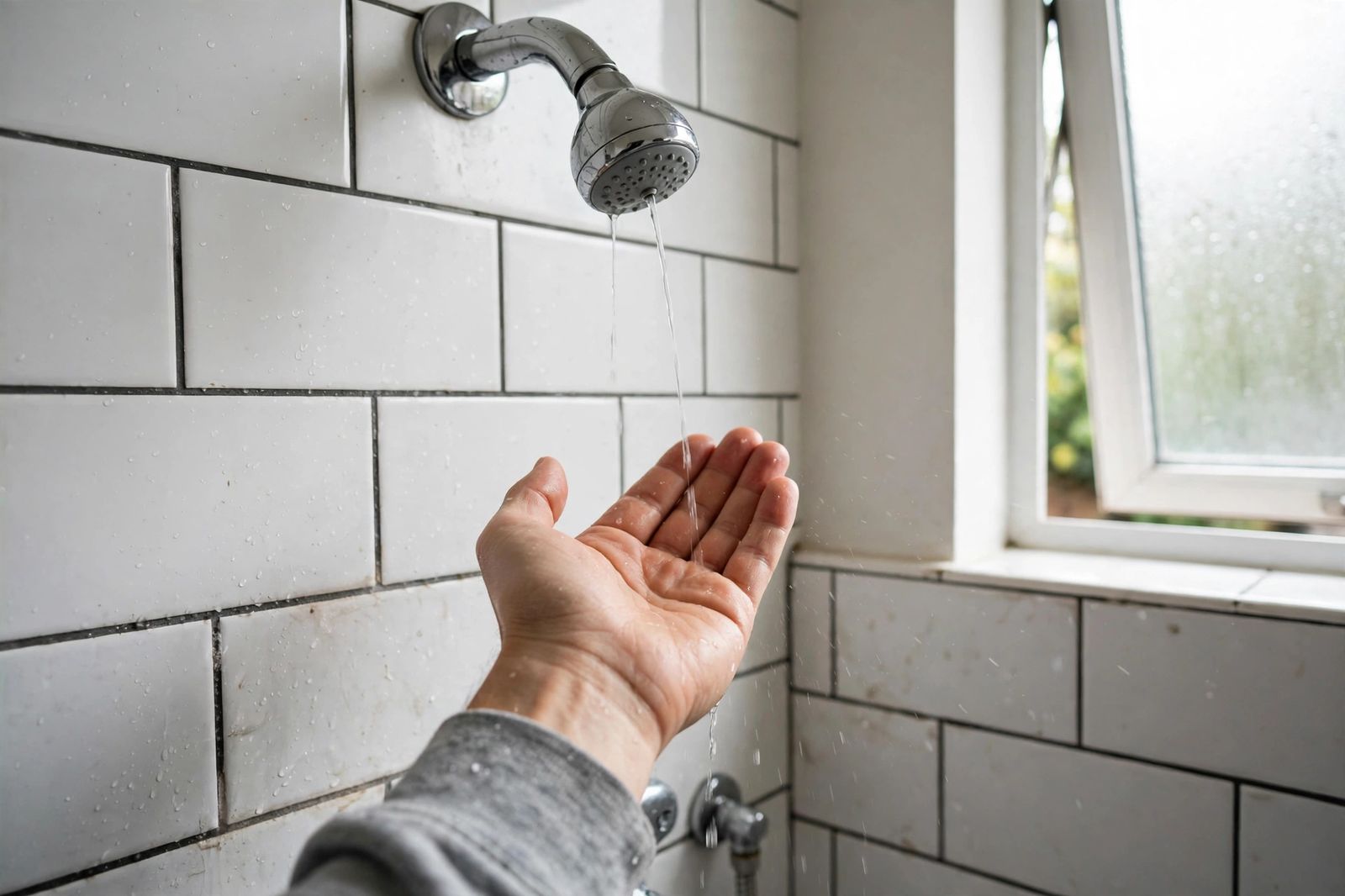
To fix low water pressure, start by locating the problem, not by replacing parts. If only one tap or shower is weak, the fault is in that fixture. If the whole house dropped suddenly, the fault is the main valve, the pressure regulator, or the city’s supply. If the whole house has faded gradually over years, the fault is most likely inside your pipes. Which branch you are on decides the fix — and on every branch, the first tests are free and the likely fixes are cheap, long before any pipe work is justified.
One distinction matters before you begin. What feels like low pressure is sometimes low flow: the Portland Water Bureau points out that a clogged faucet or corroded pipes can strangle the flow at a tap even when the pressure behind it is perfectly normal. That is why the diagnosis below works by scope — where the weakness shows up — rather than by guessing at parts.
The diagnosis tree: match your symptom before you touch a tool
Walk the house once. Run two or three taps in different rooms, a shower, and an outside hose bib, and note hot versus cold at each. Then find your row:
| What you see | Most likely causes, in order | The test that confirms it | The fix |
|---|---|---|---|
| One fixture only is weak | 1. Clogged aerator or showerhead 2. That fixture’s shut-off valve partly closed 3. Fouled cartridge or kinked supply line | Remove the aerator or showerhead and run the water: strong flow without it means the clog was in it | Clean or replace the aerator/showerhead; open the fixture valve fully; then suspect the cartridge |
| One floor or one area is weak, the rest of the house is fine | 1. A branch shut-off valve partly closed 2. A clogged or corroded run feeding that zone 3. Hot-only weakness: the water heater or its valves | Check hot and cold separately in the weak zone; find and open the branch valve; compare with the same fixture type elsewhere | Open the branch valve fully; if hot-only, check the heater’s shut-off and sediment; a single corroded run is a plumber’s repipe decision |
| Whole house, suddenly weak (days, not years) | 1. The city’s supply — main work, a break, or an outage near you 2. Main shut-off or meter valve left partly closed after recent work 3. A pressure regulator (PRV) that has just failed 4. A new leak | Ask the neighbours and call the utility before opening anything; check the main and meter valves are fully open; watch the meter with everything off — if it moves, water is escaping | If the street has it too, wait for the utility. Open your valves fully. A failed PRV or a hidden leak is a plumber call |
| Whole house, gradually weaker over months or years | 1. Corroded galvanised pipes narrowing from the inside 2. A PRV slowly failing or set too low 3. Sediment building up — heater, whole-house filter, fixture screens | The gauge test below: a fair static reading that collapses when a tap opens points to narrowed pipes; a low reading everywhere points to the PRV or the supply | Clean the screens and flush the heater; test and adjust the PRV; corroded galvanised pipe has no cleaning fix — repiping is the honest answer |
Do not work this as a generic list of tips in someone else’s order. Your order is set by your row. Work down your row only, and stop the moment the flow comes back.
Branch 1: one weak fixture — the ten-minute fixes
This is the commonest case and the cheapest. The water reaching that fixture is fine; something at the end of the line is choking it.
Clean the aerator. The aerator is the small mesh screen screwed into the tip of the faucet. Unscrew it by hand, or with pliers padded with a cloth so you do not scar the finish. Rinse out the grit, and if the mesh is crusted with scale, soak the parts in white vinegar for half an hour, scrub with an old toothbrush, rinse and refit. For a showerhead, the same soak works without removal: fill a plastic bag with vinegar, pull it up over the head, tie it on, and leave it overnight. Portland’s guidance for some-faucets-weak cases starts in exactly this place — remove the screens and check for blockages before anything else. If the flow is strong with the aerator off and weak with it on, you have found the whole problem.
Open the fixture’s own valves. Under a sink, the hot and cold shut-off valves (angle stops) are often left a quarter-turn short of open after some earlier repair, or stiffen half-closed with mineral deposits. Turn both fully counterclockwise. A valve that will not move, or weeps when turned, has become a job of its own — the same stop-and-replace logic as a shut-off that fails during a leaky faucet repair.
Then look inside the fixture. If the aerator is clean and the valves are open and that one faucet is still weak, the restriction is likely the cartridge inside it, fouled with sediment, or a kinked flexible supply line under the sink. Both are fixture-level jobs. Do not let a single weak tap talk you into whole-house work.
Branch 2: one floor or one area is weak
When a whole zone fades but the rest of the house runs normally, the restriction sits in the pipework or valving that feeds that zone alone.
First, separate hot from cold in the weak zone. Hot weak everywhere it reaches, cold normal points at the water heater: check the shut-off valve on the heater is fully open, and consider sediment in the tank, which settles and chokes the hot outlet over time. If the heater itself is wet or dripping, that is a different fault — see water heater leaking before you touch anything else. Both hot and cold weak in one area points instead to a branch shut-off valve left partly closed (check the valves in the basement, crawl space or cupboard that feed that floor), or to one clogged or corroded run. In winter, a run through an exterior wall can also narrow with ice — a zone that went weak in a cold snap, especially on an outside wall, should be checked for a frozen pipe before it thaws and bursts, which is also how a slow toilet leaking from the base or a burst-fed leak elsewhere announces itself late.
A zone fed by a long run of narrow pipe can also simply be undersized, in which case the weakness appears only when other fixtures are running. That is a design limit, not a blockage, and no cleaning fixes it.
Branch 3: the whole house dropped suddenly
Work this branch from the street backwards, and make the first step a phone call, not a wrench.
Ask the neighbours, then call the utility. If the houses around you lost pressure at the same time, the cause is the municipal supply — main work, a break, flushing, or peak demand — and nothing in your house needs fixing. Portland’s bureau is explicit that main breaks and other system events cause temporary pressure changes, and its advice for a total loss is to check for shut-off notices and look for crews working nearby before assuming the fault is yours. Call your water provider, report it, and ask whether work is happening near you. Opening walls for a city problem is the most expensive mistake on this page.
Check the two valves everyone forgets. If the neighbours are fine, find your main shut-off — where the supply line enters the house — and confirm it is fully open: a lever (ball) valve’s handle parallel to the pipe, a round (gate) valve handle turned fully counterclockwise. A gate valve even one turn short of open can cut delivered pressure sharply, and valves get knocked or left half-set after meter work, heater work, or any recent plumbing visit. The meter valve on the street side is the utility’s property; look, but if it needs moving, call the utility rather than forcing it.
Rule out a leak. Turn off every tap and appliance, then watch the water meter. If the meter’s dial or leak indicator still moves with nothing running, water is leaving the system somewhere — and a leak large enough to drop house pressure is large enough to damage the house. Portland suggests the same meter check for visible leaks inside and out. A moving meter plus sudden low pressure is a plumber call today, not a weekend project.
Suspect the pressure regulator last on this branch. If the valves are open, the street is fine, and there is no leak, a PRV that has failed shut-ish can drop the whole house at once. Proving that needs the gauge test below.
Branch 4: the whole house faded gradually
A house that has weakened slowly over years is telling a different story: something is narrowing, steadily.
Corroded galvanised pipes are the classic cause in older homes. Galvanised steel corrodes from the inside, rust and mineral growth narrowing the bore year by year until a pipe that started at three-quarters of an inch carries water through a fraction of it. Portland flags exactly this: older galvanised plumbing means restricted flow from corrosion, even when incoming pressure is normal. There is no flush, soak or chemical that restores the inside of a corroded pipe. The honest fixes are replacing the worst sections or repiping, which is why this branch ends with quotes from plumbers, not products.
A tiring PRV can also fade gradually — sticking lower, or drifting from its setting as its diaphragm ages. Unlike pipe corrosion, this one is testable in five minutes with a gauge, which is why the gauge comes before any conclusion on this branch.
Sediment everywhere is the third slow cause: screens, a whole-house filter cartridge left years past its change date, and heater sediment all nibbling at flow at once. Clean the aerators across the house, replace the filter cartridge if you have one, and flush the heater before concluding the pipes are done. Appliances suffer first and most visibly from this slow fade — a dishwasher not draining problem is different, but a dishwasher that fills slowly and washes badly is often just reporting the house’s pressure.
The gauge test: five minutes, one number, no guessing
A hose-thread pressure gauge costs roughly the price of a takeaway coffee at any hardware store and ends all argument about whether your pressure is actually low. Portland recommends the same tool for a real-time reading.
- Turn off every tap and water-using appliance in the house.
- Screw the gauge onto an outside hose bib — or a laundry tap — and open that tap fully.
- Read the dial. That is your static pressure: the pressure in the system at rest.
- Now open a couple of taps indoors and read it again. That is your pressure under demand, and the drop between the two readings is diagnostic gold.
How to read the numbers, with sources. The EPA’s WaterSense guidance for homes recommends incoming service pressure between 45 and 60 psi for efficient use and proper system function. Portland manages its system to keep most homes between 40 and 80 psi. So:
| Gauge reading (static) | What it means |
|---|---|
| Below 40 psi | Genuinely low. Below this, showers and sprinklers feel it first. If the utility says your address is simply a low-pressure location, this may be your normal — Portland notes some homes always receive under 40 psi due to elevation |
| 45–60 psi | The healthy band — EPA WaterSense’s recommended range. If your static reading sits here but taps feel weak, your problem is flow, not pressure: go back to the tree and look for blockages and narrowed pipes |
| 60–80 psi | High-normal. Fixtures will feel strong; no action needed, but a PRV should be holding you here if your street pressure runs higher |
| Above 80 psi | Too high, and a separate problem: the EPA notes most U.S. plumbing codes require a pressure-reducing valve where supply pressure exceeds 80 psi, because sustained high pressure damages piping, fixtures and appliances |
And the second reading: if static pressure is healthy but the needle collapses when you open taps, the supply can push but your pipes cannot carry — the signature of narrowed or undersized pipework, Branch 4. If static pressure is already low at the hose bib, the restriction is at or before that point: the PRV, the valves, or the street.
The pressure regulator (PRV): check it, adjust it carefully, or leave it
Not every home has one. Where street pressure is high, a PRV — a bell-shaped brass valve on the main line, usually just after the shut-off — steps it down to a safe level. Watts’ instructions for its LF25AUB-Z3 regulator show the typical pattern: the valve leaves the factory preset at 50 psi, adjustable across a 25–75 psi range, and you adjust it by loosening the locknut and turning the bolt — clockwise to increase pressure, counterclockwise to decrease it.
If your gauge reads low and you have a PRV, one careful adjustment attempt is reasonable:
- Put the gauge on the hose bib first and record the current reading.
- Loosen the locknut, turn the bolt clockwise a quarter-turn at a time — no more — re-checking the gauge after each small turn.
- Aim for the middle of the healthy band, around 50–55 psi. Never adjust toward or past 80 psi: 80 is the code-max territory the EPA cites for requiring a PRV in the first place, not a target.
- Retighten the locknut and re-test the next day.
If the reading does not respond to adjustment, or the valve body is corroded, crusted or weeping, the regulator has failed and needs replacing. Replacement means cutting into the main line: for most homeowners that is a plumber’s job, and a legitimate one — a failed PRV misdiagnosed as bad pipes has sold a lot of unnecessary repiping.
Booster pumps: the last resort, not the shortcut
A booster pump raises pressure when the supply itself is genuinely low — and only then. Portland’s position is the right test: a booster makes sense where an address is supposed to receive less than 40 psi because of its location and elevation, which the utility can confirm for your address before you spend anything.
A pump fitted over corroded pipes, a half-closed valve or a failed PRV fixes nothing and stresses old pipework with pressure it cannot handle. Booster installations may also need a permit or have to meet local plumbing and backflow rules, which vary by jurisdiction — check with your utility or local building department first, and expect a plumber to be part of the job. If a seller reaches for the pump before anyone has put a gauge on your hose bib, walk away.
When to call a plumber
Call rather than continue if: the meter moves with everything off (an active hidden leak); a shut-off or meter-side valve is seized, corroded or leaking; the PRV does not respond to adjustment or is visibly failing; the gauge shows the street supply is fine but the house cannot carry flow — the repipe conversation; any pipe is bulged, split or frozen; or you are a renter, in which case pressure beyond the fixture screens is your landlord’s system and a written report protects you better than a repair. And if several unrelated fixtures fail at once in an older house — drips appearing alongside the pressure drop — treat it as the system asking for one professional diagnosis rather than five DIY guesses, the same principle as naming the part before replacing it in how to fix a leaky faucet.
Frequently asked questions
What is normal water pressure for a house? Roughly 40–60 psi covers most homes comfortably; the EPA’s WaterSense guidance recommends incoming service pressure between 45 and 60 psi, and Portland manages its system to keep most homes between 40 and 80 psi. Below about 40 psi usually feels weak; above 80 psi is where codes require a regulator because pipe and appliance damage begins.
Why did my water pressure drop suddenly in the whole house? In order: city work or a main break near you, a main or meter valve left partly closed after recent work, a newly failed pressure regulator, or a new leak. Ask the neighbours and call the utility first — that order costs nothing and rules out the cause you cannot fix yourself.
Why is only my shower weak when the taps are fine? Almost always the showerhead itself: scale and sediment clog its nozzles and its inlet screen. The overnight vinegar-bag soak in Branch 1 fixes most of them; a head that stays weak after soaking, with strong flow from its bare pipe, needs replacing, not replumbing. If the flow is strong but the water itself will not get hot, that is not a pressure fault at all — work through shower water not getting hot, where the cause sits in the shower valve’s limit stop or cartridge.
Can low pressure damage anything? Low pressure itself is mostly misery, not damage — though appliances that fill slowly, like washing machines and dishwashers, can time out and error. The damage risk sits at the other end: sustained pressure above 80 psi wears pipes, hoses and appliance valves, which is the entire reason regulators exist.
My pressure is fine in the morning and weak in the evening. Is something broken? Probably not. Portland notes pressure fluctuates with daily and seasonal demand — mornings and evenings, when the neighbourhood showers and cooks, and summer, when it waters gardens. A pattern that follows the street’s routine is the supply breathing, not your plumbing failing.
This article is general information based on the Portland Water Bureau’s pressure guidance, the EPA WaterSense homes guidance and the regulator manufacturer’s instructions linked above, checked in November 2026. Pressure ranges, codes and permit rules vary by jurisdiction and utility — confirm your address’s expected pressure with your water provider, follow your regulator model’s own instructions where they differ, and use a licensed plumber for main-line, regulator-replacement and repipe work.