If your shower water is not getting hot, run one test before you touch anything: turn a nearby tap — the bathroom sink, then the kitchen — to full hot. If the taps run properly hot and only the shower tops out lukewarm, your water heater is fine and the fault is inside that one shower valve, most often an anti-scald limit stop set too low or a worn cartridge. If every tap in the house is lukewarm too, the fault is not in the shower at all — it is at the heater, and this page hands you over to the house-wide guide at that point. That single split, shower-only versus whole-house, decides everything below, and getting it backwards is how people replace water heaters to fix a plastic ring behind a shower handle.
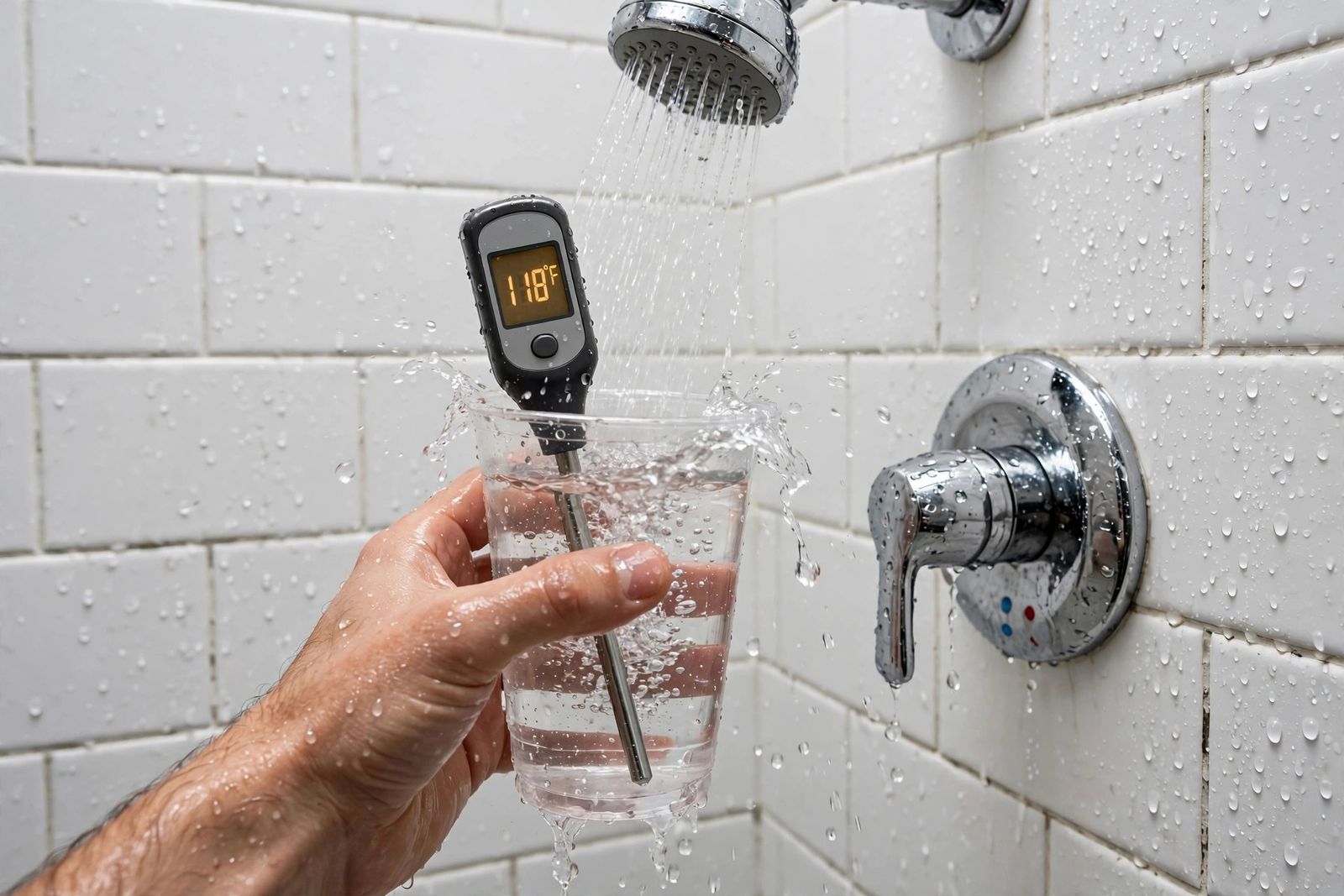
Safety — read this before the fix. The limit stop exists to prevent scalds. Every adjustment in this article is checked with a thermometer in the water stream, and the water at full hot must never exceed 120°F (49°C) — or your local code limit, if it is lower. Moen states the same cap for its Posi-Temp showers: limit the maximum temperature flowing from the shower to 120°F/49°C or less to prevent scalding. Delta gives the same instruction for its valves, to set the stop so the outlet does not exceed the code-allowed temperature — 110°F or 120°F depending on the code. Never remove the stop, defeat it, or “test by feel” with a child or older person due in that shower next. If you are not comfortable removing a handle and working around a live valve, the adjustment itself is a short plumber visit — that is a correct outcome, not a failed one.
The one-split diagnosis: find your side in 30 seconds
Run the shower on full hot for a full minute first — hot water has to travel from the heater, and judging at ten seconds condemns healthy showers. Then run the nearest sink on full hot, and one more tap in a different room. Add what the handle and the flow are telling you, and find your row:
| What you find | Which side you are on | Most likely causes, in order | Start with |
|---|---|---|---|
| Taps hot, only this shower lukewarm, handle turned all the way to hot | Shower valve | 1. Anti-scald limit stop set too low 2. Worn or scaled cartridge 3. A valve inlet stop left partly closed | The worked fix below: check the limit stop first |
| Taps hot, only this shower lukewarm, and it started right after a cartridge swap or valve repair | Shower valve | 1. Cartridge installed turned the wrong way, so hot and cold are swapped and the stop now caps the cold range 2. Inlet stop left partly closed | Re-check the cartridge orientation against its instructions, then the inlet stops |
| Taps hot, shower swings hot–cold when a toilet flushes or another tap runs, or the handle is stiff, gritty or drips when off | Shower valve | The pressure-balancing spool inside the cartridge is sticking, or the cartridge seals are worn | Cartridge replacement — adjusting the limit stop will not cure swings or a drip |
| Every tap in the house is lukewarm, not just the shower | Whole house — not the shower | Heater set too low, a failed element or burner, sediment, or a heater running out | Stop here and work the heater path in no hot water in house — do not open the shower valve |
| Shower starts hot, then fades after a few minutes, and taps do the same on a long draw | Whole house capacity | Tank running out: recovery, sediment, back-to-back use, or an undersized heater | The capacity checks in no hot water in house, not the shower valve |
| Shower flow itself is weak as well as lukewarm, while other fixtures flow strongly | Flow fault at this fixture first | Clogged showerhead screen, a partly closed fixture stop, then the cartridge | Separate flow from temperature with how to fix low water pressure — a weak shower and a lukewarm shower are different faults |
No row on that table sends a shower-only problem to the water heater. That ordering is where most guides on this keyword go wrong first: several start at the heater thermostat even for the reader whose sink is already running hot next to the cold shower. If your taps are hot, the heater has already passed its test — it is making hot water and delivering it to that bathroom. What it cannot do is push that hot water past a stop or a cartridge inside the one valve that is refusing it.
Why a healthy shower turns lukewarm in winter
This fault peaks in winter — December and January especially — and the reason is arithmetic, not breakage. The cold water entering your house is far colder in winter than in summer. Your shower valve mixes hot and cold in a fixed proportion for a given handle position, so the same handle position that gave you a hot shower in August mixes to a cooler shower in January: the cold side of the blend is colder, and it drags the result down. To compensate, the handle needs to travel further toward hot — and that is exactly the travel the anti-scald limit stop was set to forbid, usually in warmer weather, often at installation, and then forgotten.
Delta says this plainly in its own valve instructions: the rotational limit stop may need to be readjusted seasonally if the inlet water temperature changes. Nothing has failed. The setting has expired. That is also why the fix below is measured in notches and thermometer readings rather than parts: in the commonest winter case, you are not repairing the valve, you are re-setting it for the water your house is actually receiving now.
The worked fix: adjusting the anti-scald limit stop
The limit stop — makers call it a temperature limit stop (Moen) or rotational limit stop (Delta) — is a small toothed plastic ring or disc on the cartridge stem, behind the handle. It physically stops the handle’s rotation toward hot. Move it one notch, and the handle gains or loses a slice of hot travel. Work in this order, and do not skip the thermometer: it is the only thing standing between “hotter” and “too hot.”
You need: the hex key or screwdriver your handle uses (Delta notes a 1/8-inch or 3/32-inch hex key, or a Phillips screwdriver, depending on the handle design), a thermometer, and a plastic cup. Cover the drain first — handle screws and shower drains have an old arrangement.
- Prove it is the stop before you open anything. Run the shower on full hot for a minute and measure the stream with the thermometer in the cup, following the method both makers use. Note the number. On a Moen Posi-Temp, also note the handle itself: off points down at 6 o’clock, and full hot is fully counter-clockwise at the 9 o’clock position. Moen’s own troubleshooting starts here — verify the handle rotates all the way to 9 o’clock; if it stops short of that, the limit stop needs repositioning before anything else is condemned.
- Remove the handle. Loosen the set screw — commonly underneath the handle or behind a small cap — and pull the handle straight off. The limit stop is now visible on or around the cartridge stem: a notched ring (Moen) or a splined disc (Delta). Photograph its position before you move it. That photo is your way back if the first move makes things worse.
- Move it one notch toward more hot — and only one. Pull the stop straight out just far enough to disengage its teeth, rotate it by a single notch in the direction that allows more hot travel, and seat it fully back. Ignore any guide that gives you one universal direction. Direction is where the web’s advice on this job is visibly wrong, and Delta’s own support page proves it: on a Delta Monitor 1300/1400 series, rotating the stop counter-clockwise decreases the maximum by about 6°F per tooth, so a too-cool shower is corrected clockwise — while on a Delta Monitor 1700/1800 series, rotating it clockwise decreases the maximum by about 2°F per tooth, so a too-cool shower is corrected counter-clockwise. Same brand, opposite directions. Moen’s Posi-Temp instructions describe the same pull-out-and-rotate-to-the-next-notch movement, judged by whether the handle gains travel toward the 9 o’clock full-hot position. The markings on your stop and your model’s instructions outrank any sentence on the internet, including this one: if the stop is stamped “hotter,” follow the stamp.
- Test before you reassemble. Slip the handle back on without fully securing it, run the shower to full hot until the temperature settles, and measure again with the thermometer in the cup. Delta warns that a single tooth can change the outlet by roughly 4 to 16°F depending on inlet conditions, which is why this is a one-notch-at-a-time job, never a spin to the end of the range.
- Stop at 120°F. Repeat steps 3 and 4 only until full hot reads at or just under 120°F (49°C), or your local code limit if lower. Then refit the handle properly, and run Delta’s closing checks: cold water must flow from the valve first when you open it, and the hottest flow must not exceed the allowed temperature. A comfortable shower normally lives around 90–110°F — full hot is a ceiling you set for safety, not the temperature anyone showers at.
If one or two notches restore a proper hot shower, you are done, and the “repair” cost a thermometer reading. Expect to revisit it in spring: a stop set generously against January inlet water can allow a hotter-than-intended maximum when the incoming cold warms up again, which is the seasonal readjustment Delta describes, in reverse.
If the limit stop was already allowing full travel
A stop that is not restricting the handle — the handle reaches full hot, the setting is correct, and the shower is still lukewarm while the taps run hot — acquits itself. Two shower-local causes remain, in this order.
The cartridge. The cartridge is the valve’s mixing core, and in a pressure-balancing valve it contains a spool that slides to even out hot and cold pressure. Moen’s troubleshooting for its Posi-Temp valves gives the telling pressure sign: if the water pressure drops noticeably as you turn from cold toward hot, the 1222 cartridge needs replacing. Scale and wear produce the rest of the pattern — the spool sticks toward the cold side, the seals bypass, and the symptoms in the table appear: temperature that swings when a toilet flushes or another tap opens, a stiff or gritty handle, a drip after shut-off. No limit-stop setting fixes a sticking spool, because the stop only limits travel; it cannot unstick the part doing the mixing. Cartridge replacement means shutting the water off, pulling the old cartridge (a long-fitted Moen cartridge may need a puller tool), flushing the valve body clear of debris, and fitting the exact cartridge for your valve — Moen’s common pair are the 1222 for Posi-Temp and the 1225 for Moentrol, which are not interchangeable. If pulling trim and a cartridge is beyond what you want to do inside a wall, this is the honest plumber handover point.
The inlet stops and a reversed cartridge. Some valves carry small built-in shut-off stops on their hot and cold inlets, behind the trim plate, opened and closed with a screwdriver for servicing. A hot-side stop left a half-turn short after any earlier repair starves exactly one shower of hot water while the rest of the house runs normally — check both are fully open before buying a cartridge. And if the lukewarm shower dates precisely from a cartridge replacement, suspect orientation: a cartridge refitted turned the wrong way swaps the hot and cold sides, after which the handle’s “hot” end is capped by the stop in what is now the cold range. Re-seating it as its instructions show costs nothing but the trim removal you have already done.
One popular suspect does not belong on this list. A clogged showerhead or its flow restrictor can make a shower weak, and it belongs on the flow diagnosis in how to fix low water pressure — but a restrictor does not make hot water lukewarm. Temperature is set by the mix at the valve, upstream of the head; a shower that runs strong and merely cool has a valve problem, and soaking the head in vinegar will leave it exactly as cool, just cleaner. Guides that route a lukewarm shower to showerhead cleaning are treating the wrong fault.
The whole-house side: do not open the shower
If your 30-second test put you on the other side of the split — taps lukewarm alongside the shower, or no hot water anywhere — nothing in the shower valve can explain it, and adjusting the limit stop would only mask a heater fault while adding a scald risk when the heater is fixed. That path is covered in full in no hot water in house: identify the heater type first, then the supply checks in order — breaker and high-limit reset on an electric heater, pilot and gas supply on a gas heater, thermostat near 120°F on either — before any heating part is blamed. Two patterns stay on that side even though they announce themselves in the shower: a shower that starts hot and fades within minutes is a capacity problem (tank emptying, sediment, a failed lower element), and a house that has faded gradually at every tap is a heater or supply problem, never a single valve. Keep the split clean and each fault stays cheap: the shower side is a notch or a cartridge; the house side starts with a breaker or a pilot light, not a wall opening.
Two numbers the guides get wrong
“Set the water heater to 120–140°F.” This range appears across the top results for this keyword as if 140°F were a normal household setting. It is not the setting the safety guidance supports. The U.S. Department of Energy recommends 120°F for household water heaters, both makers cap the shower outlet at 120°F at the limit stop, and water stored or delivered well above that scalds quickly — in seconds for children and older adults. If your shower is lukewarm because its limit stop is set low, the correct fix is the notch adjustment above, which lets the valve use more of the 120°F water the heater already makes. Turning the heater up to 140°F to overpower one shower’s stop raises the temperature at every unprotected tap in the house to do it. Fix the restriction where the restriction is.
“Just turn the stop clockwise” (or counter-clockwise). As the Delta figures in the worked fix show — about 6°F per tooth in one direction on a 1300/1400, about 2°F per tooth in the opposite direction on a 1700/1800 — a bare direction without a model attached is a coin toss that can move your maximum the wrong way by double digits per notch. The same applies across brands: Moen judges the adjustment by handle travel toward its 9 o’clock full-hot position, not by a universal compass point. Photograph the starting position, move one notch, and let the thermometer — not the instruction’s confidence — tell you whether you went the right way.
When to call a plumber
Call a licensed plumber if: the limit stop is set correctly and a new cartridge does not restore hot water (the valve body itself, inside the wall, is now the suspect); the valve or its supply pipes leak, are corroded, or the cartridge will not come out with reasonable force; the handle or trim reveals a valve type you cannot identify and no model instructions match it; or your test put you on the whole-house side and the heater checks in the linked guide end at gas components, internal electrical testing or a leaking tank. Also call rather than adjust if the home has no way to verify the result — no thermometer — and small children or older adults use the shower: setting a scald limit blind is the one version of this job that should never be DIY.
Frequently asked questions
Why is my shower lukewarm but the sink is hot? Because the hot water is reaching the bathroom and one valve is refusing it. With the taps proven hot, the causes inside that shower valve, in order, are an anti-scald limit stop set too low, a worn or scaled cartridge whose pressure-balancing spool sticks toward cold, or a hot-side inlet stop left partly closed. The heater is not on that list — it has already demonstrated it can deliver hot water to the same room.
Why does my shower get less hot in winter? The incoming cold water is much colder in winter, so the valve’s fixed mix at any handle position comes out cooler, and the limit stop — often set in warmer months — blocks the extra handle travel needed to compensate. Delta’s valve instructions note the stop may need seasonal readjustment when inlet temperatures change. One or two notches, verified with a thermometer at a 120°F maximum, is the whole fix in most cases.
How many notches should I move the limit stop? One. Measure at full hot, move a single notch, measure again. Delta puts the change at roughly 4 to 16°F per tooth depending on inlet conditions (and its support page quantifies about 6°F per tooth on the 1300/1400 series and about 2°F per tooth on the 1700/1800 series), so a multi-notch guess can overshoot the 120°F ceiling in a single move.
Can I just remove the limit stop so the shower gets fully hot? No. The stop is the scald protection for everyone who uses that shower, including a guest who turns the handle to the end-stop by mistake. Both makers treat 120°F at the outlet as the maximum to set, not a suggestion to bypass. Adjust it, verify it, leave it in place.
My shower starts hot and then goes cold. Is that the cartridge? Usually not — that timing points the other way, to supply. A shower that starts at full temperature and fades after a few minutes is most often the tank running out (heavy or back-to-back use, sediment shrinking usable capacity, or a failed lower element giving you only the top of the tank). That is the capacity branch of no hot water in house. A cartridge fault is lukewarm from the start of the draw, or swings with other fixtures’ pressure — a different signature.
This article is general information based on Moen’s and Delta Faucet’s own support and installation guidance and the U.S. Department of Energy’s water-heating guidance linked above, checked in November 2026. Limit-stop design, adjustment direction and cartridge type vary by maker, series and model — your valve’s own instructions and the markings on its stop come first, every temperature change must be verified with a thermometer at a 120°F maximum, and valve-body, gas and electrical water-heater work belongs to a licensed professional.