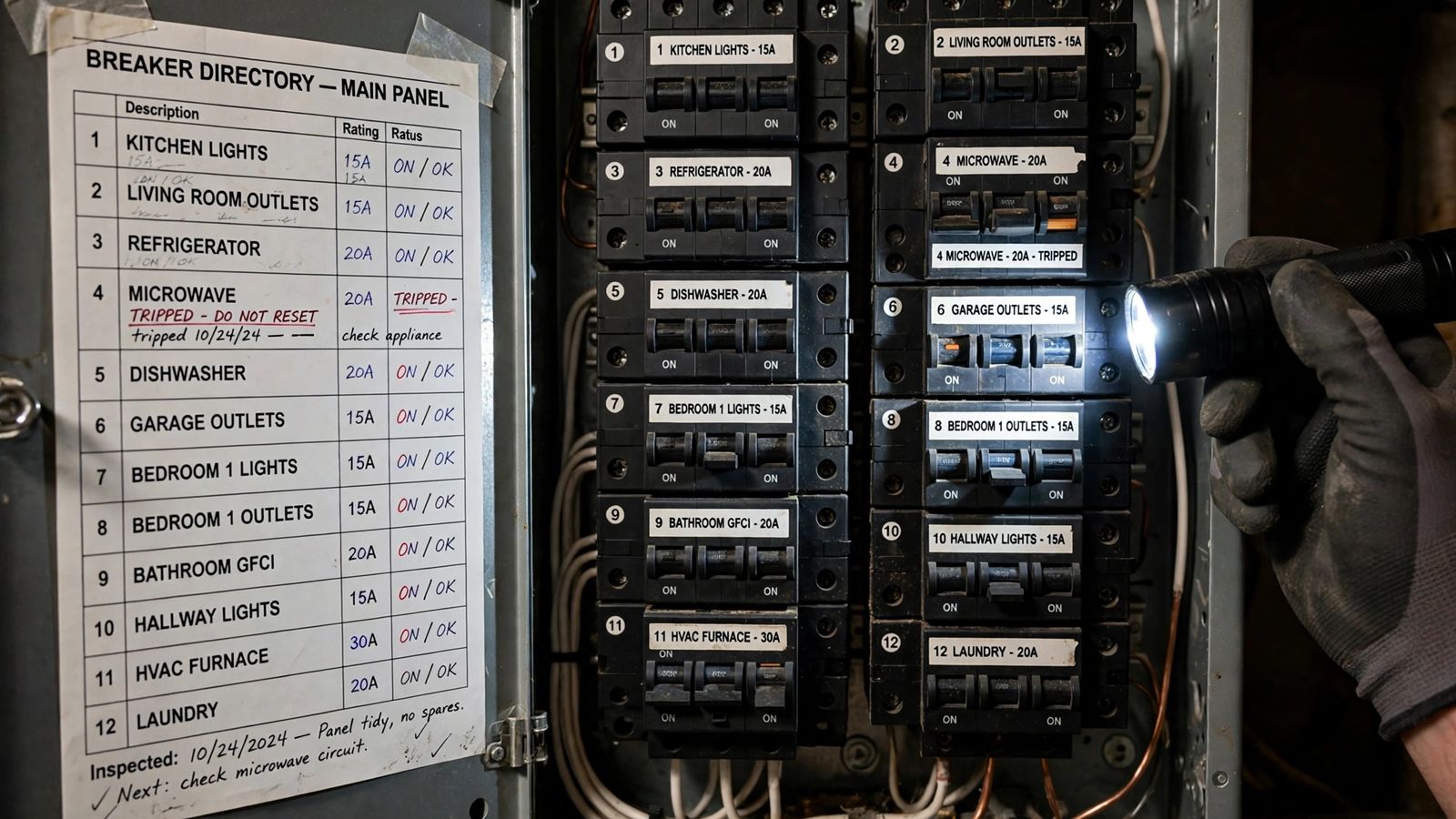
If your circuit breaker keeps tripping, it is cutting power because something on that circuit is drawing too much current or faulting — most often an overload, a short circuit, a ground fault, an arc fault, one failing appliance, or, last on the list, a failing breaker. The safe first move is not to keep resetting it: switch off and unplug everything on that circuit, reset the breaker once, and watch what happens. If it trips instantly, or again with nothing plugged in, leave it off — a breaker that trips instantly or repeatedly is a warning, not an annoyance, and the fault is an electrician’s job, not a reset’s.
Safety first — the four never rules. Never hold a breaker On or tape it there. Never replace a tripping breaker with a bigger one: it is sized to protect the wire behind it, and the U.S. Consumer Product Safety Commission (CPSC) lists overrated breakers among its home wiring hazards. Never open the panel cover — the CPSC reserves that, and repairing defects, for qualified professionals. And never keep resetting: unplug first, and if it will not hold, stop.
Why a Circuit Breaker Keeps Tripping: Read the Timing First
A breaker opens the circuit when current exceeds what the wiring can safely carry, or when built-in ground-fault or arc-fault protection sees a dangerous pattern. Schneider Electric’s guidance makes a split a homeowner can use: a breaker that trips on startup is tripping magnetically, pointing to a short circuit, while one that trips after running for a while is tripping thermally, pointing to an overload. Timing is the cheapest diagnostic you own.
| When it trips | Likely cause | Safe action |
|---|---|---|
| After minutes of several appliances running together | Overload | Unplug-all test below; spread the load across circuits |
| Instantly on reset, everything unplugged | Short or ground fault in the wiring | Leave it off; call a licensed electrician |
| The moment one appliance starts | That appliance or its cord | Unplug it; do not use it until serviced or replaced |
| Randomly, under light load | Failing breaker or loose connection | Stop resetting; an electrician tests the breaker |
| With buzzing, heat, a burning smell, sparks or scorch marks | Arcing or overheating | Leave it off; call an electrician — emergency services first if there is smoke |
The Safe Diagnostic Ladder
Everything below happens from outside the wiring: plugs, switches, the breaker handle, and your notes. Nothing involves removing an outlet cover or taking the panel cover off. Note the pattern as you go — which breaker, what was running, how long after reset it tripped, what changed just before — because that note is the first thing an electrician will ask for.
Step 1: Identify the circuit. Find the tripped breaker — its handle sits in a middle or Off position, unlike its neighbours. Work out what it feeds: which rooms went dark, which outlets and lights are dead. Panel labels are often wrong, so verify by what lost power. Hardwired items — lights, ceiling fans — stay connected even when every plug is pulled.
Step 2: Unplug everything, then reset once. Switch off and unplug every device on that circuit — power strips, chargers, anything hidden behind furniture — and switch the lights off. Then reset properly: push the handle firmly all the way to Off first, then to On. Eaton’s guidance states the same sequence — the handle must be physically moved to Off, then back to On — because pushing straight from the tripped middle position toward On does not reset the mechanism. Stand to the side of the panel.
Step 3: Read the empty-circuit result. If it trips instantly with everything unplugged and switched off, the fault is not an overload and not a plug-in appliance. It is in the fixed wiring, a hardwired load, an outlet or box, or the breaker itself — and your diagnosis is finished. Leave it off and call an electrician. If it holds empty, the cause is something you plug in — or too much of it at once.
Step 4: Add loads back one by one. Plug devices back in and switch them on one at a time, pausing between each. If it trips the moment one item is switched on, that item — or its cord — is the fault: unplug it and have it serviced or replace it. Do not re-test an appliance that sparked or smelled on a second circuit. If it only trips after several ordinary items run together, and holds with any removed, you have an overload: run fewer high-draw appliances on that circuit at once, permanently. The ladder gets one full pass — if the breaker still trips afterwards, more resets are not more diagnosis, just repeatedly energising a fault.
The Causes, One by One
Overload
The most common cause, and the only one that is truly yours to fix. Too many devices draw current on one circuit at once, the total passes what the circuit can carry, and the breaker trips — typically after minutes, as the load builds, not instantly. Standard U.S. branch circuits are rated 15 amps or 20 amps, and the classic overload is two heat-making appliances sharing one: a space heater and a hair dryer, a microwave and an air fryer. The Electrical Safety Foundation International (ESFI) lists frequently tripped breakers among the warning signs of an overloaded circuit, alongside flickering lights, warm wall plates, buzzing, and burning odours. The lasting fixes are spreading appliances across circuits, or a dedicated circuit from an electrician. Extension cords are not fixes: ESFI’s guidance is to plug major appliances directly into a wall receptacle. Overload can also ride along with lights that flicker when appliances start — the same strain, two ways.
Short circuit
A hot wire touches a neutral wire or another hot wire where it should not — inside a failed appliance, a damaged cord, or the fixed wiring itself, where insulation has failed or a nail or screw has pierced a cable. Resistance collapses, current surges far beyond the circuit’s rating, and the breaker trips instantly, sometimes with a pop, a spark, or a smell. That instant trip is the signature: a short does not wait for a load to build. If the unplug-all test still trips instantly, the short is in the wiring or a hardwired item, and locating it is professional work. Do not keep resetting onto a short: each reset drives the surge through the fault point again.
Ground fault
A hot wire contacts a grounded surface — a metal box, a pipe, an appliance casing, or a path through water — and current leaks out of its intended loop. Ground faults cluster where water and electricity meet: kitchens, bathrooms, garages and outdoor outlets, often after rain or a leak. Protection here is usually a GFCI — an outlet with Test and Reset buttons, or a breaker with a Test button. Eaton describes its Class A GFCI protection as tripping at 5 milliamps of ground-fault leakage — far below anything a standard breaker would notice, because the point is protecting people, not just wires. If a GFCI trips, unplug everything, let wet areas dry, and test again. One that persists on a dry, empty circuit is in the wiring — an electrician’s fault to find. Never bypass GFCI protection to stop the trips.
Arc fault (AFCI)
An arc fault is electricity jumping a gap — across a loose connection, a pinched cord, or cracked insulation — in small, repeated sparks that may draw too little current to trip a standard breaker but generate intense local heat. AFCI breakers, and dual-function breakers combining AFCI and GFCI protection, are built to recognise that pattern and cut power. Schneider Electric’s Time Saver Diagnostics for its Square D breakers separate the families exactly this way: a trip read as fault to ground, arc fault, or no fault — thermal overload and short circuit. An AFCI that trips when one motor appliance runs may be reporting a worn cord or failing appliance — the Step 4 test still applies. One that trips with the circuit empty is reporting the wiring itself. Either way, an arc-fault trip is information, not a nuisance to be engineered away by swapping in a standard breaker.
A faulty appliance
Sometimes the circuit and the breaker are both innocent, and one appliance has failed internally — a heating element shorting as it warms, a motor failing, a cord damaged where it bends at the plug. The signature is precise: the breaker trips when that appliance starts, every time, and the circuit behaves when it is unplugged. Heaters, hair dryers, kettles and dishwashers are the usual suspects. A microwave belongs on that list when it trips the breaker the moment cooking starts — though a microwave that runs without tripping and simply never heats is a different fault, covered in microwave not heating. A dishwasher that is not draining and a tripping breaker together point at the appliance, not the panel. The rule is absolute: unplug it and stop using it. Running it again to check is how a faulty appliance becomes a damaged circuit.
A failing breaker
Last on the list, deliberately — most tripping breakers are reporting, not malfunctioning. But breakers are mechanical devices, and they do wear: a failing breaker may trip below its rating, trip at random, feel loose, or refuse to reset firmly. Heat damage and a poor connection at the panel can produce the same symptoms, and from outside the panel you cannot tell a tired breaker from a hot connection. That is why replacement is not a DIY step: confirming failure, and swapping the breaker, means working inside the panel, which the CPSC reserves for qualified professionals. If the unplug-all test holds, no appliance reproduces the trip, and it still trips under light load, a failing breaker moves to the top of the list — and the next step is the phone call, not the screwdriver.
Know Which Breaker You Have
The breaker’s face tells you what protection it offers. A standard breaker has only a handle and an amp rating. A breaker with a Test button is a GFCI, an AFCI, or a dual-function breaker combining both, and makers publish what its indicators mean: Square D breakers show a Visi-Trip indicator when tripped, and Eaton’s AFCI breakers use LED blink patterns for an arc, a ground fault and a self-test failure. Press the Test button periodically, as makers instruct, to confirm the protection still works — and tell the electrician the breaker type and rating. When a circuit breaker keeps tripping, that information is genuinely useful, and it is free.
Red Flags: Stop and Call
Leave the breaker off and call a licensed electrician promptly if any of these apply:
- It trips instantly on reset, or again with everything unplugged and switched off
- It trips repeatedly — the same breaker, again and again, whatever you unplug
- Buzzing, crackling or sizzling from the panel, a switch or an outlet
- A burning or hot-plastic smell, scorch marks, or melted plastic anywhere on the circuit
- The breaker or panel feels warm, or the breaker will not reset firmly
- Sparks, smoke, or a tingle or shock from an appliance, switch or outlet
- Trips that started after water got in and will not clear once dry
While you wait, leave the circuit off and keep clear of anything hot or sparking. With smoke or flame, leave the building and call emergency services first. If lost hot water sent you to the panel, an electric heater’s own tripped breaker is the first check in the no hot water in the house sequence — with the same stop rules if it will not hold.
What the Electrician Will Do
Expect the pattern interview first — which breaker, what timing, what was running, what changed. From there, an electrician can test and swap a failed breaker, measure the circuit’s actual load, open outlets and fixtures to find the fault, trace it into a specific run of cable, and assess whether an overloaded circuit needs a dedicated circuit or panel work. ESFI groups repeatedly tripping breakers with sizzling sounds and flickering lights as signs for exactly this response, and recommends having the home’s electrical system inspected by qualified electricians when they appear.
Quick Answers
Why does my circuit breaker keep tripping with nothing plugged in? Because plugs are not the only loads. Lights, ceiling fans, smoke detectors, furnaces and dishwashers can be hardwired to the same circuit — and if the circuit is genuinely empty, the fault is in the fixed wiring or the breaker itself: a short, a ground fault, a loose connection, or a failing breaker. Leave it off and have it traced.
Is it dangerous if a circuit breaker keeps tripping? A single trip under an obvious overload is the protection working. Repeated trips are dangerous to ignore, because their causes — shorts, ground faults, arcing connections — are the ones that heat wiring, and repeatedly resetting forces current through the fault each time. Treat repeat trips as a warning, not a routine.
How many times can I reset a breaker? Once, properly — fully Off, then On — after unplugging what was running. If it trips again, that is your answer: stop. Forcing a breaker on removes the only protection the circuit has.
Can I just fit a bigger breaker? No. The breaker’s rating matches the wire it protects; a larger breaker lets the wire carry more than it can safely handle, so the wire becomes the fuse. The CPSC counts overrated breakers among its home wiring hazards for exactly that reason. If a circuit cannot carry your load, the fix is a dedicated circuit from an electrician.
The Bottom Line
A tripping breaker is a message with a timestamp. Delayed trips under combined load say overload — spread the load. Instant trips say fault — leave it off. Trips tied to one appliance say the appliance — unplug it for good. Work the ladder once, and let a licensed electrician take it from the moment the circuit fails empty — that handover, not another reset, is the fix.