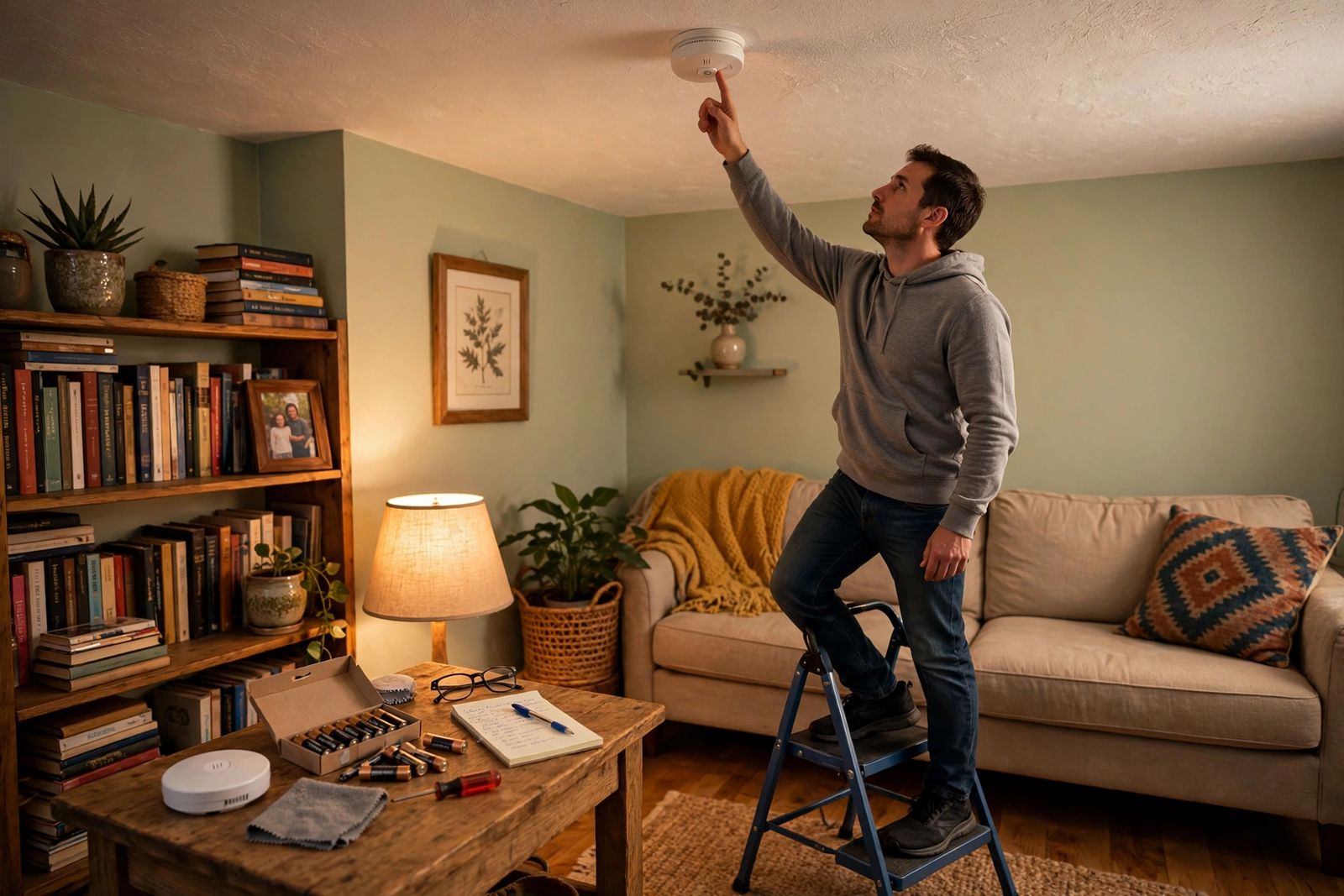
A smoke detector that keeps beeping is almost always asking for maintenance, not reporting a fire: a single short chirp repeating every 30 to 60 seconds is the low-battery warning on both Kidde and First Alert alarms, and the first fix is a fresh battery of the exact type printed on the alarm, seated firmly with the battery drawer clicked fully shut. If it still chirps with a new battery, the next suspects are a processor that needs a reset, dust in the sensing chamber, and — most often missed — an alarm that has reached the end of its life: smoke alarms are replaced 10 years from the manufacture date on the back, and no battery will revive an expired one. Two patterns are not maintenance at all, and they come first below, because they mean get out.
First: the patterns that mean danger, not maintenance
Do not troubleshoot these. Do not stand under the alarm counting beeps to be sure.
- Three loud beeps, a pause, then three again, repeating — the smoke pattern. On First Alert’s own guidance this means smoke has been detected; the Windsor Severance Fire Rescue quick guide puts it plainly: three loud beeps means smoke or fire — get out, call 9-1-1, and stay out.
- Four loud beeps, a pause, then four again, repeating — the carbon monoxide pattern on combination smoke/CO alarms, per First Alert. CO has no smell and no colour. Move everyone to fresh air immediately and call emergency services from outside.
- A loud, continuous alarm — Kidde describes this as the alarm’s response when it detects combustion products: it sounds until the air clears. Treat it as smoke until you have proof otherwise, and if you cannot find an obvious, harmless cause — burnt toast you can see and clear — get out and call from outside.
Only when the sound is a quiet, spaced-out chirp — and there is no smoke, no smell of burning, and nobody in the house has a headache, dizziness or nausea (possible CO symptoms) — is it safe to work through the diagnosis below. If you are ever unsure which kind of sound you are hearing, treat it as the dangerous kind.
The beep-pattern diagnosis table
Every interval and meaning in this table traces to a manufacturer or fire-service source opened for this article — Kidde’s and First Alert’s own support pages, and a fire district’s published sound guide. Brand-specific rows are labelled, because patterns are not fully standardised: your model’s manual outranks any general table, including this one.
| What you hear | Most likely cause | Exact fix |
|---|---|---|
| Single chirp every 30–60 seconds | Low battery (Kidde: the alarm “will chirp every 30 to 60 seconds for at least seven days”; First Alert gives the same 30–60 second interval) | Replace the battery with the exact type on the label; seat it firmly and close the drawer fully. Sealed 10-year model? The battery is not replaceable — replace the whole alarm. |
| Three loud beeps, pause, repeating | Smoke detected (First Alert; WSFR fire district guide) | Get out, call 9-1-1, stay out. Not a maintenance sound. |
| Four loud beeps, pause, repeating | Carbon monoxide detected, on combination smoke/CO alarms (First Alert; WSFR) | Get everyone to fresh air, call 9-1-1 from outside. Do not air out the house first and do not go back in to investigate. |
| Loud continuous alarm | Smoke/fire detection — sounds until the air clears (Kidde) | Check for fire once, quickly. Obvious cooking smoke and nobody at risk: hush it and ventilate. Anything unexplained: get out and call. |
| Five chirps every minute | End-of-life signal (First Alert) | Replace the entire alarm now. A new battery will not stop it. |
| Chirp continues after a battery change | Retained error in the processor, a badly seated battery or open drawer — or end of life (Kidde and First Alert both list all three) | Reseat the battery, click the drawer shut, then reset: battery out, hold the test button at least 15 seconds, refit. Still chirping? Check the date on the back — replace the alarm if it is 10 years old (smoke) or past its CO sensor life. |
| Random chirps with no regular pattern | Battery starting to lose charge; rarely, a loose white neutral wire on hardwired units (Kidde) | Replace the battery. Hardwired and still random? That is wiring — a job for an electrician, not a ladder. |
| Chirps at the same time every day, or when another appliance runs | Power surge or interruption on hardwired units (Kidde) | Note what switches on at that time; move that device to a different circuit, or have an electrician check the alarm’s circuit. |
Fix 1: the battery — done properly
Most chirping ends here, but “done properly” has four parts people skip. Use the exact battery type printed on the alarm — Kidde also advises a battery whose use-by date is no more than four to five years in the future, because a shelf-aged “new” battery can chirp again within weeks. Snap it in so it cannot be shaken loose, and reconnect it once or twice if the contacts look doubtful — a loose or poorly seated battery is, in Kidde’s words, a common cause of random beeping. On front-load models, close the battery compartment door completely; First Alert lists a drawer that is not fully closed as its own cause of chirping. Then test the alarm with its test button.
Hardwired alarms are not exempt: they run on house power but carry a backup battery, and that backup is what chirps. The U.S. Fire Administration schedule for hardwired alarms is to replace the backup battery at least once a year — the same interval as a 9-volt battery-only alarm — and to test every alarm monthly.
Fix 2: still chirping after a new battery? Reset it
Newer alarms remember errors. Kidde explains that the processor can retain an error condition such as a weak battery even after the battery is replaced, and First Alert gives the same remedy: discharge the residual charge. For a battery-only unit: remove the battery, press and hold the test button for at least 15 seconds (the unit may chirp or sound briefly, then go silent), then reinstall the battery — it should chirp once as it powers up and then stay quiet. For a hardwired AC unit, Kidde’s sequence adds two steps at the front: switch off the alarm’s circuit at the breaker panel first, and disconnect the alarm from its mounting bracket and power connector before removing the battery; reconnect power and battery at the end. If your circuit breaker keeps tripping when you restore that circuit, stop — that is no longer an alarm problem.
If a reset unit chirps again within a day, do not keep resetting it. Work down the remaining causes below, starting with the date.
Fix 3: check the date — the end-of-life rule most people miss
Turn the alarm over. The manufacture date is printed on the back, and the rule from the NFPA, the USFA and both manufacturers is the same: replace every smoke alarm 10 years from its manufacture date — not from when you moved in, and not from when it was installed. Sensors degrade with age, and an expired alarm can pass its own test-button check while its sensing chamber no longer responds reliably. First Alert’s end-of-life signal is five chirps every minute; Kidde puts its replacement ages at 10 years for smoke and heat alarms and 7 years for carbon monoxide and combination alarms, because CO sensors wear out sooner. Chirping that continues after a battery change is treated by both the NFPA’s public guidance and fire departments as the end-of-life sign: the unit gets replaced, not repaired. No date visible, or a date you cannot read? Replace it — an undatable alarm is an expired alarm for practical purposes.
While the alarm is down, write the replacement year on it. It turns the next decade’s decision into a glance.
Fix 4: dust, insects and a dirty sensing chamber
Dust in the sensing chamber causes both chirps and full nuisance alarms. Kidde’s cleaning method is compressed air blown through the openings it marks on its ionization and photoelectric models; First Alert’s is a gentle vacuum of the alarm’s vents. Either way: no water, no solvents, no opening the sealed sensing chamber. Clean the alarm whenever you change its battery, and more often in a dusty house or after renovation work — construction dust is a classic trigger for an alarm that starts misbehaving “for no reason” the week after a project.
Fix 5: steam, humidity and placement
Some alarms are not faulty at all — they are badly placed. Kidde lists humidity, steam and condensation as chirp and alarm triggers, and adds a placement detail most guides omit: a cooling or heating register, ceiling fan or open window within three feet of the alarm can drive enough airflow across the sensor to cause trouble, and the room itself should sit between 40°F and 95°F for a smoke alarm. The fire district guide puts a number on the bathroom problem: an alarm at least 36 inches from the bathroom door avoids most shower-steam nuisance alarms. Cooking does the same from the other side — an alarm close to the stove will react to ordinary frying. The USFA’s answer to a cooking-triggered alarm is specific: open a window or door, press the hush button, wave a towel at the alarm to clear the air — and never take the battery out. Moving the alarm several feet further from the kitchen or bathroom is the permanent fix; a dead alarm is not a fix at all.
Interconnected alarms: finding the one that is actually chirping
In an interconnected system, when one alarm sounds, they all sound — that is the point of the system, and it makes the chirping unit hard to find, because the noise seems to come from everywhere. Work room by room and stay in each room through a full chirp cycle; the initiating unit is the one whose light or voice message changes with the sound. Fix that unit — its battery, its date, its chamber — and the rest will quiet. Kidde notes one hardwired subtlety: a loose white neutral wire can pass an “echoing” chirp from one unit to the next, which is why a chirp that survives battery changes in several units points at wiring. Repeated unexplained triggering across a hardwired system, like lights that flicker on the same circuit, is a sign to have the circuit itself checked rather than replacing alarms one by one.
The hush button: what it does and does not do
The hush (silence) feature temporarily desensitises the alarm so a known, harmless cause — cooking smoke, shower steam — can clear without the noise. Kidde’s version of low-battery hush on newer units buys up to 12 hours of quiet from the test/hush button, which exists so a 3 a.m. chirp does not push you into removing the battery. That is all hush is: a pause. It does not charge the battery, clear an end-of-life signal, or fix a dirty chamber, and an alarm hushed for a nuisance trigger will sound again if the condition is still there when the hush period ends. Use the pause to fix the cause the same day.
Why it always starts at night
A borderline battery produces slightly less voltage as the room cools, and the house is coldest in the small hours — so a battery that held on all afternoon crosses the low-battery threshold at 3 a.m., and the chirp starts. The same physics explains the maddening version that chirps at night and stops by morning: the battery has not recovered, the room has warmed. Treat a night-only chirp as a low battery that has already told you everything it knows, and change it that day rather than waiting for the all-day version.
When to stop fixing and call for help
- Any 3-beep or 4-beep pattern, or a continuous alarm with no obvious harmless cause: leave and call 9-1-1 from outside. Fire departments would rather check a false alarm than attend a late one.
- You cannot reach the alarm safely, especially on a vaulted ceiling: many fire departments will help with battery changes and installation — the Windsor Severance district, for example, assists residents who cannot reach their alarms, and helps seniors over 65 with replacement. Call your department’s non-emergency number.
- Hardwired alarms with wiring symptoms — chirping tied to power events, a loose-wire echo between units, a breaker that trips, any heat or burning smell at the unit: a qualified electrician. The USFA is explicit that only qualified electricians should install hardwired alarms; diagnosis of their wiring is the same category of work.
- The alarm is expired, damaged, painted, or fails its test after a new battery and a clean: replace it, and replace interconnected units with listed compatible models — a plug that fits does not prove two alarms will communicate.
Keeping it quiet for good: the maintenance rhythm
The USFA’s schedule is short enough to memorise. Monthly: press the test button on every alarm. Yearly: replace 9-volt batteries and hardwired backup batteries at least once a year — many households tie it to a clock change so it cannot drift; clean the vents while the alarm is in your hand. Every 10 years: replace the whole smoke alarm from its manufacture date; sealed 10-year battery alarms are replaced whole, on the manufacturer’s instructions, with no battery changes in between. And one rule with no schedule at all: never remove a battery to silence an alarm and leave it out. A smoke alarm with a dead or missing battery, the USFA says, is the same as having no smoke alarm at all.
Frequently asked questions
Why does my smoke detector beep once every 30 seconds? That single, regularly spaced chirp is the low-battery warning — Kidde specifies every 30 to 60 seconds, sustained for at least seven days. Replace the battery with the exact type on the label. If the chirp survives a fresh, correctly seated battery and a reset, check the manufacture date: at 10 years the alarm itself is done.
My smoke alarm is hardwired. Why is it chirping — it has no battery to die? It does: hardwired alarms carry a backup battery for power cuts, and that battery chirps when it runs low, exactly like a battery-only alarm. Power surges and interruptions can also make a hardwired unit chirp as power is restored (Kidde), and a loose neutral wire can echo a chirp between interconnected units.
Can I just take the battery out to stop the noise tonight? You can, and people do — and it leaves the room unprotected, which is why the USFA calls disabling an alarm a potentially deadly mistake. Use the hush button instead (up to 12 hours of low-battery hush on newer Kidde units), then change the battery in the morning. A sealed-battery alarm that chirps has no battery to remove at all: it needs replacing.
How do I know if it is the smoke alarm or the CO alarm making the noise? By the pattern and the label. Four loud beeps repeating is the CO pattern on combination units (First Alert); three is smoke. A plain chirp is maintenance on either. If a combination alarm gives the four-beep pattern, do not stay to work out which sensor fired — get to fresh air and call from outside. For a standalone CO alarm, every pattern — including the brand differences in the end-of-life and malfunction chirps — is decoded in carbon monoxide detector beeping.
The beeping is coming from somewhere, but every alarm looks fine. What else chirps like this? Other household devices use near-identical low-battery chirps — a separate CO alarm, a security keypad, a UPS or internet backup battery, even an old alarm forgotten in a drawer. Stand still through a full cycle, then move room by room; sound bounces off ceilings and hard floors and reliably points you one room away from the real source.
This article is general information based on the manufacturer and fire-safety pages linked above — Kidde, First Alert, the NFPA, the U.S. Fire Administration and a fire district’s published guide — checked in November 2026. Beep patterns vary by model; where your alarm’s manual gives a different meaning for a pattern, the manual is right. If an alarm pattern could mean smoke or carbon monoxide, treat it as the emergency until professionals say otherwise.