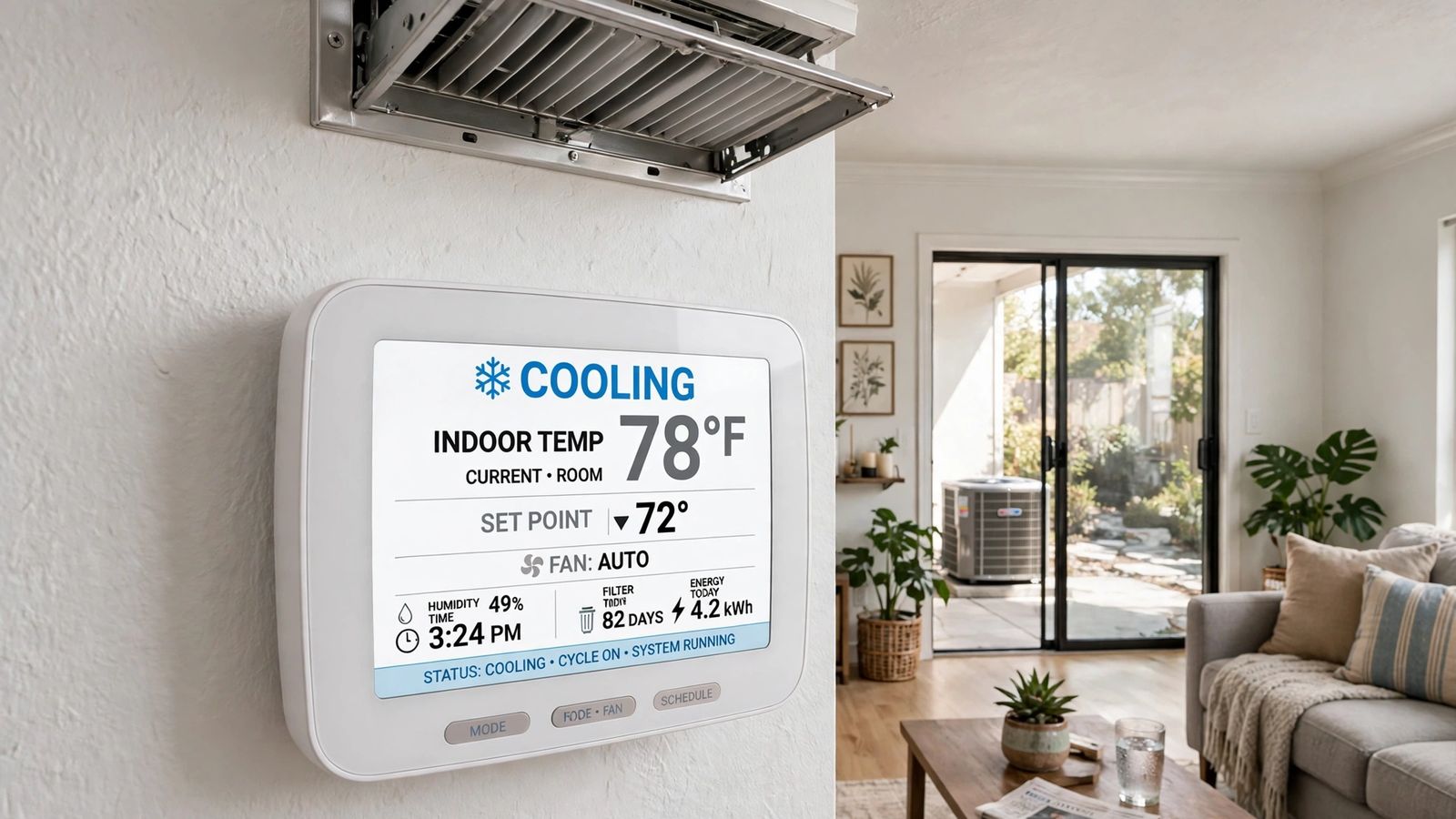
AC short cycling means your air conditioner starts, runs for only a few minutes, shuts off, and starts again soon after, over and over, instead of completing one full cooling cycle. The causes worth checking first are also the cheapest: a dirty air filter, a thermostat that is badly placed, misreading the room or running on weak batteries, blocked supply vents or return grilles, a frozen evaporator coil, and a clogged condensate drain tripping its safety switch. Only after those come the faults that need a professional: low refrigerant from a leak, an oversized system, and failing electrical or control parts. Work in that order and you will either fix it for the price of a filter or know what to tell a technician.
Safety first. Refrigerant work is licensed work. Under the U.S. Environmental Protection Agency’s Section 608 rules, certification is required for anyone whose work could open the refrigerant circuit, and refrigerant can only be sold to certified technicians or their employers. There is no legal DIY version, so this article gives no DIY refrigerant instructions. Capacitors and control boards are technician work too: they can shock even with the power off.
Time one cycle before you change anything
You cannot diagnose a rhythm problem without measuring it. Note when the outdoor unit starts, stops, and starts again, over several cycles. Carrier puts a healthy cooling run at a consistent 15 to 20 minutes — long enough to cool the house and pull moisture from the air — and treats a system that repeatedly stops after a few minutes, or cycles about every 10 minutes, as short cycling. Treat those figures as typical guidance, not a specification for your model: weather, humidity and sizing all move them.
One normal pattern is easy to mistake for a fault. On a mild day a correctly sized system may run briefly and then stay off for a long stretch, and on the hottest days it may run almost continuously; short runs followed by long rests are not the problem, but short runs followed by short rests, repeated for hours, are.
One setting can fake the symptom: with the thermostat fan on ON instead of AUTO, the blower runs continuously even when the compressor is off. Judge by the outdoor unit.
Why AC short cycling should not be left alone
Starting is the hardest moment in a compressor’s life: the motor draws its heaviest current and the parts take their greatest stress in the first seconds of every run. Carrier identifies three costs: starting uses significantly more energy than steady running, so frequent starts waste electricity; a system that never completes a cycle cannot remove humidity properly, leaving the house warm and sticky whatever the thermostat says; and the constant starting and stopping strains the compressor and fan motors, turning a minor fault into a premature breakdown. The U.S. Department of Energy’s sizing research agrees — oversized equipment shows reduced efficiency, increased wear and higher indoor humidity. Fix the cause while it is still cheap.
Cause 1: A dirty air filter
Start where Carrier starts: a clogged filter is a leading cause, because it restricts the airflow the system needs, and the system responds by overheating and shutting down as a safety precaution. Turn the system off, slide the filter out — it sits in the return grille or a slot at the air handler — and hold it up to a light. If you cannot see light through it, or the surface is grey and matted, it is done.
- Replace, do not wash or bang clean a disposable filter. Fit the same size, airflow arrow toward the air handler.
- Use the rating your system specifies. A filter far denser than the blower was designed for can restrict air almost as well as a dirty one; the manual or the old filter’s frame gives the size and type.
- Then time the cycles again. If the runs lengthen within the hour, the filter was the fault.
ENERGY STAR’s maintenance checklist tells owners to inspect, clean or change the filter monthly; Carrier and Trane both put replacement at every one to three months. The filter lesson generalises to every heat-pump appliance in the house — a clogged filter is likewise the most common way a heat pump water heater silently loses its efficiency edge.
Cause 2: The thermostat is reading the wrong room
The system obeys the thermostat, so one reading its own patch of wall instead of the house will switch a healthy system off early and call it back soon after. Trane’s guidance is that it belongs in a central location, away from supply registers and heat-generating appliances and out of direct sunlight, and that moving a badly placed one sometimes resolves the problem outright. The Department of Energy’s thermostat guidance adds an interior wall, away from drafts, doorways, skylights and windows.
- Sun and heat. Afternoon sun on the thermostat, or a lamp, television or oven nearby, warms the sensor faster than the house cools, so it satisfies early. A supply register blowing across it does the reverse.
- Batteries. If your thermostat uses them, replace them. A weak battery supply is a mundane cause of erratic switching, and a two-minute test.
Relocating one can mean new wiring — a technician’s job — but a remote room sensor, where your model supports one, gives the same honest reading. If the display itself is blank, erratic or not responding at all, work through thermostat not working first, because a thermostat that has lost power can imitate short cycling while the air conditioner itself is healthy.
Cause 3: Blocked vents and returns
Air that cannot get back to the system cannot be cooled by it. Walk the house: supply registers get closed in unused rooms, covered by rugs or blocked by furniture; return grilles, fewer and larger, get hidden behind sofas and bookcases. Enough of either starves the evaporator coil of warm air, pushing the system into the same protective shutdowns as a clogged filter and, by letting the coil run colder, setting up the next cause, a frozen coil. ENERGY STAR, in the checklist linked above, notes airflow problems can cut efficiency by up to 15 percent. Open every supply register fully, clear the returns, and time the cycles again.
Cause 4: A frozen evaporator coil
If airflow checks do not cure the pattern, look for ice. When the evaporator coil, inside the indoor unit, ices over, the ice blocks airflow, cooling collapses, and the system shuts down, thaws a little, restarts and freezes again. Signs are weak or warming vent air, frost on the coil housing or the insulated copper line outside, and sometimes water at the indoor unit as meltwater overwhelms the drain.
Ice has two usual parents, both already on this page: restricted airflow and low refrigerant. Thawing a coil without fixing what froze it buys a day at most.
- Turn cooling off, leave the fan running, and wait for a complete thaw — hours, not minutes. Fan-only operation melts the ice safely. Do not chip or pry it off: a punctured coil turns an airflow problem into a sealed-system repair, the same rule that applies to a refrigerator that has stopped cooling.
- Restart and observe. If the system now completes full cycles, airflow was the cause. If ice returns within a day or two, the cause sits in the refrigerant circuit, where homeowner work ends.
Cause 5: A clogged condensate drain and its float switch
An air conditioner wrings a steady stream of water out of indoor air, leaving through a drain line from a pan under the indoor coil. Algae and debris build up until the line blocks; ENERGY STAR’s checklist includes inspecting that drain because a plugged drain can cause water damage and affect humidity.
Many systems add a safety device that turns this plumbing problem into an electrical symptom: a float, or overflow, switch in the pan. When the pan fills, the rising float cuts power before water spills into a ceiling or floor. A little water seeps away, the float drops, the system restarts — and the pan fills again.
Signs: water standing in the pan, dampness or a musty smell at the indoor unit, and shutdowns at irregular intervals rather than a steady rhythm. If your manual shows an accessible clean-out, clearing the line is a homeowner job on many systems, usually with a wet-or-dry vacuum at the line’s outside end. If there is no access point, or the switch is damaged, have a technician clear it and test the switch. Never bypass or tape down a float switch: the water it holds back goes into the house instead. A drain that clogs repeatedly has a source worth finding, like a dishwasher that will not drain. The same float switch is also on the before-you-call checklist in AC not cooling, where a full pan stops cooling outright rather than cycling it.
Cause 6: Low refrigerant — which means a leak
Refrigerant is not a fuel, and a sealed air conditioner does not use it up, so a system low on charge has a leak. Carrier states this plainly: low refrigerant is not a normal condition, it stops the system absorbing heat properly, it can drive the compressor into malfunction and cycling, and it requires professional diagnosis. Low pressure can also trip a protective switch and stop the compressor; pressure recovers while it rests, the switch resets, and the system restarts into the same fault — a neat explanation for a perfectly regular short cycle.
The signs overlap with a frozen coil: ice on the lines or coil, vent air cool rather than cold, and a decline spread over a season rather than a failure on one day. None of it can be confirmed from outside the sealed circuit.
So this section has no steps, deliberately. Finding and repairing the leak, evacuating the circuit and recharging by weight is exactly the work the Section 608 certification in the safety note exists for. A top-up offered without a leak search is not a repair — the new charge leaves through the same hole. Ask any technician quoting for it what leak test they will run.
Cause 7: The system is oversized for the house
If the equipment is healthy, the charge correct and the pattern has existed since installation, suspect the sizing. An oversized air conditioner drives the temperature at the thermostat to the setpoint in a few powerful minutes and shuts off, before running long enough to condense much moisture from the air. The house warms slightly, the thermostat calls again, and the day becomes a series of short, damp cycles. Trane, linked above, describes the usual history: no proper sizing calculation — square footage alone, or a same-size swap.
The signature is comfort, not noise: rooms cold and clammy at the same time, temperatures swinging between cycles, and the shortest runs on mild days, when the load is smallest.
There is no cheap correction. The permanent fix is a correctly sized system at replacement time, chosen from a load calculation rather than a like-for-like swap. Until then, a contractor may soften the pattern through thermostat cycle settings, and a separate dehumidifier can carry the moisture the short runs leave behind — mitigations, not cures. Get the load calculation before replacing anything: it also proves the case.
Cause 8: Electrical and control faults
A failing run capacitor, a pitted contactor, a weak relay or a control board that drops its signal can cut the compressor out at irregular intervals, or let it try to start, fail, and try again. Carrier, linked above, lists damaged controls such as faulty capacitors and relays among the causes, and warns that these parts are a shock hazard, so diagnosis belongs to a qualified professional.
The homeowner’s share is observation. Note whether the outdoor fan keeps running while the compressor stops, any click, buzz or hum at the moment of failure, and whether the breaker has tripped. A breaker that trips once and holds after one reset may simply have done its job; one that trips repeatedly is reporting a fault — leave it off and call for service. If the cycling arrives with dimming or flickering lights, read why lights flicker too: together, the two can point at a supply or connection problem rather than at the air conditioner.
When to stop checking and call a technician
Book service if any of these is true:
- The pattern survives a new filter, open vents and returns, a thawed coil and a checked thermostat.
- Ice returns within a day or two of a full thaw, or appears with weak, barely cool air.
- There is water in or under the drain pan that you cannot clear.
- The breaker trips more than once, the outdoor unit buzzes or clicks, or the compressor tries and fails to start.
- The pattern has existed since installation and comfort is poor: ask for a load calculation, not a repair.
Leave the system on while you wait, unless there is a tripping breaker, a burning smell or active water overflow — a technician diagnoses a live symptom faster than a silent one.
Frequently asked questions
Is it normal for my AC to be short cycling every 10 minutes? No. Carrier’s answer is that a healthy system runs for longer periods, and a unit cycling that frequently may be oversized or have a mechanical issue needing inspection.
Can it damage the compressor? Yes, over time. Starting is the highest-stress moment of each cycle, and multiplying starts multiplies wear on the compressor and fan motors — the point behind Carrier’s warning about premature breakdowns.
Why does my AC wait several minutes before restarting? Usually a built-in anti-short-cycle delay. Restarting a compressor against refrigerant pressure that has not yet equalised can stall or damage it, so the equipment enforces a pause of a few minutes. It is protection, not a fault; worry when the runs themselves last only a few minutes.
Does refrigerant slowly get used up? No. It circulates in a sealed loop and is not consumed. A low charge always means a leak, and the repair is to find and seal it before recharging — work for a Section 608 certified technician.
My system has done this since it was new. Is something broken? Possibly nothing. A pattern present since installation, in a house that cools fast but feels clammy, is the classic signature of oversizing. The next step is a load calculation.
This article is general information based on the manufacturer and government guidance linked above, checked in November 2026. Cycle lengths and part locations vary by model — follow your manual, and leave refrigerant and electrical work to a qualified, certified technician.