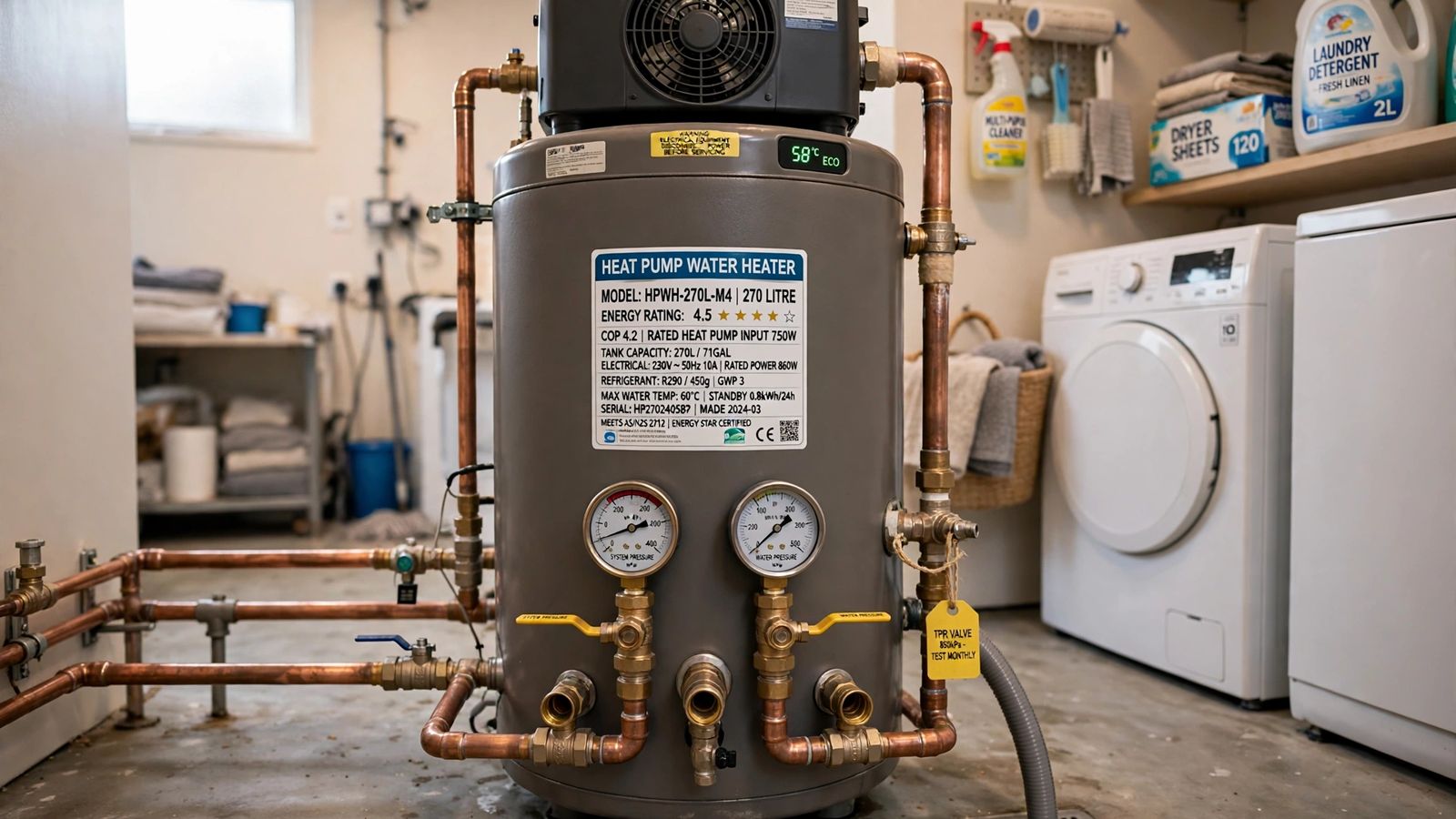
A heat pump water heater is an electric water heater that moves heat instead of making it: a small heat pump on top of the tank pulls warmth out of the surrounding air and transfers it into the water, instead of heating water directly with an element or a flame. Because moving heat takes far less energy than creating it, the U.S. Department of Energy (DOE) says these units can be two to three times more energy efficient than a conventional electric resistance water heater — the same job on roughly a third to a half of the electricity. Most home models are “hybrid” units: the heat pump does the everyday work, and electric elements step in when demand is high or the room is too cold.
How a heat pump water heater works
The DOE’s summary is that the unit works like a refrigerator in reverse: a refrigerator pulls heat out of its cabinet and dumps it into the kitchen, while this appliance pulls heat out of the room air and dumps it — concentrated — into a tank of water. It is the same compressor technology as in a refrigerator that is not cooling, run the other way:
- Collect. A fan draws room air across an evaporator coil; refrigerant inside absorbs heat from the air — even cool-feeling air holds heat it can take — and warms into a gas. The air leaves cooler and drier.
- Concentrate. A compressor squeezes the gas, raising its pressure and temperature well above the water temperature.
- Deliver. The hot refrigerant passes through a condenser coil around or inside the tank, and its heat flows into the water.
- Reset. Cooled, the refrigerant passes through an expansion valve, drops in pressure and temperature, and returns to collect heat again.
Two consequences matter most. The unit cools and dehumidifies its space as it heats water. And it heats slowly, which is why it has a tank: it works steadily into stored water so cheap heating is ready at the tap.
That is also what “hybrid” means. In heat-pump-only mode the elements stay off and costs are lowest. In hybrid mode they join in when showers empty the tank faster than the heat pump can refill it, or when the air is too cold. In electric-only mode the unit is simply a conventional electric tank — the most expensive way to run it. How often a household pushes it onto its elements is the biggest reason real bills differ from the label.
Efficiency: what UEF actually tells you
Water heaters are compared by Uniform Energy Factor (UEF), the DOE rating for hot-water energy delivered per unit of energy consumed over a standard day. A resistance element can never exceed about 1.0 — it cannot deliver more heat than the electricity it used. A heat pump is not bound by that ceiling, because most of its heat came from the room air.
| Type | Typical UEF |
|---|---|
| Standard gas tank | about 0.60–0.70 |
| Standard electric tank | about 0.90–0.95 |
| Gas tankless | about 0.82–0.97 |
| Electric tankless | about 0.91–0.99 |
| Heat pump (hybrid) | about 3.0–4.0+ |
ENERGY STAR’s certification bar for an integrated heat pump water heater is a UEF of 3.30 or higher, with a first-hour rating of at least 45 gallons — over three times the federal minimum for a comparable electric tank. Treat UEF as a comparison tool, not a bill promise: it is measured at a fixed laboratory temperature, and a unit in a cold January garage will fall short of it.
ENERGY STAR’s published saving is an estimate with its assumptions attached: a certified model can save a household of four approximately $550 per year against a standard electric water heater, and more than $5,610 over its lifetime — assuming electricity at 14.6 cents per kWh, an incremental cost of $1,503, and a 13-year lifespan (ENERGY STAR savings table, read November 2026). Your arithmetic moves with your electricity price and hot-water use.
Versus a standard tank, and versus tankless
Against a standard electric tank, the trade is clear: the heat pump unit costs more, is taller, makes fan and compressor noise, and needs air and a drain — then uses about a third of the electricity for the same showers and laundry. If your current heater is an electric tank with room around it, this is the comparison it wins most clearly.
Against a standard gas tank, the running-cost gap is narrower and can reverse where gas is cheap and electricity dear. The heat pump still wins on efficiency — a gas tank sends a third or more of its fuel’s heat up the flue — but efficiency is not price per unit of heat, and leaving gas means electrical work too.
Against tankless, the difference is storage versus flow. Tankless has no standby loss, fits in a fraction of the space and can last 20 years or more — but it still makes heat, so its UEF stays under 1.0, and an electric tankless unit needs a very heavy supply to heat water in the seconds it passes through. The heat pump needs its tank, air space and height and recovers more slowly — but heats water for a fraction of the electricity. Endless simultaneous showers favour tankless; lowest running cost favours the heat pump.
What a heat pump water heater costs
No primary source publishes a national installed price, so these are labelled estimates from current guides, checked in November 2026 — get local quotes before budgeting.
- Unit price (estimate): roughly $1,400–$2,500 for common 50–80 gallon models, from about $1,200 for budget hybrids to over $2,800 premium (ABS Pipes cost guide, updated October 2026).
- Installed total (estimate): roughly $2,500–$4,500, with a typical professionally installed 50-gallon job around $3,300 in the same guide. A New England installer guide quotes $5,000–$10,000 before rebates in its high-cost region — why the range matters less than your own quotes.
- What pushes the price up: a new 240-volt circuit, a condensate pump where no drain is near, ducting for a small room, and panel work.
At the modelled savings above, the premium over a standard electric tank typically pays back in roughly two to four years. Against a gas tank, payback is slower, rate-dependent, and may not arrive where gas is very cheap.
Sizes, and why first-hour rating matters more
Common sizes are 40, 50, 65 and 80 gallons. Because a heat pump reheats more slowly than a gas burner, sizing is not like-for-like: a 50-gallon heat pump unit can leave a busy household short at peak times where a hard-worked 50-gallon tank coped. Size by first-hour rating, not by tank gallons alone, and consider going one size up.
First-hour rating — the figure on the yellow EnergyGuide label — is how many gallons the unit can deliver in one hour from a full, hot tank: storage and recovery combined, exactly the trade a heat pump makes. As a starting point, 50 gallons suits most one- to three-person households; households of four or more, or homes with a soaking tub or back-to-back showers, are usually pointed at 65–80 gallons. If you already run out of hot water, work through no hot water in the house before assuming a bigger tank is the answer — capacity faults and heater faults feel similar.
Where it can go: space, air and cold rooms
- Air volume. DOE guidance is at least 1,000 cubic feet of air space — roughly a 12 × 12 × 7 foot room. Some makers allow about 450–700 cubic feet, and a smaller room can work with a louvred door or ducting. A tight, sealed closet will chill its own air, force the elements on, and erase the saving.
- Temperature. The same guidance puts the working range at 40°F to 90°F (about 4°C to 32°C) year-round. Below the range the heat pump fades and the elements carry the load.
- Cold basements and garages. A basement that stays above 40°F all winter — common where it shares heat with the house — is usually a good home for one, and the dehumidification is a real bonus in a damp basement. An unheated garage below freezing for weeks is the weak case: the unit still makes hot water, but much of it is made by the elements at standard-electric cost. It does not fail in the cold; it stops being the efficient appliance you paid for until the space warms.
- Cooling effect and condensate. Expect the room to run a few degrees cooler while the unit works — free comfort in a hot garage, a small extra heating load in a finished winter basement. Dehumidifying produces water, so the unit needs a floor drain within reach or a condensate pump. No drain plan, no installation.
- Noise and height. Typical models run around 45–55 decibels — near a quiet dishwasher — and the heat pump on top makes them taller than the tank they replace. Measure headroom, and keep the unit away from bedroom walls where you can.
120-volt plug-in vs 240-volt models
Most models run on a dedicated 240-volt circuit, typically 30 amps — the supply a standard electric tank already uses, which is why swapping an electric tank is the simplest job. The newer 120-volt plug-in models were built mainly for homes replacing a gas heater, where no 240-volt circuit exists at the tank: they run from a standard outlet (some need a dedicated 15-amp circuit, some can share), removing the electrician and the panel question entirely.
The trade is recovery. A 240-volt hybrid can call on full-power elements to reheat quickly; a 120-volt unit leans almost entirely on its slower heat pump, so it suits smaller households and steadier demand, usually with a larger tank to compensate — installers commonly size a plug-in about two steps up from the gas tank it replaces, for example a 40-gallon gas tank giving way to a 65-gallon plug-in. Neither voltage moves heat more efficiently; they differ in recovery speed and electrical work. If you already have the 240-volt circuit, that model is normally the stronger choice; if adding it blocks the project, the plug-in is a real option, not an apology.
The tax credit has ended — what help actually remains
Much of what still ranks for this topic is out of date on exactly this point. The federal Energy Efficient Home Improvement Credit (Section 25C) — 30% of project cost, up to $2,000 — does not apply to any unit placed in service after 31 December 2025. The IRS states that the credit “will not be allowed for any property placed in service after December 31, 2025,” following its termination under Public Law 119-21. There was no phase-down. Two things remain true:
- Installed on or before 31 December 2025? The credit is still claimable on your 2025 federal return, using IRS Form 5695, at 30% of cost up to the $2,000 category limit. Keep the manufacturer’s certification and the product identification details the 2025 return requires.
- Installing now? The help is rebates, not tax credits. The federal Home Energy Rebates programmes — state-administered, income-qualified, rolled out state by state — include up to $1,750 for an ENERGY STAR certified heat pump water heater for eligible households, and many states and utilities add their own rebates, commonly a few hundred dollars. Some programmes require approval before you buy, so check your state energy office and utility first — and treat any 2026 quote that includes a “$2,000 federal credit” as a reason to ask questions.
Lifespan and looking after it
Expect 10 to 15 years — about the same as a standard electric tank, because the tank, not the heat pump, usually ends the unit’s life; warranties of around 10 years are common. Maintenance is short:
- Clean the air filter every few months. A clogged filter starves the heat pump of air and pushes it onto its elements — the most common way owners lose the saving with nothing broken. It is the same first check as on the cooling side of the house, where a clogged filter is cause one in why is my AC short cycling.
- Flush the tank about once a year to clear sediment, as with any tank heater, especially in hard-water areas.
- Check the anode rod every three to five years and replace it when used up; it keeps the tank from corroding.
- Keep the condensate line clear, and do not let clutter turn the unit’s air space into a cupboard.
Skip one, however efficient the label, if the only spot is a small sealed closet with no scope for louvres or ducting; if the space spends winter well below 40°F; if demand is sharply peaked and a larger tank cannot fit; or if you are on very cheap gas, use little hot water, and switching needs extensive electrical work — in that house the premium may never pay back.
Frequently asked questions
Is a hybrid water heater the same as a heat pump water heater? Yes — the same appliance: a heat pump on a tank, with resistance elements as backup. “Hybrid” names the two heating methods, not a lesser heat pump.
What is a heat pump water heater’s biggest running-cost trap? Living on its backup elements. An undersized tank, a cold room or a clogged filter all push it into electric mode, where it costs what a standard electric tank costs.
Do heat pump water heaters work in cold climates? Yes, provided the room stays in range — why a basement usually works in a cold climate while an unheated garage may not. Below about 40°F it leans on its elements and the saving shrinks until the space warms.
Is the federal tax credit still available? No — not for installations placed in service after 31 December 2025. It can still be claimed for a qualifying 2025 installation on a 2025 return; for anything installed now, look to state rebates and utility programmes instead.
This article is general information based on the DOE, ENERGY STAR and IRS sources linked above and checked in November 2026. Prices are labelled estimates from the guides cited in the cost section, not quotes; savings are modelled estimates under the assumptions stated. Requirements vary by model — follow your model’s manual, and have electrical and plumbing work done by qualified installers. Confirm tax and rebate positions with the IRS, your state energy office and your utility before buying.