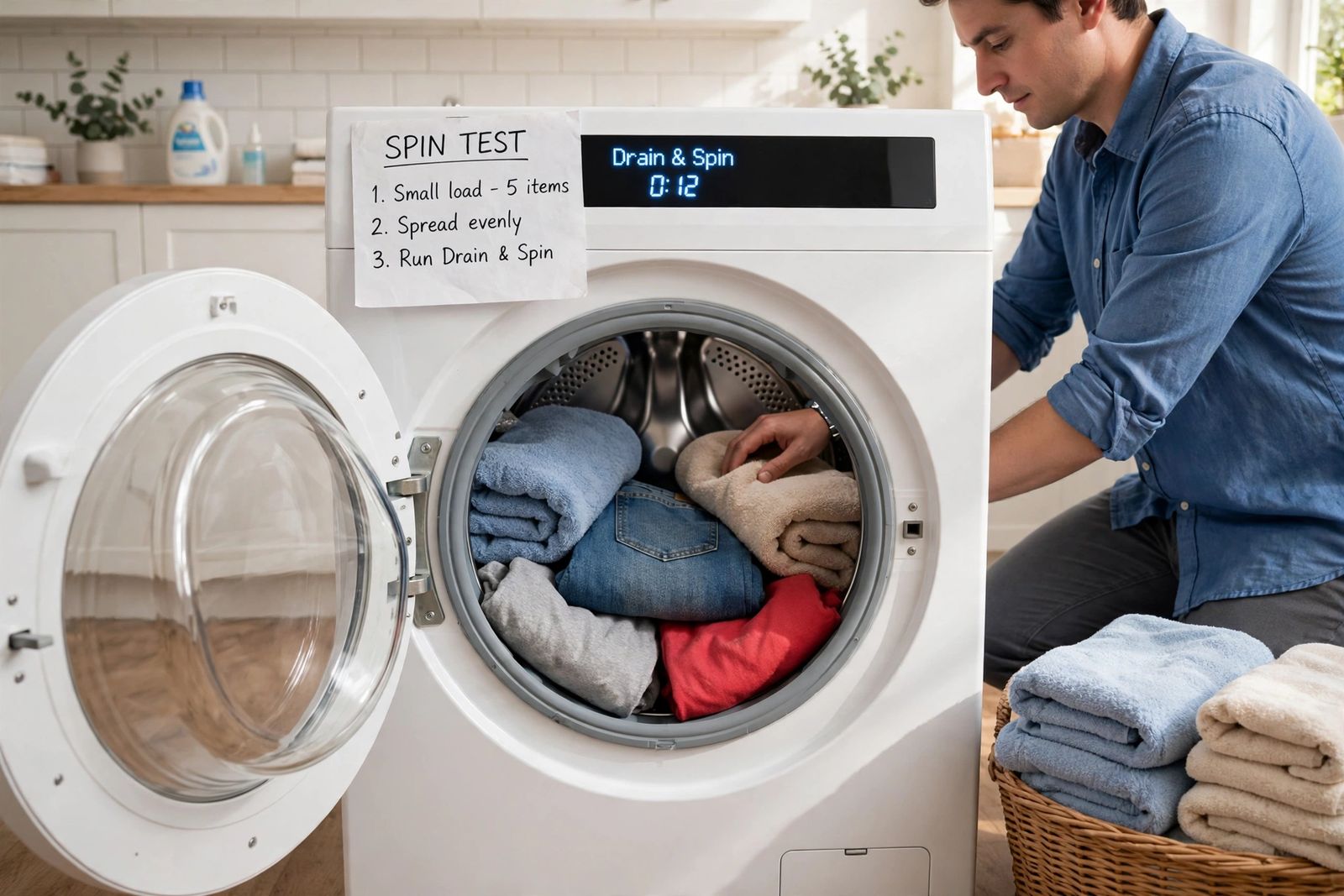
A washing machine that will not spin is most often refusing, not broken — and one test proves which before you touch a part: the small-load test. Take everything out, put back five ordinary items spread evenly around the drum — two towels, two T-shirts and a pair of jeans is the test load used throughout this article — and run Drain & Spin. An unbalanced load is the most common cause of a failed spin by a wide margin, and a machine that spins that small, balanced load has just told you the motor, belt and locks are all working and the fault was the load itself: too much, too little, or everything bunched to one side. A machine that will not spin even that load has a real fault, and from there the diagnosis splits by machine type, because the two types fail in different orders. Top-load, work in this order: lid switch → drive belt → motor coupling. Front-load, work in this order: drain pump and filter blockage → door lock → motor. Two boundaries before the test: if the tub is still holding water, the machine is locked out of the spin by the drain, and the fault is worked as a drain fault first in washer not draining; and if there is water on the floor, that is a leak, not a spin fault — stop and work it from washing machine leaking instead. A machine that will not start at all — dead, or lit but refusing to begin — has not reached the spin stage either: washing machine not starting works that split first, and its lid and door lock checks are the same interlocks named in the table below.
First, clear the two false alarms, because the makers list them ahead of every part. Cycle settings: a Delicate, Hand Wash or Wool cycle runs a slow spin by design, and a No Spin, Rinse Hold or soak setting skips it altogether — Whirlpool’s spin guide puts misset cycle settings first on its list of eight reasons, ahead of the load itself. Suds: too much detergent, or non-HE detergent in an HE machine, fills the drum with foam the machine cannot balance or drain against; it pauses, retries, and gives up in a way that looks mechanical. Samsung’s code for it is SUD, and its remedy is the same as Whirlpool’s: run an empty rinse with no detergent until no suds show, then dose to the label. Note any other code on the display before you reset anything — on the spin family the code often names the chain link for you (the code table is below).
Step 0: The small-load test — the test that comes before every part
The test exists because a modern washer checks the load before it spins, and refuses when the check fails. The drum ramps up slowly, the machine feels the weight distribution, and if the load is packed to one side it stops, tries to redistribute — some machines add water and tumble the load loose, which is why a struggling spin cycle can fall back into rinsing — and tries again. LG allows that unwinding process up to two cycles and about 10 extra minutes before it concedes; if the load still will not balance, the spin is abandoned and the clothes come out soaking. That refusal is the machine protecting its suspension and your floor, not failing. It is also why a single heavy item — a bath mat, a duvet, one soaked blanket — is the classic failed spin: one item cannot be spread, so there is nothing for the machine to balance.
Run the test exactly like this:
- Stop the cycle and take everything out. Check the drum and, on a top-loader, the gap between the wash plate and the tub — LG’s top-load guidance starts its motor-locked codes with a coin or foreign object trapped there, removed with tweezers.
- Check the obvious setting once: a normal cycle, a spin speed actually selected, no Rinse Hold or No Spin option lit.
- Load the test load: five items — two towels, two T-shirts, one pair of jeans — spread evenly around the drum, no item balled inside another, nothing nested. Five mixed items can be distributed; one item, or two, often cannot.
- Run Drain & Spin (Spin Only on LG top-loaders) and stay for the first two minutes. Watch for the ramp: the drum should climb through its slow balance turns into a steady high spin.
Read the result — it routes everything after it:
- It spins to full speed and finishes. Every part in the chain works. The fault was the original load: too big, too small, or bunched. Nothing is ordered and nothing is opened. The prevention section below is your fix.
- It will not spin the test load, but spins with the tub completely empty. The drive works and the balance system is at its limit: level is the next check (rock the machine corner to corner; any rock is a foot off the floor), then load size discipline. A machine that repeatedly fails small, even loads it once handled is showing worn suspension — that is the service line for this result.
- It will not spin at all — not the test load, not empty. The load is cleared and a part is at fault. Go to your column of the table below and work it in order. Samsung builds this exact empty test into its machines as Calibration Mode — hold Temp. and Delay End together for 3 seconds until Cb appears — and its verdict is the same: if the tub did not spin in Calibration Mode, the fault is a part, and Samsung sends it to service.
One warning about the empty test on its own, because LG states it plainly: a load can be too light to balance, not just too heavy — LG’s front-load UE guidance names a load that is “bulky or too light” as unbalanced either way, and sets the machine’s best working load at about 2/3 of the drum’s capacity. That is why the routing test is a small load and not only an empty tub: empty proves the drive turns, the five-item load proves the balance system can do its ordinary job.
The ordered split: one table, two machines
The test belongs first, and then the chain splits by machine type in a fixed order. The maker pages cover their own brand only; a single mixed list sends a front-loader owner to a drive belt their machine may not have, and a top-loader owner to a pump filter their machine does not have either. Work your column top to bottom; at each step, the sign in the last column names that step — if the sign is absent, move down without replacing anything.
| Step | Top-load — in this order | Front-load — in this order | The sign that names this step |
|---|---|---|---|
| 0. Small-load test (both types) | Five items spread evenly, Drain & Spin | Five items spread evenly, Drain & Spin | Spins the test load → the fault was the load. Stop here |
| 1 | Lid switch / lid lock — the switch the lid strike presses, and the lock on locking models | Drain pump / filter blockage — the spin is locked behind the drain; a blocked filter or pump leaves water the machine will not spin against | Top: washes or fills but will not spin, no click at the switch, or a lid-lock light that flashes and gives up. Front: water still in the drum, a drain code (5C / 5E Samsung, OE LG), or a pump that hums and moves nothing |
| 2 | Drive belt — on belt-drive models, the belt between motor and transmission/pulley | Door lock — the latch assembly that must lock before spin is allowed | Top: motor runs, drum turns weakly, slips, or not at all; a burning-rubber smell. Front: door will not lock, lock light flashes, cycle will not advance to spin on a drained drum |
| 3 | Motor coupling — on direct-drive models (no belt), the plastic-and-rubber coupling between motor and transmission | Motor — direct-drive or belt-drive motor and its sensor, after drain and lock are proven | Top: motor runs and buzzes, machine fills and drains, but no agitate and no spin. Front: codes in Samsung’s 3C / 3E family or LG’s LE, a drum that will not turn in Calibration Mode |
The correction most guides get wrong: your washer may have no belt — and no coupling — to check. Belt advice is written as if it were universal: one widely read guide ends every reader’s checklist at “replace or readjust the drive belt,” and LG-specific guides tell LG owners to troubleshoot “the drive belt or motor coupling.” LG’s washers are built around a belt-free Direct Drive motor mounted straight on the drum shaft — there is no belt, and there is no coupling either — which is why LG’s own support never sends an owner to either part and diagnoses a no-spin by code instead: UE balance, OE drain, dE door lock, LE motor. The same over-generalising runs the other way: Whirlpool’s own eight-reason list stops at settings, detergent, load, level, power, hose and an open lid — sound as far as it goes, but a reader whose lid switch has failed or whose coupling has sheared will work all eight, fix nothing, and conclude nothing. A part can only be your fault if your machine has the part. The table above is split by type for exactly that reason, and within the top-load column, steps 2 and 3 are alternatives, not a sequence: a top-loader has a belt or a coupling, set by its drive design, never both.
Top-load step 1: The lid switch and lid lock
A top-loader will not spin with the lid open, so it will not spin when it merely thinks the lid is open — and a worn switch makes it think exactly that. The switch sits where the lid meets the cabinet, pressed by a small plastic strike on the lid. Check the strike first: cracked, bent or missing, it never presses the switch, and the part that failed costs almost nothing. Press the switch by hand where the lid meets it and listen: a healthy switch clicks, every press and every release. A switch with no click, or a machine that spins if the lid is pressed down hard and stops when it is released, has named this step.
On newer top-loaders the simple switch is a locking lid lock, and the tell is different: the lock light flashes, the machine tries to lock more than once, or a cycle that washed happily refuses at the spin because the lock is only demanded at full strength there. Clean the strike and the lock receiver — detergent residue and lint build up in both — before condemning the assembly. One rule with no exceptions: never bypass, tape down or jumper a lid switch to “test” it. A basket at full spin with the lid readable as open is the injury the switch exists to prevent; a switch suspected after the click test is replaced, or the machine goes to a technician.
Note what this step is not: if the machine will not agitate either, and the motor is silent, the fault may sit earlier than the spin chain altogether — power, settings and start faults are worked in washing machine not starting. The lid switch earns its place at step 1 of the spin chain because its classic presentation is a machine that fills, washes and drains, and then simply never spins.
Top-load step 2: The drive belt (belt-drive models)
On a belt-drive top-loader, one belt carries the motor’s work to the transmission and basket. Belts fail gradually and then suddenly: they stretch and glaze until they slip under the spin’s load, or they crack and snap outright. The signs are in the table — a drum that turns weakly or not at all while the motor audibly runs, agitation that has gone feeble in the weeks before the spin failed, a burning-rubber smell during the attempt. A belt that has come off its pulleys leaves the drum free-turning by hand with no resistance at all.
Checking it means the machine unplugged and the belt reached by the route your manual describes — an access panel or a tilted cabinet, varying by design. A belt that is cracked, frayed, glazed shiny, or slack enough to deflect far past its neighbours is replaced, with the exact belt for the model; a belt that has snapped because something seized is a warning, not just a part — if the new belt is fitted to a transmission or pump that cannot turn, it will snap the same way. If your top-loader is a direct-drive design, skip this step entirely: there is no belt in the cabinet to find, and your step is the coupling below.
Top-load step 3: The motor coupling (direct-drive models)
Direct-drive top-loaders — the long-running Whirlpool-built design sold under several badges — join motor to transmission with a small plastic-and-rubber coupling instead of a belt. It is a deliberate weak point: if the drive system seizes or the machine is habitually overloaded, the coupling shears and breaks the connection before the motor burns out. Its presentation is the most specific in this article, and Sears Home Services states it exactly: the motor runs with a loud buzzing in spin mode, the washer can still fill and drain, but it will not agitate or spin. No agitate and no spin, with a motor that plainly runs and water that plainly drains, is the coupling until proven otherwise.
A coupling is an inexpensive part, but reaching it means separating the motor from the transmission, and the job sits at the edge of home repair: comfortable for an owner who has the model’s service instructions and works unplugged, a technician job otherwise. And read the failure, do not just replace it: a coupling that broke under a seized transmission will break again, and a coupling that broke under years of overloaded washes is asking for smaller loads — LG’s 2/3-of-capacity figure is a sound ceiling on any brand.
Front-load step 1: The drain pump and filter — the spin is locked behind the drain
A front-loader will not spin a drum that still holds water, by design: Samsung’s support page puts it in one line — before the washer spins, it tries to drain, and if it is unable to drain, it never moves to the spin step. So a front-loader that “will not spin” with water standing in the drum has a drain fault wearing a spin fault’s clothes, and its first step is the drain chain, not the spin chain: pump filter first, because a filter packed with lint, coins and hair blocks the pump exactly where the water must leave.
Clean it in the safe order: machine unplugged, tub drained through the small emergency drain hose beside the filter first, then the filter unscrewed, rinsed, and the housing checked — the pump impeller inside should turn freely. Samsung scopes the step correctly: only front-load models have pump filters, cleaned on its schedule of at least monthly or about every 40 washes; the full routine is part of how to clean a washing machine. With the filter clean, run Drain & Spin and listen: a pump that hums but moves no water is jammed or failed, and silence from a pump that should be running is electrical. The full chain — hose, standpipe, pump test — is the whole of washer not draining, and it applies unchanged; what belongs to this article is the routing: on a front-loader, prove the drain before you suspect anything with the word spin on it. The codes agree: Samsung 5C / 5E and LG OE are drain codes, and either one on the display means step 1, whatever the symptom felt like.
Front-load step 2: The door lock
Once the drum is drained and the machine still will not spin, the lock is next, because spin is the stage the lock exists for: the door must be locked, and be known to be locked, before the drum may turn fast. A lock that is failing usually announces itself at the door — the door will not lock at all, the lock light flashes and the cycle will not advance, the machine locks and unlocks repeatedly, or clothing caught in the seal or an overloaded drum is physically holding the door off its latch. Clean the latch and the strike, check the boot fold for trapped fabric, and close the door firmly once more before suspecting the assembly.
LG’s codes name this step dE, dE1 and dE2 — the door is not locking. A lock assembly is a replaceable part, but it is wired inside the front of the cabinet; owners who are not comfortable working unplugged behind the door boot should hand it over here. As with the lid switch: never defeat a door lock to make a cycle run.
Front-load step 3: The motor
Last, because it is the least common and the makers’ own order agrees: the motor. Samsung routes motor faults to its 3C and 3E-family codes (3E1–3E4) and LG routes them to LE — the motor is locked or the drum will not rotate. Before the code is believed, clear the mechanical impersonators: a coin or object jammed in the drum, a load so heavy the motor stalls against it (the small-load test has already excluded this), and — on belt-drive front-loaders, which exist alongside the direct-drive designs — a belt that has slipped or snapped, checked by the signs in the top-load belt step. A drum that will not turn by hand at all is a jam or a seized bearing, not a diagnosis to run repeatedly: each attempt is the motor straining against whatever is holding it.
A motor fault confirmed by code, on a drained machine with a working lock, is technician territory — it is tested electrically, and on direct-drive designs the sensor that reports the motor’s rotation fails more often than the motor itself, which is a distinction only testing can make. Samsung’s routing is the honest summary for the whole step: a tub that would not spin in Calibration Mode, with the drain and lock cleared, goes to service.
Reading the display: the spin-family codes
Codes differ by model and your manual’s list governs your machine, but the spin family is consistent enough across the three makers to route by:
| Code | Maker | What it names | Your step |
|---|---|---|---|
| UE (with lowercase uE while it retries) | LG | Unbalanced load — uE means the machine is still trying to rebalance; UE means it gave up | Step 0 — redistribute, add or remove items, check level |
| Ub | Samsung | Unbalanced load | Step 0 — redistribute; make sure the washer is level |
| OE | LG | The water did not drain, so the spin never started | Front-load step 1 (drain chain) |
| 5C / 5E | Samsung | Drainage problem | Front-load step 1 (drain chain) |
| dE / dE1 / dE2 | LG | The door will not lock | Front-load step 2 |
| LE | LG | Motor locked / drum will not rotate — overload or a trapped object first | Clear the drum, lighten the load; if it returns, front-load step 3 |
| 3C / 3E family | Samsung | Motor issue detected | Front-load step 3 — service |
| SUD | Samsung | Excess suds — not a part failure | Empty no-detergent rinses until no suds show |
Spins, but slowly — or stops halfway
A machine that spins but leaves clothes soaking has usually not failed at a part either; it has been refused full speed. The short list, in the order to clear it: a low-spin cycle or speed setting chosen (Whirlpool’s first reason); a load that balanced well enough to spin but not well enough to spin fast, so the machine capped its speed — redistribute and rerun; excess suds cushioning the load and fooling the sensors; an overloaded drum, where the sheer weight extends the cycle and cuts the extraction; and a machine out of level, rocking onto its suspension at speed. A spin that starts, bangs, and stops is the same family with worse balance: stop it, redistribute by hand — do not just restart it and let it try to walk again — and check the level before the next load. A spin that has grown gradually slower and noisier over months is the one version of this section that is a part wearing out: belt slip on a belt-drive machine, or bearings beginning to go, and a new grinding or rumbling note with it settles which side of the line you are on.
Keeping it spinning
Almost everything that stops a spin arrives by the load or the dose. Spread loads evenly and mix sizes — heavy and light together balance each other — and never wash one bulky absorbent item alone: add towels to a bath mat’s load so the machine has something to balance it against. Respect the maker’s working load — LG’s figure is about 2/3 of the drum — rather than the most that can be forced in. Empty pockets before every wash: the coin in the filter and the coin between the wash plate and the tub are the same coin at different addresses. Keep the machine level and re-check it after any move, and dose HE detergent to the measure in an HE machine. On a front-loader, clean the pump filter on the maker’s schedule rather than at the next refusal.
When to call a professional, and when to replace instead
Call a technician if the small-load test fails and your column’s steps are clear; if a motor-family code (LE, 3C/3E) returns on a light, clear, drained load; if the drum will not turn by hand; if there is a burning smell, a tripping breaker, or grinding from the drum; or if the fault is inside the cabinet on a machine you are not equipped to open unplugged and by the manual. Stop using the machine for any of those — repeated attempts against a jam or a stalled motor are how a cheap fault becomes a motor replacement.
On repair or replace: the load, settings, suds, level and filter causes cost nothing; a lid switch, a belt and a coupling are inexpensive parts on machines that are otherwise sound, and a door lock sits just above them. The decision changes at the motor, the control board and the bearings — and at the tub itself. On a young machine those are normally worth a quote; on a machine well into its second decade, a motor or board quote approaching about half the price of a comparable new washer is usually money better spent on the replacement. Judge by the named step, not the symptom: a drum of soaking clothes looks identical whether the cause was a free redistribution or a dead motor, which is the whole reason the test comes first.
Frequently asked questions
Why does my washer fill and wash but not spin? Because spin is the gated stage: the machine must drain, balance and confirm the lid or door is locked before it will spin, while washing needs none of those at full strength. Run the small-load test, then work your column of the table — on a top-loader the lid switch is the classic cause of exactly this presentation; on a front-loader it is a drain that has not finished or a door that has not locked.
Why won’t my washing machine spin with a small load? Often because the load is too small, not despite it. LG states that a load can be too light to balance as well as too heavy — one or two items sling to one side and there is nothing to set against them. Add items until the load is a mix that can be spread evenly (the five-item test load is the working example), or wash the small items with the next full load.
Can a clogged filter really stop the spin? Yes — on a front-loader it is one of the commonest routes. The machine drains before it spins; a blocked filter or pump leaves water in the drum, and the machine will not spin against it. Samsung’s page is explicit that if the washer cannot drain, it never moves to the spin step. The codes tell on it: 5C/5E (Samsung) or OE (LG) mean the fault is drainage, worked in washer not draining.
My washer hums but the drum doesn’t move. What is it? Read it by type. On a direct-drive top-loader, a running, buzzing motor with no agitate and no spin is the motor coupling’s signature. On a front-loader, a hum with water still in the drum is the drain pump trying and failing — go back to the filter. A hum with an empty drum and nothing turning at all is a jammed drum or a stalled motor: stop, unplug, and check by hand for a trapped object before running it again.
Does every washing machine have a drive belt I can check? No. Many current machines — LG’s Direct Drive designs are the clearest case — mount the motor directly on the drum shaft and have no belt and no coupling at all; other designs have one or the other. Check your manual for your model’s drive type before opening anything to look for a belt, and diagnose a belt-free machine by its codes instead.
The spin works on some loads and not others. Is something wearing out? Usually not — that pattern is the balance system doing its job on the loads it can and refusing the ones it cannot. Note which loads fail: single bulky items, very small loads and overfilled drums are the three that recur. If even ordinary mixed loads begin failing, or the machine has started rocking or travelling, check the level first and treat repeated failure on fair loads as worn suspension — the service line.
This article is general information, based on the manufacturer support pages linked above (Whirlpool, LG and Samsung). Drive designs, filter access, calibration steps and error codes differ by model — in places the makers’ own guidance differs from each other, as the correction box shows — and your washer’s manual governs your machine. Never bypass a lid switch or door lock, and anything that needs testing with the machine live belongs to a qualified technician.