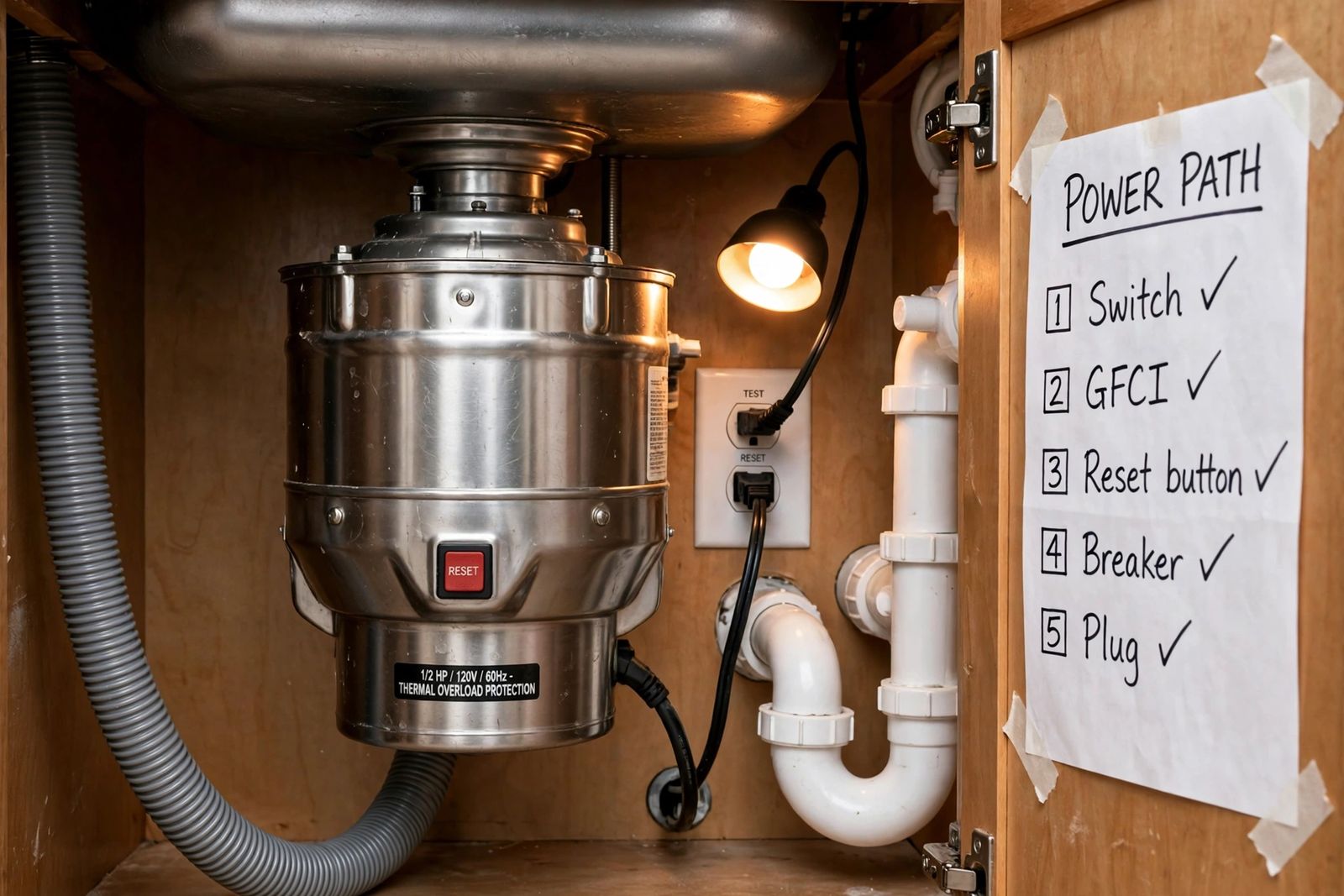
A garbage disposal that will not turn on and makes no sound at all is not jammed and not grinding badly — it is getting no power, or its own safety switch has cut the power before the motor ever sees it. This article owns that exact fault: completely dead, completely silent. Work one chain in order — wall switch → GFCI/reset on the outlet → the disposal’s own reset button → breaker → cord/plug or hardwired check — and the link that restores power names the fault. If your disposal makes a humming sound instead, it has power and a different problem: that is garbage disposal humming, the jam diagnosis, and it is not this page. If the cabinet is wet, that is garbage disposal leaking, and the water is dealt with before any electrical check. Silence is useful evidence, because it rules things out: a motor with power and a jam hums, a motor with power and worn parts grinds or screeches — a motor with no power does exactly what yours is doing, which is nothing. Do not condemn the disposal until every link in the chain has passed, because four of the five links are outside the disposal, cost nothing, and are more common than a dead motor.
First: make the silent check safe
Everything in the chain is an outside-of-the-unit check — buttons, switches, a plug, a panel — and none of it requires opening the disposal, opening a wiring cover, or reaching into anything. Keep it that way:
- Start with the wall switch off. Every check below is done with the switch off, and the disposal is switched on only for one brief test at the end of each fix. Repeatedly flipping the switch on a silent unit tells you nothing new after the first flip and can overheat a motor whose overload has not yet tripped.
- Never put a hand into the grinding chamber — for this or any other fault, even with the power off. This needs saying plainly because a widely read national guide in the ranking set instructs the reader to “reach into the disposal with your hand and feel around for the jammed object and pull it out.” Both makers state the opposite without exception: InSinkErator — “Do not place your hand in the garbage disposal at any time” — and Moen’s manual — “Never put your hands or fingers inside disposal.” The impellers are sharp, hidden objects are sharper, and nothing in a silent-disposal diagnosis requires a hand in the chamber at all. The one freedom check this article uses is done with a wooden spoon, exactly as Moen directs.
- A wet cabinet stops the electrical checks. If the plug, the cord, the outlet or the switch area is wet — from a leak above, a spill, a damp cabinet floor — do not touch it, do not test the outlet, and do not press anything. Water next to under-sink electrics is a different job: find the water first (the towel test in garbage disposal leaking names the source), and if the electrical parts themselves are wet, that part belongs to a qualified electrician.
- A breaker or GFCI that trips again is an answer, not a nuisance. Any protection device in the chain gets reset once. If it trips a second time, the chain has told you there is a real electrical fault, an overload that is still present, or moisture — stop resetting it and read the dead-motor and call-a-pro sections below.
- Hardwired units end the DIY chain earlier. If your disposal has no plug — it is wired directly — the cord check becomes a look only: no opening covers, no pulling the unit, no touching connections. Everything upstream (switch, GFCI, the disposal’s own reset, breaker) is still yours to check.
The power-path chain: the whole diagnosis in one order
Power reaches the motor through five links, and a silent disposal has failed at exactly one of them — or at the motor itself, which is proven only when all five pass. Work top to bottom, in this order, and do not skip ahead: each link is cheaper and more common than the one after it, and each test is only meaningful if the links before it have passed.
| # | Link in the chain | The check | What a pass looks like |
|---|---|---|---|
| 1 | Wall switch (or countertop air switch, or batch-feed stopper) | Switch off, then on, once. Air switch: confirm its under-sink module is plugged into a live outlet and its hose is connected. Batch-feed model: the stopper must be fully seated and turned, or the unit cannot run by design | Switch feels positive, not loose, warm or crackling. A switch that works the kitchen light circuit of the outlet test (link 5) but not the disposal has failed itself |
| 2 | GFCI on the outlet | Find the under-sink outlet — and any GFCI outlet on the same kitchen circuit. Press TEST, then RESET, on a tripped one (a tripped GFCI often shows its indicator or a popped RESET button) | RESET clicks and stays in. A GFCI that trips again instantly is reporting a ground fault — stop, do not keep resetting |
| 3 | The disposal’s own reset button (overload protector) | Under the unit, facing the floor: a small square red button (InSinkErator) — on Moen units, red and opposite the discharge elbow, near the bottom. Tripped = dropped down about 1/4 inch (5 mm). Switch off, press it gently back in | Button stays in. If it will not stay in, the motor is still hot: wait 10 minutes and try again (manual-reset models). Automatic-reset models have no button to press — switch off and allow up to 20 minutes to cool before testing |
| 4 | Breaker | At the service panel, find the kitchen/disposal breaker — a tripped one sits in a middle position or shows its trip indicator. Push it fully off, then back on | Breaker stays on with the disposal switched off, and stays on through one brief disposal test. Tripping again = fault still present — stop |
| 5 | Cord/plug — or hardwired connection | Cord models: confirm the plug is fully seated in the switched under-sink outlet (stored bottles and bins knock plugs loose), cord undamaged. Then the proof test: unplug the disposal and plug a small working device — a lamp, a phone charger — into the same outlet, switch on: it must run. Hardwired models: visual check only | Test device runs with the wall switch on and stops with it off = power reaches the outlet and the switch works. Test device dead = the fault is upstream wiring, and it is an electrician’s |
| ✕ | DEAD MOTOR — the line | Reached only when links 1–5 all pass and the turntable check below passes: outlet proven live, switch proven, reset in, breaker holding — and the disposal is still completely silent | This is the point where it stops being a power problem. The fault is inside the sealed unit — motor or internal electrical failure — and the verdict is replacement, not repair |
No page in the ranking set lays the chain out as one ordered path with the dead-motor line marked on it. The strongest silent-unit guide buries the disposal’s own reset at step 8 of 10, after the breaker and outlet, and pads the page with a lifespan table for refrigerators and dryers; the national guides list the same five causes as an unordered paragraph or miss links entirely — one omits the GFCI altogether, another never mentions that the wall switch itself can fail. The chain is the article; the sections below are each link explained, in the order you will work them.
Link 1: the wall switch — and its two disguises
The switch is the first link because it is the one human hands touch, and it fails in ordinary ways: worn contacts, a loose connection behind the plate, a switch that was never actually on because someone else in the household turned it off. Flip it off and on once, deliberately. A switch that feels loose or gritty, crackles, or is warm to the touch has told you its answer — that is a failed switch, it belongs to an electrician (the switch is mains wiring in a wet-room cabinet), and the disposal below it may be perfectly healthy.
Two disguises catch people out. Air-switch models are controlled by a countertop push button that puffs air down a small tube to a switch module plugged in under the sink. If that module has been unplugged — or plugged into the unswitched half of the outlet — the disposal is silent no matter what the button does, and InSinkErator’s own instructions treat the air switch as its own case: turn off and unplug the disposer and allow up to 20 minutes before plugging back in when an automatic-reset unit has tripped. Check the module is plugged in and the air tube is pushed onto its nipples before suspecting anything else. Batch-feed models have no wall switch at all: the disposal runs only when its stopper is seated in the drain and turned into place. A stopper that is sitting loose, or a model whose stopper was replaced with a plain strainer, is a silent disposal with nothing wrong with it — seat and turn the correct stopper before working the rest of the chain.
Link 2: the GFCI — the reset button that is not on the disposal
Many disposals plug into an outlet protected by a GFCI (ground fault circuit interrupter), and when a GFCI trips it cuts power so completely that the disposal behaves exactly like a dead one. The catch is location: the GFCI that protects the under-sink outlet is not always the under-sink outlet itself. It may be a GFCI outlet elsewhere on the same kitchen circuit — the one by the counter, sometimes further away — and its trip takes the disposal’s power with it. One local guide in the set gets this right and most miss it: check for any tripped GFCI on the circuit, not just the one under the sink.
On the GFCI itself, press TEST (the outlet should click off) then RESET — or, on an already-tripped unit, simply press RESET firmly. It should click and stay. Then make the one brief switch test. If the GFCI trips again straight away, it is detecting a ground fault — moisture in the outlet or unit, or an internal electrical failure — and that is a stop point, not a retry loop: power off, and the fault belongs to an electrician or to the replacement decision below. Never defeat, bypass or swap out a tripping GFCI to “test” the disposal.
Link 3: the disposal’s own reset — the overload protector
This is the link that fixes the most silent disposals, because it is the one designed to create this exact symptom. Inside the disposal, an overload protector watches the motor: if the unit jams, is overloaded, runs too long, or overheats, the protector trips and cuts power to protect the motor — and the disposal goes completely silent until it is reset. InSinkErator’s reset guidance is explicit that a clogged, long-run or overheated disposal “will shut down automatically and need to be reset.”
Where it is — precisely, because the ranking set is vague about it. One national guide tells the reader the button is “usually on the side or the bottom” and that “you may have to feel around the back of the unit to locate it.” The makers are exact, and exactness matters when you are reaching under a sink: on InSinkErator units the overload protector is on the bottom of the unit, facing the floor — a small square red button; on Moen units the red reset button is opposite the discharge elbow, near the bottom. If it has tripped, the button has dropped down about 1/4 inch (5 mm). If it sits flush, it has not tripped, and this link has passed — move on rather than pressing a button that is not out.
How to press it — and the two errors to avoid. Switch off first. Then, in InSinkErator’s word, press the button gently back in; Moen’s manual says push it in until it clicks and remains depressed. That is the whole technique, and it corrects two things the ranking set teaches. First, one plumbing guide’s reset instructions say to “press and hold the button for 5–10 seconds until you feel it click” — holding does nothing the press does not; a protector does not charge up or latch by being held, and a reader holding a hot unit’s button for ten seconds learns nothing about why it popped out. Second, a local guide’s version — “press it firmly back in and wait a few minutes before testing” — puts a vague wait after the press, in the wrong place. The makers put an exact wait in a different place: if the button will not stay in, the motor is still hot — wait 10 minutes, then try again. A button pressed too early pops straight back out, and without the reason, a healthy, hot disposal gets misdiagnosed as dead. The wait belongs inside the silent-unit checklist itself, not buried in a separate reset how-to — one retailer guide in the set does state the correct 10 minutes, but only in its reset section, while its not-turning-on section never mentions cooling at all.
Automatic-reset models have no button. InSinkErator’s current EZ Connect, Builder Series, Amana and ES units use an automatic overload switch instead: there is nothing to press. Switch the unit off — at the wall switch, or off and unplugged for air-switch models — and allow it to cool for up to 20 minutes before turning it back on. Hunting the bottom of one of these units for a red button that does not exist wastes the whole cool-down.
One reset is a fix; repeated resets are a diagnosis. InSinkErator’s position is that if the button still will not stay in after cooling, or you have to repeatedly reset the protector, the disposal may require service or replacement. A jam is the usual reason a protector trips and re-trips — which is why the turntable check below comes before any dead-motor verdict.
Link 4: the breaker
At the service panel, find the breaker for the disposal’s circuit. Disposals commonly share a circuit with the dishwasher, and in some kitchens with counter outlets as well, so a breaker can trip from combined load rather than from the disposal itself. A tripped breaker usually sits in a middle position, neither fully on nor fully off, and some show an orange or red trip indicator. Reset it properly: push it fully off first, then back on — pushing a tripped breaker straight at “on” without the full-off first often fails to reset its mechanism.
Then test once, briefly, with the disposal. Two outcomes matter. Breaker holds and the disposal runs: the trip was the fault — but note whether it recurs, because a breaker that trips every time the disposal and dishwasher run together is a circuit-capacity problem for an electrician, not a disposal problem. Breaker trips again, immediately or the moment the disposal runs: stop. A re-tripping breaker is reporting an overload or short that is still present — in the wiring, the switch, or the disposal’s motor — and repeatedly resetting it is how a diagnosis turns into damage. That outcome skips the rest of the chain and goes to the call-a-pro section.
If no breaker is tripped and every other link passes, also check the obvious companion fact: if the dishwasher and other kitchen outlets on the same circuit are dead too, the fault was never the disposal — it is the circuit, and it is electrical work.
Link 5: the cord and plug — or the hardwired limit
Cord-connected disposals live in a cabinet full of stored bottles, bins and cleaning supplies, and plugs get knocked partway out of outlets without anyone noticing. With the wall switch off, confirm the plug is pushed fully home and look at the cord: crushed, frayed, chewed or heat-discoloured cord is a stop-and-replace item, not a wiggle-it-and-see item — a disposal that runs only when its cord is moved has a damaged connection and stays off until it is dealt with properly.
Then run the proof test, which is InSinkErator’s own suggested check in spirit and the strongest test in the chain: unplug the disposal, plug a small device you know works — a desk lamp is the classic — into the same outlet, and work the wall switch. Lamp on with the switch on, off with the switch off proves three links at once: the breaker is feeding the circuit, the GFCI is passing power, and the switch works. The fault is then inside the disposal — its reset (recheck link 3) or its motor. Lamp dead in both switch positions proves the opposite: the disposal may be fine and the power simply never arrives — the fault is in the outlet, the switch wiring or the circuit, and it belongs to an electrician. Dry hands and a dry cabinet only for this test, as with every check in this article.
Hardwired disposals have no plug to seat and no outlet to test. Your check is visual — connections covered, no scorching, no corrosion, no loose junction box — and it ends there. Do not open the wiring cover or the junction box to “check inside”: if links 1–4 pass on a hardwired unit and it stays silent, the remaining possibilities are the switch wiring, the internal connections and the motor, and separating them is professional work with a meter, not a homeowner visual check.
The turntable check: the jam hiding inside a silent disposal
Before the dead-motor line can be called, one mechanical check remains, because silence has a hidden cause the chain alone cannot see: a disposal that jammed hard, strained, overheated and tripped its overload may have had its plug knocked out or its breaker trip at the same time — and it will sit silent through every electrical fix until the jam itself is cleared. Moen’s manual builds its whole “unit does not start” sequence around this: before the reset button, check whether the turntable rotates freely.
Do it Moen’s way. Power off — unplug the unit or turn the wall switch or breaker off. Remove the stopper. Reach the wooden spoon down the drain, brace it against the turntable, and try to rotate the turntable freely, in either direction. (On InSinkErator-type units the equivalent test is the hex wrench in the centre socket on the bottom of the unit, worked back and forth until the plate turns freely in complete circles in both directions — the full method is in garbage disposal humming.)
- Turntable rotates freely: there is no jam. If the chain has passed and the reset is in, the silence is genuinely electrical or internal — proceed to the dead-motor verdict below.
- Turntable will not rotate freely: something is lodged between the turntable and the grind ring. Dislodge it by rotating the turntable with the spoon (Moen sells an unjamming wrench kit, part 1037, for exactly this), remove the object with tongs or pliers — never fingers — then, with power restored, press the red reset button before resuming use, in Moen’s order. Expect the unit to hum or run when tested; if it hums but will not spin, you have crossed into the sibling fault and its fix order applies.
The dead-motor line: where replacement starts
The line marked ✕ on the chain is a proof, not a guess. The motor is dead — and the disposal is replaced, not repaired — when all of these have been established, in order:
- Power is proven at the outlet by the lamp test (link 5), with the wall switch proven by the same test.
- The GFCI and the breaker are reset and holding, with no second trip.
- The disposal’s own reset is in and staying in after a full cool-down — 10 minutes for a manual-reset model, up to 20 minutes for an automatic-reset model.
- The turntable rotates freely by spoon or wrench, so no jam is holding the plate.
- And the disposal is still completely silent — no hum, no click, no vibration — on a brief switch test.
At that point every cause outside the sealed unit has been eliminated, and what remains is what Moen’s manual states in one line: if the wiring and electrical components are intact, “the unit may have an internal problem that requires service or replacement.” The motor and its internal connections are not homeowner service parts on ordinary disposals; there is no component under the sink left to adjust. InSinkErator reaches the same end from its side: a reset button that will not stay in after cooling, or a protector that needs repeated resetting, means the disposal may require service or replacement — with the maker’s qualification that a quality failure on a unit under warranty may be covered through its authorised service route, which is worth taking before paying for a new unit on a young disposal.
Three shorter paths also end at the line, without the full proof: a burning smell, smoke, or scorch marks at the unit, plug or outlet at any point (power off at the breaker, no further tests); a breaker or GFCI that trips again the moment the disposal runs, after one proper reset; and a reset button that pops back out after a full cool-down with a provably free turntable — the motor is overheating because it is failing, not because it is jammed.
Age frames the spending, and the ranking set’s lifespans agree closely enough to state plainly: most disposals serve roughly 8 to 12 years (one local guide’s replacement range runs to 15; a retailer guide says about 10). A dead motor well into that range is the expected end of the unit. The same proof on a two- or three-year-old unit points first at warranty and the maker’s service route, not at a shopping trip.
When to call a professional
- Any wet electrical part — plug, outlet, switch module or wiring damp or dripping. Electrician or plumber first, disposal second.
- A breaker or GFCI that trips a second time, at any point in the chain. That is a fault being reported, not a button to keep pressing.
- A failed wall switch — loose, crackling, warm, or proven dead by the lamp test while the outlet’s power is otherwise present. Switch replacement is mains wiring in a wet cabinet: an electrician’s job.
- A hardwired unit that passes links 1–4 and stays silent. Separating switch wiring from internal failure needs a meter and opened covers.
- The dead-motor proof is complete and you are not comfortable swapping the unit — replacement involves plumbing and electrical connections together, and paying for the swap is reasonable.
- Burning smell, smoke or scorching anywhere — power off at the breaker, and the call is the next step, not another test.
Frequently asked questions
Why is my garbage disposal completely silent when I turn it on? Because no power is reaching the motor, or the disposal’s own overload protector has cut it. In order of the chain: a failed or off wall switch (or an air-switch module unplugged, or a batch-feed stopper not seated), a tripped GFCI on the circuit, the disposal’s tripped reset button, a tripped breaker, or a plug knocked loose. Only when all five pass and the turntable turns freely is the motor itself the fault.
Where is the reset button on a garbage disposal? On the unit under the sink, low down. InSinkErator: a small square red button on the bottom of the unit, facing the floor. Moen: a red button opposite the discharge elbow, near the bottom. If it has tripped it sits dropped down about 1/4 inch (5 mm). Some current models have no button at all — they reset automatically after cooling for up to 20 minutes with the switch off.
I pressed the reset button and it keeps popping out. What now? Stop pressing and let the motor cool — 10 minutes with the switch off, then press once more. A hot motor’s button will not stay in, and that is the makers’ stated reason, not a broken button. Clear any jam first (turntable check, above) if you have not. If it still will not stay in after a full cool-down with a free turntable, the motor or protector is failing and the unit is heading for service or replacement.
How is the disposal’s reset button different from the GFCI reset? They protect against different faults and sit in different places. The disposal’s own button is its overload protector: it trips when the motor overheats, jams or is overloaded, and it lives on the bottom of the unit. The GFCI reset is on an electrical outlet — sometimes not the under-sink one — and it trips on a ground fault, a leakage of current where it should not go. A silent disposal can need either, both, or neither; the chain checks them as separate links for that reason.
Can I test the outlet under the sink myself? Yes, if — and only if — the cabinet, the outlet and your hands are completely dry. Unplug the disposal and plug in a small device you know works, like a lamp. If it runs with the wall switch on and stops with it off, power, breaker, GFCI and switch are all proven in one test. If the area is wet, skip the test entirely.
My disposal is silent, but the outlet has power. Does that mean the motor is dead? Not yet — two checks remain. Press the disposal’s own reset after a full cool-down (link 3), and prove the turntable rotates freely with a wooden spoon (a jam plus a tripped overload is silent until both are dealt with). If both pass and it is still silent, then yes: the fault is internal, and the unit is replaced, not repaired.
The disposal worked yesterday and died mid-use. What happened? The most likely story is an overload trip: the motor strained — a heavy load, a jam starting, a long run — overheated, and its protector cut power to save it. That is why it stopped suddenly and silently rather than fading. Let it cool fully, check the turntable for a jam, press the reset, and test with cold water running. Run cold water for the test and for grinding generally — one guide in the ranking set advises flushing the disposal with hot water weekly, which works against the makers’ operating guidance: cold water keeps grease solid so it can be ground and carried away, while hot water melts it just long enough to coat the chamber and pipes and set there.
This article is general information, based on the manufacturer guidance linked and cited above — InSinkErator’s troubleshooting and reset instructions and Moen’s Use and Care manual troubleshooting — and the top guides checked in November 2026. Reset-button location, automatic-versus-manual reset, and switch arrangements vary by maker and model; your unit’s manual governs your model. Work involving failed switches, hardwired connections, wet electrics, or re-tripping breakers and GFCIs belongs to a qualified electrician or plumber.