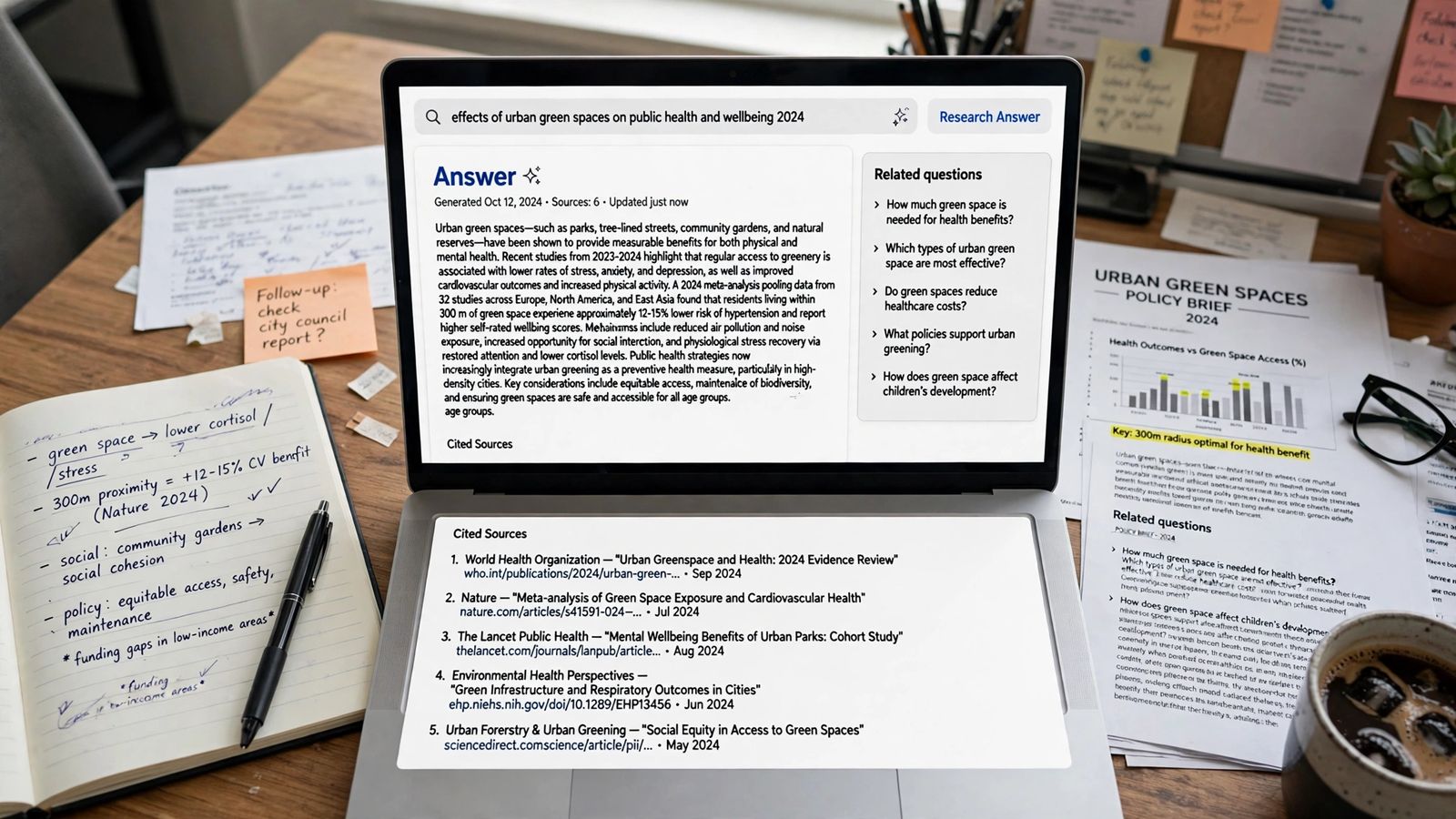
How to make money with Perplexity comes down to one honest fact: Perplexity itself pays you nothing — clients pay you for research work that Perplexity makes much faster. The paid work is selling findings, not answers: market-research reports for small businesses, competitor and lead research, literature and fact research assistance, and research-backed briefs for writers and creators. Perplexity’s edge for this work is that every answer carries numbered citations you can open and check, so what you deliver can be verified instead of merely plausible. The money is real but modest and earned: you still have to find clients, check every claim before it ships, and do the judgment work the tool cannot.
Why Perplexity suits paid research work
Most AI chatbots answer from training data and leave you to guess where a claim came from. Perplexity searches the live web for each question and attaches numbered citations to the original pages, which is exactly the raw material a research deliverable is built from. Its help centre describes the Research mode as performing dozens of searches, reading hundreds of sources and delivering a comprehensive cited report in roughly two to four minutes — work that would take a person hours of tab-opening to assemble by hand.
That speed is the whole business case, and also the whole risk. A client is not paying for the report Perplexity drafts; anyone can generate one of those. A client is paying for a report whose numbers have been checked against the sources, whose dead ends have been removed, and whose conclusions someone will stand behind. Keep that distinction in view and the services below make sense. Lose it, and you are reselling free output — which clients notice quickly.
Cost is low, which helps beginners. The free tier includes a limited number of Pro searches each day and limited Research access. Perplexity Pro costs $20 a month (less per month billed annually) and extends those limits considerably. The sensible order is to start free, land paid work, and let the first client pay for the upgrade — not the other way round.
How to make money with Perplexity: the four services that sell
1. Market-research reports for businesses
A small business owner deciding whether to launch a product, enter a new area or raise prices needs the same facts a big company buys from an agency: market size, who the competitors are, what they charge, and what customers complain about. Few small businesses can justify agency prices, and few owners have a spare day to research it themselves. That gap is the service.
The deliverable is a short, structured report — typically five to fifteen pages — covering the market, the main competitors with prices and positioning, the customer complaints visible in reviews and forums, and a closing section on what the evidence suggests. Perplexity’s Research mode produces the first pass; your job is verifying the figures against the cited sources, replacing anything shaky, and writing the conclusions in plain language tied to the client’s actual decision.
2. Competitor and lead research
Sales teams and small agencies constantly need lists: which companies fit a target profile, who their competitors are, what those competitors launched this quarter, what they charge. Perplexity is good at the discovery pass — building a first list of companies that match stated criteria and summarising each one with sources.
Be honest about the limits here, because clients discover them fast. Perplexity can identify companies and describe them; it cannot guarantee that a named contact’s email address is current, and it should not be treated as a scraping tool for personal data. The professional version of this service is company-level research — firms, offerings, pricing, positioning — with any contact details verified through the client’s own tools before outreach. Selling “verified leads” you have not actually verified is how this service gets a bad name.
3. Literature and fact research assistance
Writers, consultants, podcasters, students and professionals regularly need the same thing: a reliable map of what is known about a topic — the key papers, reports and data sources, summarised accurately, with working citations. Perplexity’s academic and web searching makes assembling that map fast, and a well-organised literature summary or fact dossier is a legitimate, sellable deliverable.
One line must stay bright here. Helping someone research — finding sources, summarising a field, checking facts — is legitimate work. Doing a student’s graded assignment, essay or exam for them is not research assistance; it is academic dishonesty, it can get the student expelled and you banned from the platforms you sell on, and it is not a service this article recommends or that reputable clients ask for. If a request crosses from “help me understand the literature” into “write the thing I will submit as my own work,” decline it. There is enough honest demand without it.
4. Research-backed content briefs
Content teams, agencies and solo creators publish on schedules, and the slow part of an article is rarely the typing — it is the research: finding the statistics, checking the claims, collecting the sources a writer will cite. A research-backed brief packages that work: the angle, the verified facts with citations, the competing pages’ coverage, and the questions readers actually ask.
This service suits people who read carefully more than people who write flashily, and it repeats well — a creator publishing weekly needs a brief weekly, which is how one-off gigs turn into retainers. Checking each fact before it goes into the brief is the entire value, because a wrong statistic published under a client’s name costs them more than the brief cost you. If you want to see how easily AI output goes wrong without that check, our explainer on what an AI hallucination is shows the failure modes, and a tool like NotebookLM is a useful second step for interrogating a fixed set of source documents once you have gathered them. Google’s research engine is the other common starting point for this kind of work — how to make money with Gemini maps its service routes.
The verification rule: the step that makes it a service
Every service above stands or falls on one habit: never deliver a Perplexity claim you have not opened at the source. Perplexity’s citations point to real pages, but the summary layer can misread a figure, quote a page out of context, or cite a source that itself was wrong — the same failure pattern described in our article on what plagiarism is applies to carelessly copied summaries, too. A workable routine:
- Generate the research with Perplexity, in Research mode for reports.
- Open every citation behind a load-bearing claim — any number, date, price or quote the client will act on.
- Check the claim says what the source actually says, and that the source is current and credible.
- Where two sources disagree, report the disagreement instead of picking the convenient one.
- Write the deliverable in your own structure and words, with the source list attached.
This takes real time — often as long as the generation saved. That is not a flaw in the business; it is the business. Verification and judgment are the parts a client cannot get by typing the question themselves.
Where the clients actually are
Research is an established freelance category, not a new invention. Upwork’s researcher hiring pages list thousands of working researchers offering market research, competitor analysis and literature reviews, and its market research category shows the same demand from the buyer’s side — clients post research jobs there every day. Fiverr carries the same categories in packaged-gig form. These marketplaces are the realistic starting point: the clients are already there, already looking, and the platform handles payment protection while you have no reputation of your own.
Beyond the marketplaces, the buyers named in the services above are reachable directly: local businesses making a launch or pricing decision, small marketing agencies that white-label research, and creators with a publishing schedule. Direct clients pay better eventually — no platform fee, and retainers are easier to arrange — but they require outreach and trust that a beginner has not built yet. The common working pattern is marketplaces first for proof and reviews, direct clients second.
Whichever route you take, lead with a sample. One polished, fully sourced sample report on a topic you understand — made before anyone pays you — answers the only question a first client really has: can this person deliver something I can use?
What you can charge: estimates, labelled as estimates
There is no official price list for this work, and anyone quoting you a precise going rate without a source is guessing. The most solid published reference is Upwork’s own hiring guidance, which states that small research tasks may cost a few hundred dollars, while larger market research engagements can cost thousands, and prices a full market research study at $2,500–$8,000 for mid-level to senior researchers. Treat those as the established end of the market, not a beginner’s expectation — they describe experienced researchers selling to businesses, observed on Upwork’s site in November 2026.
A realistic beginner pattern, offered as an estimate rather than a promise: price small, well-defined deliverables first — a competitor snapshot, a single-topic fact dossier, one content brief — in the tens of dollars rather than the hundreds, deliver them verified and on time, and raise prices as reviews and repeat clients accumulate. Per-deliverable pricing suits research better than hourly billing at the start, because the client can see exactly what they are buying. What this work will not do is produce a predictable monthly income on a schedule; freelance research income arrives in lumps, follows your client pipeline, and stops when you stop pitching. No honest version of this article can put a monthly figure on it, and you should distrust any that does.
How to make money with Perplexity: a realistic starter path
- Pick one service and one kind of client. Competitor reports for small e-commerce businesses, or briefs for creators in one niche you know — narrow beats general.
- Build two or three samples on the free tier. Full deliverables, verified at the source, formatted the way a client would receive them.
- List on one marketplace and pitch directly in parallel. A Fiverr or Upwork listing with the samples attached, plus short, specific outreach to a handful of agencies or creators whose published work shows they need research help.
- Price the first jobs to be bought, not to be maximal. The goal of job one is a review and a reference, not a rate record.
- Deliver verified, early, and with sources attached. Then ask the question that builds the business: “Do you need this monthly?”
- Upgrade to Pro only when paid work justifies it, and raise prices gradually as repeat work arrives.
The honest difficulties
- Clients can use Perplexity too. Your defence is not access to the tool; it is verification, structure, niche knowledge and saved time. If a deliverable looks like pasted AI output, the client will simply do that themselves next time.
- The answers can be wrong. Confident, cited and wrong happens. Your checking routine is what stands between a client and a bad decision made on your report — and your reputation carries the cost when it slips.
- Finding clients is the actual job. The research is the easy half. Most beginners who stall do so with good samples and no pipeline.
- Platform economics are real. Marketplace fees, unpaid pitching time and clients who vanish mid-brief all come with the territory, especially early.
- It is a skill business, not passive income. Income follows hours and reputation. It grows slowly, and it is not guaranteed — by this article, by any marketplace, or by the tool.
Frequently asked questions
Can you make money directly from Perplexity? No. Perplexity does not pay users for asking questions. The money comes from clients who pay for research deliverables — reports, briefs, competitor and lead research — that you produce faster and verify properly using Perplexity.
Do I need Perplexity Pro to start? No. The free tier’s limited Pro searches and Research access are enough to build samples and deliver first small jobs. Pro, at $20 a month, becomes worth it when paid work is regularly hitting the free limits.
Is it legal and allowed to sell research made with AI tools? Selling your own research and analysis is ordinary freelance work. The obligations are honesty and care: verify what you deliver, do not pass off unverified AI output as checked fact, respect the marketplace’s rules, and never do students’ graded work for them. If you are comparing how the major tools handle sourced work generally, our Claude vs ChatGPT comparison covers the wider landscape.
How is this different from selling AI-written articles? A research deliverable sells verified facts, sources and conclusions for a decision; its value survives the client checking it. Pasted AI text sells words, and falls apart on first checking. Clients renew the first kind and refund the second.