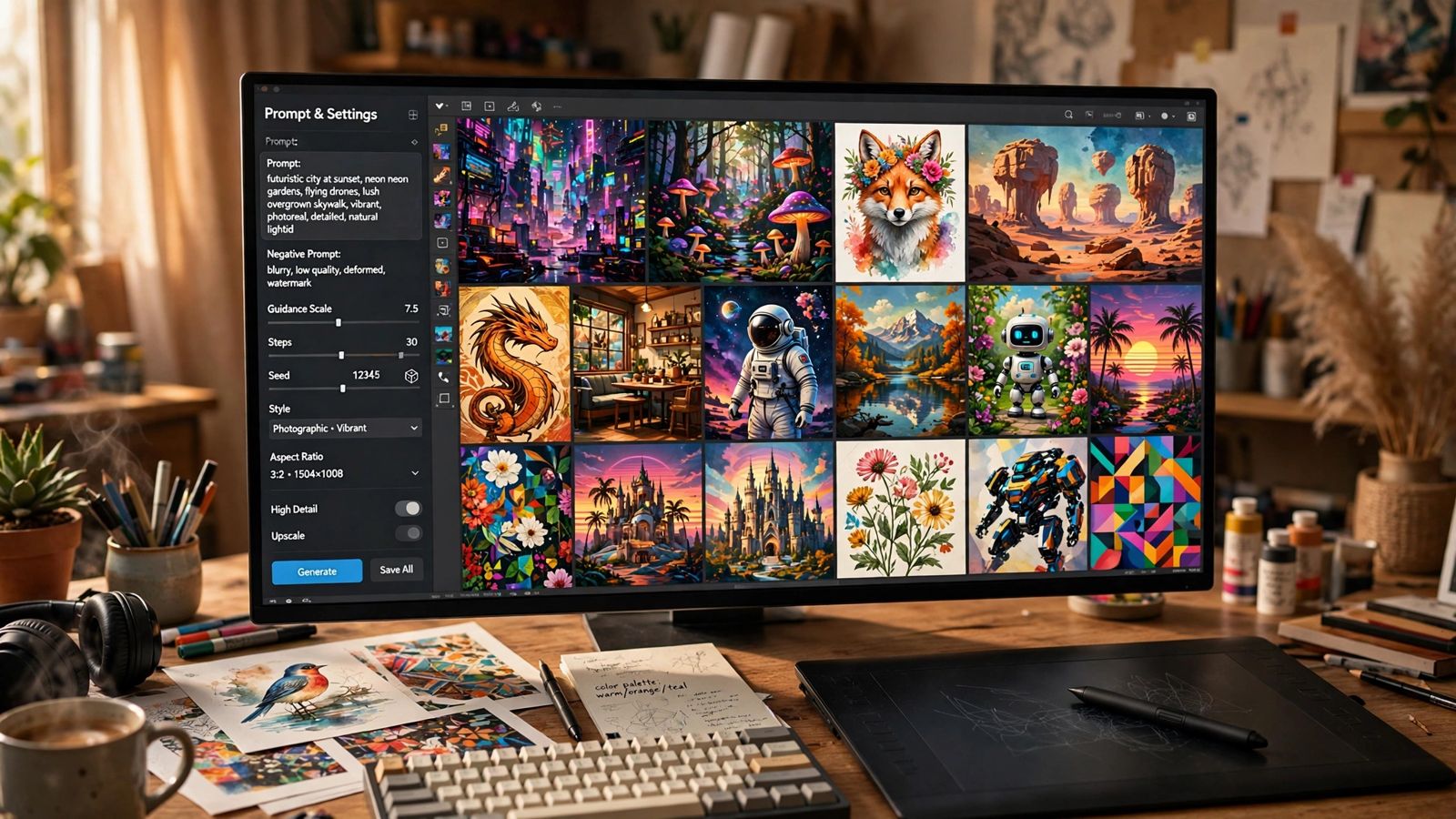
How to make money with Midjourney comes down to selling work, not just images: clients pay for book covers, branding visuals, social media packages and design help, while stock sales and print-on-demand products pay smaller amounts per sale and build slowly. There is no passive-income shortcut. Every route below requires a paid plan, editing skill beyond prompting, and finding buyers — but the routes are real, the rules are checkable, and starting costs are low.
First, the rights: what your plan actually lets you sell
Midjourney is a generative AI image tool, and it is paid-only — no free plan, no free trial on the website or in Discord. Whether you may sell what you make depends on your subscription, and Midjourney’s Terms of Service (current version effective 27 May 2026) draw the lines clearly:
- Paid members own their images. The Terms state: “You own all Assets You create with the Services to the fullest extent possible under applicable law.” Ownership persists even if you later downgrade or cancel, so images made while subscribed remain yours to sell after you stop paying.
- All four paid plans carry the same commercial terms. Basic ($10/month), Standard ($30), Pro ($60) and Mega ($120) differ in speed, volume and privacy — not in whether you may sell the output. A popular claim online says you need Pro or Mega for “full commercial rights.” That is wrong for individuals and small businesses, and it pushes beginners onto a $60 plan they do not need.
- The one exception is company size. If you are a company, or an employee of one, with more than $1,000,000 USD a year in revenue, you must be on Pro or Mega to own your assets — the only tier rule about ownership, stated in the Terms and on Midjourney’s plan comparison page.
- Non-paid use gets no commercial rights. Anyone who is not a paid member is licensed only under Creative Commons Attribution-NonCommercial terms — shareable with credit, never sellable.
- Your work is public by default. On Basic and Standard, your generations sit in Midjourney’s public gallery, viewable and remixable by other users. Stealth Mode, which keeps images and prompts private, exists only on Pro and Mega. For client work under wraps — an unreleased book cover, a product launch — that privacy gap is a genuine reason to pay more, unlike the invented “commercial rights” one.
- You cannot sell access itself. The Terms bar reselling access to the service, and only one person may use each account. Selling images you made for a client is fine; renting out your login is not.
- Midjourney keeps a licence too. You grant Midjourney a broad, perpetual, royalty-free licence over your prompts and assets, and the Terms offer no indemnification: if an image you sell is claimed to infringe someone’s rights, defending it is your problem.
Prices are from Midjourney’s official plan page, checked November 2026; re-check before building a business on them.
How to make money with Midjourney: the service work
The most reliable money is not in uploading images and waiting. It is in services — a named client, a defined deliverable, an agreed price. Small businesses, self-published authors and content creators constantly need visuals they cannot produce themselves; what they buy is your judgement, consistency and finishing work, with Midjourney as the production tool underneath.
Logo and branding work. Businesses need logos, brand imagery, website heroes and social templates as a matching set, and Midjourney generates marks, mood imagery and style directions quickly. One hard limit must be stated honestly: a raw Midjourney logo is a flat image, not a vector file, and it may not be protectable as a trademark (see below). Serious delivery means redrawing the chosen mark in a vector tool so the client gets a scalable, ownable asset — sellers who skip that step are selling something a business cannot fully use.
Book covers and illustration. Self-published authors are the steadiest client pool. They need genre-appropriate covers that survive thumbnail size, plus, for children’s books, interior art with the same character on every page. Character consistency is the hard part — Midjourney’s character reference tools help, but expect repeated generation and manual fixes. If you illustrate a book published through Amazon KDP, the author must disclose the AI-generated images: KDP’s content guidelines require disclosure of AI-generated text, images and translations (covers and interior art included), while work a human created and merely polished with AI counts as AI-assisted and needs no disclosure.
Social media and thumbnail packages. Creators and small brands need a constant flow of on-brand images: post backgrounds, story graphics, YouTube thumbnails, ad visuals. Sold as a monthly package rather than per image, this becomes recurring work. The skill being bought is a repeatable look, not one-off pretty pictures.
Concept art and visual packages. Indie game developers need environment concepts, character mood boards and marketing art; web designers and agencies need sets of bespoke images for client sites. These buyers pay for art direction plus technical delivery — consistent lighting, usable formats, transparent backgrounds — exactly what raw generation does not do.
Where the clients are. Freelance marketplaces (Fiverr, Upwork) are the standard start: crowded and price-competitive, but full of people already searching to buy. Author groups and indie-dev communities are narrower and less crowded. Direct outreach — LinkedIn posts showing before-and-after brand work, local businesses with dated visuals — is slower but carries no platform fee or bidding war.
Selling the images themselves: stock
Stock is the closest thing to passive income here, and it is genuinely slow. You upload once and earn a royalty per licence; per-download amounts are small, so income depends on hundreds of well-tagged images in categories businesses buy — office and technology scenes, seasonal campaigns, abstract backgrounds, lifestyle imagery without identifiable people.
Platform rules differ sharply, and getting them wrong costs accounts:
- Adobe Stock accepts AI-generated images, with conditions. Adobe’s generative AI guidelines require you to tick “Created using generative AI tools” on every AI submission, submit photorealistic work as Photos and everything else as Illustrations, keep artist names, real people and fictional characters out of prompts, titles and keywords, provide releases for anything based on a real person or recognisable property, and avoid batches of near-identical variations. Adobe also tells contributors to confirm their AI tool’s terms allow stock submission — which a paid Midjourney plan does.
- Some major libraries accept none at all. Shutterstock and Getty Images have barred AI-generated submissions from contributors, so an “upload everywhere” plan fails on day one. Check each platform’s current contributor terms before uploading; these policies have changed repeatedly since 2023.
Print-on-demand and digital downloads
Print-on-demand (POD) puts your design on shirts, mugs, posters and tote bags that a fulfilment company prints and ships per order; you keep a margin per sale and never hold stock. Digital downloads on Etsy — printable wall art, sticker sheets, clipart packs — skip fulfilment entirely. Both are legitimate, and both are the most crowded routes in this guide: anyone with a $10 subscription can list the same categories, so undifferentiated designs compete against unlimited supply. Niches with a specific buyer (a profession, a hobby, an occasion) fare better than generic “beautiful AI art.”
Marketplace rules apply here too. Etsy’s Creativity Standards place AI work under “designed by a seller”: creations from your own original prompts are allowed, but you must disclose within the listing description that the item was created with AI, and POD listings must name the production partner. Two traps catch new sellers: Etsy does not allow AI prompt bundles as products, so the popular “sell your prompts on Etsy” advice fails on Etsy itself (prompt marketplaces such as PromptBase are the venue for that, at low per-prompt prices); and calling AI output “handmade” misdescribes the item and risks the listing.
What sellers typically charge
Knowing how to make money with Midjourney is mostly knowing what buyers actually pay for, so here are the going rates — with a warning attached. Treat every figure as an estimate of asking prices, not earnings data: they come from prices sellers commonly list on freelance marketplaces and in seller guides, observed in November 2026. What any individual earns varies enormously with niche, reviews and output; nobody’s income is guaranteed.
- Single custom pieces (portraits from a customer’s photo, one-off illustrations, invitation artwork): commonly listed around $15–$250, personalised portraits at the low end, finished invitation suites and concept pieces higher.
- Book covers: commonly listed from roughly $50 for simple premade-style covers to several hundred dollars for custom work with revisions; full children’s book illustration packages are listed higher still, priced per book.
- Freelance design gigs (logos, brand visuals, social packages) on Fiverr and Upwork: entry-level listings often start around $25–$75 per project; experienced sellers list brand and content packages in the hundreds of dollars, and monthly social packages in the low hundreds per client.
- Stock and POD: per-sale money is small by design — stock royalties are a fraction of each licence fee, and POD margins are a few dollars on a typical garment — so these only become meaningful at volume.
The pattern: services pay for your skill by the job; uploads pay per sale of a file. Beginners usually over-invest in the second and under-invest in the first.
The honest difficulties
You probably cannot copyright the raw output. The US Copyright Office concluded in its January 2025 copyrightability report that copyright does not extend to purely AI-generated material, and that prompts alone do not give the user enough control to be the author. Your creative selection, arrangement and modification of generated material can be protected; the untouched generation generally cannot. Practically: a competitor can copy your bestselling poster design at limited legal risk, and a client cannot be given exclusive rights you do not hold. Substantial human editing is not just quality control — it is what makes the work legally yours. Other countries differ; check your own jurisdiction.
Outputs still need fixing. Extra fingers, warped text, near-miss logos and trademark-shaped objects appear regularly — the image-side cousin of the text errors covered in what is AI hallucination. Professional delivery means zoom-checking every image, correcting artefacts in an editor, and upscaling for print. Budget that editing time into your price; clients pay for a finished file, not a prompt result. The same finishing discipline is what clients pay for in moving images — see how to make money with Runway.
Saturation is real. Prints, downloads and stock were the first routes everyone tried, and marketplaces are full of AI listings competing on price. Service routes hold up better because the buyer pays for fit, consistency and a deadline — not for an upload that might get found.
Rules move. Midjourney’s terms, Etsy’s standards, Adobe’s guidelines and KDP’s disclosure rules have all been revised within the last two years; a workflow that complied in 2024 may not comply now. Re-read the primary pages for any platform you sell on, a few times a year.
A realistic starter path
The realistic shape of how to make money with Midjourney is slower than the listicles suggest:
- Subscribe at the right tier. Basic ($10/month) is enough to start selling legally as an individual; Standard ($30) adds unlimited slower Relax generations for volume work. Buy Pro only for Stealth Mode privacy — or if the $1M company rule applies to you.
- Pick one service and one buyer. “Book covers for romance authors” beats “AI art for everyone.” Build 8–12 portfolio pieces in exactly that style, to a professional finish.
- List where those buyers already are. One marketplace profile plus a presence in one community of those buyers. Price at the low end of the ranges above while you gather reviews, and say plainly that the work is AI-assisted and finished by hand — honesty is a selling point among sellers who hide it.
- Deliver like a professional. Fixed scope, revision limits, print-ready files, vector finishing where the job needs it. Repeat business comes from reliability, not from the tool.
- Add uploads second. Once service work is paying, put spare finished designs into stock or POD as a slow background stream — not before, and not as the plan.
- Track real numbers. Subscription, software and marketplace fees are costs from day one; your first goal is simply covering them. Anyone promising you a monthly figure at this stage is selling you something.
Authors often pair image work with text tools — for cover-plus-blurb packages, Claude vs ChatGPT maps what those tools do well. Designers selling finished layouts rather than raw images follow the template route in how to make money with Canva AI.
Questions sellers ask before their first sale
Do I need the Pro plan to sell Midjourney images? No. Every paid plan carries the same ownership and commercial terms for individuals and companies under $1M in annual revenue. Pro and Mega are required only above that revenue line, and otherwise buy Stealth Mode and more generation time.
Can I keep selling images after I cancel my subscription? Yes. The Terms say ownership of assets you created persists even if you downgrade or cancel later. Keep records of when images were made and under which plan, in case a marketplace or client asks.
Can a client trademark a logo made in Midjourney? Not safely on the raw output. A purely AI-generated mark generally cannot be copyrighted in the US, and trademark registration needs a distinctive, ownable design. The workable route: Midjourney for concepts, then redraw the final mark as a vector with real human authorship. Tell logo clients this before they pay, not after.
Which stock sites accept Midjourney images? Adobe Stock does, under its generative AI labelling rules. Shutterstock and Getty Images do not accept AI-generated content from contributors. Other libraries sit between the two — check each one’s current contributor terms.
Can I sell my Midjourney prompts? Yes, on prompt marketplaces built for it, at low per-prompt prices — but not as prompt bundles on Etsy, whose Creativity Standards exclude them. Treat prompt sales as a minor extra, not a business.
How much will I earn in the first month? Honestly: possibly nothing, and no guide can promise otherwise. Service sellers typically spend their first weeks on portfolio and listings before the first paid job; upload routes take longer. The realistic first milestone is covering your subscription and tool costs — beyond that, income depends on niche, finishing quality and how consistently you put work in front of buyers.