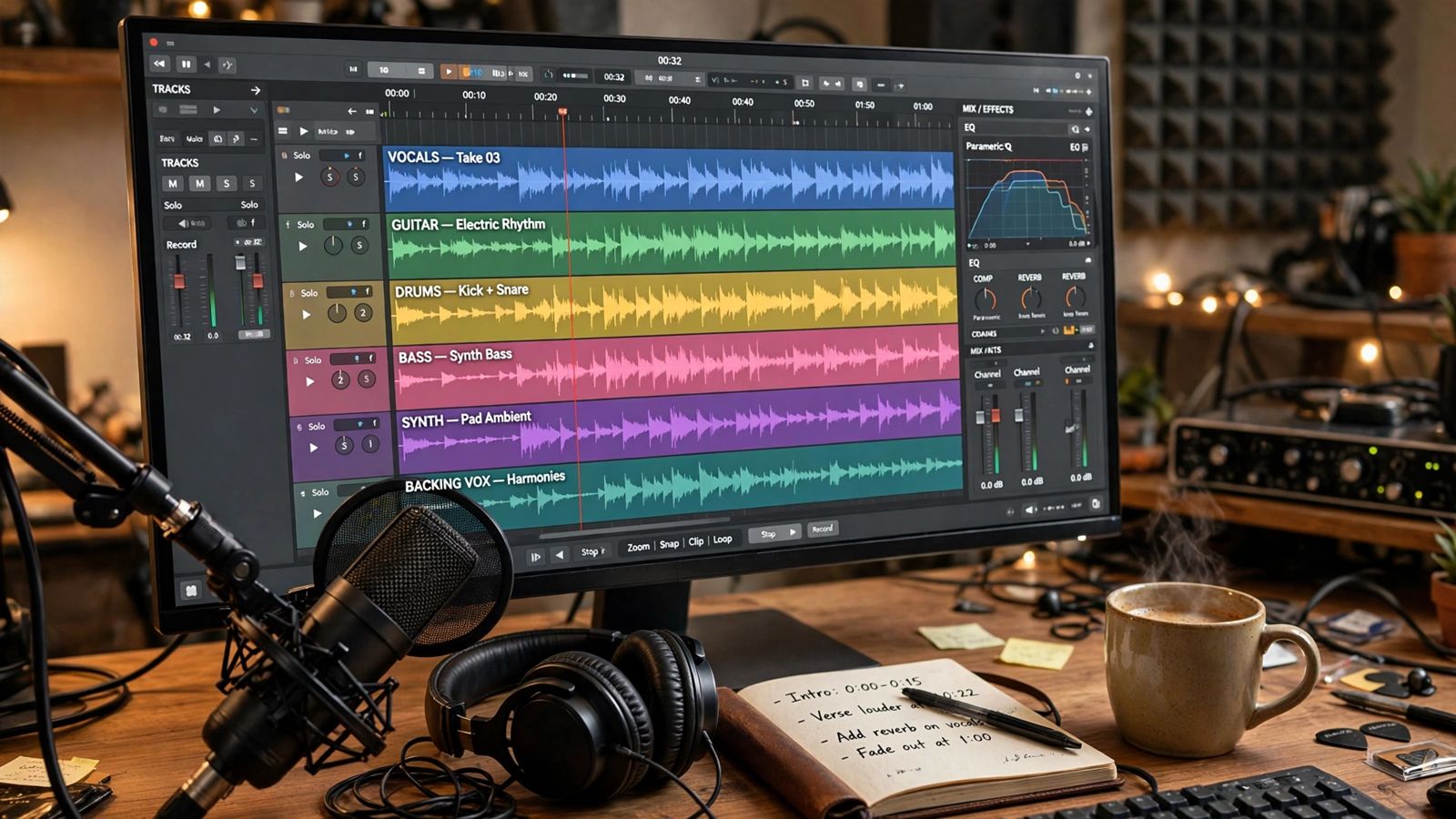
The realistic way to make money with ElevenLabs is to sell finished audio, not to wait for the tool to pay you. Clients pay for voice-overs for videos and ads, narration for courses and audiobooks, and regular podcast audio — and ElevenLabs is the production tool that lets one person deliver all of that quickly. There is no guaranteed income here, and the passive routes you will see advertised pay far less than the headlines suggest. What follows is the service route, what it typically charges, where the clients are, and the platform rules that decide which jobs you can legally take.
First, the licence rule that decides everything
ElevenLabs’ free plan does not include a commercial licence. Audio generated on it is for testing and personal use, so it cannot be sold, delivered to a client, or used in monetised content. Every paid plan includes commercial rights, and the tiers differ mainly in how much audio you can generate each month and which cloning features you get. On the official pricing page (checked November 2026), the ladder runs: Free at $0 with 10,000 credits a month and no commercial use; Starter at $6 a month with 30,000 credits; Creator at $22 a month with 121,000 credits and Professional Voice Cloning; and Pro at $99 a month with 600,000 credits. As a rough guide, 1,000 credits produce about a minute of speech on standard models, so Starter buys roughly half an hour of finished audio a month and Creator about two hours.
That math shapes the whole business. Short jobs — ads, intros, explainers — fit comfortably inside a cheap plan. A single audiobook can eat several months of Creator credits, which is why long-form work usually means a higher plan or a client who pays for the overage. Regenerations cost credits too: budget extra for retakes, mispronunciations and the client who changes one paragraph after delivery. Prices change often, so confirm the current numbers on the pricing page before you quote a job against them.
One more rule sits underneath everything: only clone a voice you have the right to use — your own, or someone else’s with clear, written consent. Cloning a client, a celebrity or a stranger without permission is the fastest way to lose an account and, in a growing number of places, to create legal exposure. Library voices and your own clone are the safe raw material.
How to make money with ElevenLabs: sell services, not the tool
Nobody pays for access to ElevenLabs — they can buy that themselves for $6. They pay for a finished file: the right voice, clean editing, correct pronunciation, delivered on time in the format their platform needs. That production layer is the product. Four services account for most of the real demand.
1. Voice-over services for video, ads and explainers
This is the most common entry point. Small businesses, YouTubers, course sellers and local agencies constantly need short narration: product explainers, social ads, app demos, real-estate walkthroughs, training clips. The work is sold on freelance marketplaces such as Fiverr and Upwork, through direct outreach, or as a standing arrangement with a small agency that produces video but has no voice capacity.
Typical charges, as estimates drawn from marketplace listings and seller guides surveyed in November 2026, run from about $25 to $150 for a short voice-over gig, with packaged work — a set of videos, several languages, or ad variants — priced higher than one-off reads. Treat those figures as a range sellers advertise, not a rate you are owed: the bottom of this market is crowded, because anyone with a subscription can produce a basic read. What clients pay a premium for is judgement — voice casting, pacing, pronunciation of their product names, and files that drop straight into an edit without fixes.
2. YouTube narration — as a service, or your own channel
Faceless channels need narration every week, and many creators would rather buy it than record it. Selling narration per video, or as a monthly bundle for one channel, turns a one-off gig into recurring work. The alternative — running your own channel — is a content business, not a service: it pays nothing until the channel qualifies for the YouTube Partner Program and finds an audience, which takes months for most people.
Either way, know YouTube’s disclosure position before you upload. YouTube’s official guidance on disclosing GenAI content requires disclosure when AI generates or meaningfully alters content that seems realistic — for example, making a real person appear to say something they did not say. The same page lists “cloning one’s own voice to create voice overs or dubs” among the examples that do not need disclosure, and it states that disclosing AI content does not limit a video’s audience or its eligibility to earn money. Two practical consequences follow. First, narrating your own scripts in a library voice or your own clone is a normal, permitted workflow — say so plainly in your gig description and let clients decide. Second, the monetisation risk for AI-narrated channels is not the voice itself but repetitive, templated content with nothing original in it; channels built on original scripts and real editing are a different proposition from mass-uploaded filler. If you write scripts with an AI assistant, fact-check them yourself — the failure mode described in our guide to AI hallucination applies to scripts exactly as it does to articles. The video those scripts sit on is a separate service market again, covered in how to make money with Runway.
3. Audiobook narration — with one hard platform rule
Self-published authors are the most motivated buyers in this market: a human narrator commonly costs more than their book will earn, so a competent AI-narrated production at a lower price is genuinely attractive. Seller guides surveyed in November 2026 quote AI narration offers roughly in the $30–$150 per finished hour range — again, advertised estimates that vary widely, not a standard rate. Per finished hour is the right unit: a ten-hour book is ten hours of generated, proof-listened, corrected and mastered audio, whatever the generation itself cost.
Here is the rule most guides get wrong or leave vague. Audible is not an open outlet for this work. ACX, Amazon’s audiobook submission platform, states in its official audio submission requirements: “Your submitted audiobook must be narrated by a human unless otherwise authorized. Unauthorized use of text-to-speech, AI, or automated recordings in ACX titles is prohibited.” The AI narration Audible does carry comes through Amazon’s own programmes — its Virtual Voice beta for eligible Kindle books and an invite-based voice-replica beta for narrators — not through files you generate and upload. The same ACX page says Audible is working toward accepting third-party text-to-speech content in future, but no open route exists today.
So the honest audiobook offer looks like this: agree the destination before you produce anything. If the author needs Audible through ACX, an ElevenLabs production is the wrong tool for that job, and promising it anyway is how producers get books rejected and clients burned. If the author is publishing through channels that accept disclosed AI narration — ElevenLabs’ own ElevenReader store, or distribution routes such as Spotify’s that accept digital narration from named providers — the service is viable, provided the narration is disclosed as AI-generated wherever the platform requires it. Put the destination in writing in every quote.
4. Podcast and course audio production
Podcasters and course creators buy consistency. A podcast needs an intro, an outro, sponsor reads and episode segments that sound the same every week; a course creator needs hours of narration delivered lesson by lesson, with the same voice and the same pronunciation of technical terms across fifty files. Both are natural retainer work: guides surveyed in November 2026 describe podcast intro and outro packages around $75–$150 as one-off estimates and monthly audio retainers in the low hundreds of dollars, while e-learning narration is often quoted per finished minute rather than per project. As with the other figures here, treat these as advertised estimates to test against your own market, not as going rates anyone guarantees.
This is also where a second tool quietly helps. Course and podcast clients often start from documents — a slide deck, a manuscript, a research pack. Our walkthrough of how to use NotebookLM shows how source material can be organised and even turned into draft audio overviews before you produce the final narration properly in ElevenLabs.
The routes ElevenLabs pays for directly — and what they really pay
Two programmes pay you without a client, and both are worth understanding precisely because they are the ones the hype is built on.
Voice Library payouts. If you record roughly two hours of clean audio and build a Professional Voice Clone (a Creator-plan feature), you can share it in ElevenLabs’ Voice Library and earn when paying subscribers generate audio with it. ElevenLabs’ own payouts documentation puts the default reward at around $0.03 per 1,000 characters generated — about $0.27 when someone voices a full ten-minute script with your voice. Do the arithmetic before you dream: even 100 scripts a month is under $30. ElevenLabs reports large cumulative totals paid to voice creators across the whole library, but it publishes no per-voice earnings, and most voices are used rarely. Treat the library as a small background stream that might grow if your voice fills an unusual niche — a distinctive accent, an under-served language, a characterful older voice — not as an income plan.
The affiliate programme. ElevenLabs pays a commission — widely reported at 22% of a referred subscriber’s payments for their first 12 months, run through PartnerStack — if you recommend the tool to an audience. This is real, but it is marketing income: it requires an audience that trusts your recommendations, and it is unrelated to voice work itself. If you build one through the service work above, it can become a genuine second stream; it is not a starting point.
A realistic starter path
Week one — set up and sample. Use the free plan to learn the voices, then move to Starter before taking any paid work, because the free plan’s output cannot legally be sold. Generate three short samples in one niche — say, a 60-second explainer, a 30-second ad read and a two-minute narration excerpt — and edit them properly in a free audio editor. Proof-listen on headphones; fixing a mispronounced name at this stage is what separates a sellable file from a demo.
Week two — list one specific offer. Not “AI voice-overs” in general, but one defined product: a 30-second explainer voice-over, a podcast intro-and-outro package, narration for one YouTube video. State in the listing that the narration is produced with AI voice technology. Some clients will pass; the ones who stay are the ones who would have been a problem later, and a growing share of buyers actively prefer the speed and price. Price your first few jobs to win reviews rather than to maximise income, and keep the arithmetic honest — marketplace fees (Fiverr keeps 20% of the gig price) come out of your side.
Weeks three and four — deliver, then specialise. Deliver early, fix revisions fast, and ask every satisfied client what else they publish. The second sale to the same client — the next video, the next lesson, the next episode — is where this becomes a business rather than a series of one-off gigs. Raise prices as reviews accumulate, move up a plan only when credit limits actually bite, and add a second service (dubbing an existing client’s videos into another language is the natural one) once the first is running smoothly.
Expect the first month to pay little or nothing. That is normal for any freelance service and is the part the “$3,000 a month” headlines omit. The skill being sold is not operating ElevenLabs — it is finding buyers, packaging audio they can use without extra work, and knowing the rules well enough to never sell them a file their platform will reject. If you want the wider picture of what tools like this one actually are, our explainer on generative AI is a good companion read.
Frequently asked questions
Can you really make money with ElevenLabs? Yes — as a service business. Clients pay for finished voice-overs, narration and podcast or course audio, and ElevenLabs lowers the cost and time of producing them. The direct programmes (Voice Library payouts, affiliate commission) exist but pay small or audience-dependent amounts. No route guarantees income, and any course or post promising a specific monthly figure should be treated as marketing.
Which ElevenLabs plan do you need to make money? At minimum, Starter ($6 a month, checked November 2026 on the official pricing page), because the free plan carries no commercial licence. Creator ($22) becomes necessary when you need its larger credit allowance or Professional Voice Cloning — for long-form narration, or to share your own voice in the Voice Library.
Can you sell an ElevenLabs-narrated audiobook on Audible? Not through the standard route. ACX requires submitted audiobooks to be human-narrated unless otherwise authorised, and prohibits unauthorised text-to-speech and AI recordings in its submission requirements. Audible’s AI-narrated titles come through Amazon’s own programmes. AI narration can be sold through outlets that accept it with disclosure, such as ElevenReader — agree the destination with the author before producing anything.
Do you have to disclose that a voice-over is AI-generated? To clients: yes, as a matter of basic honesty and self-protection — put it in the listing and the quote. On YouTube, the official rule is narrower than most people assume: disclosure is required for realistic AI-generated or altered content, the help page lists cloning your own voice for voice-overs among the cases that do not require it, and disclosure does not affect monetisation eligibility. Other platforms and some jurisdictions have their own rules, so check the destination platform for each job.