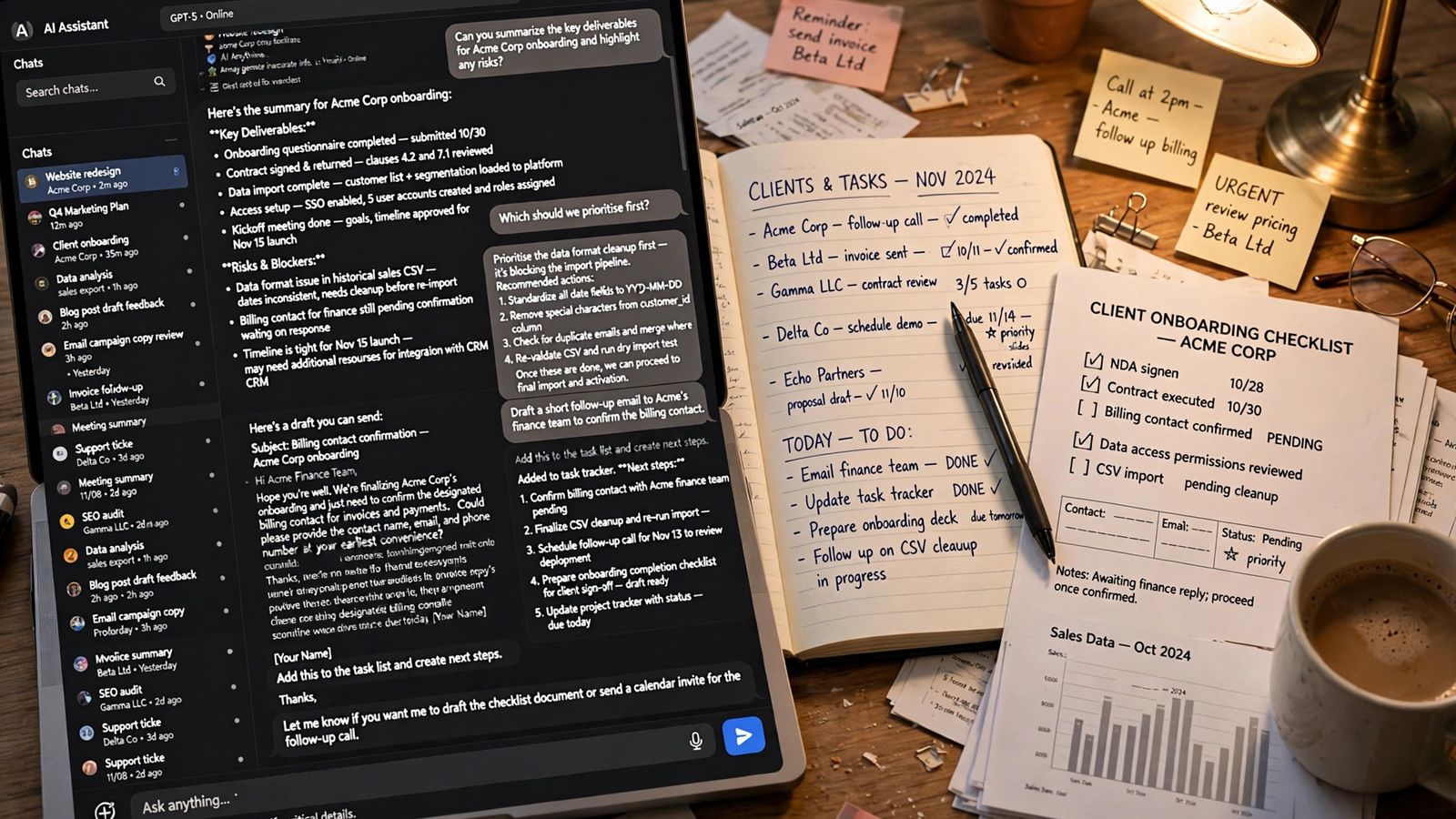
How to make money with ChatGPT comes down to one thing: sell a finished service that a client already pays for — writing, a working chatbot, a month of social posts, admin help, or a tested prompt system — and use ChatGPT to do the drafting faster while you supply the judgement, checking and accountability. Nobody pays for access to a chatbot, and nobody pays for raw AI output. They pay for a blog post that is accurate and in their voice, a support bot that answers correctly, a content calendar that actually goes out. ChatGPT is the power tool; the money is payment for the finished work, not for the tool.
That framing matters because most advice on this topic blurs it. Lists of 12 or 17 “ways” mix client services, audience-building and outright speculation as if they were the same thing, and their income figures usually come with no source, date or method. This guide is narrower on purpose. It covers five services you can sell to an identifiable buyer, explains where those buyers are found, gives charge ranges only where they can be labelled as estimates with a source and a date, and is plain about the difficulties — including that many beginners earn nothing at first.
How to make money with ChatGPT: start with the service, not the tool
Every workable route follows the same sequence. Pick one service and one type of buyer. Build two or three samples that prove you can deliver it. Offer it in a place where that buyer already hires. Deliver carefully, get a review or a referral, then repeat or raise the price. ChatGPT shortens the middle of that sequence — research, outlining, first drafts, variations — but it does not create the buyer, the trust or the quality control. Those remain your job.
One cost decision belongs at the start. You do not need a paid plan to land a first client. OpenAI’s ChatGPT pricing page lists a Free plan alongside paid tiers, with Plus at $20 a month in the US at the time of checking (November 2026). The free tier is enough to produce samples and early client work. The sensible trigger for paying is arithmetic: upgrade when paying work regularly hits free-plan limits and makes the $20 easy to justify; until then it is a cost the business has not earned. OpenAI’s help page on ChatGPT Plus sets out what the paid tier adds. Which model sits behind the plan also affects draft quality, which is why comparisons such as Claude vs ChatGPT matter before you standardise on one tool. Sellers who standardise on the other chatbot instead follow the parallel service routes in how to make money with Claude.
Service 1: Content writing for businesses
This is the most common starting point because the demand is easy to find and easy to understand. Businesses need blog posts, service pages, product descriptions, email sequences and newsletters, and most owners either dislike writing or have no time for it. What you sell is a finished, publishable piece: researched, structured, fact-checked, and written in the client’s voice. What ChatGPT does is the outline, the first draft, headline options and rewrites. What you add is everything that makes it safe to publish — checking every claim against the client’s own sources, cutting generic phrasing, and adding the specific detail a model cannot invent honestly.
Where clients are: freelance marketplaces such as Upwork and Fiverr are the standard first shelf, because buyers arrive there already looking to hire. Direct outreach works alongside them — local businesses with a neglected blog, small online stores with thin product pages. One narrow offer (“product descriptions for small Shopify stores,” “a monthly blog post for local service firms”) is easier to buy than “writing services” in general.
On charges: treat any figure as a benchmark, not a promise. Upwork’s own guide to freelancer earnings put writers at $30–$59 an hour in its 2026 rate round-up, checked in November 2026 — that is what established freelancers in the category charge on that platform, not what a beginner with no reviews will get. Beginners typically start below a category range, often pricing per finished piece rather than per hour, and raise rates as reviews accumulate. Anyone quoting you a monthly income from writing without naming their source is guessing.
The honest difficulty: this is also the most crowded service. Raw, unedited AI text is easy to spot and easy to refuse, and clients who have been burned by it now ask harder questions. Your edge is not speed — everyone has the same tool — it is accuracy, niche knowledge and a voice that sounds like the client.
Service 2: Custom chatbots for small businesses
Many small businesses answer the same twenty questions every day: opening hours, prices, delivery, booking, returns. A chatbot service means building a bot that answers those questions correctly from the business’s own information, knows when to hand over to a human, and gets maintained as prices and policies change. ChatGPT helps you draft and organise the answers, write the conversation flows and sort real customer questions into categories. The building itself is usually done with a no-code chatbot tool or ChatGPT’s own custom-GPT features, and the core of the work is the knowledge base: collecting the client’s actual FAQs, policies and product details, and testing the bot against real questions before launch.
Where clients are: businesses with visible repetitive support — online stores, clinics, salons, training providers, local services with an active inbox. This is rarely a marketplace gig; it is sold by direct approach, ideally with a short demo built from the business’s public FAQ page. Charge for the setup as a project and for upkeep as a small monthly arrangement, since an unmaintained bot quietly starts giving wrong answers. No reliable primary rate source for this service was verifiable for this article, so no figure is quoted — pricing varies sharply with scope, and an invented range would help no one.
The honest difficulty: a chatbot that invents a refund policy creates a real problem for a real business. The failure mode of these systems is the one described in what is an AI hallucination — fluent, confident, wrong. Testing, narrow scope and a clear human handover are not extras; they are the product.
Service 3: Social media content packages
Here the deliverable is a package, not a pile of posts: typically a month of planned content for one or two platforms — topics, hooks, captions, calls to action — matched to the business’s offers and tone. ChatGPT is genuinely good at the volume work: turning one idea into a week of angles, drafting captions in a consistent voice, repurposing a blog post or video into shorter pieces. You supply the local and specific layer — the actual promotion running this month, the local event — and you check that nothing goes out promising something the business does not do.
Where clients are: local businesses are the natural market (cafés, gyms, salons, estate agents, trades), plus online sellers and creators who post inconsistently. Marketplaces list this work too, and Upwork’s freelancer earnings guide put social media managers at $14–$35 an hour in its 2026 round-up, checked in November 2026 — again a category benchmark for the platform, not a beginner guarantee. In practice this service is usually sold as a fixed monthly package rather than by the hour, priced by number of posts and platforms.
The honest difficulty: clients churn when posts feel generic, and generic is ChatGPT’s default setting. The renewal — where this service becomes worthwhile — depends on the package sounding like that specific business every month.
Service 4: Virtual assistance and admin work
Virtual-assistance work is the least glamorous service here and, for many beginners, the most realistic first income. The tasks are ordinary: drafting and tidying emails, summarising meetings, turning rough notes into documents, formatting spreadsheets and reports, preparing slides, doing first-pass research. ChatGPT accelerates nearly all of them, which is why this service works — a client is buying back hours, and you can hand back more hours than a non-AI assistant could in the same time. Handling client files well is part of the craft, and knowing the practical limits described in ChatGPT file upload limits avoids mid-task surprises. For the research-heavy end of this work — briefing packs and source summaries — the workflow in how to use NotebookLM is the natural companion tool.
Where clients are: solo founders, consultants, coaches and small teams are the usual buyers, found on the same marketplaces, through VA agencies, or by direct offer to owners visibly doing their own admin. Upwork’s 2026 round-up, checked in November 2026, put data-entry work at $10–$20 an hour and bookkeeping at $11–$25 — adjacent categories that show where general admin support is priced on that platform. Package a block of hours or a fixed weekly task list rather than open-ended availability.
The honest difficulty: trust is the whole business. You will see inboxes, documents and half-formed plans, so the privacy rules below are not fine print — they are the reason a client keeps you.
Service 5: Prompt services and prompt packs
The fifth service sells the system rather than the output. There are two honest versions. The stronger one is a service: you design, test and document a set of prompts for one profession’s repeated task — property descriptions for estate agents, lesson-plan starters for tutors — and you set it up, train the buyer, and refine it against their real work. The weaker, riskier version is the downloadable prompt pack, sold on a marketplace. Packs are cheap to copy, easy to find free, and several marketplaces restrict or require disclosure for AI-generated products, so a generic bundle of prompts is a poor bet. A tested workflow for a named job, with examples and guardrails, is a different and defensible product.
Where clients are: the same professionals you would sell writing or admin help to — the prompt system is often an upsell after a first service job, when the client has seen the output and wants to produce it in-house. Because no primary rate source for prompt work could be verified for this article, no charge range is given; in practice it is priced as a setup project, like the chatbot, and its value depends entirely on whether it saves the buyer measurable time.
The rules that keep this legitimate
Four rules protect both you and the client. First, know OpenAI’s Usage Policies before selling anything: whole categories of use are restricted, and “the client asked for it” is not a defence. Second, respect ownership and honesty. OpenAI’s Terms of Use assign you the output as between you and OpenAI, but output may not be unique — another user can receive similar text — and the terms bar presenting AI output as human-generated when it was not; several platforms and publishers additionally require you to disclose AI assistance, and a client who asks what tools you used is entitled to a straight answer. Third, protect client data: do not paste customer lists, contracts or personal details into prompts; use placeholders, remove identifying detail, and check the data controls on your plan before handling anything sensitive. Fourth, verify everything factual. Names, prices, dates, statistics and quotes in a draft are claims, not facts, until you have checked them against a real source.
How long does it take, and what usually goes wrong?
Services are the fastest of the routes in this guide because the demand already exists — you are not waiting for an audience or for search traffic — but “fastest” still means a period of unpaid setup: choosing the offer, making samples, writing profiles and pitches, and being ignored or refused before the first yes. What goes wrong is predictable. Beginners pick five services at once and finish none. They send raw drafts and collect bad reviews. They price so low that the work is not worth doing well, or copy an income claim from a video and feel cheated when reality differs. And they treat the first client as the finish line, when the actual business is month two and three with that client.
How to make money with ChatGPT: a realistic starter path
Week one: pick one service and one buyer type, and build two or three samples as if for a real client — a full blog post, a demo chatbot answering a real firm’s public FAQs, a two-week content calendar, a sample inbox-and-summary workflow, or a small tested prompt set. Week two: put up one marketplace profile built around that single offer, and contact a short list of businesses directly with a sample attached and a specific, small proposal. Stay on the free ChatGPT plan until paid work makes the upgrade arithmetic obvious. Deliver the first job carefully, over-check it, and ask for a review. Then decide, from evidence rather than hope, whether to deepen that service or test the next one.
Frequently asked questions
Can you really make money with ChatGPT? Yes, indirectly: by selling work that ChatGPT helps you produce faster. The tool itself pays nothing, guarantees nothing, and gives you no advantage your competitors do not also have. The income, when it comes, is payment for a service a client values.
What is the fastest service to start with? Whichever one matches a skill you already have. For most beginners that is writing or virtual assistance, because samples are quick to make and buyers are easy to find. Chatbots and prompt systems pay as larger projects but take longer to sell, because the client has to trust the setup.
Do I need ChatGPT Plus to start? No. Start on the free plan, make your samples, and find the first client. Plus at $20 a month (US list price, November 2026) makes sense once paying work is regularly hitting free-plan limits.
How much can I charge? Start from evidence: the platform benchmarks quoted above — writers $30–$59 an hour and social media managers $14–$35 an hour on Upwork’s 2026 figures — describe established freelancers, so a beginner should expect to enter below them, usually on fixed per-piece or per-package prices, and rise with reviews. Be suspicious of any guide that states a monthly income as if it were a rate.
This article is general information, checked in November 2026. Charge ranges are labelled estimates drawn from Upwork’s published 2026 freelancer-rate round-up and OpenAI’s public pricing as cited above; they are benchmarks, not earnings data, and no income from using ChatGPT is typical or guaranteed.