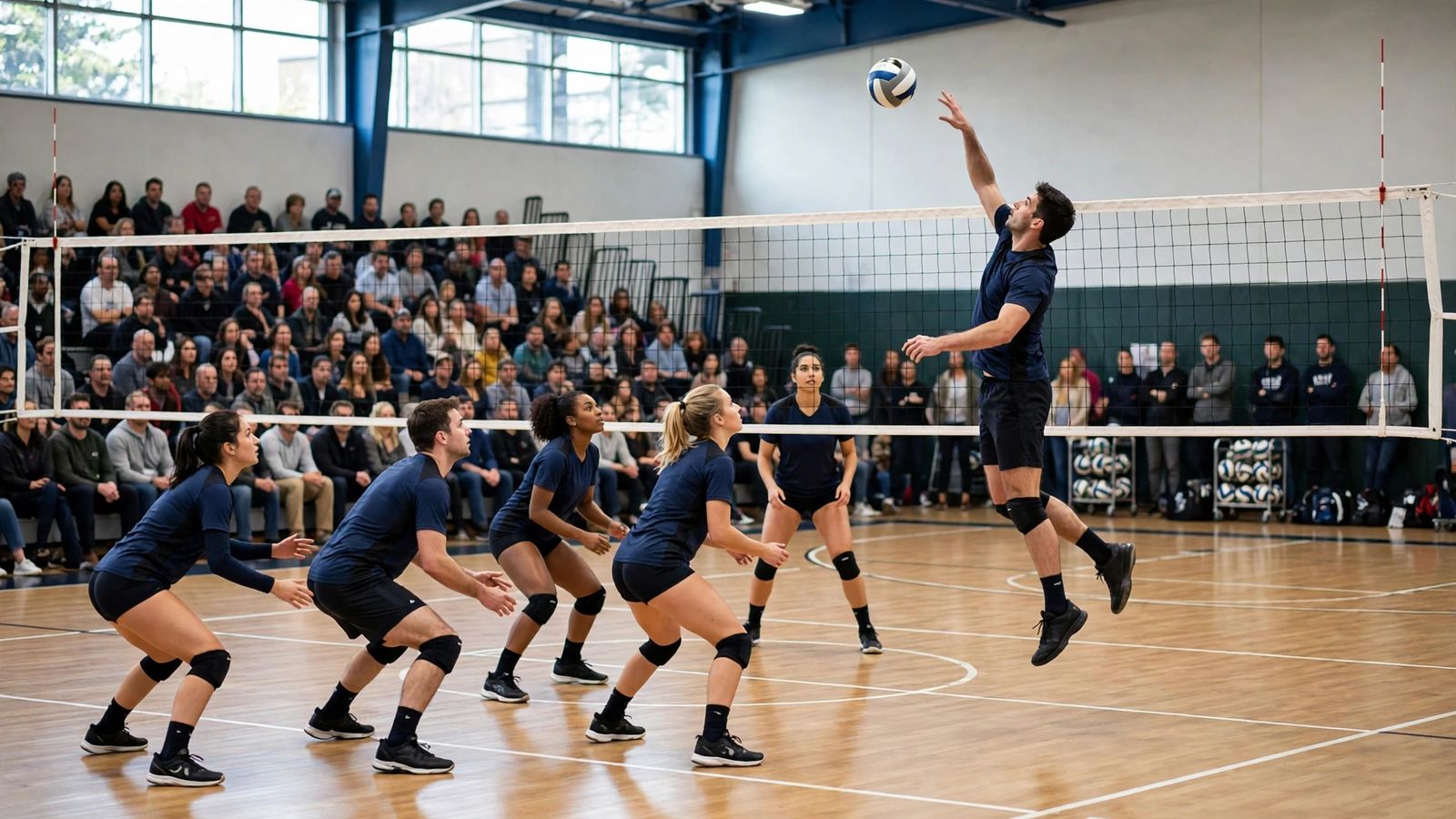
Six players from each team are on the court in indoor volleyball — twelve players in total — and that number is the same at every level of the indoor game, from a school gym to the Olympics. Beach volleyball is the exception: it is played two against two, with no substitutes at all. Everything else about how many players are on a volleyball team depends on whether you mean the six on the court or the larger roster behind them, and the roster number changes with the level: 12 players for a standard match under the international (FIVB) rules, rising to 14 at senior FIVB world and official events, 12 at the Olympic Games, and up to 18 on an NCAA Division I college roster, while US high schools set no single national roster cap at all. This article keeps those two questions — on the court, and on the roster — separate, because most confusion around this topic comes from guides that answer one of them with the other’s number.
The numbers at a glance:
| Level or format | On the court (per team) | Roster |
|---|---|---|
| Indoor, FIVB standard match | 6 | Up to 12 |
| Indoor, FIVB senior world and official events | 6 | Up to 14 on the scoresheet |
| Olympic Games (indoor) | 6 | 12, plus one alternate |
| NCAA college (Division I) | 6 | Roster limit 18; match squads are smaller |
| US high school (NFHS rules) | 6 | No national cap — set by school and state |
| Beach volleyball | 2 | 2 — no substitutes |
| Sitting volleyball | 6 | Set by the event; 12 is typical at major events |
How many players are on a volleyball team on the court?
Six, arranged in two rows of three. The FIVB’s basic rules put it in one sentence: there are six players on court in a volleyball team, and each must rotate one position clockwise every time their team wins back service from the opposition. The three players nearest the net are the front row — the only players who may jump and block or attack close to the net — and the three behind the attack line (the three-metre line) are the back row, who may only attack a ball from behind that line. When the receiving team wins a rally, it also wins the serve, and all six players shift one place clockwise before the next serve: right back (the serving spot, position 1) to middle back, and so on through left back, left front, middle front and right front.
That rotation rule is why lineups look fluid a second after the serve. Players must be in rotational order when the server contacts the ball, but once the rally starts they move to the spots their role calls for — the setter hurries to the net, the hitters take their attacking positions. Their front-row or back-row status travels with them, though: a back-row player who has drifted forward still cannot block, and cannot complete an attack hit on a ball fully above net height from in front of the attack line. The six places are fixed; the jobs done from them are not.
The roster behind the six: 12, 14, and why both numbers are right
The on-court number never changes indoors. The roster number does, by rulebook — which is why one guide says 12, another says 14, and both can be quoting a real rule about a different competition.
The standard FIVB match roster is 12. Rule 4.1.1 of the Official Volleyball Rules 2025–2028 provides that a team may consist of up to 12 players for a match, plus coaching and medical staff. Only players recorded on the scoresheet may play. Six of the 12 start; the rest are substitutes and the libero (explained below), and a team may use a maximum of six substitutions per set — libero replacements do not count against that six.
At senior FIVB world and official competitions, the scoresheet grows to 14. The same rule adds that, for FIVB, World and Official competitions for seniors, up to 14 players may be recorded on the scoresheet and play in a match. Volleyball World’s regulations for events such as the Nations League agree: a team may register up to 14 players and a minimum of 12, with at least one libero listed. So “12” is the general match rule and “14” the senior international-event rule; pages that print one as the single worldwide answer leave half the rule out.
The Olympics stay at 12. Olympic rosters are capped at 12 players, with one additional alternate who can replace an injured player. When USA Volleyball announced its women’s team for Paris 2024, it named exactly that structure: 12 players, plus alternates from whom the one official alternate would be chosen. The tight roster is one reason international coaches prize versatile players.
College rosters are bigger, because a college roster is a season squad, not a match scoresheet. NCAA teams play six against six like everyone else, but the roster behind the six is a programme’s whole group. Following the House settlement, NCAA Division I programmes that opted in moved to a straight roster limit, and the Division I limit for volleyball is 18 players for both the men’s and women’s games. The same settlement set the limits sport by sport — how many players are on a baseball team works through baseball’s cap of 34 in the same framework. Not all 18 feature in every match: NCAA women’s volleyball allows 15 substitutions per set — far more than the FIVB’s six — so college coaches rotate more deeply, but a regular rotation still runs through roughly eight to ten players. Divisions II and III are not bound by the Division I limit; their roster sizes follow school and conference practice.
High school has no national roster number to quote. US high school volleyball is played under NFHS rules, which fix the on-court six and the substitution allowance (18 substitutions per set) but leave roster size to the school and its state association. Varsity rosters commonly run from about 12 to 15 players, but that is custom, not a cap: a small school may dress ten, a large programme more. Any page stating a hard NFHS roster maximum — the pages ranking for this question variously claim 12, 15 and 15 to 20 — is presenting a local habit as a national rule.
The libero: the extra name on the roster who is never a seventh player
Every roster figure above can include a player type no other major court sport has: the libero, a back-row defensive specialist introduced by the FIVB in 1998 to strengthen serve reception and defence and lengthen rallies. The libero is easy to spot — the rules require a contrasting jersey colour, precisely so officials can track the player’s movements on and off the court.
Three facts about the libero settle most of the confusion the position causes:
- The libero never makes seven. A libero does not arrive as an extra player. The libero replaces a back-row player — most often a middle blocker who has rotated back — and that player leaves the court. Six is the total, all match.
- Libero replacements are not substitutions. They are unlimited, can happen whenever the ball is out of play, and do not count against the team’s six substitutions per set under FIVB rules (or the NCAA’s 15) — which is why the same libero can shuttle in and out a dozen times in a set. The player the libero replaced is the one who returns when the libero leaves.
- The job comes with hard limits. The libero plays only in the back row: no blocking, and no completing an attack hit on a ball entirely above the top of the net. One US difference is worth knowing, because it contradicts what many international guides state flatly: in FIVB play the libero cannot serve at all, while NCAA rules allow the libero to serve in one rotation per set, and high school rules follow the US pattern.
How many liberos can a team carry? Up to two, designated from within the roster — they count inside the 12 or 14, not on top of it — and senior FIVB event rosters must include at least one. Only one libero is on court at a time.
The six places, by job: positions at a glance
The rulebook itself only cares about the six rotational spots and the libero. The named positions are the tactical layer teams build on top, and a standard high-level lineup — the 5-1 system, one setter and five attackers — fills the six places like this:
- Setter (1). The playmaker, who takes the second contact and chooses which hitter attacks. In a 5-1 the same setter sets in all six rotations; in a 6-2, two setters set from the back row and hit in the front row.
- Outside hitters (2). The left-side attackers, and usually the team’s main serve receivers. They pass, defend in the back row and attack from both rows — normally the most complete players on the roster.
- Middle blockers (2). The centre front-row players, who run quick attacks through the middle and lead the block. Because back-row passing is usually their weakest skill, the libero replaces them when they rotate back — the most common libero exchange in the sport.
- Opposite (1). The right-side attacker, who lines up opposite the setter in the rotation — when the setter is front row, the opposite is back row, and vice versa — so the team always has a front-row right-side option.
- Libero (from the bench). Not one of the starting six, but on court for roughly half of each set in place of a back-row middle. A defensive specialist is the related bench role: a regular substitute used mainly for back-row defence and passing, whose entries do count as substitutions.
Add the roles up and a roster’s arithmetic explains itself: two setters, three or four outside hitters, three middle blockers, one or two opposites and one or two liberos or defensive specialists cover every job twice over. The same court-versus-roster split drives the answer to how many players are on a basketball team — five on the court there, with league rosters behind them.
Beach volleyball and the other formats
Beach volleyball is two players per team, full stop. The FIVB’s beach rules state that beach volleyball is played by two teams of two players each, that both players must always be in play, and that there is no substitution or replacement of players during a game. With no bench and no libero, both players do everything — serve, pass, set, attack, block and dig — on a smaller sand court (16 by 8 metres, against the indoor 18 by 9). If a beach player cannot continue, the pair cannot borrow a third player; the match is forfeited. The contrast is the sharpest in the whole topic: the indoor team’s problem is choosing which six of 12 or 14 to use, and the beach pair has no choice to make at all.
One US college wrinkle deserves a sentence, because it produces a “10 players” answer that is also correct in its own terms: NCAA beach volleyball is contested as a dual, in which a school fields five pairs — ten athletes — across five simultaneous matches, each match still two against two. Ten is the dual squad, not the team on one court.
The remaining formats are quick to place. Sitting volleyball, the Paralympic game played seated on a smaller court with a lower net, keeps the indoor shape: six per team on the court. Recreational and grass volleyball flexes the number by agreement — fours and triples are common outdoors — but those are league formats, not a different rulebook answer. And if the smaller-court net game you are thinking of uses paddles rather than hands, that is a different sport entirely: see pickleball rules.
Frequently asked questions
How many players are on a volleyball team in total? On the court, six indoors and two in beach — those numbers never change. In total it depends on the level: 12 for a standard FIVB match, up to 14 on the scoresheet at senior FIVB world and official events, 12 at the Olympics, up to 18 on an NCAA Division I roster, and however many a high school chooses to carry, since NFHS rules set no national cap.
How many players are on the court in a volleyball game? Twelve indoors — six per team, three front row and three back. A beach game has four in total, two per team.
How many substitutes does a volleyball team have? On a standard 12-player FIVB roster, six players start and up to six are available off the bench, one or two of them liberos whose replacements do not count as substitutions. Substitution limits per set: six under FIVB rules, 15 in NCAA Division I women’s play and 18 under NFHS high school rules.
Is the libero a seventh player? No. The libero replaces a back-row player, who leaves the court, so the team still has six in play. The contrasting jersey marks a special replacement status, not an extra position.
How many players are on a beach volleyball team? Two, with no substitutes: both players play the whole match, and a pair that loses a player to injury forfeits. A college beach dual fields ten athletes in five pairs, but each match is still two against two.
How many players does a team need to start a volleyball match? Six indoors — a team that cannot put six on the court, and keep six in play through legal substitutions, is declared incomplete under the FIVB rules. Beach volleyball starts and finishes with its two.
This article is general information based on the FIVB Official Volleyball Rules 2025–2028 and the FIVB’s published basic rules for the indoor and beach games, Volleyball World competition regulations, and NCAA and NFHS guidance linked and described above, checked in November 2026. Roster and substitution rules change with new rule editions and event regulations — the governing body’s current rulebook is the authority for any specific competition.