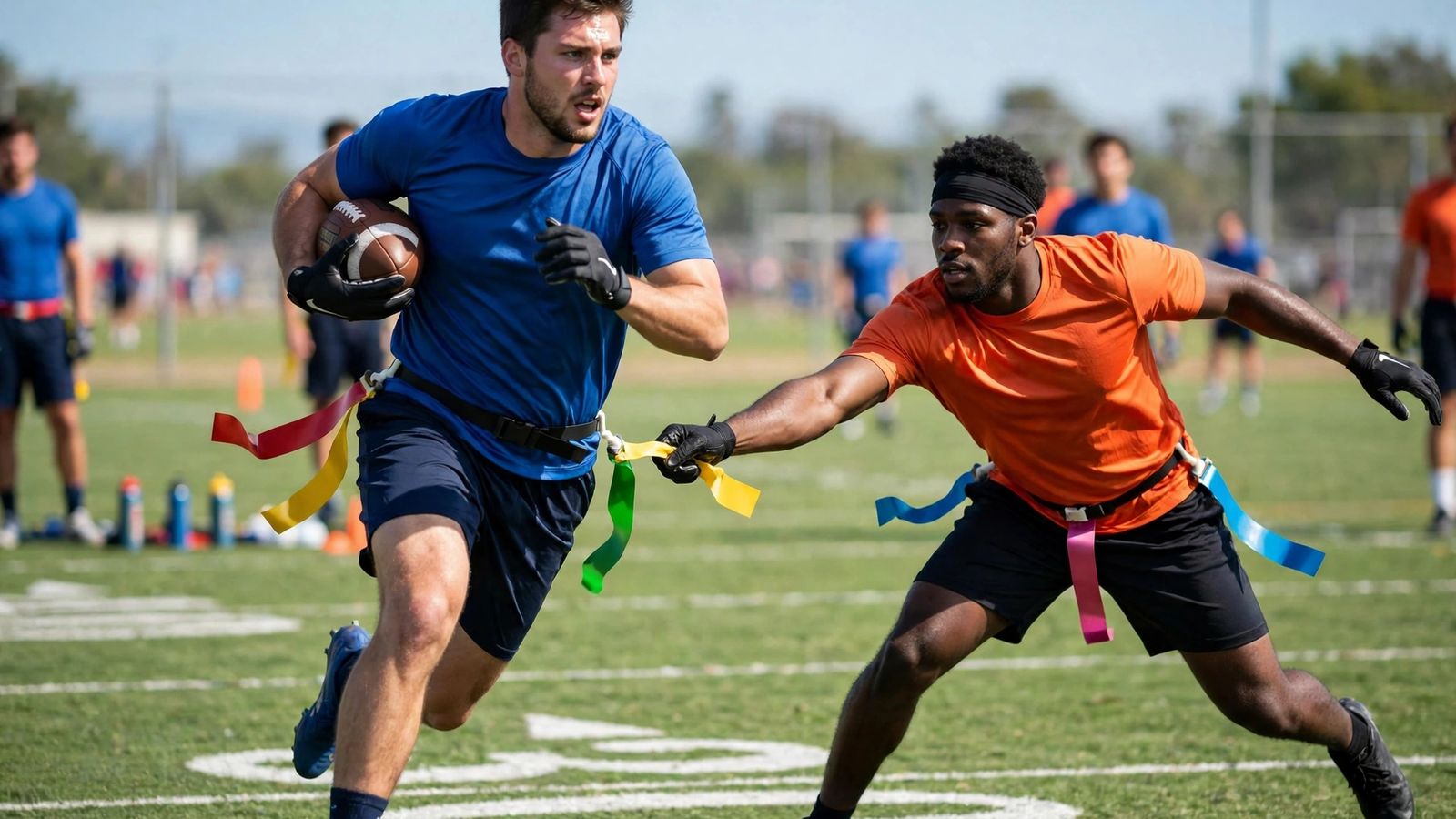
Flag football rules replace the tackle with a flag pull: a defender stops the ball carrier by pulling one of the flags hanging from the carrier’s belt, and the play ends on that spot. Everything else — downs, passing, scoring — works like a smaller, faster version of American football, with no tackling, no blocking and no kicking in the standard game. The one thing that decides the details is format. 5v5 is the standard: it is the format of NFL FLAG, the largest youth programme in the United States, and of the Olympic tournament at Los Angeles 2028, under the international IFAF rulebook. The main alternative is 7v7, the format of girls’ high school flag football under the NFHS rulebook and of the US college game — and it differs from 5v5 on field size, game length, the pass rush and even whether the quarterback may run. Most confusion about this sport comes from reading one format’s numbers as if they applied to the other, so this article keeps the two apart.
The three rulebooks, at a glance:
| IFAF 5v5 (Olympic) | NFL FLAG 5v5 (youth) | NFHS 7v7 (high school) | |
|---|---|---|---|
| Players on the field | 5 per side | 5 per side | 7 per side |
| Field of play | 50 × 25 yards, plus 10-yard end zones | 50 yards between the goal lines, 30 yards wide, 10-yard end zones (70 yards in total) | State’s choice of three sizes, up to a full high school field |
| Downs | 4 to cross midfield, then 4 to score | 4 to cross midfield, then 3 to score | 4 to reach the next zone line |
| Game length | Two 20-minute halves | Two halves of 15–25 minutes, set by the league | Four 12-minute periods |
| Quarterback run | Not straight off the snap | Not allowed off the snap | Allowed |
| Pass rush | Up to 2 blitzers, from 7+ yards back | Up to 2 rushers, from 7 yards back | Any number, from 1 yard back |
| Blocking | None | None | Screen blocking only |
| Kicking | None | None | Only if the state adopts it |
How does flag football work?
A game starts without a kickoff — there are no kickoffs, punts or field goals in 5v5 at all. The offense takes the ball at its own 5-yard line and tries to reach the opponent’s end zone in a series of downs, as in tackle football, except that the line to gain is not 10 yards away. In 5v5 the field is split in two: the offense gets four downs to cross midfield, and crossing it earns a fresh set of downs to score. Fail, and the other team takes over at its own 5-yard line. An interception can be caught and returned for a touchdown.
Each play starts with a snap from the center to the quarterback. Only one forward pass is allowed per play, thrown from behind the line of scrimmage, and it must be caught beyond the line. Handoffs, pitches and laterals are legal behind the line. Because there is no blocking, the offense cannot build a wall for its quarterback — the rules protect the passer directly, through the rush line and pass clock described below. When a flag is pulled, the ball is spotted where the pull happened. A ball that hits the ground is dead at that spot: there are no fumbles to scramble for. After a score, the other team starts again from its own 5.
Flag football rules on contact: the flag pull is the tackle
Flag football is a non-contact sport, and NFL FLAG’s own summary of its basic rules puts it first: no tackling, no blocking, no screening, no diving at a runner. The flag pull does all the work a tackle does in the other code. Every player wears a belt with flags at the hips — two in the IFAF and NFL FLAG games, three on many high school belts — and a legal pull while the carrier has the ball ends the play. If a flag falls off on its own, the carrier is down at that spot in most rulebooks.
The ban runs in both directions. A defender may not hold, push, wrap up or run through the carrier to reach the flag, and may not strip the ball. The carrier may not flag guard: stiff-arming, or dropping a hand, arm or shoulder over the flags, is a penalty, as is charging into a defender who has position. Spinning and cutting are legal; jumping, leaping or diving to avoid a pull are not. Contact penalties cost more than procedural ones — under IFAF rules, illegal contact and pass interference carry 10 yards against 5 for most non-contact fouls, and flag guarding adds a loss of down.
Two linked rules keep the passing game fair without blockers. First, the rush line: a rusher must start at least 7 yards behind the line of scrimmage — in IFAF and NFL FLAG play at most two defenders may blitz, identifying themselves by raising a hand before the snap. Second, the pass clock: in NFL FLAG the quarterback has 7 seconds to get rid of the ball, or the play is dead and the down is lost. Together these replace the offensive line: a protected window, but not an unlimited one.
The field, the no-run zones and the downs
The IFAF field, set out in the IFAF Flag Football Rules 2023, is 50 yards long and 25 yards wide, with a 10-yard end zone at each end — 70 yards in total. NFL FLAG’s published field is the same overall footprint: 30 yards wide by 70 yards long including the end zones, with midfield as the line to gain. One honest complication: NFL FLAG rulebook editions have also printed 25-yard widths and a 64-yard option with 7-yard end zones, so measure by your league’s paperwork, not a generic diagram.
Marked on that field are the no-run zones, a rule with no tackle-football equivalent. In NFL FLAG they sit 5 yards before midfield and 5 yards before each goal line; inside them the offense may not run at all — every play must be a pass, even after a handoff. The point is to stop power running in tight spaces, where contact would creep back in. IFAF’s zones guard the goal line the same way. NFL FLAG drops them for its youngest divisions (8U and under in regular-season play).
The downs system follows from the field. There is no 10-yard chain: in 5v5 it is four downs to cross midfield, then a fresh set — four more under IFAF, three more under NFL FLAG, the most-quoted difference between the two 5v5 rulebooks. In 7v7 the field is divided into zones instead (commonly 20-yard zones), with four downs to reach the next zone line.
5v5 vs 7v7: the differences that actually change the game
The extra two players per side in 7v7 are not just more bodies. They change what the sport is.
Space and style. Five-a-side on a 25-yard-wide field leaves huge gaps: nearly every offensive player is a receiver, routes are run against single coverage, and scores come quickly. Seven-a-side crowds the field, allows more specialised roles, and plays closer to tackle football’s structure. Small-sided versions of big sports all make this trade — pickleball compresses a net game onto a small court in the same spirit, as pickleball rules shows.
The quarterback. In both 5v5 rulebooks the player who takes the snap cannot simply run past the line of scrimmage; the ball must first be handed off or pitched before a run develops. In NFHS 7v7 the quarterback can run, which restores the quarterback keeper as a real threat and changes how defenses line up — you can see this difference within the first series of each format.
The rush and blocking. The 5v5 games hold rushers 7 yards back, cap them at two, and ban blocking outright. The NFHS game lets any number rush from a 1-yard neutral zone and permits screen blocking — taking a defender’s path without contact — so its pass protection looks much more like the tackle game’s. This is the biggest on-field split between the rule families.
The clock and the field. 7v7 high school games run as four 12-minute periods with a tackle-style clock, on fields the state chooses from the NFHS options — 80, 100 or 120 yards between the goal lines, 40 or 53⅓ yards wide, with 10-yard end zones. The NFHS published its first flag football rules book in 2025, written for 7v7, and most sanctioning states have adopted it, though each state still sets details such as the mercy rule, overtime and whether place kicking exists.
How long is a flag football game?
By format, because there is no single answer:
- IFAF / Olympic 5v5: two 20-minute halves — 40 minutes of playing time, on a mostly running clock that stops in the last 2 minutes of each half. Plan on about an hour in the venue — far shorter than a tackle game, as how long is a football game shows.
- NFL FLAG 5v5: two halves, length set by the league — NFL FLAG’s global guidance puts them at 15 to 25 minutes each, and tournaments often use shorter halves. Most youth games are done inside an hour.
- NFHS 7v7: four 12-minute periods — 48 minutes of playing time, with tackle-style clock stoppages, so a high school game typically runs longer than a 5v5 game.
If the scores are level, 5v5 overtime gives each team a short series from midfield rather than the open-ended extra period described in NFL overtime rules.
Scoring: familiar numbers, no kicks
Scoring barely changes between rulebooks:
| Score | Points |
|---|---|
| Touchdown | 6 |
| Try (extra point) from the 5-yard line | 1 |
| Try from the 10-yard line | 2 |
| Safety (carrier downed in their own end zone) | 2 |
| Interception returned on a try | 2 |
The try replaces the kicked extra point: after a touchdown the scoring team runs one more play from scrimmage, choosing the 5-yard line for 1 point or the 10-yard line for 2; the 1-point try is a pass play. A safety works as in tackle football — pull the carrier’s flag in their own end zone — and an interception returned all the way is a 6-point defensive touchdown. Kicking appears only in the high school game, and only where a state has adopted it: there a field goal can be worth 3 points, which is why some school scoreboards show numbers no 5v5 game can produce. Full NFL FLAG answers are collected in the NFL FLAG FAQ.
Positions in 5v5: everyone is a receiver
With no linemen, positions are roles rather than fixed posts, and most players work both ways — a sharp contrast with tackle football, where how many players are on an NFL team runs to a 53-man roster. On offense in 5v5:
- Quarterback — takes the snap, reads the coverage, and must pass or hand off within the pass clock; cannot run straight off the snap.
- Center — snaps the ball, then releases downfield as a receiver; often the quarterback’s safest short option.
- Receivers / backs — the other three offensive players: they run routes, take handoffs and pitches behind the line, and can throw after receiving a handoff.
On defense, the rusher (or two) attacks from the 7-yard line, defensive backs cover receivers one-to-one and make most flag pulls, and a safety patrols deep. In 7v7 the extra players usually become an additional receiver and rusher on one side and extra coverage on the other.
Equipment is short: a flag belt, a football sized to the age group, and a mouthguard — required in NFL FLAG play. Helmets and shoulder pads are banned under IFAF rules, and metal cleats are not allowed.
Frequently asked questions
What are the basic flag football rules? No tackling, blocking or screening; pull a flag to stop the carrier. The offense starts at its own 5-yard line, gets four downs to cross midfield and a fresh set to score, may throw one forward pass per play from behind the line, and must pass inside the no-run zones. A ball on the ground is dead — there are no fumbles.
Is flag pulling really the same as a tackle? In effect, yes: it is the only legal way to stop a ball carrier, it ends the play immediately, and the ball is spotted where the pull happened. Holding or wrapping up the carrier to get at the flag is a penalty.
How many players are on a flag football team? Five per side on the field in NFL FLAG and Olympic play; seven per side in NFHS high school and US college play. Rosters are larger — IFAF squads may carry up to 15, NFL FLAG tournament rosters 10 — with free substitution between plays.
Can the quarterback run in flag football? Not straight off the snap in 5v5: in NFL FLAG the quarterback may not cross the line of scrimmage with the ball at all, and in IFAF play only after another player has possessed the ball. In NFHS 7v7 high school play, the quarterback can run.
What is a no-run zone? The 5 yards before a line to gain — before midfield and each goal line in NFL FLAG, before the goal line in IFAF play. Inside it, every play must be a pass.
How long is a flag football game? Two 20-minute halves at IFAF/Olympic level; two halves of 15–25 minutes in NFL FLAG, set by the league; four 12-minute periods in NFHS high school play.
Is flag football an Olympic sport? Yes — it debuts at Los Angeles 2028 in the IFAF 5v5 format, with men’s and women’s tournaments of six teams each.
This article is general information based on the IFAF Flag Football Rules 2023, NFL FLAG’s published rules and guidance, and the NFHS flag football framework, checked in November 2026. Flag football has no single rulebook: your league’s or state association’s adopted rules govern your game — check them before the season starts.