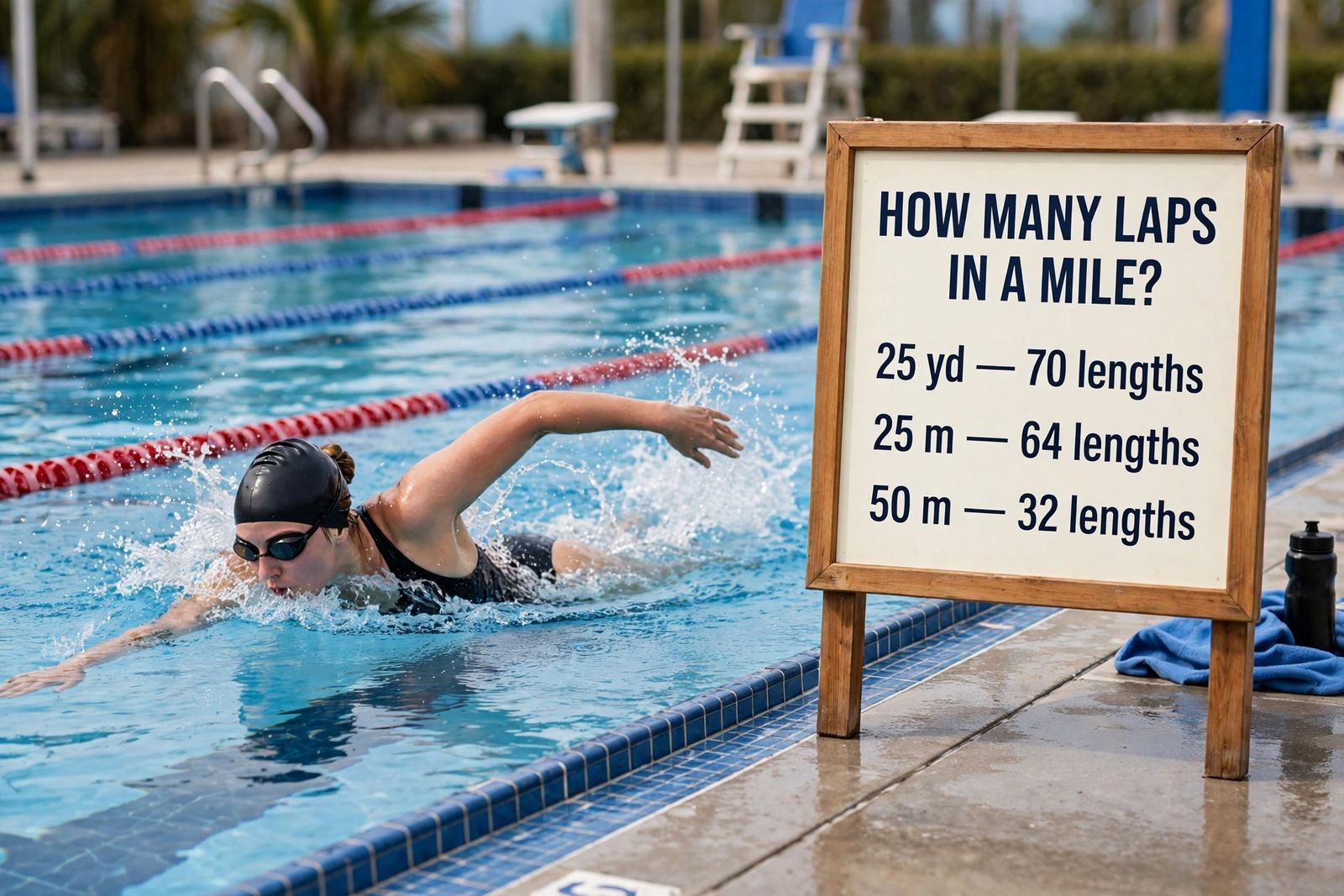
A true mile — 1,760 yards, or 1,609.34 metres — is 70.4 lengths of a 25-yard pool, 64.4 lengths of a 25-metre pool, or 32.2 lengths of a 50-metre pool. If you count a lap as a full round trip, down and back, halve those numbers: 35.2 laps, 32.2 laps and 16.1 laps respectively. Those are the figures U.S. Masters Swimming (USMS) gives for an exact mile, and they are the numbers this article is built on. One complication explains almost every other answer you will see: competitive swimming does not race a true mile. Its longest freestyle events — the 1,650-yard freestyle in yard pools and the 1,500-metre freestyle in metre pools — are both called “the mile,” and both fall about 6–7% short of one. So “66 laps” and “70.4 laps” can both be answers to this question, for the same 25-yard pool, depending on which mile you mean. The table below separates them, pool by pool, in both lengths and laps.
The answer by pool: lengths and laps, for all three “miles”
A length is one trip from wall to wall. A lap, in the strict sense USMS uses, is down and back — two lengths. Many swimmers and coaches use “lap” to mean a single length, which is why this table gives both counts for every pool. Read the row for your pool and the column for the mile you actually intend to swim.
| Pool | True mile (1,760 yd / 1,609.34 m) — lengths | True mile — laps (down and back) | Swimming mile, 1,650 yd — lengths / laps | Metric mile, 1,500 m — lengths / laps |
|---|---|---|---|---|
| 25 yards (short course yards) | 70.4 | 35.2 | 66 / 33 | 65.6 / 32.8 |
| 25 metres (short course metres) | 64.4 | 32.2 | 60.4 / 30.2 | 60 / 30 |
| 50 metres (long course / Olympic) | 32.2 | 16.1 | 30.2 / 15.1 | 30 / 15 |
| Open water | 1,609.34 m — no walls, no laps | — | Not raced as 1,650 yd | Not raced as 1,500 m in open water |
Two patterns in that table matter more than any single number. First, a true mile is never a whole number of lengths in any standard pool — it always ends part-way down a length (10 yards into the 71st length of a 25-yard pool, 9.34 metres into the 65th length of a 25-metre pool). That awkward fraction is the entire reason the substitute distances exist. Second, the substitutes are only tidy in their home pool: the 1,650 is a clean 66 lengths only in a 25-yard pool, and the 1,500 is a clean 60 or 30 lengths only in metre pools. Carry either distance into a different pool and it becomes just as fractional as the true mile it replaced.
In open water there is nothing to count: a mile swim is simply 1,609.34 metres of measured course, which is the distance triathlons and open-water races use. If you are training in a pool for an open-water mile, train to the true-mile row of the table, not to the 1,650 or the 1,500.
What to actually swim: whole lengths that reach the mile
Because you cannot stop mid-length and call it a finish at the wall, the practical question is how many whole lengths meet or pass a true mile:
| Pool | Whole lengths to reach or pass a true mile | Distance that gives you |
|---|---|---|
| 25 yards | 71 lengths (70 lengths is 1,750 yards — 10 yards short) | 1,775 yards |
| 25 metres | 65 lengths (64 lengths is 1,600 metres — 9.34 metres short) | 1,625 metres |
| 50 metres | 33 lengths (32 lengths is 1,600 metres — 9.34 metres short) | 1,650 metres |
USMS notes that lifeguards often round the other way for convenience — 70 or 72 lengths in a 25-yard pool, 64 or 66 in a 25-metre pool, 32 or 34 in a 50-metre pool — because an even number of lengths brings you back to the end where you started. That is fine for a workout. Just know which side of the mile your rounded number lands on: 70 lengths of a 25-yard pool and 64 lengths of a 25-metre pool are both under a true mile, while 72, 66 and 34 are over it.
This is also where several popular guides go visibly wrong, so it is worth being precise. One widely shared guide tells readers who want a full mile to take the race distance and “add another 2 lengths in a 50-metre pool, 4 more lengths in a 25-metre pool.” That arithmetic gives 32 lengths and 64 lengths — 1,600 metres in both cases — which is still 9.34 metres short of a true mile, not a full mile at all. The correct whole-length targets are 33 and 65. Other pages in this search carry larger errors: one states a mile is “72 lengths in a 25-metre pool” (it is 64.4), another mixes yards into a metre-pool row to produce a count that matches no definition of a mile, and one describes the 1,500-metre metric mile as “about 260 yards shorter than a true mile” — the real gap is about 120 yards (1,500 metres is about 1,640 yards). Even USMS’s own article contains a slip, calling the metric event the “1500-yard freestyle” where it plainly means the 1,500-metre freestyle. The figures in the tables above are not taken on trust from any of them: each one is the division shown in the formula section below, checked against USMS’s stated exact values of 70.4, 64.3736 and 32.1868 lengths.
Lap or length? The argument that doubles or halves your swim
No question in lap swimming causes more confusion, and USMS is explicit that both usages are in circulation: traditionally a lap is a round trip, while many coaches and programmes use lap and length interchangeably for a single wall-to-wall trip. Competitive timing and lap-counting practice treats one lap as one length — a counter for a 1,650 shows a new number at every wall — while many recreational swimmers, and some pool signs and workout apps, count a lap as down-and-back.
There is no authority that settles this for your pool session, so settle it before you start:
- If your workout, app or coach says “66 laps” for a mile in a 25-yard pool, they mean 66 lengths — the 1,650-yard swimming mile.
- If someone tells you a mile is “about 35 laps” in the same pool, they mean round trips — 35.2 of them make a true mile.
- The safe habit is to plan in lengths and yards or metres, not in laps. Lengths and distance mean the same thing in every pool; laps do not. Write your target as “71 lengths / 1,775 yards” and no definition can halve or double it by accident.
The identical ambiguity affects land sport in reverse: on a track or a road course nobody counts laps at all, which is why how many miles is a marathon can be answered with a single fixed distance — 26.2 miles — while a pool mile needs a table.
The swimming mile: why 1,650 yards is called a mile at all
The 1,650-yard freestyle is the longest standard freestyle event in short-course yards competition — the event list in the USA Swimming Rulebook runs the freestyle distances up to the 1,650-yard / 1,500-metre pairing — and swimmers simply call it “the mile.” USMS states the facts plainly: the event is 66 lengths, or 33 laps, of a 25-yard pool, and it falls 110 yards, or 6.25%, short of a true mile. In distance terms, 1,650 yards is 1,508.76 metres — 0.94 of a true mile.
The reason for the odd number is the fraction problem from the table above. A true mile in a 25-yard pool is 70.4 lengths: a race cannot finish four-tenths of a length from a wall. Sixty-six lengths is a clean, raceable distance close to a mile that starts and finishes at walls, so it became the standard — the nearest tidy substitute, not a measurement of a mile. The metre world made the same choice independently: the 1,500-metre freestyle, raced since the 1908 Olympics and the longest pool event at the Games, is exactly 60 lengths of a 25-metre pool or 30 lengths of a 50-metre pool, and it falls 109.34 metres, or 6.8%, short of a true mile (USMS’s figures). Hence “metric mile.”
Which one should you swim? It depends on what the number is for:
- Racing or comparing with other swimmers: swim the event distance for your pool — 1,650 yards or 1,500 metres. That is the distance with records, time standards and a name everyone in the sport recognises.
- A fitness goal, a charity mile, or triathlon and open-water preparation: swim a true mile — 71, 65 or 33 whole lengths by the table above. A challenge that says “swim a mile” almost always means the real 1,609.34 metres, and the race distances leave you 100 metres or more short of it.
- Following a training plan that just says “mile”: check the plan’s own definition before you count. Plans written around US pool racing usually mean 1,650 yards; plans written for open water usually mean the true mile.
Work it out for any pool: the formula
Every number in this article is one division:
Lengths = distance ÷ pool length (using the same unit for both)
- True mile in yards: 1,760 ÷ pool length in yards. In a 20-yard hotel pool: 1,760 ÷ 20 = 88 lengths, the example USMS itself gives.
- True mile in metres: 1,609.34 ÷ pool length in metres. In a 30-metre pool: 1,609.34 ÷ 30 = 53.6 lengths.
- Swimming mile: 1,650 ÷ pool length in yards (66 in a 25-yard pool). Metric mile: 1,500 ÷ pool length in metres (60 in a 25-metre pool, 30 in a 50-metre pool).
- To convert a length count into round-trip laps, divide by two. To check a count, multiply back: lengths × pool length should give you the distance you intended.
One conversion underlies the mixed rows of the main table: 1 yard is exactly 0.9144 metres, so 1,650 yards is 1,508.76 metres and 1,500 metres is about 1,640.4 yards. That is also why a 25-metre pool is not interchangeable with a 25-yard pool even though both are called “25”: the metre pool is about 2.34 metres — roughly 9% — longer per length, and over a mile that difference is worth six lengths (70.4 versus 64.4). If your pool was built in yards and you count it as metres, or the other way round, your “mile” will be wrong by more than the entire gap between the true mile and the swimming mile. If you do not know your pool’s length or its unit, ask the operator — guessing the unit is the single most common way this calculation goes wrong. USMS takes the underlying measurement seriously for competition: its rule book requires pools to be measured with a steel tape or a laser device accurate to at least ±0.005 metres, with no minus tolerance on the stated length, so that records mean the same thing from pool to pool.
How long does a mile swim take?
There is no official time, only your pace held over the distance — so, as with the lap counts, the honest answer is arithmetic. For a true mile (1,609.34 metres), at a steady pace per 100 metres:
| Pace per 100 m | Time for a true mile (1,609 m) |
|---|---|
| 1:30 | about 24:09 |
| 1:45 | about 28:10 |
| 2:00 | about 32:11 |
| 2:15 | about 36:13 |
| 2:30 | about 40:14 |
| 3:00 | about 48:17 |
Every row is simply the pace multiplied by 16.09. Read it realistically: a pace you can hold for 100 metres fresh is not the pace you will hold for sixteen of them back to back, and rest at the wall is not in these numbers — they are swimming time, not the clock time of a session with stops. The 1,650-yard swimming mile at the same effort takes a little less, because it is a shorter distance: at 2:00 per 100 yards it is 33 minutes of swimming (16.5 hundreds × 2:00). Counting is the other practical problem over 60-plus lengths: swimmers lose track, which is why distance races appoint a counter to show the length count at the far wall, and why lap swimmers break the mile into hundreds — 4 lengths is 100 yards in a 25-yard pool, so the swimming mile is 16 hundreds plus a final 50, a much smaller set of numbers to hold in your head than 66 individual lengths.
Frequently asked questions
How many laps is a mile in a 25-yard pool? A true mile is 70.4 lengths — 71 whole lengths (1,775 yards) to reach or pass it at a wall — or 35.2 laps if a lap means down and back. The competitive “swimming mile” swum at meets is shorter: 1,650 yards, exactly 66 lengths or 33 round-trip laps.
How many laps is a mile in a 25-metre pool? A true mile is 64.4 lengths — 65 whole lengths (1,625 metres) to reach or pass it — or 32.2 round-trip laps. The 1,500-metre metric mile is exactly 60 lengths. Note that 64 lengths is 1,600 metres, which is 9.34 metres short of a true mile, despite guides that present 64 as the full-mile count.
How many laps is a mile in a 50-metre pool? A true mile is 32.2 lengths — 33 whole lengths (1,650 metres) to reach or pass it — or 16.1 round-trip laps. The 1,500-metre metric mile is exactly 30 lengths.
Is 66 laps a mile? 66 lengths of a 25-yard pool is 1,650 yards — the competitive swimming mile, and the distance most US swimmers mean by “the mile.” It is not a true mile: it falls 110 yards (6.25%) short of 1,760 yards, a fact USMS states directly. If your goal is a full mile, swim 71 lengths in that pool.
Is a lap the same as a length in swimming? A length is always one wall-to-wall trip. A lap traditionally means down and back (two lengths), but many coaches, programmes and swimmers use lap to mean a single length, and USMS notes both usages coexist. State your count in lengths and distance and the ambiguity disappears.
How many laps is a mile in open water? None — there are no laps. An open-water mile is a measured 1,609.34 metres, the true mile. Pool training for it should use the true-mile counts: 71 lengths of a 25-yard pool, 65 of a 25-metre pool or 33 of a 50-metre pool.
How many laps is half a mile swimming? Half a true mile is 880 yards or about 804.7 metres: 35.2 lengths of a 25-yard pool, 32.2 lengths of a 25-metre pool, or 16.1 lengths of a 50-metre pool — halve any figure in the main table. For a different kind of counting question in this section, see how many players are on a basketball team.
This article is general information, based on U.S. Masters Swimming’s “How Many Laps Make a Mile in Swimming?” and the USA Swimming Rulebook linked above, checked in November 2026. All length and lap counts are arithmetic from 1 mile = 1,760 yards = 1,609.34 metres and 1 yard = 0.9144 metres, as shown in the formula section; pool lengths and challenge distances at your own facility are set by its operator.