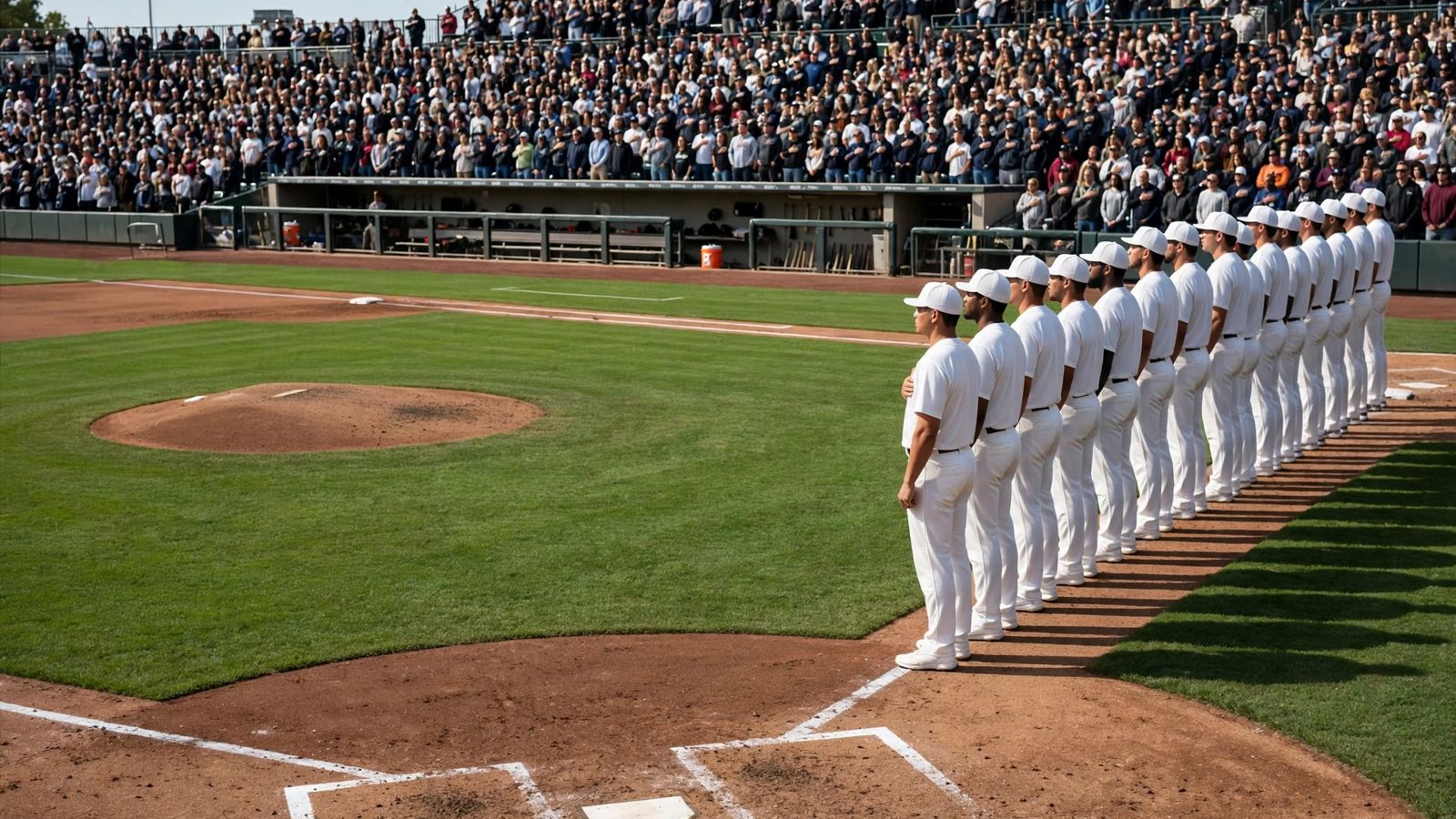
Nine players from each team are on the field, an MLB club carries 26 players on its active roster, and 40 players on its full roster — and almost every argument about how many players are on a baseball team comes from mixing up those three numbers. The on-field number is a rule of the game itself and never changes: nine defenders, in nine fixed positions, at every level from Little League to the World Series. The other two are MLB roster rules answering different questions. The 26-man active roster is the group eligible to play in today’s game. The 40-man roster is the wider pool under major league contract from which that 26 must be drawn. In September the active number rises to 28, and below the majors the numbers change again — 34 is now the NCAA Division I cap, while high school and youth teams size their rosters under their own associations’ rules. Keeping the three numbers separate is the whole answer.
The numbers at a glance:
| Measure | Number |
|---|---|
| On the field per team (defence) | 9 |
| In the batting lineup | 9 (including the designated hitter) |
| MLB active roster, Opening Day to 31 August | 26 |
| Maximum pitchers on the active roster | 13 (14 in September) |
| MLB active roster, 1 September to end of regular season | 28 |
| Temporary doubleheader addition | 27th player, that day only |
| MLB postseason roster | 26 |
| MLB 40-man roster (full contract pool) | 40 |
| Triple-A active roster | 28 |
| NCAA Division I roster cap | 34 |
| High school varsity roster | No national cap — typically 15–20 |
| Little League Majors roster | Typically 12–15 (12–14 for International Tournament play) |
The one number that never changes: nine on the field
Rule 1.01 of the Official Baseball Rules defines the game in its first sentence: baseball is a game between two teams of nine players each. When a team is on defence, all nine are on the field. When it bats, it sends one hitter to the plate at a time, with any runners who have reached base — the rest of the lineup waits in the dugout. So “18 players on the field” answers, which some guides give, count both teams’ defensive nines across a whole game; at any one moment, only one team’s nine are fielding.
The nine positions are fixed, and scorekeepers have numbered them the same way for generations:
| No. | Position | What the player does |
|---|---|---|
| 1 | Pitcher | Throws each pitch from the mound |
| 2 | Catcher | Receives the pitch, calls the game, controls the running game |
| 3 | First baseman | Takes throws across the infield |
| 4 | Second baseman | Covers the right side of the infield; turns double plays |
| 5 | Third baseman | Guards the left-field line; makes the long throw across |
| 6 | Shortstop | The most range-demanding infield spot, between second and third |
| 7 | Left fielder | Tracks fly balls in left |
| 8 | Center fielder | Covers the most outfield ground |
| 9 | Right fielder | Needs the strongest outfield arm, for the throw to third |
One modern wrinkle confuses the count. Since 2022, MLB uses a universal designated hitter: the DH bats in place of the pitcher. Guides that say a team then has “10 players in the lineup” are wrong. The batting order still has exactly nine spots — the DH occupies one, and the pitcher simply does not bat. Nine players bat and nine field, but they are not quite the same nine: eight position players do both, the pitcher fields without batting, and the DH bats without fielding.
The nine is enforced, too. Under Rule 7.03(b), a game is forfeited when a team is unable or refuses to place nine players on the field. There is no eight-against-nine version of a regulation game.
How many players are on a baseball team in MLB? The 26-man active roster
For most of the season, the working size of an MLB team is 26 players. From Opening Day through 31 August, each club must carry at least 25 and no more than 26 players on its active list — the full detail is set out in the MLB roster rules compiled from the league’s regulations — and those 26 are the only players who can appear in a game. The starters, the bench and the bullpen all come out of the same 26.
Not all 26 spots can go to pitchers. A club may carry a maximum of 13 pitchers, which in practice fixes the split most teams use: 13 pitchers and 13 position players. A qualifying two-way player — one who both pitches and hits to the standard the rules set — is the exception: he counts as a position player for this limit rather than against the pitcher cap, which is part of why a genuine two-way player is so valuable to a roster.
Inside a game, the manager works through that 26 under one hard restriction: substitution is permanent. A player removed from a game cannot return to it, in any capacity — the opposite of basketball, where a substituted player can come back on (compare how many players are on a basketball team). With nine starters in the game, up to 17 teammates sit in reserve: bullpen pitchers, a backup catcher, utility infielders and outfielders, and hitters kept back for one important at-bat — the kind measured by the sport’s summary statistics, such as what is OPS in baseball.
Before 2020, the active roster was 25. The move to 26 was made permanent in the current collective bargaining framework, which is why older pages — and pages copied from them — still say 25. If a guide gives you 25 as the current MLB roster size, it is describing the pre-2020 game.
The 40-man roster: the pool the 26 come from
Behind the active roster sits the 40-man roster, and confusing the two is the single most common error in answers to this question. The 40-man is not a bigger bench. It is the list of every player signed to a major league contract with the club: the 26 active players, plus players on the 10-day and 15-day injured lists, plus players optioned to the minor leagues — prospects developing at Triple-A or below who remain the club’s property at the major league level. Players on the 60-day injured list are the exception: they do not count against the 40 while they are on it.
Two consequences follow. First, a player must be on the 40-man roster before he can be added to the active roster and appear in a major league game; a call-up is a move between the two lists, not a signing. Second, the 40-man is protection: eligible minor leaguers left off it can be taken by another club in the annual Rule 5 Draft, so teams use their last spots on the prospects they least want to lose. The Baseball-Reference glossary tracks the transaction terms that move players on and off it. An MLB club has 26 players who can play today, and up to 40 who are one move away.
September, doubleheaders and the postseason: when 26 is not the number
Three situations change the active figure, and guides that blur them produce most of the wrong numbers in circulation.
September — 28, and it is required, not optional. From 1 September through the last day of the regular season, every club must carry 28 players, with the pitcher maximum rising to 14. These two additions are the modern “September call-up.” The old form was far bigger: until 2019, clubs could activate anyone on the 40-man roster in September, and benches swelled toward 40. The 28 cap replaced that from 2020, so the season’s most important month is played with teams built roughly like April’s. A September addition is not automatically eligible for the postseason, either — eligibility runs from the 40-man roster as it stood before September, as the September call-up rules spell out.
Doubleheaders — a 27th player for one day. When a club plays two games in a day during the 26-man part of the season, it may add a temporary 27th player from its 40-man roster for that day. He returns to the minors afterwards. This is a one-day exception, not an expansion — which is why the claim found on some pages that rosters reach “28 for doubleheaders” mixes up two different rules: 27 is the doubleheader number, 28 is the September number.
The postseason — back to 26. Once the playoffs begin, the active roster returns to 26, with the same 13-pitcher maximum. A club sets a fresh 26 for each series and can change it between series, but every player on it must have been eligible — on the 40-man roster or 60-day injured list before September.
One more list deserves a line: the taxi squad. In its current form it is narrow — a club can recall a player from the minors and hold him with the team for a day while it decides on a move, such as placing an injured player on the injured list; if he is not added to the active roster by the next day, he goes back, and he earns no service time meanwhile. The larger travelling taxi squads of three to five players belong to the 2020–21 pandemic seasons; pages describing that version as current are out of date.
College, high school and youth: how many players are on a baseball team below the pros?
The nine on the field does not change at any level. Everything behind it does.
College. NCAA Division I baseball changed its maths in 2025. Under the roster limits that followed the House settlement, Division I programmes at participating schools now work to a roster cap of 34 players, in the NCAA’s roster-limit framework summarised in the NCAA roster limits by sport. The cap replaced the old arrangement — a 35-player squad built around 11.7 scholarships split into partial awards — under which some programmes dressed more than 40. Pages still quoting “35 players, 11.7 scholarships” are describing the system that ended with the 2024–25 season. Divisions II and III do not use the same national cap; their sizes are set by programme and conference.
High school. There is no national roster cap. US high school baseball is played under NFHS playing rules — nine fielders, seven-inning games — but roster size is decided by the school and its state association. A typical varsity roster runs from about 15 to 20 players: the nine starters, enough pitchers to survive a week of games, and a short bench. A small school may dress fewer, as long as nine can take the field.
Youth and Little League. Little League Majors teams (ages roughly 10–12) typically carry 12 to 15 players in local play; International Tournament rosters are set at 12 to 14 under the Little League tournament rules. Youth baseball also has two participation ideas the pro game lacks: a mandatory-play rule, under which every rostered player must get into the game, and the optional continuous batting order, under which the whole roster bats in turn while the nine defensive positions rotate among them. The continuous batting order does not put a tenth fielder on the field — the defence is still nine.
Frequently asked questions
How many players are on a baseball team in total? At the major league level, three answers are correct about three different lists: 9 on the field, 26 on the active roster (28 in September), and 40 on the full roster of players under major league contract. A college team is capped at 34 in NCAA Division I, a high school varsity team typically carries 15 to 20, and a Little League team 12 to 15.
How many players are on the field in a baseball game? Nine per team on defence. Counting both teams across a game, 18 players hold the nine defensive positions — but only one team’s nine are on the field at a time, facing one batter (plus any runners on base).
How many substitutes does a baseball team have? An MLB team with 26 active players and nine in the game has 17 in reserve — but substitution is permanent: once a player comes out, he cannot go back in. There is no limit on how many substitutes a manager may use, only on the 26 he has. Hockey sits at the opposite pole: how many players are on a hockey team dresses 18 skaters precisely so lines can change on the fly, with players returning freely all game.
Why do some sites say 25 players and others say 26? Because the active roster used to be 25. MLB raised it to 26 in 2020 and kept it there. Pages saying 25 — or hedging with “25 to 26” — are repeating the old rule; 26 is the current figure, 28 in September.
How many players are in MLB altogether? Thirty teams at 26 active players is 780 players who can appear on a given day, and 30 times 40 is a maximum of 1,200 players held on 40-man rosters across the league at one time, before the hundreds more under minor league contracts in each organisation are counted.
How many players does a team need to start a game? Nine. A team that cannot place nine players on the field forfeits the game under Rule 7.03(b) of the Official Baseball Rules — there is no shorthanded version of a regulation game.
Does the designated hitter make it 10 players? No. The DH is one of the nine spots in the batting order, batting in place of the pitcher. The lineup is nine, the defence is nine; the pitcher is simply the one fielder who does not bat.
This article is general information based on the Official Baseball Rules, MLB’s roster regulations, the NCAA roster-limit framework and Little League tournament rules linked and described above, checked in November 2026. Roster rules change with collective bargaining agreements and league rule editions — the league documents are the authorities for the current season.