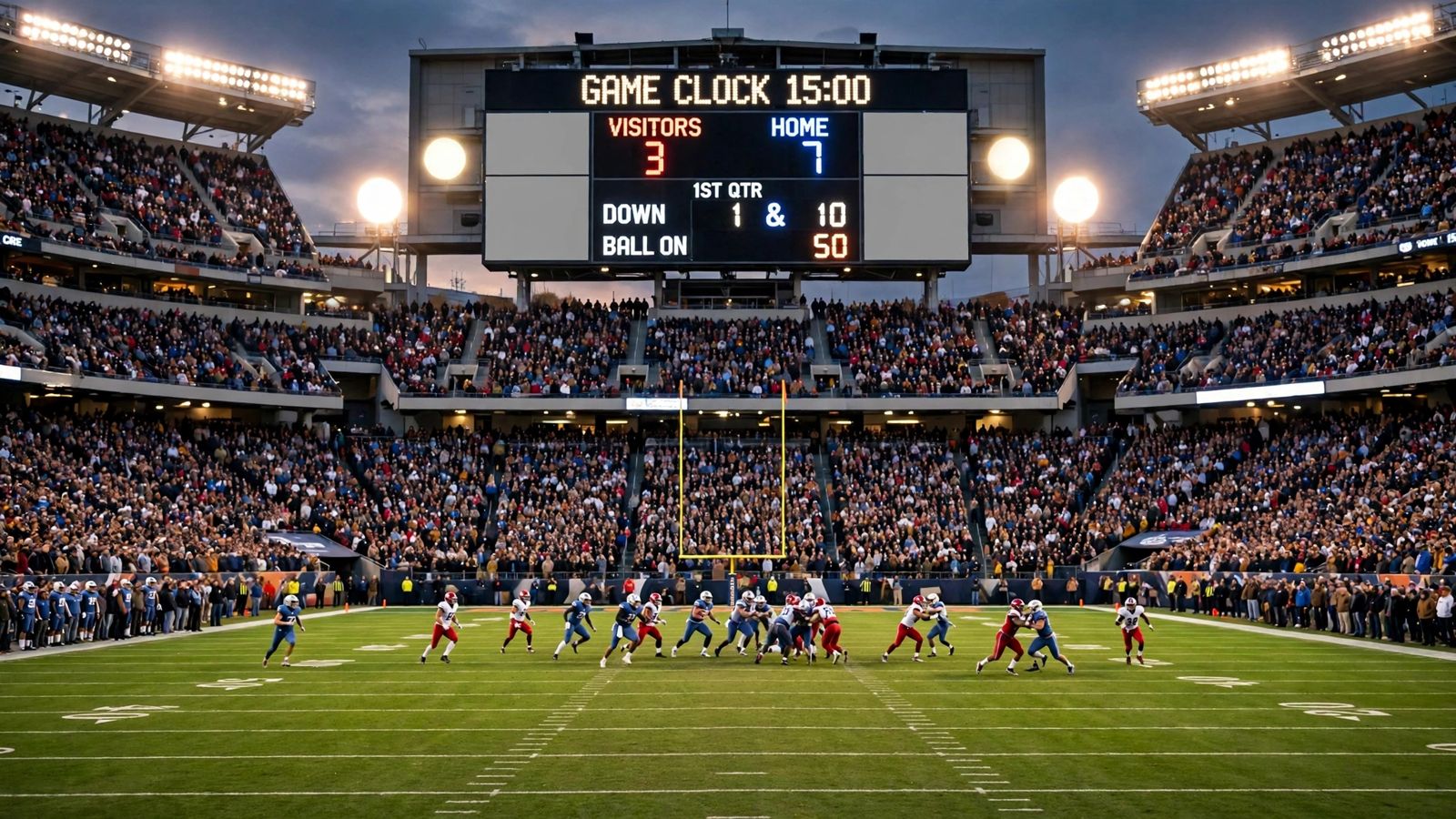
How long is a football game? On the game clock, 60 minutes: four quarters of 15 minutes at the professional and college levels, with a halftime break between the second and third quarters. In real time, though, an NFL game takes about three hours from kickoff to final whistle, a college game usually runs longer still, and a high school game — played with shorter 12-minute quarters — is over in roughly two to two and a half hours. The Super Bowl is the longest of all, at three and a half to four hours. The gap between the clock and the wall is the whole story: the football clock stops constantly.
The quick version:
| Level | Game clock | Quarters | Halftime | Typical real time |
|---|---|---|---|---|
| NFL | 60 minutes | 4 × 15 minutes | 13 minutes | About 3 hours |
| College (NCAA) | 60 minutes | 4 × 15 minutes | 20 minutes | About 3 hours 20 minutes to 3 hours 30 minutes |
| High school (NFHS) | 48 minutes | 4 × 12 minutes | 15 minutes normal (10–20 allowed) | About 2 to 2.5 hours |
| Super Bowl | 60 minutes | 4 × 15 minutes | About 25–30 minutes | About 3.5 to 4 hours |
The 60 minutes: quarters, breaks and the shape of a game
The structure comes from Rule 4 of the NFL rulebook, published by NFL Football Operations: Rule 4, Section 1, Article 1 sets the length of the game at 60 minutes, divided into four periods of 15 minutes each. The NCAA rulebook builds the college game the same way. Only the high school game shortens the clock itself, to four 12-minute periods — 48 minutes in all.
Around the quarters sit the breaks, and here the rulebooks already diverge. The NFL requires intervals of at least two minutes between the first and second quarters and between the third and fourth; the NCAA and NFHS books allow just one minute for the same change of ends. Each half starts with a kickoff, and the long break — halftime — comes after the second quarter. What each rulebook does with halftime gets its own section below: it is the single biggest fixed difference between the levels.
Why 60 minutes of football takes about three hours
The football clock is not a stopwatch. Under the NFL rulebook it stops after an incomplete pass, when a ball carrier goes out of bounds, after a score, after a penalty, on a change of possession, during a replay review, at the two-minute warning in each half, and for every timeout — and each team gets three timeouts per half. Between plays, a play clock of 40 seconds (25 after some stoppages) runs in real time while the offense lines up. Add television timeouts, injury stoppages and the quarter breaks, and one hour of clock routinely fills three hours of afternoon.
Measured averages back that up. ESPN reported a 2022 NFL regular-season average of 3 hours, 1 minute and 40 seconds from kickoff to the final play, and timing studies of recent seasons have landed close to that, at about 3 hours 3 minutes. One number to treat with suspicion is the 3 hours 12 minutes quoted all over the internet: it traces back to reporting from over a decade ago and has been copied from guide to guide ever since, long after games got slightly shorter.
At the other extreme, the ball itself is in play for a startlingly small share of those three hours: a widely cited Wall Street Journal study of game broadcasts timed the action from snap to whistle at under 11 minutes in an average NFL game. A high-scoring game full of reviews and late timeouts can push past three hours twenty; a low-scoring, run-heavy game can finish in under two hours fifty.
How long is halftime in football?
NFL: 13 minutes. Rule 4, Section 1, Article 3 of the current rulebook states that between the second and third periods there shall be an intermission of 13 minutes, and the league’s game-operations manual uses the same figure unless the league has told both clubs otherwise in advance. Plenty of guides still print 12 minutes — you will find it in older rulebook excerpts and in page after page of copied content — but the current figure is 13, and 13 is the number to plan around.
College: 20 minutes. The NCAA Football Rules and Interpretations set the intermission between halves at 20 minutes, which may be shortened before the game only by mutual agreement of both schools’ administrations. It is one of the reasons college games outlast NFL games on the same 60-minute clock — and college halftime is also when the marching bands perform.
High school: 15 minutes normally, 10 to 20 by rule. The NFHS timing table (Rule 3, Table 3-1) sets a normal halftime of 15 minutes; a state association may set it anywhere from 10 to 20 minutes, and it can be raised to 20 for occasions such as homecoming if the opponents are notified before the game. On top of the intermission sits a mandatory three-minute warm-up before the third-quarter kickoff, so the full pause between halves runs longer than the halftime figure itself — a detail almost no guide to this keyword mentions.
Super Bowl: about 25 to 30 minutes. The one NFL game where halftime is not 13 minutes is the championship: the break stretches to roughly half an hour so a stage can be built, a performance of about 12 to 15 minutes can run, and the stage can be cleared again.
How long is a college football game?
A college game has the same 60 minutes on the clock as an NFL game — four 15-minute quarters under NCAA rules — but it usually takes longer to play: plan on about three hours and twenty minutes to three hours and thirty minutes for a televised FBS game. Reported season averages put the 2024 FBS average at 3 hours 27 minutes.
Three things stretch the college game past the pro game. First, the 20-minute halftime, seven minutes longer than the NFL’s. Second, the clock rules: college football historically stopped the clock after every first down while the chains were reset, and although a 2023 rule change now keeps it running after first downs except in the last two minutes of each half, the late-half stoppages remain — and FBS games added a two-minute timeout in each half from 2024. Third, television: FBS broadcasts carry media timeouts, and kickoff windows are built around a three-and-a-half-hour slot.
College overtime ignores the clock entirely: tied teams alternate possessions from the opponent’s 25-yard line, round by round, until one team finishes a round ahead. A multi-round overtime adds real minutes — sometimes half an hour or more — without adding a second of regulation time, which is why the occasional college game crosses four hours.
How long is a high school football game?
A high school game is 48 minutes on the clock: four quarters of 12 minutes, under Rule 3 of the NFHS rulebook, the national rules most states adopt. In real time a varsity game typically takes about two hours to two and a half hours — shorter quarters, a shorter halftime than college, and few television stoppages pull the total down.
The NFHS timing structure, set out in Rule 3 and its Table 3-1 as reproduced by a state officials’ association, is precise about the small breaks too: one-minute intermissions between the first and second quarters and between the third and fourth, the 15-minute normal halftime (10 minimum, 20 maximum) covered above, and the mandatory three-minute warm-up after halftime.
Two forces can change a high school game’s length a lot. The first is the running clock: many states adopt a mercy rule under which, once a lead reaches a set margin — the threshold varies by state — the clock keeps running through stoppages that would normally pause it, and a lopsided game can finish well under two hours. The second is level: below varsity, quarters shrink. State timing guides, such as Oklahoma’s timing rules, set junior varsity games at 10- or 12-minute quarters and junior high games at eight- or ten-minute quarters, with halftimes of eight to ten minutes — a junior high game can be done in about an hour and a half. One wrinkle: Texas plays under NCAA-based rules with state exceptions that keep varsity quarters at 12 minutes — the same 48-minute clock, reached by a different rulebook.
How long is the Super Bowl?
The Super Bowl is an NFL game — the same 60 minutes and four 15-minute quarters on paper — that in practice runs about three and a half to four hours, roughly 30 to 50 minutes longer than a regular-season game. Recent editions have landed around 3 hours 35 minutes to 3 hours 45 minutes, and the February 2024 edition, which went to overtime, ran past four hours.
The extra time is not football. Halftime accounts for much of it: instead of 13 minutes, the break stretches to about 25 to 30 minutes for the halftime show. On top of that come the heaviest commercial load of any broadcast of the year and longer ceremonies built around the game. Budget four hours and be pleasantly surprised if it ends sooner — and if it goes to overtime, there is no fixed end at all, because playoff football cannot end in a tie.
Overtime: the one part with no set length
Everything above assumes a game decided in regulation. In the NFL regular season, overtime is a single period of up to 10 minutes of game clock — both teams are now guaranteed an opportunity to possess the ball under the league’s 2025 rules changes — yet measured NFL overtime games run about 25 minutes longer in total than games decided in regulation. Playoff overtime uses 15-minute periods and repeats until there is a winner. The full mechanics, including the coin toss and the tie rules, are in our guide to NFL overtime rules. A fight sport never faces any of this: how many rounds are in a UFC fight fixes the maximum length in advance, and a draw is simply an allowed result.
Youth and flag football: the short end of the scale
Below high school, the clock shrinks fast: youth leagues set their own lengths, but quarters run eight to ten minutes rather than twelve or fifteen. Pop Warner’s rulebook, to take the largest national example, is reported to set eight-minute quarters for its youngest division and ten-minute quarters for players up to 14, with a ten-minute halftime — a youth game takes roughly an hour to an hour and a half. Flag football is shorter still and often uses a running clock: the format chosen for flag’s Olympic debut at the 2028 Los Angeles Games is two 20-minute halves, about an hour door to door. For a child’s game the league’s own schedule is the authority — but expect nearer one hour than three.
So how long will the game you are watching actually take?
- NFL regular season: about 3 hours — 60 minutes of clock, a 13-minute halftime, and stoppages throughout. Add roughly 25 minutes if it goes to overtime.
- College (FBS): about 3 hours 20 minutes to 3 hours 30 minutes — the same clock, a 20-minute halftime and more late-half stoppages.
- High school varsity: about 2 to 2.5 hours — 48 minutes of clock and a 15-minute halftime; less with a running clock.
- Super Bowl: about 3.5 to 4 hours, thanks to a halftime break of roughly half an hour and the heaviest commercial load of the season.
- Youth or flag: about 1 to 1.5 hours, on eight- to ten-minute quarters or two short halves.
And a naming caution that genuinely trips people up: outside the United States, “football” usually means soccer, and at least one page ranking for this very search answers the American question with soccer’s 90 minutes. If that is the game you meant, a soccer match is two 45-minute halves — see how long is a soccer game for its stoppage-time rules, which work nothing like the clock above.
Frequently asked questions
How long is a football game in total, including halftime? Sixty minutes of game clock plus halftime — 13 minutes in the NFL, 20 in college, normally 15 in high school — plus all the stoppages. In real time: about three hours for the NFL, three hours twenty or more for college, and two to two and a half hours for high school.
How many quarters are in a football game, and how long is each one? Four quarters at every level covered here: 15 minutes of game clock each in the NFL and NCAA, 12 minutes in high school under NFHS rules. In real time an NFL quarter typically takes around 40 minutes to play, because of stoppages.
How long is halftime in the NFL? Thirteen minutes under the current rulebook (Rule 4, Section 1, Article 3). The 12 minutes quoted by many guides is an outdated figure. Super Bowl halftime is the exception, at roughly 25 to 30 minutes.
Are college football games longer than NFL games? Yes, usually by about 20 to 30 minutes of real time. The clock is identical, but college halftime is 20 minutes instead of 13, the clock still stops after first downs late in each half, and televised FBS games average around 3 hours 27 minutes against about 3 hours for the NFL.
Can a football game end in a tie? In the NFL regular season, yes: if the score is still level after the single 10-minute overtime period, the game is recorded as a tie. Playoff and college games cannot end tied — both play on until someone wins. The possession rules are covered in NFL overtime rules.
This article is general information based on the NFL rulebook (Rule 4 and Rule 16), the NCAA Football Rules and Interpretations (Rule 3) and the NFHS football rules (Rule 3, Table 3-1) linked above, checked in November 2026. Real-time averages are season measurements reported by ESPN and CBS Sports as cited in the text; individual games vary with scoring, reviews, weather and overtime, and local leagues may vary the national frameworks — check the rules of the level in front of you.