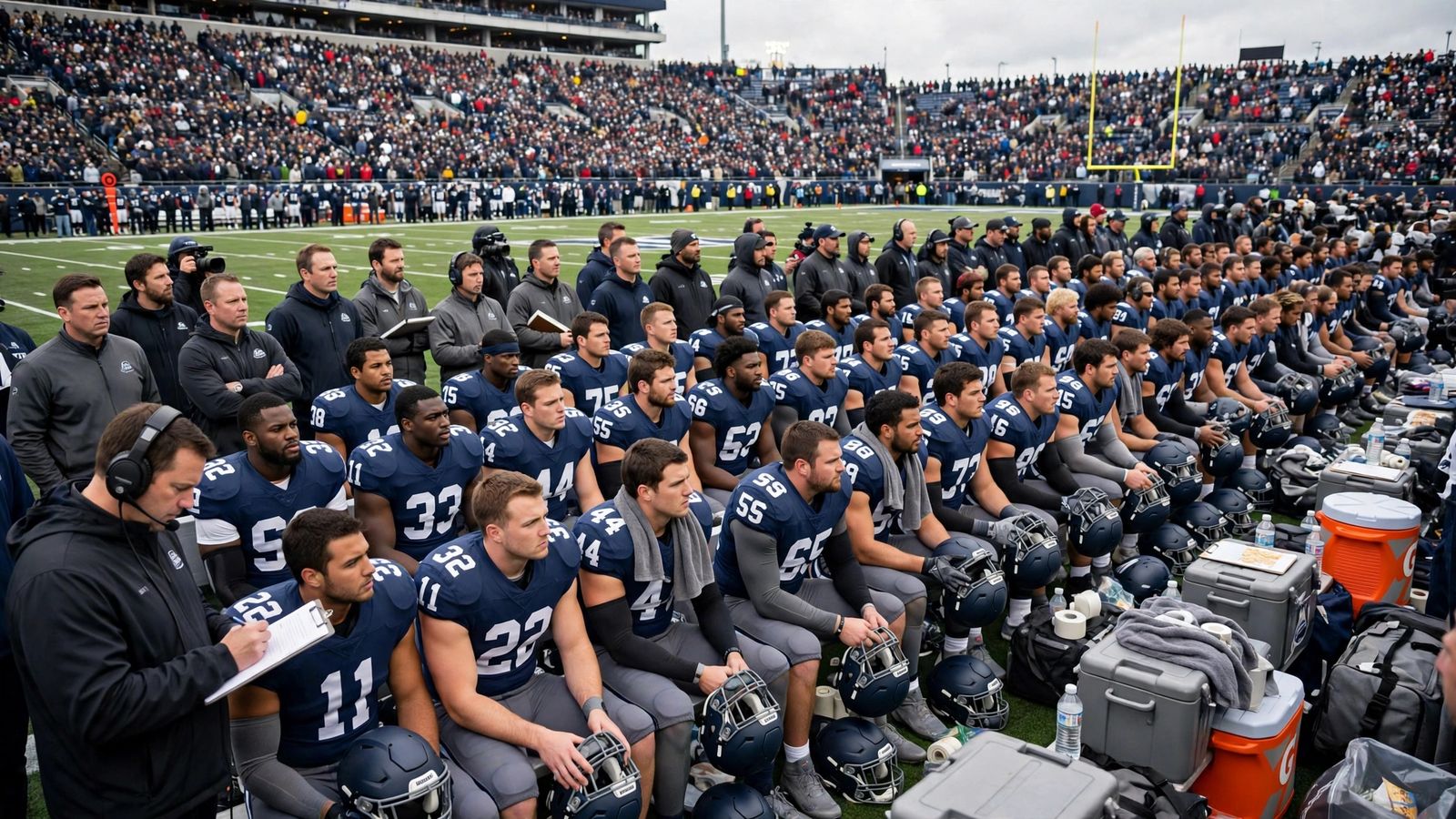
Eleven players from each team are on the field at any one time — 22 in total — while the team behind them carries 53 players on its regular-season roster, of whom 48 can dress for a game. That layered split is the whole answer to how many players are on an NFL team, and it is also why the question causes so much argument. “The team” can mean the 11 men actually playing a snap, the game-day group in uniform, or the full roster a club carries through the season — and each of those is a different number, set by a different rule. Add the practice squad and the swollen offseason roster and there are five numbers in regular use: 11, 48, 53, 16 and 90. This article takes them in order, from the field outwards.
The numbers at a glance:
| Group | Size |
|---|---|
| On the field, per team | 11 (22 total) |
| Game-day active list | 48 — only with at least 8 offensive linemen active; otherwise 47 |
| Regular-season roster (Active/Inactive List) | 53 |
| Practice squad | 16, plus a 17th exempt spot for an International Player Pathway player |
| Offseason and training camp roster | 90 (91 with an international exemption) |
How many players are on an NFL team on the field? Eleven a side
The playing game is eleven against eleven, and it has been throughout the modern history of professional football. Rule 5, Section 1, Article 1 of the NFL Rulebook states it in one sentence: “The game is played by two teams of 11 players each.” The same rulebook section makes two points that surprise people. Having more than 11 players on the field when the ball is snapped is a foul, punished by a five-yard penalty — the familiar “too many men on the field” call. Having fewer than 11 is not a foul at all: if a snap happens while a team has ten players out there, the ball is live and play simply continues, badly outnumbered. The NFL’s own glossary puts the substitution side of it plainly: each team is allowed to play with 11 men on the field, and all substitutions must be complete before the next play begins.
Those 11 are never the same 11 for long, because American football is played by three separate units that swap wholesale between plays. The offense — quarterback, running backs, receivers, tight ends and five offensive linemen — tries to advance the ball. The defense — linemen, linebackers, cornerbacks and safeties — tries to stop it. Special teams handle kicks, punts and returns, mixing dedicated specialists (kicker, punter, long snapper) with players borrowed from the other two units. Substitutions are unlimited and a player who comes off can return on the next play, so across a game a team may send out 40 or more different players while never having more than 11 on the field at once. That specialisation is the reason the roster behind the 11 has to be so large: most players are trained for one unit, and many for one role inside it.
The 53-man roster: the number most people mean
When fans say a player “made the team”, the team they mean is the 53-man roster. During the regular season and the playoffs, each of the NFL’s 32 clubs may carry a maximum of 53 players on what the league calls its Active/Inactive List. The limit is set jointly by the NFL and the NFL Players Association through the collective bargaining agreement, and it is the same for every club — no team may stockpile a 54th rostered player to keep him away from rivals.
The league fixes the total, not the mix. No rule says how many quarterbacks, receivers or linebackers a club must carry, so every front office solves the same puzzle differently. Most land near a common shape — roughly 25 players on offense (typically 2–3 quarterbacks, 8–9 offensive linemen, 5–6 wide receivers, 3–4 running backs and 3–4 tight ends), roughly 25 on defense (9–10 linemen, 5–7 linebackers and 9–11 defensive backs), and three specialists. A backup who can cover kicks on special teams, or a lineman who can play both guard and centre, is worth more than his depth-chart position suggests, because the last few spots on the 53 are chosen for flexibility as much as for talent.
Fifty-three is also a ceiling, not a fixed squad photograph. The roster churns every week of the season: players are signed, waived, traded and promoted, and a club’s 53 in January rarely matches its 53 from September in more than broad outline. What never changes mid-season is the size of the container. And the roster is not the game-day team, which is where the next number comes in — and where most published answers to this question go wrong.
Game day: 48 dress, and only with eight offensive linemen
Making the 53 does not mean dressing on Sunday. For each game a club designates a smaller game-day active list from its roster, and only those players are in uniform and eligible to play. The current limit, under the 2020 collective bargaining agreement, is 48 players — provided at least eight of them are offensive linemen (centres, guards or tackles). If a club activates fewer than eight offensive linemen, its limit drops to 47, as the league’s club-level summary of the same agreement confirms: game-day actives rise to 48 only with eight linemen; with fewer, a team may dress 47. The condition is a safety device: it pays clubs, in the currency of an extra active player, to keep enough spare linemen dressed for a position group where one injury can otherwise leave a team unable to field a line.
The remaining five or six players on the 53 are declared inactive for that game, a list the club delivers to the referee 90 minutes before kickoff. Inactive is a one-game designation, not a demotion: the player stays on the 53, is usually a mixture of the injured, the recovering and the tactically unneeded, and can be active again the following week. One narrow exception sits inside the inactive list — a club may designate an emergency third quarterback from its 53, who may enter a game only if both quarterbacks ahead of him are lost to injury or disqualification.
This is the point on which the web most often misleads. A large share of pages still answering this question state that 46 players dress for an NFL game. That was the rule — until 2019. The 2020 CBA raised the game-day cap from 46 to 48 (47 without the eight linemen) from the 2020 season, so any page giving 46 as the current figure is at least two agreements of the game out of date, however confidently it presents the number. The layered answer is: 53 on the roster, 48 in uniform, 11 on the field.
Two smaller mechanisms let a club stretch slightly beyond those numbers for a single game. Under the standard elevation procedure, a team may temporarily elevate one or two practice-squad players for a game, expanding its Active/Inactive List to 54 or 55 for that week; the elevated players revert to the practice squad afterwards, and an individual player can be elevated only a limited number of times before the club must sign him to the 53 properly. Elevations change who is available, not the game-day cap itself: the active list for the game is still 47 or 48.
How many players are on an NFL team beyond the 53? The practice squad
Alongside the roster sits the practice squad: 16 players who train with the team through the week but cannot play in a game unless they are elevated or signed to the 53. A club taking part in the league’s International Player Pathway programme may carry a 17th practice-squad player under an exemption, a spot reserved for an international player that cannot simply be used for an extra domestic signing — which is why some teams are reported, correctly, as holding 17.
The practice squad is a development pool with experience limits, not a second full roster. Its mix is weighted toward young players — those with little or no accrued NFL service — while allowing a limited number of veterans (up to six with unlimited experience) so a club can keep proven cover on hand. Practice-squad players are not locked to their club: any other team may sign one away at any time, but only by putting him on its own 53-man roster. Counting the two groups together, a club has 69 players in its building in a normal game week — 70 with the international exemption — before injured-reserve players are counted at all.
The offseason: 90 players, and the cutdown to 53
For most of the year the team is much bigger than 53. Through the offseason programme, training camp and the preseason, each club may carry up to 90 players — 91 with an international exemption. The 90 is an evaluation pool: drafted rookies, undrafted free agents, tryout players and returning veterans all competing through camp practices and preseason games for the places that will exist when the season starts.
They cannot all stay. On a single league-wide cutdown deadline shortly before the regular season — in recent practice, one deadline rather than the staged cuts of earlier eras — every club must reduce its roster from 90 to the 53-man limit at once. Roughly 37 players per team, well over a thousand across the league, are released on or around that one day. What happens next sorts them: players with fewer than four accrued seasons pass through waivers, where other clubs may claim their contracts in a set order; vested veterans with four or more accrued seasons become free agents immediately. Many of the cut players who clear waivers are signed straight back onto practice squads — their own club’s or another’s — which is why the practice squad is largely built in the 24 hours after cutdown day. The 53 announced that week is best read as an opening position, not a final squad: waiver claims and injuries usually change it again within days.
Injured reserve: the players who stop counting
One group of players belongs to the team but, for a time, to none of the numbers above. A player placed on injured reserve (the reserve/injured list) comes off the 53, freeing his roster spot for a healthy replacement, while remaining under contract to the club. Under the current rules he must miss at least four games — games, not weeks, so a bye week in the middle does not shorten the absence. A club may bring back a limited number of players from injured reserve during a season: eight return designations in the regular season, with playoff clubs receiving two additional designations, and a club may designate up to two players for return on cutdown day itself without first carrying them on the initial 53 — a procedure the league’s 2025 approved bylaws adjustments amended to tidy exactly that cutdown-day route. A player on injured reserve who is not designated for return under those limits is out for the season. Injured reserve is why a team’s true headcount is always a few names longer than 53 plus 16: the injured players are still its players, just temporarily outside every active count. The full playing rules that frame all of these lists are published in the NFL Rulebook, of which the roster limits themselves sit in the league’s bylaws and the CBA rather than the on-field rules.
Frequently asked questions
How many players are on an NFL team in total? In the regular season, 53 players on the roster plus 16 on the practice squad — 69 players, or 70 counting an exempt international practice-squad player — and more again once players on injured reserve are included. In the offseason the same club may hold 90 players at once.
How many players are on the field in an NFL game? Eleven per team, 22 in total, on every play. More than 11 is a five-yard foul; fewer than 11 is legal but a serious disadvantage.
How many players dress for an NFL game? 48, if at least eight of them are offensive linemen; otherwise 47. The other five or six members of the 53 are inactive for that game. Pages that say 46 are quoting the pre-2020 rule.
How many players are in the NFL altogether? Thirty-two teams at 53 roster places gives a maximum of 1,696 players on active rosters at any one time, plus up to 512 more on practice squads (16 per team) — before offseason rosters expand the pool to as many as 2,880 under the 90-man limit.
Why is an NFL roster so much bigger than a soccer or basketball squad? Because the units are separate. A soccer team’s 11 players attack and defend together; an NFL team fields largely different players for offense, defence and special teams, and needs cover at more than twenty specialised positions. For the layered version of the same question in another sport, see how many players are on a basketball team. At the other end of the scale, how many players are on a volleyball team puts six on the court with a match roster of 12 to 14 — its whole team would fit inside one NFL unit.
Does the roster size change for the playoffs? No. The 53-man roster, the 47/48 game-day active limit and the practice squad all carry into the postseason unchanged; the one addition is that playoff clubs receive two extra injured-reserve return designations. Playoff games themselves can run longer than regulation games — see NFL overtime rules for how a tied postseason game is settled.
This article is general information based on the NFL Rulebook, NFL Football Operations roster guidance and the 2020 NFL–NFLPA collective bargaining agreement framework linked and described above, checked in November 2026. Roster limits are set by the CBA and league bylaws and can change with a new agreement — the NFL’s own operations pages are the authority for the current season.