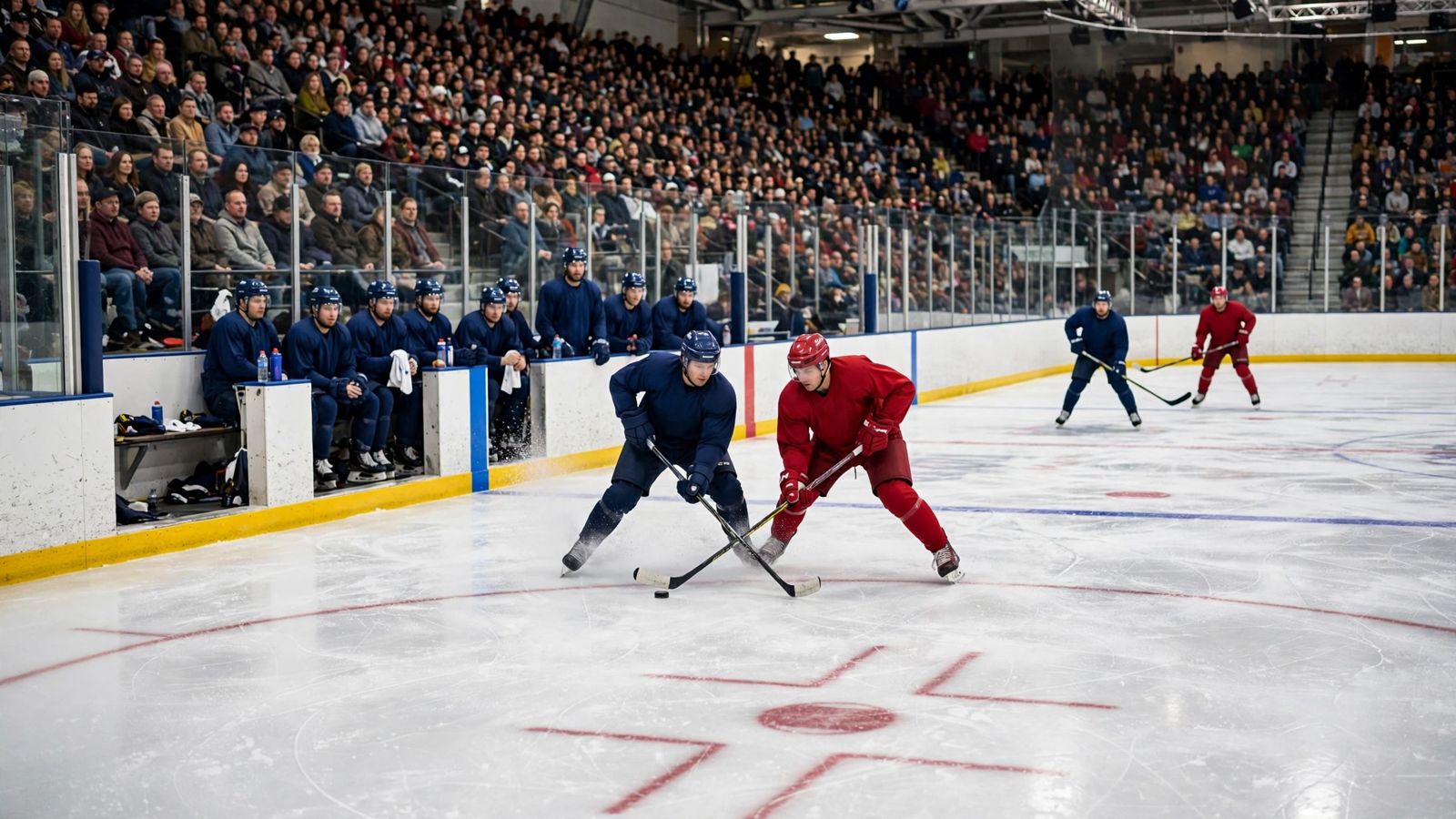
Six players from each team are on the ice at any one time in ice hockey — one goaltender and five skaters — so twelve players in total, and that is only the first of three different numbers hidden inside the question of how many players are on a hockey team. The three numbers are: the players on the ice (6), the players dressed for a single game — in uniform, on the bench and eligible to play — and the full roster a club carries across a season. In the NHL those numbers are 6, 20 and 23: twenty players dress for each game, eighteen skaters and two goaltenders, drawn from an active roster of up to twenty-three. International hockey under the IIHF dresses one more skater pair — a game team of 22, twenty skaters and two goaltenders. And if by hockey you mean field hockey, the game played on a pitch rather than a rink, the on-field answer is different again: 11 players per team, from a match squad the rules set at up to 16, which a competition regulation may raise to 18. Most confusion about this question comes from guides that give one of those numbers as if it answered all three.
The numbers at a glance:
| Game | On the ice / field | Dressed for one game | Full roster or squad |
|---|---|---|---|
| NHL (ice hockey) | 6 | 20 (18 skaters + 2 goaltenders) | 23 active roster |
| IIHF international (ice hockey) | 6 | 22 (20 skaters + 2 goaltenders) | Set by tournament rules |
| Field hockey (FIH) | 11 | Whole match squad | Up to 16, raisable to 18 by regulation |
| Indoor hockey (FIH) | 6 | Whole match squad | Set by competition rules |
How many players are on a hockey team on the ice?
Six — and the shape of the six is fixed by custom so firmly that it reads like a rule. In front of the goaltender, a team at full strength skates three forwards and two defensemen. The forwards are a centre and two wingers, left and right; the defensemen play as a pair, left and right. The goaltender is the sixth player, and only one goaltender per team may be on the ice at a time.
That six-against-six picture is the standard across professional, collegiate and international ice hockey, in the NHL and under IIHF rules alike. Six is the full-strength number: the most a team may have on the ice in normal play, and the number both teams start with. Penalties, overtime formats and the pulled goaltender all change the count legally, as a section below sets out.
Ice hockey is not the only team sport where the playing number and the roster number pull apart. Basketball has the same three-layer structure — five on the court, a larger game-night list, a larger roster again — set out in how many players are on a basketball team. Hockey’s version is simply wider apart: in the NHL, fewer than a third of the roster is on the ice at any moment.
The three numbers, and why guides keep mixing them up
A hockey team is three nested groups. The six on the ice are the players taking part at that moment. The dressed twenty (in the NHL) are everyone in uniform that night: the six on the ice plus the fourteen on the bench. The roster is everyone the club carries — in the NHL, up to 23 players — including the ones who will watch tonight’s game from the press box.
Guides go wrong in two predictable ways. The first is to answer one layer with another layer’s number: “a hockey team has 20 players” states the dressed figure as if it were the roster. Pages in the current top results do exactly this — one widely ranking guide calls 20 the “full team roster”, without ever naming the 23-man roster behind it. The second error is to mix the two hockeys, which share a name and almost nothing else about team size: six on the ice against eleven on the field. This article keeps the layers and the two games separate throughout.
The NHL: 23 on the roster, 20 dressed, 6 on the ice
The NHL has the most layered answer, because it separates the season roster from the game-night list more sharply than any other hockey competition.
Full roster — 23 players. Under the NHL’s Hockey Operations Guidelines, there may be a maximum of 23 players on each club’s playing roster at any one time from the start of the regular season through the trade deadline, and each club must carry at least 20, composed of 18 skaters and two goaltenders. Players on injured reserve do not count against the 23. A team tight against the salary cap may deliberately carry only 20 or 21; the 23 is a ceiling, not a requirement.
Game night — 20 dressed. Rule 5.1 of the NHL Official Rules provides that a team shall be composed of twenty players — eighteen skaters and two goaltenders — and only the players named on the official game roster may take part. So of the 23 on the active roster, 20 dress and three do not. Those three are the healthy scratches: fit, available, and left out by the coach’s choice for that night.
The usual build of the twenty. Coaches most often dress 12 forwards, 6 defensemen and 2 goaltenders — four forward lines of three, and three defence pairs. The alternative you will occasionally hear on a broadcast is an “11 and 7” night — eleven forwards and seven defensemen. Either way the total dressed stays at 20, and the two goaltenders are a starter and a backup who dresses, fully equipped, on the bench.
Goalies per team, answered plainly. Two dress for an NHL game. A club typically carries two on its active roster, sometimes three for a stretch — but however many it carries, only two can be in uniform on a given night, and only one can be on the ice at a time.
International ice hockey: the IIHF dresses 22
International hockey plays the same six-against-six game with a deeper bench. Rule 5.1 of the IIHF Official Rulebook provides that a team shall be composed of twenty-two players — no more than twenty skaters and two goaltenders — and that to start a game a team must be able to put at least five skaters and one goaltender on the ice. Only players listed on the roster sheet submitted before the game may play.
So an Olympic or World Championship team dresses 22 where an NHL team dresses 20 — extra skaters across the bench, which matters in tournament hockey, where games arrive on consecutive days and there is no farm team to call a replacement from. A third goaltender may travel with a tournament squad, but he is not part of the 22-man game team unless he is named in it. The on-ice answer does not change at all: six per team, twelve in total.
Lines and positions: how the dressed skaters are organised
The reason a team dresses eighteen skaters to put five on the ice is that ice hockey is played in shifts. A skater’s shift typically lasts well under a minute at the top level, and substitutions — line changes — are made on the fly, while the puck is live. The dressed skaters are therefore organised into units that go on and off together:
- Four forward lines of three: a centre, a left wing and a right wing. The first line usually carries the team’s top scorers and hardest matchups; the fourth line plays the fewest minutes.
- Three defence pairs of two: a left and a right defenseman. The top pair typically plays the most minutes of any skaters, because defensemen’s shifts run longer than forwards’.
- Special teams units drawn from the same pool: power-play units when the opponent is penalised, and penalty-killing units — usually two forwards and two defensemen — when the team itself is short-handed.
The lines are a coaching construction, not a rule. What the rules fix is the ceiling — eighteen skaters dressed, six players on the ice — and coaches build their rotations underneath it. The only major sport organised even more completely into separate units is American football: how many players are on an NFL team reaches 53 because its offense, defence and special-teams units barely overlap.
When the number on the ice changes
Six per team is the full-strength figure, not a constant. Four situations change it legally, and one changes it illegally.
Penalties. When a player takes a minor penalty, he sits for two minutes and his team plays short-handed with four skaters and its goaltender — five players — against the opponent’s six. A second simultaneous penalty drops the team to three skaters and the goaltender, and no team can be reduced below three skaters on the ice. The team with more players is on the power play.
Too many men on the ice. Because line changes happen during play, they are the one moment a team can accidentally put a seventh player on the ice. Under Rule 74 of the NHL Official Rules, a change is legal only when the player coming off is within five feet of the bench and out of the play before his replacement steps on; a substitute who comes on too early, or either player in the change who plays the puck while both are on the ice, draws a bench minor penalty for too many men on the ice — two minutes, served by a player the coach designates.
Overtime. In the NHL regular season, overtime is three skaters against three, plus each goaltender — four players per side — for five minutes before a shootout. Playoff overtime returns to full strength in twenty-minute sudden-death periods.
Pulling the goaltender. A team trailing late may take its goaltender off for an extra skater, giving it six skaters and an empty net. The player count stays at six per team; what changes is the composition. The same move appears during a delayed penalty, when the non-offending team can pull its goaltender safely because play stops the moment the offending team touches the puck.
How many players are on a hockey team in field hockey?
Eleven — and field hockey is the older claimant to the name “hockey” in most of the world, so a large share of the people asking this question mean this game. Under Rule 2 of the FIH Rules of Hockey, a maximum of eleven players from each team take part in play at any one time — one goalkeeper and ten outfield players, arranged across defenders, midfielders and forwards in shapes such as 4-3-3. Twenty-two players are on the field in total.
The squad behind the eleven works differently from the NHL’s dressed list. The FIH rules define a team as a maximum of sixteen persons — eleven players on the field and up to five substitutes — and allow a competition regulation to raise that to a maximum of eighteen players, which is what major international tournaments generally use. Substitutions are rolling and unlimited: a player may come off and go back on repeatedly, through the substitution area, without the game stopping. There is no separate active roster behind the match squad in the NHL sense; the 16 or 18 named for the match are the team for that match.
Indoor hockey, the FIH’s boarded indoor version, halves the side: six players per team, one goalkeeper and five outfield players — the same on-surface count as ice hockey, reached by a completely different route. The FIH also sanctions Hockey5s, a five-a-side format. So “hockey” alone can honestly mean 11, 6 or 5 on the surface at once, which is why the format has to be named before the number means anything. For a smaller-sided game where team size never varies, compare pickleball rules — singles or doubles only.
Frequently asked questions
How many players are on a hockey team in total? In the NHL, 23 players on the active roster, of whom 20 dress for a game and 6 are on the ice at a time. In IIHF international hockey, 22 dress for a game. In field hockey, a match squad is up to 16 under the rules themselves, raisable to 18 by competition regulation, with 11 on the field.
How many players are on the ice in a hockey game? Twelve at full strength — six per team: a goaltender, three forwards and two defensemen. Penalties reduce the penalised team to five or four players on the ice; NHL regular-season overtime is played with four per team, three skaters and a goaltender.
How many goalies are on a hockey team? Two dress for every NHL and IIHF game — a starter and a backup — and only one may be on the ice at a time. An NHL club usually carries two goaltenders on its 23-man roster, occasionally three.
How many players dress for an NHL game? Twenty: eighteen skaters and two goaltenders, named from the club’s active roster of up to 23. Roster players who do not dress are healthy scratches if fit; injured-reserve players sit outside the 23 count.
What is the too-many-men penalty in hockey? A bench minor penalty — two minutes — given when a team has more than the permitted number of players on the ice, almost always because of a mistimed line change: a substitute stepping on before the player he replaces is within five feet of the bench and out of the play.
How many players are on a field hockey team? Eleven per team on the field, one goalkeeper and ten outfield players, from a match squad of up to 16 — or up to 18 where the competition’s regulations allow it, as major FIH tournaments do. Substitutions are unlimited and rolling. Indoor hockey plays six per team.
This article is general information based on the NHL Official Rules and Hockey Operations Guidelines, the IIHF Official Rulebook and the FIH Rules of Hockey linked and described above, checked in November 2026. Roster limits and game-team sizes change with new rule editions and competition regulations — the NHL, IIHF and FIH documents are the authorities for the current season.