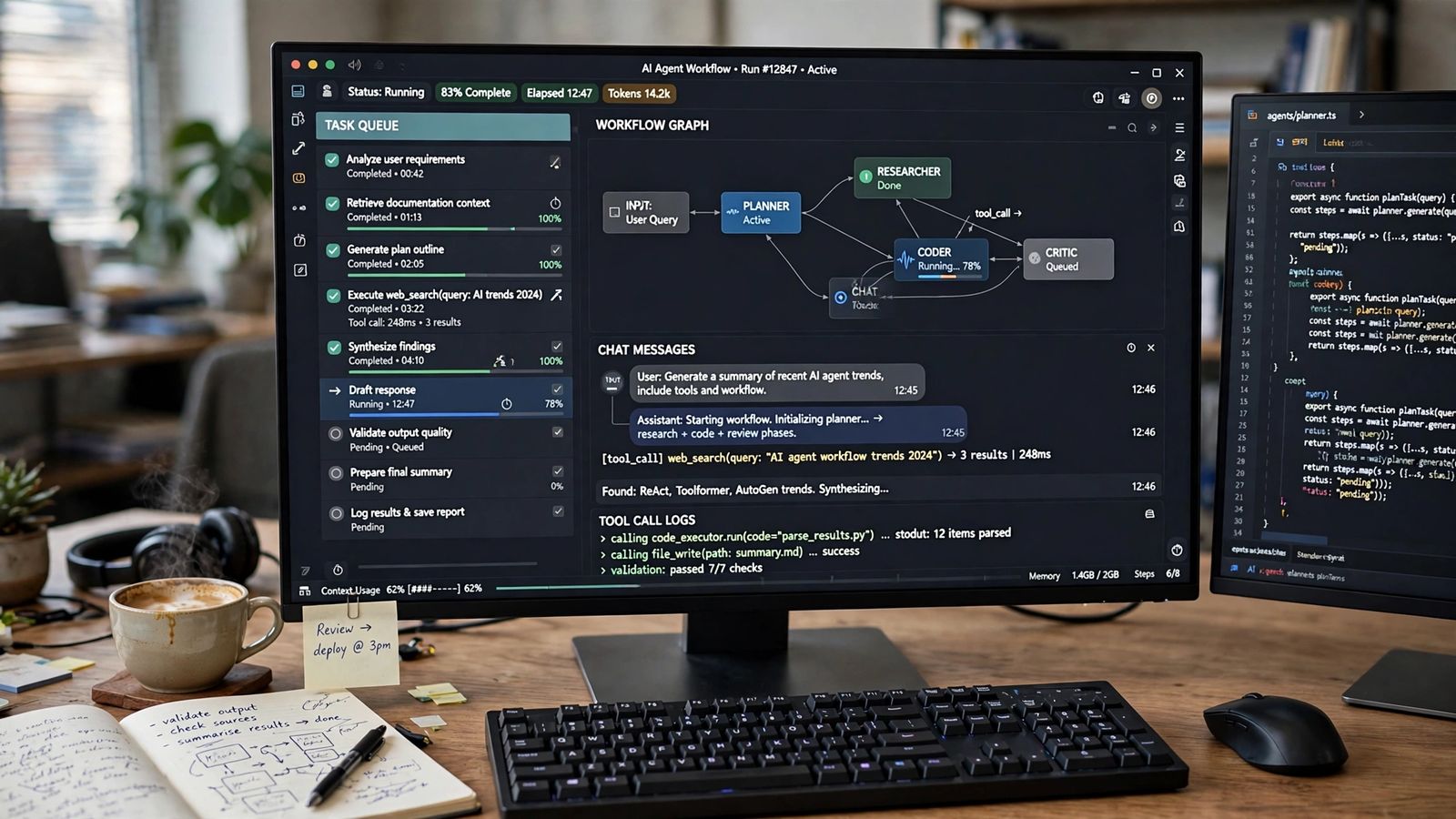
What is agentic AI? It is artificial intelligence that pursues a goal, not just a prompt: you give it an outcome, and it plans the steps, uses tools, checks what happened and decides what to do next, with limited supervision. A chatbot answers and stops. An agentic system keeps going. Ask a chatbot to plan a trip and it writes an itinerary. An agentic system can search flights, compare them against your dates and budget, and — where you have given permission — hold or book the chosen option, coming back when a step fails or needs approval. “Agentic” comes from agency, the capacity to act on someone’s behalf.
What is an AI agent?
An AI agent is the individual worker: a program built around a model — usually a large language model — that perceives information, reasons about a goal, calls tools and acts toward that goal. IBM defines agentic AI as a system that can accomplish a specific goal with limited supervision, made up of AI agents that mimic human decision-making in real time, coordinated when several are involved.
Vendors draw the lines differently, so separate three terms:
- AI agent — one system doing a job: a support agent resolving a ticket, a coding agent fixing a bug.
- Agentic AI — the broader approach: systems built to plan, act and adapt with a degree of autonomy. Some definitions require several agents together; others count a single capable agent.
- Multi-agent system — several specialised agents coordinated toward a larger goal.
Google Cloud draws the line as building blocks and the finished structure: agents are the individual tools, agentic AI is the coordinated use of those tools for broader workflows. IBM and Microsoft are looser and call a single autonomous system agentic. Neither usage is wrong — what matters is what a system can actually do.
The simplest test: who decides the next step?
One question dissolves most confusion: after the first instruction, who decides what happens next?
- If you decide — you read the answer, copy it somewhere, prompt again — you have a chatbot or assistant, however clever it sounds.
- If pre-written code decides — the same fixed steps in the same order every time, with a model filling in text — you have a workflow or automation. Useful, predictable, not really an agent.
- If the model decides — it looks at the goal and current state, chooses a tool, reads the result and chooses again — you have an agent.
That last line is Anthropic’s distinction: workflows orchestrate models and tools through predefined code paths, while agents are systems where the model dynamically directs its own process and tool use. Keep it in mind when a product is marketed as “agentic”: a chatbot with a new label — no tool access, no loop, no authority to act — is not an agent. That relabelling is called agent washing.
How does agentic AI work?
Microsoft describes agentic AI as systems that perceive their environment, reason to create a plan, act by calling tools, APIs or other systems, and reflect on outcomes and adjust. The same loop appears in almost every serious account:
1. A goal and permissions. A person (or another system) gives an objective in plain language — “resolve this customer’s problem,” “research these five suppliers and summarise the trade-offs” — plus boundaries: which tools it may use, which data it may touch, what it may spend, and which actions need approval first.
2. Perception. The agent gathers the state of the world it needs: an inbox, a database record, a web page, a file. A plain model knows only its training data and what you paste into the prompt. The engine is the kind of model explained in what is a large language model — here, wired to live information.
3. Planning and reasoning. The model breaks the goal into steps and orders them. Some agents plan fully first, then execute. Others decide one step at a time, reacting to each result — the pattern called ReAct, for reasoning plus acting. Either way, the model’s judgement does work a script or human coordinator would do in older automation.
4. Action through tools. The agent calls a tool: searches the web, runs code, queries a database, sends an email, updates a record. Tool use separates acting from describing. A standard connection method is the Model Context Protocol (MCP), introduced by Anthropic in November 2024 as an open standard for connecting AI systems to tools and data — a common plug shape, so no custom connector is needed for every application.
5. Observation and correction. Each action returns a result, and the agent reads it. The flight is sold out, the code failed its test, the customer replied with new information — so it revises the plan or retries differently. The loop continues until the goal is met, a stopping rule is reached, or it escalates to a person.
6. Memory — which is not the same as learning. Agents keep context while they work: what they tried, intermediate results, sometimes notes from earlier jobs. But most deployed agents do not retrain or permanently improve their model from your tasks; they remember stored facts, while the model itself stays as it was. When a page promises an agent that “learns from every interaction,” ask whether it means stored memory — common — or actual model learning, which is rare in products today.
Agentic AI vs generative AI
Generative AI creates content. Agentic AI pursues goals. Generative AI — behind chatbots, image generators and code completion — takes a prompt and produces an output, then stops while you decide what to do with it. Agentic AI uses a generative model as its engine, wrapped in the loop above: tools, memory, permissions and repeated decision-making, so one step’s output becomes action.
| Generative AI | Agentic AI | |
|---|---|---|
| You give it | A prompt | A goal, plus tools and boundaries |
| It returns | Content — an answer, draft or image | A completed task, or progress toward one |
| Steps | One response per prompt | Many steps, chosen by the system |
| Tools | Mostly none, or simple built-ins | APIs, databases, browsers, code, other software |
| Your role | Prompt, judge, act on the output | Set goal and limits, supervise, approve what matters |
| Typical failure | A wrong or invented answer | A wrong action, possibly repeated across steps |
They are not rivals. Almost every agent shipping today is built on a generative model, and a research agent still generates the summary it hands you. Google Cloud describes agentic AI as centred on orchestrating agents that use large language models as a brain to act through tools. The practical question is: does this job need content, or a sequence of decisions and actions? A first draft needs content. Chasing five overdue invoices — checking each payment status and sending the right reminder — needs actions.
A third neighbour: traditional automation follows steps specified in advance — form submitted, copy the row, send the email. Fast, cheap, predictable, and it breaks when the situation does not match the script. An agent handles variation, at the price of being less predictable and more expensive. Many systems mix both.
Agentic AI examples
Grouped by how concrete they are today. Already working, in bounded jobs:
- Customer support resolution. Not a bot quoting the returns policy, but an agent that checks carrier tracking, finds the parcel, offers a new delivery slot and updates the order — resolving the request, not describing resolution.
- Coding agents. Given an issue or a failing test, the agent explores the codebase, writes a fix, runs the tests and revises until they pass or it gets stuck. Human review remains the norm.
- Research and reporting. Searching multiple sources, cross-checking figures, noting disagreements and assembling a brief — a web search with the checking done inside the run.
- Back-office processing. Matching payments to invoices, triaging tickets with account history gathered, enriching and routing sales leads. Unglamorous, measurable, and where much real deployment sits.
- IT and security monitoring. Watching logs and system health, running standard diagnostics, and escalating with evidence already collected.
Still supervised: travel and purchasing agents (approval before payment), and multi-agent teams, where coordination failures are the current ceiling.
The pattern in what works: a clear goal, a bounded scope, tools the agent may use, a checkable result, and a person who can step in. That is also the test for a product you already use: ones that complete multi-step tasks in another system for you are agentic to a degree; a chat window that only replies is not. See also Claude vs ChatGPT for how the best-known assistants’ models differ.
How much autonomy? The two kinds of human oversight
Autonomy is a dial, not a switch, set per task. At the low end the agent suggests and a human acts. In the middle, it acts but pauses for approval before anything hard to undo — sending money, deleting data, messaging a customer. At the high end, it completes a class of tasks alone and a human reviews logs afterwards.
Those settings have names. Human-in-the-loop: a person approves steps as they happen — safer, slower, the right default for anything irreversible. Human-on-the-loop: the agent runs alone while a person monitors and intervenes on exceptions — faster, and only defensible where errors are cheap, visible and reversible. Rule of thumb: the harder an action is to undo, the closer a human should be to it.
Risks and limits: what can go wrong when AI acts
- Errors compound. A chatbot’s mistake sits in one visible answer. An agent’s early mistake becomes the foundation for its next ten steps: a misread record in step one can produce a confidently wrong booking, email or payment in step ten. Checkpoints inside the loop matter more than raw model quality.
- Confident wrongness, with consequences. Agents are built on the same models that produce AI hallucinations — plausible, unsupported content stated fluently — and an agent can act on a hallucinated fact before anyone reads it. NIST’s Generative AI Profile, NIST AI 600-1, names this behaviour confabulation; giving the system tools does not remove the risk, it gives the risk hands.
- Permissions are the attack surface. An agent that can read your email, query your database and send messages for you is valuable because of that access — and dangerous for the same reason. Content it reads can contain planted instructions (prompt injection): a page or email telling it to do something its owner never asked for. Defences: least-privilege access, approval for sensitive actions, full logs, revocable access.
- Cost and latency. Each loop step is a model call, and a long task can mean dozens. Anthropic’s guidance is blunt that agentic systems trade latency and cost for performance, and recommends the simplest solution possible. An agent is a poor choice for a job a prompt or script already does well.
- Accountability. When an agent sends the wrong email or books the wrong thing, “the AI did it” satisfies no customer, regulator or court. Whoever deployed it owns its actions, so someone must be able to explain what it did and why.
- Overclaiming. Forecasts about agents replacing whole job categories, and vendor adoption surveys, run ahead of measured deployment. Treat them as marketing unless they name their method. The grounded picture: bounded agents doing bounded jobs well, under supervision.
When should you use an agent — and when not?
A task suits agentic AI when it has most of these traits: several steps, steps that depend on what earlier steps find, varying inputs, tools and data the agent may reach, and a checkable outcome. It is a poor fit when the process is perfectly fixed (use a script), when one prompt already works (use the chatbot), or when errors are irreversible and cannot be gated by approval.
Frequently asked questions
Is agentic AI the same as an AI agent? Not quite. An AI agent is one system doing a job; agentic AI is the broader approach of systems that plan, act and adapt autonomously. Some definitions reserve it for several agents coordinated together; IBM, Google Cloud and Microsoft also use it for the general capability. Judge products by the test above, not the label.
What is the difference between agentic AI and a chatbot? A chatbot responds: one prompt, one answer, then it waits, and you do everything the answer implies. An agentic system acts: given a goal, it plans steps, uses tools, checks results and continues until the task is done or it needs you.
Does agentic AI replace generative AI? No. It is built on generative AI — the model inside an agent is generative, and agents generate text or code while completing tasks. Generative AI is the engine; the agent is the vehicle around it, with tools, memory and permission to act.
Can agentic AI work completely on its own? Within a narrow, well-tested scope, yes — that is the point of human-on-the-loop setups. For consequential, open-ended work, no honest deployment today is “set it and forget it.” Autonomy is granted task by task, with approval gates and monitoring.
Is ChatGPT an agent? The chat interface alone is a generative AI assistant: it answers, and you act. Agent modes — browsing, running code, completing multi-step tasks in connected apps — are agentic features layered on top. That spectrum is why the capability test matters more than the name.
What happens when an agent gets stuck? A well-built agent stops, reports what it tried, or asks for help; designers guard against endless looping with step limits and escalation rules. IBM’s FAQ gives the operational version: terminate the stalled process, clear its memory or context, and refine its instructions. If an agent cannot show you what it has done, do not let it keep going.
This article is general information based on the primary sources linked above — IBM Think, Google Cloud, Microsoft and Anthropic, with NIST AI 600-1 for risk terminology — checked in November 2026. Definitions change quickly; the loop, the permissions question and the who-decides test are the durable parts.