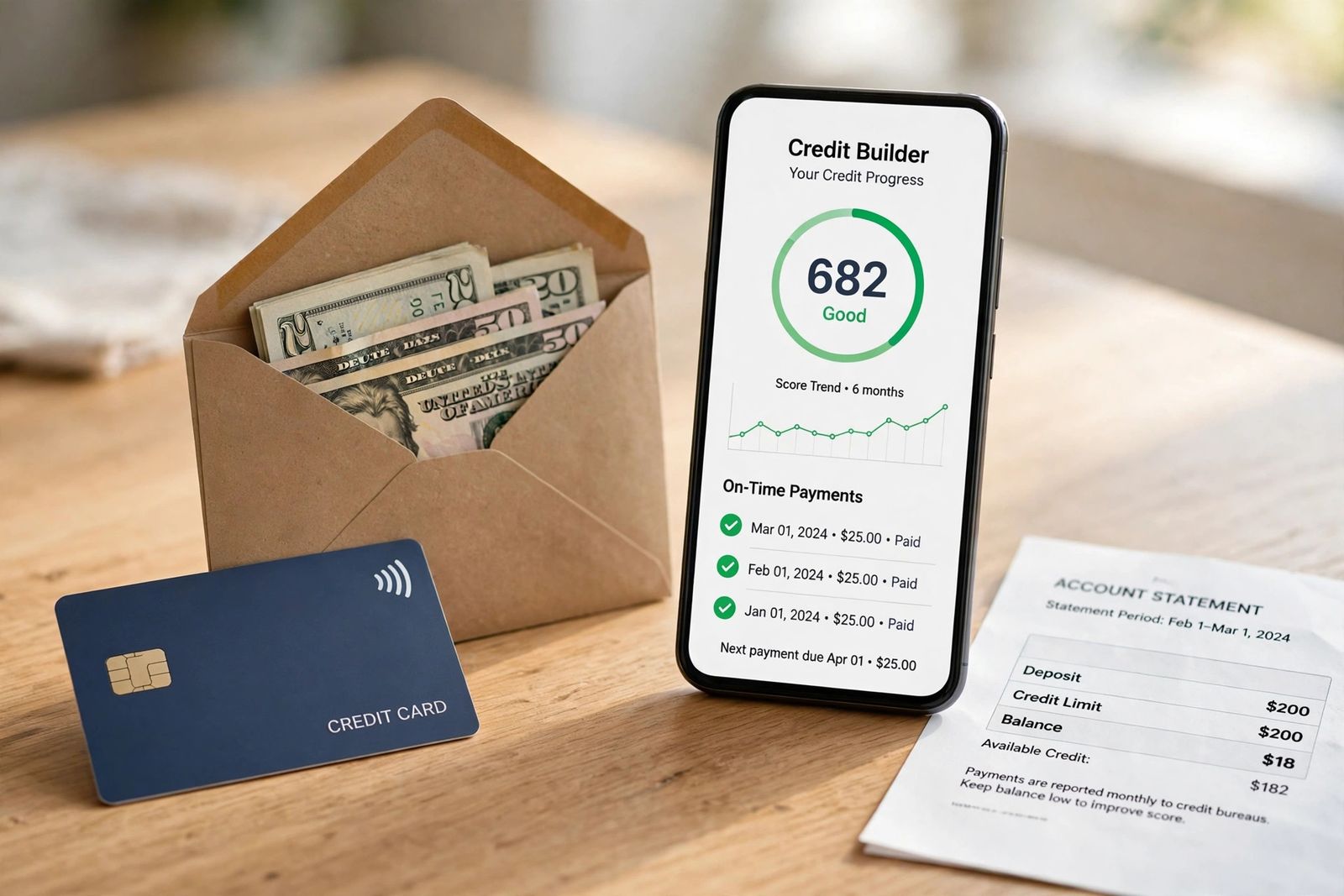
A secured credit card is a real credit card backed by a refundable cash deposit you pay up front. The deposit is held as collateral, and it usually sets your credit limit — put down $200 and you can typically spend up to $200. Because the issuer’s risk is already covered by your money, the card can be issued to people with no credit history or a damaged one, who would be turned down for a regular card. Used carefully — small purchases, paid in full and on time — it reports your payments to the credit bureaus like any other card, and after a run of responsible use many issuers upgrade it to an unsecured card and hand the deposit back.
That last part is what makes a secured card different from a prepaid card with a similar shape, and it is the part most explanations rush. This article follows the money in order: deposit in, limit set, months of reporting, review, deposit back.
How a secured credit card works, step by step
1. You apply — and approval is easier, not guaranteed. The deposit lowers the issuer’s risk, so approval standards are lower than for unsecured cards. They are not absent. Issuers still verify your identity and income, and Capital One states plainly that its secured card needs no credit score to apply but an application can still be declined over income and existing-debt conditions. Recent delinquencies, unpaid collections or an open bankruptcy can still stop an application.
2. You pay the deposit. Once approved, you fund a refundable security deposit. How much varies more than most articles admit. Capital One’s Platinum Secured asks for a minimum deposit of $49, $99 or $200, assigned according to your creditworthiness. U.S. Bank’s secured cards ask for $300 to $5,000. The Consumer Financial Protection Bureau (CFPB) uses $500 as its worked example: you put in $500, and you can spend up to that amount. The deposit is not a fee and it is not spent — it sits as collateral for as long as the account stays secured. Capital One notes that no interest is applied to the deposit; U.S. Bank holds its deposit in a secured savings account.
3. The deposit becomes — or partly becomes — your limit. On most secured cards the limit equals the deposit, dollar for dollar. Capital One is the well-known exception: every one of its three deposit tiers opens a starting credit line of at least $200, so a $49 deposit can open a $200 line. If you deposit more than your minimum before the card is activated, the extra raises your starting line — Capital One allows this up to $1,000. You have a fixed window to fund the deposit: Capital One gives you 35 days from approval, payable in instalments of at least $20 by bank transfer, and if the full amount does not arrive in time the account is not opened and any partial payments are returned.
4. You spend and get a bill, exactly like a normal card. This is the point people most often get wrong: the deposit does not pay your bill. You borrow when you spend, a statement arrives each month, and you must pay at least the minimum by the due date — Capital One says so explicitly, and every issuer in this article’s research says the same. Pay late and the late payment is reported and damages the record you opened the card to build, deposit or no deposit.
5. Your activity is reported. The issuer reports your balance, limit and payment history to the credit bureaus, and that reporting is the entire mechanism by which the card builds credit. Capital One and Discover both state that they report to the three major bureaus — Equifax, Experian and TransUnion. Not every secured card does, which is why reporting is the first question in the choosing checklist below.
6. The account is reviewed, and it can graduate. After a period of responsible use, the issuer may convert the account to an unsecured card — same account, no new application — and refund the deposit. The timing differs sharply by issuer and is covered in the timeline below, because it is where the honest differences between cards actually live.
The deposit-to-graduation timeline
This is the path the whole product exists for, in the order it happens. The issuer examples are taken from the issuers’ own pages, checked in November 2026 — and one of them changed recently, which is itself a lesson in checking the page before you apply.
| Step | What happens | Typical timing |
|---|---|---|
| 1. Apply | Application and identity/income checks; easier than an unsecured card, not automatic | Minutes to days |
| 2. Fund the deposit | Pay the refundable deposit in full; Capital One allows instalments of $20 or more inside the window | Within 35 days of approval (Capital One and Discover both state 35 days) |
| 3. Limit is set | Limit equals the deposit on most cards; Capital One opens at least a $200 line on a $49, $99 or $200 deposit, raisable to $1,000 with a larger deposit | When the deposit clears and the card is activated |
| 4. First reports reach the bureaus | Balance, limit and payment history begin appearing in your credit reports | Within the first one or two billing cycles |
| 5. Months 1–6: build the record | One small recurring charge, balance kept low, statement paid in full, autopay on. A first FICO Score generally needs an account reporting for about six months | Months 1–6 |
| 6. Review window opens | The issuer reviews the account for a limit increase or graduation, looking at your payment record — and, at some issuers, your wider credit file | Issuer-specific: see below |
| 7. Graduation | The account converts to unsecured; the deposit comes back (Capital One pays it as a statement credit on upgrade); the account’s age and history carry over | Commonly somewhere in the 6–12 month range, never guaranteed |
| 8. Deposit back the other way | If the card never graduates, you can still recover the deposit by closing the account with the balance paid in full | Whenever you close in good standing |
Two issuer examples show why step 6 has no single answer:
- Capital One does not publish a fixed review month on its secured card page. It says you can earn your deposit back and upgrade by building a positive track record, and that you may earn credit line increases based on payment history with no additional deposit. In plain terms: reviews happen, the date is not promised.
- Discover used to be the issuer that did promise a date: its long-running secured card began automatic reviews at seven months. That card was relaunched under Capital One in 2026, and Discover’s current secured card page now uses the same $49, $99 or $200 deposit tiers, the same 35-day funding window, and deposit refunds on upgrade or on closing in good standing — but it no longer publishes a fixed review month. Older articles and videos still quoting “seven months” are describing the previous version of the card. Check the live page, not the article you found first — including, after enough time has passed, this one.
What graduation is worth, beyond the refunded cash: the account survives. Your oldest account keeps ageing, its history stays in your reports, and you do not have to close a card and open a new one — which would restart the clock and cost you a hard inquiry. A secured card with no graduation path at all is a materially worse product than one with a review process, even if everything else matches, because the only exit is closing the account.
Who a secured credit card is for
- People with no credit file at all — new to credit, new to the country, or simply never borrowed. There is nothing for a normal issuer to judge, so the deposit does the judging instead.
- People rebuilding after damage — late payments, collections, a settled bankruptcy. A mainstream unsecured card may be out of reach, but a secured card’s approval turns on the deposit and basic checks, not on a clean past. This is the rebuilding route named in what is a good credit score, where the poor and fair bands are explained.
- People who have just been declined for an unsecured card. Another unsecured application is likely to repeat the result and add another inquiry; a secured application is the realistic next step.
It is not for everyone. If you already qualify for a decent unsecured card, tying up cash in a deposit buys you nothing. And if the deposit itself would empty your emergency cash, wait: a secured card funded with your last $200, followed by one surprise bill charged to it and one missed payment, leaves you worse off than no card at all.
How to choose a secured credit card
Four checks, in the order they matter. Everything else — rewards, card design, welcome offers — is decoration on a card whose job is to be temporary.
1. It must report to all three bureaus. A card that reports to only one or two bureaus builds a thinner record than you are paying for, and a card that does not report at all builds nothing, however carefully you use it. The issuer should state its reporting plainly on the product page, as Capital One and Discover do. If you cannot find the statement, that is your answer.
2. No annual fee — the good ones have none. Capital One’s Platinum Secured charges $0 annual fee, U.S. Bank’s secured cards charge $0, and Discover’s secured card is built the same way. So a secured card that charges an annual fee is charging you for something the major issuers give free — and the fee is worse than it looks, because on many cards it is billed to the account and eats your limit: a $29 fee on a $200 limit means you start life at 15% utilisation before you have bought anything. Beyond the annual fee, walk away from application fees, monthly maintenance fees and account setup fees. The CFPB’s guidance on starter products comes with the same warning in general form: fees and interest rates on these products can be high, so the terms deserve reading before the application, not after.
3. A real graduation path. Look for the words the issuers above use — reviews, upgrades, earning the deposit back — on the product page itself. If an issuer cannot describe how the account becomes unsecured, assume it does not, and price the card accordingly: your deposit then comes back only by closing the account, with the utilisation and history costs that closing carries.
4. A deposit you can genuinely afford to park. The minimum matters less than the match between deposit, limit and your spending. A $200 limit with a $60 monthly grocery habit is a 30% utilisation problem in the making; the same habit on a $500 limit is 12%. If you can afford a somewhat larger deposit without raiding money you need, the higher limit makes the card easier to run well. If you cannot, take the small limit and shrink the habit instead — one small subscription is enough to generate a payment history.
Rewards are the one pleasant surprise in the current market: Discover’s secured card earns cash back and matches it at the end of the first year. Treat that as a bonus on a card that already passes the four checks, never as a reason to pick one that fails them.
How to use it so it actually builds credit
The routine is deliberately boring, and it is the same routine as the wider method in how to build credit — a secured card is simply where that method usually starts.
- Put one small, predictable charge on it. A subscription or a phone bill you would pay anyway. Predictability is the point: the amount should never surprise you, and it should be small against the limit.
- Keep utilisation low. Utilisation is your balance as a share of your limit, and on a small secured limit it turns against you fast — $90 on a $300 limit is already 30%. Issuers generally report the balance around the statement closing date, so what matters is the balance on that date, not the balance on the day you pay. Lower is better; there is no target to aim at, only a ceiling to stay well under.
- Pay the statement balance in full, every month. Paying in full builds exactly the same payment history as carrying a balance, and it costs nothing. Carrying a balance on a secured card is the expensive option: these cards carry high APRs because they are issued to borrowers lenders consider risky — Capital One’s page currently shows 29.24% variable — and what APR is works through what a rate like that does to a balance over a year. If you want the comparison the other way, what is a good APR shows where secured-card rates sit against the wider market.
- Turn on autopay for the full balance (or, at minimum, for the minimum payment, with a manual top-up). A single payment that reaches 30 days late can undo months of careful use, and autopay removes forgetfulness from the equation. Keep enough in the bank account the payment draws from — a bounced autopay is a late payment plus a returned-payment problem.
- Do not apply for other cards while this one is young. Each application can add a hard inquiry, and a cluster of them reads as desperation to the next lender. One account, run well, is the strategy.
And the myth to leave behind: you do not need to carry a balance, pay interest, or “leave something on the card” for the bureaus to see activity. The reported balance and the paid-on-time record are the activity. Interest paid is just interest paid.
Secured, prepaid and debit: the distinction that decides everything
These three cards sit in the same wallet slot and behave completely differently in your credit file. The CFPB draws the line explicitly: debit card and cash use is not borrowing, and prepaid cards do not help you establish a credit history.
| Secured credit card | Prepaid card | Debit card | |
|---|---|---|---|
| Whose money do you spend? | The issuer’s — you borrow up to your limit, then repay | Your own, loaded onto the card in advance | Your own, drawn from your bank account |
| Is there a deposit? | Yes — a refundable deposit held as collateral, separate from your spending | The money you load is the spending money | No |
| Do you get a monthly bill? | Yes, with a due date and a minimum payment | No | No |
| Can you be charged interest? | Yes, if you carry a balance | No | No |
| Reported to the bureaus? | Yes — that is the point (verify all three before applying) | No | No |
| Builds credit history? | Yes | No | No |
The trap is the prepaid card marketed to people who are rebuilding. It feels like a secured card — money in first, card second — but nothing is borrowed and nothing is reported, so a year of perfect prepaid use leaves your credit file exactly as empty as it found it. If the goal is credit, the product name must contain the words secured credit card.
Secured vs unsecured, once you are choosing between them
An unsecured card is the ordinary credit card: no deposit, approval based on your credit history, income and overall profile, limits set by the issuer rather than by your cash. Capital One’s own comparison puts the difference in one line — the main difference is collateral. Everything else follows from it: unsecured cards generally carry lower APRs and higher limits and the better rewards, and they are harder to get. Secured cards invert each of those — higher APR, a limit tied to your deposit, modest or no rewards — in exchange for being gettable now.
In practice the two are rarely competitors for the same person at the same moment. The secured card is the bridge: you hold it for the months it takes to build the record that the unsecured card’s approval process wants to see, then you cross — ideally by graduating in place, keeping the account and its age.
What happens to the deposit if things go wrong
Honest answers, because the deposit is real money:
- You close the account in good standing: pay the balance to $0, close the card, and the deposit is refunded. Capital One describes exactly these two refund routes — upgrade, or close and pay in full — and Discover’s page states the same pair.
- You default: the issuer can apply the deposit to what you owe. That is what collateral means. If your balance, interest and fees exceed the deposit, you still owe the difference — the deposit caps the issuer’s loss, not yours. The default itself is also reported, so a defaulted secured card damages your file at the exact moment it was supposed to be repairing it.
- You pay late but keep the account: the deposit stays where it is — it is not docked per late payment — but the late payment is reported and a late fee may be charged to the account, raising your balance and your utilisation. The deposit protects the issuer, not your score.
- You simply stop using the card: nothing happens to the deposit while the account remains open and secured. It comes back at graduation or at closing, not before. Money you will need next month does not belong in a security deposit.
Quick answers
Do secured credit cards build credit? Yes — provided the issuer reports to the bureaus, which is why reporting is the first check before applying. The payments, balances and on-time record land in your credit reports like any other card’s.
How much deposit do I need? Less than it used to be. Current minimums at the major issuers run from $49 (Capital One’s lowest tier, assigned by creditworthiness, for a $200 starting line) to $300 (U.S. Bank’s minimum, where the deposit sets the limit up to $5,000). Choose by the limit you can run at low utilisation, not by the smallest number advertised.
How long before a secured card becomes unsecured? There is no guaranteed date anywhere. The realistic window across issuers is roughly 6 to 12 months of on-time, low-balance use; some issuers review automatically, some — Capital One among them — publish no schedule at all. A card with no graduation path never converts, which is why the path is a selection criterion, not a hope.
Can I be turned down for a secured credit card? Yes. The deposit lowers the bar; it does not remove it. Identity, income and existing-debt checks still apply, and Capital One says so on its own page.
Does the deposit earn interest or cover my payments? Neither, in the general case. Capital One states no interest is applied to its deposit, and every issuer is clear that the deposit does not pay your monthly bill — you pay that separately, in full and on time, or the card works against you.
The bottom line
A secured credit card is a deposit with a reporting line attached. Your cash removes the issuer’s risk, the issuer gives you a small, real credit line, and the bureaus hear about how you handle it. Choose it on reporting, a $0 annual fee, a graduation path and a deposit you can afford to leave parked; run it on one small charge, low utilisation, autopay and payment in full; and expect the deposit back the day the account graduates — or the day you close it paid in full, and not a day before. Checked against the issuers’ own pages, the mechanics have not changed — but Discover’s quiet removal of its seven-month review promise is a reminder that the terms on the live product page, not the terms in anyone’s article, are the ones you are actually signing.
This article is general education about how secured credit cards work, not personal financial advice. Card terms, deposits and APRs change — the issuer figures quoted here were read on the issuers’ own pages in November 2026, and the same pages are where to confirm them before applying.