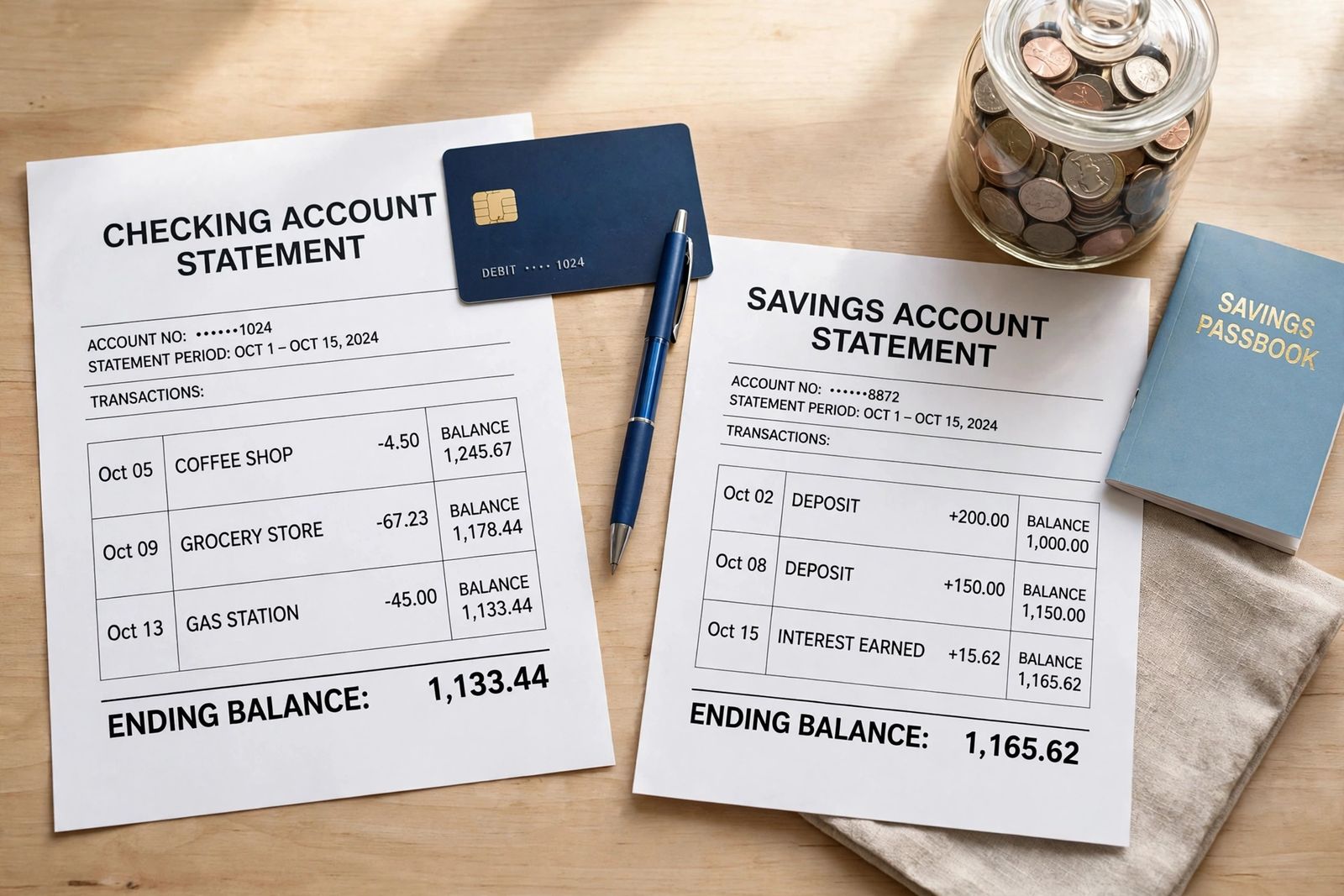
A checking account is for money in motion — the pay that lands, the bills that leave, the debit card you tap every day — while a savings account is for money at rest: parked, separate from spending, and earning interest while it waits. That is the whole checking account vs savings account distinction, and it is a distinction of jobs, not of quality. Neither account is the better one. Most people need both, and the real skill is not choosing between them but splitting your money between them by job: this week’s spending lives in checking, money with no spending date lives in savings.
Get the split wrong in either direction and it costs you. Leave everything in checking and your savings sit at roughly zero interest, mixed into the balance you judge your spending against — so they quietly get spent. Run your daily life out of savings and you hit the friction savings accounts are built with: no debit card for purchases, no checks, and at many banks a limit on how often you can pull money out. The sections below work through the differences, then put three real piles of money in the right account.
Checking vs savings account at a glance
| Checking account | Savings account | |
|---|---|---|
| Purpose | Everyday spending: pay in, bills and purchases out | Parking money you do not need today: emergency fund, goals, reserves |
| Access / debit card | Debit card as standard, plus ATMs, bill pay, transfers, payment apps | Usually no debit card for purchases; access is mainly by transfer to checking, ATM or branch |
| Checks | Yes — check-writing is the feature the account is named for | No — traditional savings accounts do not come with checks |
| Interest | Usually none; interest-bearing checking pays very little (national average 0.07% — see below) | Yes — every savings account pays interest, quoted as APY; how much varies enormously |
| Typical fees | Monthly maintenance fee (often waived with direct deposit or a minimum balance), overdraft fees, out-of-network ATM fees | Monthly maintenance fee on some accounts, excess-withdrawal fees at banks that still cap monthly withdrawals |
| Withdrawal friction | Deliberately low — built for frequent, unlimited transactions | Deliberately higher — no spending tools attached, and some banks still limit monthly withdrawals (see the Regulation D section) |
| FDIC insurance | $250,000 per depositor, per insured bank, per ownership category | Identical — and the limit is shared with your checking at the same bank, not separate |
| Best for | Money you will spend within the month | Money you want fenced off from spending that still needs to stay reachable |
Two rows of that table are routinely got wrong elsewhere, so they get their own sections below: the insurance limit is shared, not per account, and the famous six-withdrawals-a-month rule is no longer federal law — even though your bank may still behave as if it were.
What a checking account actually does
A checking account is a transaction machine. Pay and benefits arrive by direct deposit; rent, utilities and card bills leave by automatic payment; groceries and everything else leave by debit card, which subtracts the purchase directly from the balance. Checks still exist for the payments that need them. There is no practical limit on how many transactions you can run through it — daily caps on ATM withdrawals and debit purchases exist at most banks, but they cap amounts, not the account’s job.
The price of all that motion is that the money earns almost nothing while it sits there. Most checking accounts pay no interest at all, and the ones that do pay very little: in the FDIC’s national rates table published October 19, 2026, interest checking averaged 0.07%. Checking is not a bad place to keep money — it is a bad place to store it. Whatever sits in checking beyond this month’s spending plus a small buffer is earning nothing and, worse, inflating the balance you see when you decide whether you can afford something.
Checking is also where the sharpest fees live, because it is where your balance can go below zero. The main ones:
- Monthly maintenance fees, commonly waived if you set up direct deposit or keep a minimum balance — the CFPB’s bank account guidance starts from exactly these questions: what the fees are, and what waives them.
- Overdraft fees, charged when the bank pays a transaction your balance cannot cover. For debit card purchases and ATM withdrawals, federal rules let you choose whether that coverage is even on — the CFPB’s checklist treats the opt-in decision as one of the first things to settle when you open the account, because declining it means the transaction is refused instead of paid-plus-fee.
- Out-of-network ATM fees, charged by your bank, the ATM’s owner, or both.
What a savings account actually does
A savings account is the same insured deposit with the spending tools stripped off and interest switched on. No checks, usually no debit card for purchases, and at many banks no direct connection to bill pay or payment apps. What looks like a worse account is the point: the friction is the feature. Money that takes a transfer to reach is money you do not spend on impulse, and while it waits, it earns interest — quoted as APY, the yield after compounding, which is why savings rates are not stated the way loan rates are in what APR is.
How much interest is a wider question than most comparison pages admit. The same FDIC table put the national average for savings accounts at 0.38% — but that is a deposit-weighted average across every insured bank and credit union, dragged down by the large banks that still pay near zero on basic savings. Competitive savings accounts, mostly at online banks, pay several times the average. So “savings earns interest, checking doesn’t” is true and almost useless: on a real balance, the gap that matters is between your savings account’s APY and the best you could actually open. A savings account paying 0.01% is a parking space with no benefit over checking except separation — which, to be fair, is sometimes benefit enough.
Where the parked money is headed decides which savings account it wants. An emergency fund needs a plain, reachable savings account above all. Money for a known future date opens a second comparison — high-yield savings account vs CD — because a CD will often pay more for money you can lock away, and a money market account sits between the two, paying interest while restoring some checking-style access. And none of this depends on where the account lives: the same checking-versus-savings split works at a credit union, as credit union vs bank explains — only the ownership, rates and fees around it change.
The six-withdrawal rule that no longer exists (but might still apply to you)
For decades, Federal Reserve Regulation D capped “convenient” withdrawals and transfers from savings accounts at six per month, and the rule is still quoted as current law all over the internet — including, in places, by banks describing their own accounts. It is not current law. On April 24, 2020, the Federal Reserve deleted the six-per-month limit from Regulation D, and its FAQ is explicit about the two things that follow:
- The change is not temporary. The Board states it has no plans to re-impose transfer limits.
- The rule permits banks to stop enforcing the limit — it does not require them to. A bank may keep a six-a-month cap in its own account agreement, charge for withdrawals past it, and some large banks still do.
So the honest answer to “how many times can I withdraw from savings?” is: federal law no longer says — your account agreement does. Read that one clause before you open the account, especially if you plan to pull from savings often. A bank that kept the old cap as a private rule will typically charge an excess-withdrawal fee per transaction over it, and repeated breaches can get the account converted to checking. None of that is Regulation D any more. It is a contract term, and other banks have dropped it entirely — which makes it a legitimate point of comparison when choosing where the savings account lives.
Insurance: the $250,000 limit is shared, and it is the same for both
Safety is the one dimension on which this comparison is a complete draw — with one arithmetic trap. At an FDIC-insured bank, the FDIC covers both checking and savings accounts as deposit products, automatically, up to $250,000 per depositor, per insured bank, for each account ownership category, including principal plus interest accrued to the day the bank closes. Credit unions carry the equivalent cover from the NCUA on the same standard terms.
The trap: the limit is per depositor and per category, not per account. A checking account and a savings account in your own name at the same bank are both single accounts, so their balances are added together under one $250,000 limit — opening the second account did not buy a second $250,000. What raises cover is a different ownership category (a joint account, for instance, is insured per co-owner) or a second insured institution. For most households this never binds. For anyone parking a house deposit or house-sale proceeds, it is the first thing to check.
What insurance never covers, in either account’s neighbourhood: investments. Stocks, bonds, mutual funds, annuities and crypto are not deposits even when bought through the bank, and the FDIC does not insure them.
Which account for this money? Three worked decisions
1. This week’s spending money — $640 for groceries, fuel and two bills due Friday. Verdict: checking. This money’s whole job is to leave, several times, through several channels — debit card at the shop, automatic payments for the bills. Checking does all of that with no transaction limit and no transfer step in between. The interest argument for savings is empty at this horizon: $640 parked at the 0.38% national average for a week earns about five cents. And routing daily spending through savings risks the one fee structure savings still has — excess-withdrawal charges at a bank that kept its own monthly cap.
2. A $5,000 emergency fund. Verdict: savings — a separate savings account, ideally a competitive one. An emergency fund fails in checking for a behavioural reason before any financial one: sitting inside the spending balance, it reads as spendable, and it gets spent a little at a time without any single decision ever being made. In savings it is visibly separate, still reachable within a day or so by transfer when a real emergency lands, and it earns something while it waits: about $19 a year at the 0.38% average, about $200 a year at a 4% APY. That spread is why the choice of savings account matters for this money even though the choice of account type is obvious. Keep it out of anything with a lock-in or early-withdrawal penalty — an emergency has no date you can match a term to.
3. $900 set aside for a bill due in 10 days. Verdict: checking — or more precisely, leave it where the bill will be paid from. This is the case people most often get wrong in the savings direction. Ten days of interest on $900 at the national average is about nine cents; even at a top savings rate it is about a dollar. Against that, the money has a hard appointment: if it sits in savings at a different bank, the transfer back can take one to three business days, and a bill that bounces for arriving late costs a late fee or an overdraft fee that wipes out a year of such manoeuvres. Money with a near, fixed date belongs in the account the payment leaves from. Savings is for money without an appointment.
The pattern across all three: ask what the money is for and when it will be needed, and the account chooses itself. Spending soon or on a fixed near date → checking. No date, or a date months away with no lock-in needed → savings. Both accounts, split by job, is not a compromise answer — it is the system working as designed.
Frequently asked questions
Do I need both a checking and a savings account? For most households, yes — not because two accounts are inherently better, but because the two jobs conflict. Spending money needs zero friction and earns nothing; parked money needs friction and earns interest. One account forced to do both does one of them badly. The common setup is a linked pair, often at the same institution for instant transfers between them — though the best savings rate and the best checking account are frequently at different institutions, and a day or two of transfer time is a fair price for a materially better APY on a large balance.
How much should I keep in checking vs savings? A workable rule: checking holds roughly one month of bills and spending, plus a small buffer so a timing mismatch does not trigger an overdraft. Everything beyond that — the emergency fund first, then goal money — belongs in savings, where it earns interest and stops inflating your spending balance. The exact emergency target depends on your essential expenses and income security; three to six months of essentials is the widely used range.
Can I pay bills or write checks from a savings account? Generally no. Traditional savings accounts do not offer check-writing, and most do not connect directly to bill pay or payment apps — payments are made from checking, with savings feeding it by transfer. If you want interest and limited check or debit access in one account, that product exists: it is a money market account, with its own trade-offs.
Can I lose money in a checking or savings account? Not to a bank failure, within the $250,000 FDIC or NCUA limit per depositor, per institution, per ownership category — remembering that your checking and savings in the same category at the same bank share one limit. You can lose money to fees (overdrafts on checking, excess withdrawals on savings at banks that cap them), and money in either account loses buying power if its interest rate sits below inflation, which at the 0.38% national average savings rate it usually does. That is an argument for shopping for the savings rate, not for keeping savings in checking at 0%.
Is it safe to keep all my money in checking? It is insured exactly as safely as in savings — safety is not the issue. The costs are the zero interest on money that could be earning some, and the behavioural one: with no boundary between spending money and reserve money, the reserve tends to be spent. Separation, not safety, is what the second account buys.
This article is general information, checked in November 2026. The interest figures are FDIC national averages from the table published October 19, 2026, not offers — check any account’s current APY and fee schedule with the institution itself before opening it. It is not personal financial advice.