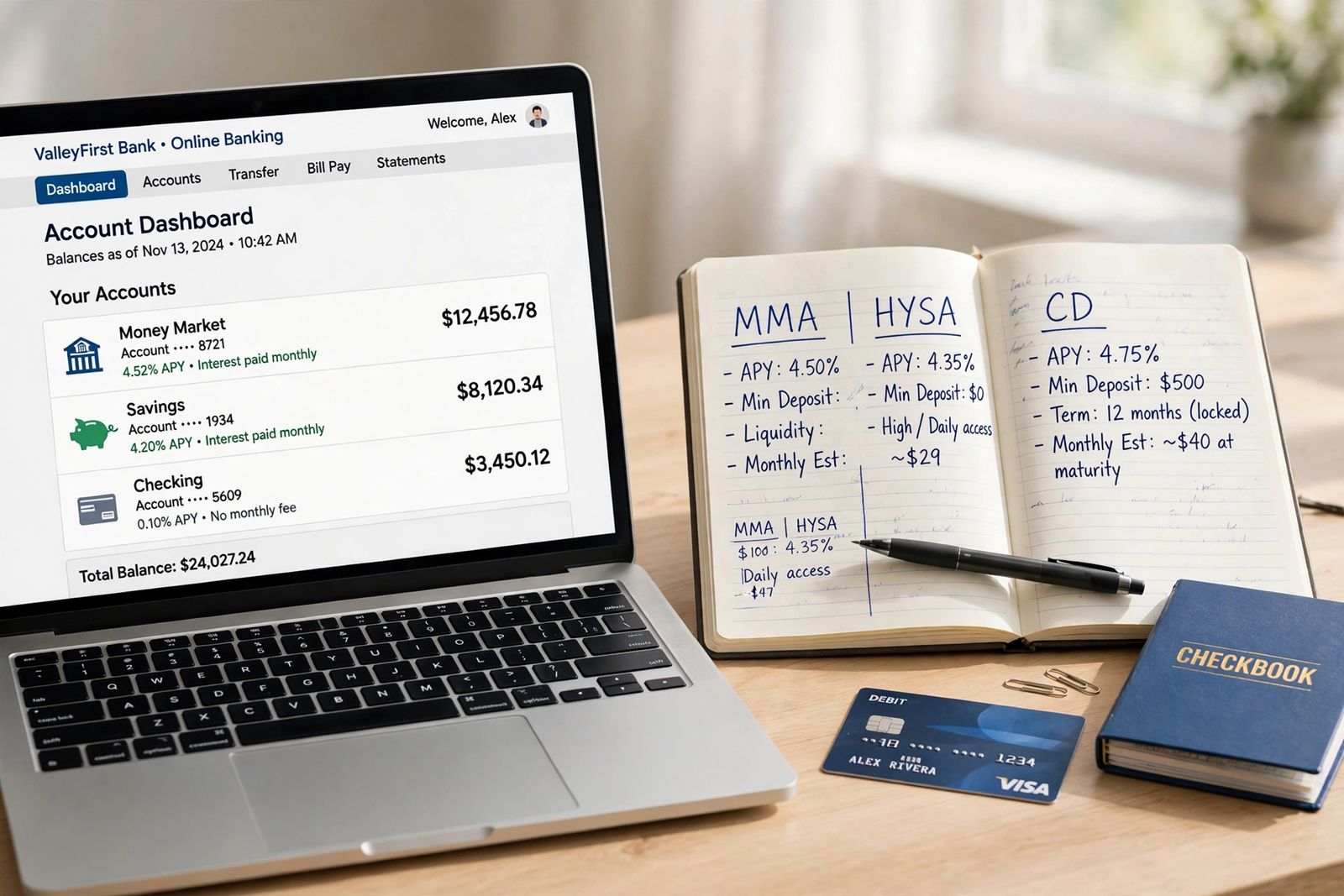
A money market account is a deposit account at a bank or credit union that pays savings-style interest — usually more than a regular savings account — while keeping limited checking-style access, so you can often pay straight from it by cheque, debit card or transfer instead of moving the money first. It is insured like any other deposit account, up to $250,000 per depositor, per insured institution, for each ownership category. That hybrid is the whole product: interest like savings, a narrow door out like checking — and, in exchange, higher minimum balances and fees than plain savings usually carry.
The Consumer Financial Protection Bureau’s definition is the plainest version: a type of account offered by banks and credit unions, insured by the FDIC or NCUA up to $250,000, which tends to pay higher interest than other savings accounts, usually limits transactions by cheque, debit card or electronic transfer, and might require a minimum deposit. Everything else on this page is what those few lines mean for your money in practice.
How a money market account works
You deposit money, the bank pays interest on the balance, and the interest is usually calculated daily and credited monthly. Three mechanics matter more than the rest:
- The rate is variable. The bank can raise or cut it at any time, and money market rates tend to drift with wider interest rates — when central-bank rates fall, money market APYs usually follow them down. The rate you open at is a current offer, not a promise.
- The rate is often tiered. Larger balances may earn a higher APY than smaller ones, and the headline rate in an advert may apply only above a balance you do not have. Always check the tier your own balance falls into.
- Access is real but rationed. Many accounts come with a debit card, cheque-writing, ATM access and online transfers. The rationing is in the detail: as the CFPB notes, transactions by cheque, debit card or electronic transfer are usually limited, while withdrawals at an ATM, in person, by mail or by phone are usually unlimited. The old federal rule behind this — a six-per-month cap on convenient withdrawals — was suspended by the Federal Reserve in 2020 and never reinstated, but many banks kept a version of it in their own account terms. Your agreement, not the old rule, is what counts now.
That rationing is deliberate design, not a defect. A money market account is built for money that mostly sits still and occasionally moves in a lump — a tax bill, a contractor’s invoice, an emergency repair — not for daily spending. If you need daily spending access, that is a checking account’s job; checking account vs savings account draws that line in full.
What the rate actually looks like
Most pages on this question lead with the highest APY any online bank advertises this week. Those offers are real, but they are the top of a very wide spread. The steadier benchmark is the FDIC’s national rates table, the deposit-weighted average of what all insured banks and credit unions pay. In its table as of October 19, 2026, the national average was 0.63% for money market accounts, against 0.38% for savings accounts and 1.76% for a 12-month CD.
Read that table the right way. First, the average money market account beats the average savings account, but not by much — about a quarter of a point, worth roughly $25 a year on $10,000. Second, the spread around the average is the real story: competitive online money market accounts pay several times the average, in the same broad range as competitive high-yield savings accounts, while many large branch banks pay close to the floor. Where you hold the account matters far more than which of these account labels you pick. Third, no figure in that table is an offer to you — it is a dated national average, and your APY will be whatever your bank’s current rate sheet says on the day you open.
Money market account vs high-yield savings vs CD
This three-way choice is the decision most people asking this question are actually making, so here it is in one place. The rate row uses the FDIC’s national averages as of October 19, 2026, as context — competitive accounts of all three types pay well above these averages, so compare live APYs account against account.
| Money market account | High-yield savings account | Certificate of deposit (CD) | |
|---|---|---|---|
| Typical rate | Variable; national average 0.63% (FDIC, Oct 19, 2026), top accounts several times higher | Variable; standard savings average 0.38% (FDIC, Oct 19, 2026), “high-yield” accounts several times higher | Fixed for the term; 12-month national average 1.76% (FDIC, Oct 19, 2026) |
| Rate fixed or variable | Variable — can change at any time | Variable — can change at any time | Fixed on a standard CD until maturity |
| Access | Cheques and/or debit card at many banks, ATM, transfers; some transaction types often limited per month | Transfers and ATM at most banks; cheques and debit cards uncommon | None until maturity without a penalty |
| Early-withdrawal penalty | No early-withdrawal penalty; excess-transaction or low-balance fees instead | No early-withdrawal penalty | Yes — typically months of interest, set in the agreement |
| Minimum deposit | Often higher — commonly $1,000–$2,500 to open, earn the top tier or waive the fee, though some accounts open from $0–$100 | Often low or none | Varies; a set deposit at opening, commonly $500+ |
| Best for | A larger balance you may need to pay from directly, a few times a year | An emergency fund and goals you add to steadily, with no need to pay from the account | Money with a known future date that will not be needed before it |
Two rows decide most cases. If you need to pay from the account — write the occasional large cheque straight from savings — the money market account is the only one of the three built for it. If you will never pay from it, the money market account’s advantage shrinks to its rate on your tier, and a high-yield savings account with a lower minimum is often the simpler win. The fuller savings-versus-CD half of this decision, including penalties and ladders, is worked through in high-yield savings account vs CD.
The costs: minimums, fees and the balance trap
The interest is the advert; the minimums are the contract. Money market accounts commonly ask for more money up front and more money kept in than savings accounts do — figures around $1,000 to $2,500 are typical for opening, earning the advertised tier or waiving the monthly fee, and some banks set the bar at $10,000 or more, while a few online accounts open with $100 or nothing at all. Monthly maintenance fees are common when the balance drops below the required level, and excess-transaction fees can apply if you use the account like a checking account.
That creates the balance trap: on a small balance, a single monthly fee can erase a year of the extra interest that made the account look attractive. Do the arithmetic before opening, not after. If the rate advantage over the savings account you already have is worth, say, $30 a year on your balance, and one month below the minimum costs a $5–$12 fee, the account only pays if you are certain the balance will stay above the line every month. Below a few thousand dollars, a no-minimum high-yield savings account usually keeps more of its interest.
Is a money market account safe?
Yes, in the specific sense that matters: it is a deposit, and deposits are insured. At a bank, the FDIC covers money market deposit accounts on the same terms as checking, savings and CDs; at a credit union, the NCUA’s share insurance does the same job. The FDIC states the standard limit as $250,000 per depositor, per insured bank, for each account ownership category, covering principal plus interest accrued to the date of a failure.
Two points people get wrong. First, the limit is not per account: a money market account, a savings account and a CD in your own name at the same bank are added together under one $250,000 limit for that ownership category. Second, insurance protects you against the bank failing — it does not protect the rate, which can fall, or against fees, which can quietly take back the interest. Within the limit, an insured money market account cannot lose your deposit to a bank failure; it can still disappoint you in slower ways.
Warning: a money market account is not a money market fund
This is the most expensive confusion in this corner of finance, because the names differ by one word. A money market account is the bank deposit described on this page: insured, interest-bearing, your balance does not fall. A money market fund — also called a money market mutual fund — is an investment product sold by brokerage and fund companies. It pools your money into short-term debt securities, aims to hold a steady $1.00 share price, and is not FDIC-insured and not a deposit. That $1.00 price is a goal, not a guarantee; funds can, rarely, fall below it, and you can lose money.
The CFPB draws the same line: a money market mutual fund is considered an investment, not a savings or checking account, even when the fund lets you write cheques against it. The SEC’s investor guidance makes the insurance point just as bluntly — as Investor.gov explains, a money market deposit account at an FDIC-insured bank is insured up to the legal limits, while an investment in a money market fund has no FDIC coverage because it is a mutual fund, not a bank product. SIPC protection, which you may see mentioned for brokerage accounts, covers missing assets if a brokerage fails — it does not protect against a fund losing value.
The practical test is where you opened it and what the paperwork calls it. Opened at your bank as a deposit account, insured explicitly by FDIC or NCUA: account. Bought in a brokerage account as shares of a named fund: fund — whatever the marketing around it implies.
Who a money market account suits — and who should skip it
A money market account tends to work well if:
- You hold a larger, fairly stable balance — comfortably above the account’s minimum every month, so tiers work for you instead of fees working against you.
- The money is an emergency fund or a near-term lump — a house deposit, a tax payment, a planned large purchase in the next year or two — and you want to be able to pay or transfer it out in one movement when the moment comes. For sizing that emergency layer first, see what is an emergency fund.
- You want one account, not two — savings-level interest without keeping a separate savings account and moving money into checking before every large payment.
Skip it, or look elsewhere, if:
- Your balance is small or swings a lot. Minimums and monthly fees will likely eat the rate advantage; a no-minimum high-yield savings account is the safer earner.
- You transact constantly. This is not a checking account, however it is advertised; frequent payments belong in one built for them.
- The money is long-term. Money you will not touch for many years is a different question entirely — deposit accounts of every kind are for keeping cash safe and reachable, not for growing it over decades.
- You bank at a credit union and are comparing like with like. Credit union money market accounts work the same way under NCUA insurance; whether the institution itself suits you is the credit union vs bank question.
How to open a money market account
- Compare the rate on your tier, not the headline. Note each candidate’s APY at the balance you will actually keep, whether that rate is tiered, and how far it sits above the FDIC’s 0.63% national average.
- Read the three numbers that cost money: the minimum to open, the balance needed to waive the monthly fee and that fee’s amount, and any monthly limit on cheques, debit payments or electronic transfers.
- Confirm the insurance. The account should state FDIC insurance at a bank or NCUA insurance at a credit union. If the word “fund” appears, you are looking at the investment product instead — stop and re-read the warning above.
- Gather the usual documents: government photo ID, your Social Security number, and a funding account for the opening deposit. Credit unions will ask you to join and meet their membership rule first, which is often a small deposit or a local/employer connection.
- Open and fund it online or in branch, then set a balance alert just above the fee-waiver minimum. That single alert prevents the commonest way these accounts lose money.
Frequently asked questions
Can you lose money in a money market account? Not to a bank failure, within the $250,000 insurance limit per depositor, per insured bank, per ownership category. You can lose ground to fees on a low balance, and to inflation if the rate sits below it — the balance will not fall because of investments, because as a depositor you have none.
Is a money market account the same as a money market fund? No. The account is an insured bank or credit union deposit. The fund is a mutual fund investment, not insured by the FDIC or NCUA, whose $1.00 share price is aimed for but not guaranteed. Similar name, opposite protection.
How much interest does $10,000 earn in a money market account? It depends entirely on the APY, which is variable. At the FDIC’s national average of 0.63% (October 19, 2026), about $63 in a year, before tax. At a competitive APY around ten times the average, roughly ten times that. Run your own balance against the specific account’s current APY — and subtract any monthly fee you would actually pay.
Do money market accounts still limit you to six withdrawals a month? Federal law no longer imposes that cap — the Federal Reserve suspended it in 2020. Some banks kept similar limits in their own terms, and ATM, in-person, mail and telephone withdrawals were usually unlimited even under the old rule. Check your account agreement for the limit that actually applies to you.
Is the interest taxable? Yes. Interest on a money market account is taxed as ordinary income, like interest on savings accounts and CDs, and the bank reports it on Form 1099-INT when it pays $10 or more in a year.
Is a money market account better than a high-yield savings account? Only in one clear case: when you want to pay directly from the account by cheque or debit card, and your balance is large enough to earn a good tier and dodge the fees. On rate alone, the best of each type pay similarly, and the savings account usually asks for less money up front.
This article is general information, checked in November 2026. The FDIC figures are national averages as of October 19, 2026, not offers; any bank’s current APY, minimums and fees must be checked with that bank. It is not personal financial advice.