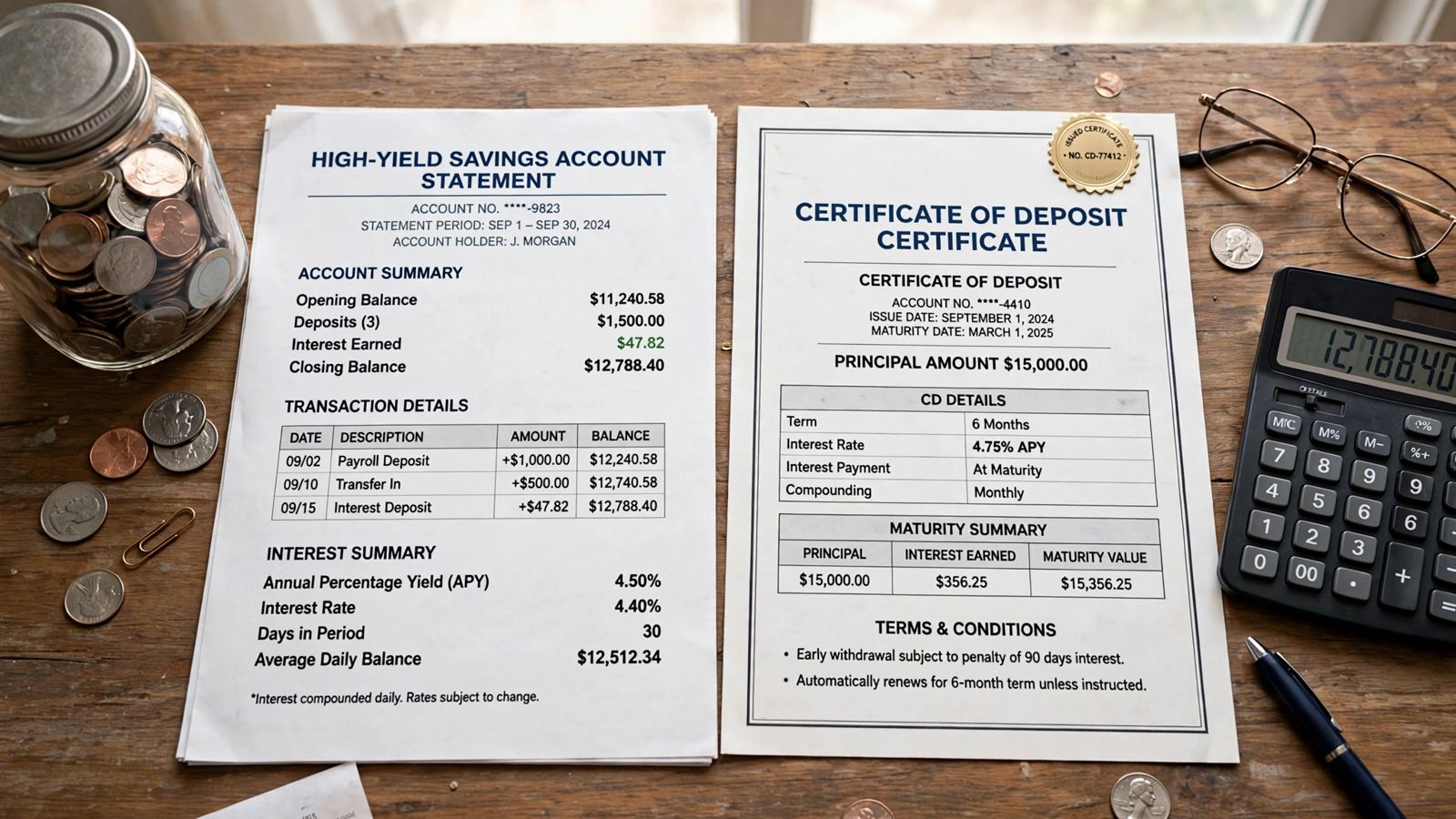
A high-yield savings account vs CD is a choice between access and certainty: the savings account keeps your money liquid at a variable rate that can rise or fall at any time, while a certificate of deposit locks your money in for a set term at a fixed rate, and charges a penalty if you leave early. So the savings account suits money you might need at an unknown date — above all an emergency fund — and the CD suits money you will not need until a known date, where being paid to wait is worth giving up the exit.
Neither is clearly “better” in the abstract. Both are deposit accounts, both are federally insured on the same terms, and both pay interest taxed the same way. Everything that separates them fits in four questions: when can you have the money back, what happens to the rate while you wait, what does leaving early cost, and is the extra interest large enough to pay for the lock?
The side-by-side
| High-yield savings account | Certificate of deposit (CD) | |
|---|---|---|
| Rate | Variable — the bank can raise or cut it at any time | Fixed for the term on a standard CD |
| Access | Withdraw when you need to; some banks still limit certain transfers per month | Locked until maturity; early exit usually costs a penalty |
| Adding money | Any time, in any amount | Usually one deposit at opening only |
| Term | None | A set term, commonly three months to five years |
| Early-withdrawal penalty | None | Typically months of interest, set in the account agreement |
| Insurance | FDIC at banks, NCUA at credit unions, up to $250,000 per category | Same — and the limit is shared with your other deposits at that bank |
| Tax on interest | Taxable as ordinary income in the year credited | Same — including interest credited before the CD matures |
| Best for | Emergency funds, goals with no fixed date, money still being built up | Money with a known future date, money you want fenced off from spending |
One row corrects a common mistake. The $250,000 limit is not per account. The FDIC states the standard limit as $250,000 per depositor, per insured bank, for each account ownership category, covering principal plus accrued interest. A savings account and a CD in your own name at the same bank share one limit — they do not each get $250,000. Different categories, or a second insured bank, are what raise it. Credit unions work the same way under the NCUA, as credit union vs bank explains.
What the rates actually look like, without the advertising
Most pages on high-yield savings account vs CD lead with the highest APY any bank advertises that week. Those are real offers, but they are the top of a wide spread, and they expire. A steadier benchmark is the FDIC’s national rates table, which publishes the deposit-weighted average paid by all insured banks and credit unions. In its table as of October 19, 2026, the national average was 0.38% for savings accounts and 1.76% for a 12-month CD, with money market accounts at 0.63%. If that middle figure caught your eye, what is a money market account explains that third option in full — the deposit account that pays savings-style interest while letting you pay from it by cheque or debit card.
That table teaches three lessons. First, “high-yield” is a marketing label, not a legal category: it means an account paying well above that 0.38% average. Second, averages hide the overlap — a competitive savings account routinely beats a mediocre CD, so compare the two specific accounts in front of you, APY against APY, never the labels. Third, longer did not mean higher: the 24-month CD averaged 1.55%, the 36-month 1.39% and the 60-month 1.41% — all below the 12-month figure. Locking money up for five years bought a lower average rate than locking it for one.
Do the dollar maths on your own balance. A half-point gap on $2,000 for six months is about $5; the same gap on $40,000 for three years is about $600. The lock-in question is trivial in the first case and serious in the second.
Liquidity vs lock-in: the difference that decides most cases
A savings account’s defining feature is not its rate but its exit. You can add money on payday, pull money out for a broken boiler, and close the account, with no penalty. The caveats are practical: some banks limit certain transfers per month, transfers to another bank can take a day or more, and the highest APY sometimes requires a minimum balance.
A CD fences it deliberately. As the Consumer Financial Protection Bureau puts it, you generally agree to keep your money in the CD for a specified length of time, and withdrawing early means paying a penalty fee. The CFPB’s shopping checklist is the right one: compare the term, the interest rate, and the early-withdrawal penalty. Two of those three are about the lock, not the yield.
That is why the standard advice — savings for emergencies, CDs for dated goals — is a statement about dates, not accounts. Money whose spending date you cannot name cannot be matched to a maturity date. Money with a date on it — tuition next September, a house purchase in two years — can be, and for that money the lock costs nothing because you were never going to touch it early anyway. If you are still building the reserve, what is an emergency fund covers how large it should be before any of it is a candidate for a CD.
Early-withdrawal penalties: the price of changing your mind
The penalty is where a CD comparison is won or lost, and it is the figure affiliate pages most often wave past with no amount. There is no single national penalty: each bank sets its own in the account agreement, typically a fixed number of months of interest — commonly around three months on shorter CDs and six to twelve months on longer ones. Treat those as typical ranges to check against, not a rule.
Three consequences follow. First, the penalty is charged on interest, and interest takes time to accumulate. Break a CD very early, before it has earned enough to cover the penalty, and at many banks the remainder comes out of your principal — you can get back less than you deposited. An insured CD cannot lose money to a bank failure within the limits; it can lose money to its own penalty clause.
Second, the penalty can erase the CD’s entire advantage. If a CD charges six months of interest for leaving, leaving halfway through a one-year term hands back most of the extra you earned for locking up. Ask before opening: how long must I stay for the rate gap, on my balance, to exceed the penalty? If the answer is “almost the whole term”, the CD is worth it only if you are nearly certain about the date.
Third, penalty terms are the whole difference between CD types that look similar. No-penalty CDs delete this clause and pay a lower rate for it; bump-up CDs trade some rate for the right to move it. Each is the same bargain — rate for restrictions — struck at a different point.
Fixed vs variable: what the rate environment does to each account
A standard CD’s rate is a contract: it runs to maturity whatever happens outside. A savings account’s rate is a current offer the bank can change. Behind both sits the Federal Reserve, whose Federal Open Market Committee sets a target range for the federal funds rate. Deposit rates tend to follow that rate’s direction, loosely and at each bank’s own pace — the Fed does not set your savings APY.
That produces the cleanest rule in the high-yield savings account vs CD comparison:
- When rates are falling, the CD’s lock gains value. Your fixed rate keeps paying yesterday’s higher rate while savings APYs are cut around it.
- When rates are rising, the savings account gains value. Its APY can be raised while your money stays accessible, while an existing CD keeps paying the older, lower rate — and a long term means a long wait.
- When you do not know, which is the honest position most of the time, the answer is not a forecast. It is to split by date, below.
One warning: do not break an existing CD and pay a certain penalty to chase a higher rate unless the arithmetic — balance, penalty, new rate over the remaining term — still leaves you ahead.
The CD ladder, and what happens at maturity
A CD ladder splits one sum across several CDs with staggered maturity dates instead of placing it all in a single term. The classic shape divides the money equally across one-, two-, three-, four- and five-year CDs. When the one-year CD matures, you either spend that slice or roll it into a new five-year CD at the long end. From then on, one CD matures every year.
A ladder buys three things: a slice becomes penalty-free every year; reinvestment is spread across different years’ rates, so the whole sum is never locked at one day’s rate; and longer terms become usable without committing everything to the longest wait. It does not buy emergency access — a ladder whose first rung matures in a year is still the wrong home for money you might need next month.
Ladders also need tending, because a CD does not simply end. The CFPB’s key terms note that a rollover or renewal can occur at the end of a CD’s term: if your agreement provides for automatic renewal and you miss the grace period after maturity — a short window whose length your agreement sets — the bank places the money into a new CD of the same term at whatever rate it then offers, restarting the penalty clock. Diary the maturity date when you open the CD: at maturity you have a brief, penalty-free moment to move the money — the only such moment in the CD’s life.
Taxes: the same for both, and due before the CD lets you touch the money
Tax does not separate these accounts, with one timing twist. The IRS lists interest on bank accounts and certificates of deposit as taxable interest, taxed as ordinary income — at your normal income-tax rate, not the lower capital-gains rates. The bank reports it on Form 1099-INT when it pays $10 or more in a year, and the IRS is explicit that you must report all taxable interest even if no form arrives.
The twist is timing. Interest is generally taxable in the year it is credited, and a multi-year CD credits interest as it goes — so you can owe tax each year on interest inside a CD you cannot withdraw without a penalty. On a large, long CD that mismatch is worth planning for. Interest left in either account compounds meanwhile — the mechanics are the same as in compound interest — but compounding does not defer the tax. The main exception is a CD inside a tax-advantaged retirement account, where the account’s rules govern when tax falls due.
Which should you choose in a high-yield savings account vs CD decision?
Work through the money, not the marketing:
- You might need it at an unknown date, or you are still adding to it regularly. Savings account. Liquidity is the product; the variable rate is a price worth paying for an emergency fund.
- You will need it on a known date at least a few months away, and the CD’s APY is meaningfully above the savings APY on your balance. CD, with a term that ends shortly before the date — never after it.
- The APY gap is tiny. Savings account. A lock-in, a penalty clause and a renewal date to diary are real costs; a gap worth a few dollars over the term does not pay for them.
- You have both kinds of money. Split it: the emergency layer stays liquid, the dated layer goes into a CD or a ladder. Using both is the normal end state, not a compromise.
- Your combined deposits at one bank approach $250,000 in one ownership category. Spread across categories or institutions, because the limit is shared.
Frequently asked questions
Does a CD always pay more than a high-yield savings account? No. On averages it usually does — the FDIC’s October 19, 2026 table put a 12-month CD at 1.76% against 0.38% for savings — but a competitive savings account can beat a poor CD, and in that same table longer CDs averaged less than the 12-month CD. Compare the two specific APYs in front of you.
Can you lose money in a CD or a high-yield savings account? Not to a bank failure, within the $250,000 limit per depositor, per insured bank, per ownership category. You can lose money in a CD to its penalty if you break it before it has earned enough interest to cover it, and money in either account can lose buying power if its rate sits below inflation.
Is the interest taxed differently in a CD than in a savings account? No. The IRS treats interest on both as taxable interest, taxed as ordinary income in the year credited. The difference is that a CD may credit interest you cannot yet withdraw, so tax can fall due before the money is in your hands.
Should an emergency fund go in a CD? No — an emergency has no date you can match a term to, and breaking a CD to meet one can cost months of interest or part of the principal. Consider CDs only for money beyond the emergency fund.
What is a CD ladder, in one sentence? Several CDs with staggered maturity dates — classically one maturing each year — so part of your money becomes available regularly and is reinvested at the long end, instead of the whole sum being locked to one date and one rate.
This article is general information, checked in November 2026. The FDIC figures are national averages as of October 19, 2026, not offers; check any bank’s current APY with that bank. It is not personal financial advice.