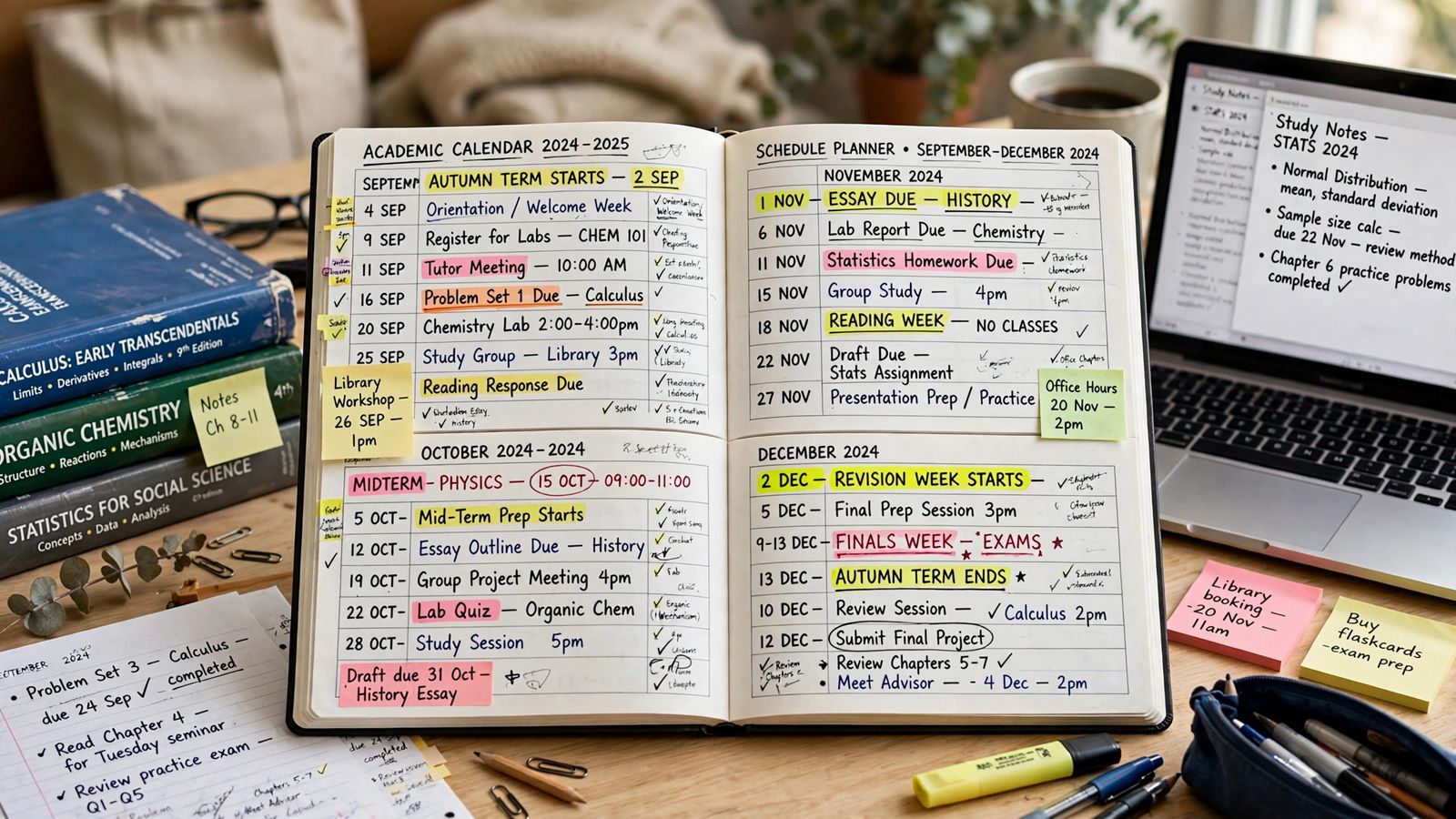
The difference in semester vs quarter systems is term length, and everything else follows from it: a semester runs about 15 to 16 weeks and a college fits two of them into a year, while a quarter runs about 10 to 11 weeks and a college fits three of them (fall, winter and spring, with summer as an optional fourth). Because the quarter is roughly two-thirds as long, quarter courses move faster, students carry fewer courses at once — typically three or four instead of four to six — and quarter credits are worth two-thirds of a semester credit when they transfer. Neither calendar changes how much you learn in a full year: both deliver roughly 30 weeks of instruction. They package the same year at two different speeds.
Semester vs quarter at a glance
| Semester system | Quarter system | |
|---|---|---|
| Weeks per term | 15–16 | 10–11 |
| Main terms per year | 2 (fall, spring) | 3 (fall, winter, spring) |
| Summer term | Optional, usually shortened | Optional full quarter |
| Typical start and end | Late August to mid-May | Mid-to-late September to mid-June |
| Courses at once (full-time) | 4–6 | 3–4 |
| Credits per term (typical full-time) | About 15 | About 15 |
| Credits per year | About 30 | About 45 |
| Credits for a bachelor’s degree | About 120 | About 180 |
| Midterms typically arrive | Around week 7–8 | Around week 3–5 |
The last three rows are the ones students most often misread. The credit totals look different — 120 against 180 — but they describe the same degree, because the credits themselves are different sizes. The sections below take each row in turn.
How the semester system works
A semester divides the academic year in half. The fall semester usually begins in late August or early September and ends in mid-December; the spring semester begins in mid-January and ends in early to mid-May. A long winter break sits between them and a long summer break follows the spring term. Many schools add an optional summer session, usually compressed into six to eight weeks, for catching up or getting ahead.
Fifteen to sixteen weeks is long enough for a course to develop in stages: foundations first, then application, with a midterm near the middle and time to recover from a bad week or a slow start before finals. Full-time students usually carry four to six courses at once, most often five, adding up to roughly 15 credits a term and 30 a year. Individual courses are commonly worth three or four credits each.
The semester is the dominant calendar in American higher education by a wide margin — the large majority of four-year colleges and universities use it, including most flagship state universities and most private universities. If a school you are considering says nothing about its calendar, it is almost certainly on semesters.
How the quarter system works
A quarter divides the year into shorter terms of about 10 to 11 weeks. Students attend three of them — fall, winter and spring — and most quarter schools also offer a summer quarter as an optional fourth. Because the year is split three ways instead of two, the calendar starts later and ends later: fall quarter typically begins in mid-to-late September, and spring quarter runs into mid-June.
The University of Washington’s advising office states the shape plainly: there are three quarters in the academic year plus an optional summer quarter, and courses last “normally 10 weeks plus finals,” with registration for the next quarter opening about halfway through the current one. Stanford’s published calendar shows the same rhythm in dates: for 2026–27, Autumn Quarter runs from late September to mid-December, Winter Quarter from early January to mid-March, and Spring Quarter from late March to early June, with an optional Summer Quarter after it.
With only 10 or 11 weeks, the pace is the defining feature. Midterms can arrive by week three or four, and there is little slack: one week of a quarter is about a tenth of the course, the equivalent of a week and a half of a semester. In exchange, students carry fewer courses at once — usually three or four — and get three fresh starts a year instead of two. Over a year they typically complete more separate courses than semester students (roughly nine to twelve against eight to ten), which means more subjects sampled, more electives, and an easier path to a double major or a minor.
One point the comparison guides often get wrong: quarter courses are not necessarily small-credit courses. At the University of Washington, the same advising office notes that many courses are 5 credits and meet five hours a week, and that most bachelor’s degrees there require 180 credits — 15 credits a quarter, three quarters a year, for four years. Course credit values vary by school in both systems; what is fixed is the ratio between them, covered below.
Semester vs quarter vs trimester
The third calendar in the semester vs quarter comparison is the trimester, and it causes the most confusion because its name is used loosely. Strictly, a trimester system divides the year into three terms of about 12 to 13 weeks each — longer than a quarter, shorter than a semester — and, unlike the quarter system, it does not count summer as a fourth term waiting in reserve; the three terms are the year. In practice the word is also used for the quarter system’s three attended terms, which is why some pages describe trimesters as 10 to 12 weeks: they are describing quarters under another name.
True trimester calendars are uncommon at American universities — you will meet them more often in K–12 schools, where three grading periods replace two or four — and a handful of colleges use the label for what is functionally a three-term year. If a college says “trimester,” check its actual term length in weeks and whether a summer term exists. Those two facts tell you which system you are really looking at, whatever it is called. A related variant, the 4-1-4 calendar (two four-month terms with a one-month January term between them), is a semester calendar with an extra short term inserted, not a separate system.
Converting quarter credits to semester credits
Credits are not interchangeable between the two systems, because a credit measures contact time over a term, and the terms differ in length. The standard conversion, used by registrars across the country, follows the two-thirds ratio of the term lengths:
- Quarter credits × 2/3 (× 0.667) = semester credits
- Semester credits × 1.5 = quarter credits
Pace University’s registrar, at a semester-system university, states the rule directly: to convert credit hours from the quarter system to the semester system, “multiply by 0.667.” Cal Poly’s catalog applies the same factor from the other side of a system change: quarter units are converted to semester units by multiplying by 0.667, so a 4-unit quarter class equates to about 2.67 semester units.
Worked examples make the arithmetic concrete:
| You earned | It becomes |
|---|---|
| 5 quarter credits | 3.33 semester credits |
| 4 quarter credits | 2.67 semester credits |
| 45 quarter credits (one year) | 30 semester credits (one year) |
| 180 quarter credits (bachelor’s degree) | 120 semester credits (bachelor’s degree) |
| 3 semester credits | 4.5 quarter credits |
| 120 semester credits (bachelor’s degree) | 180 quarter credits (bachelor’s degree) |
Two warnings belong with the formula. First, the receiving school does the converting, not you, and schools handle the fractions differently: Pace, for example, rounds fractional credits down and groups fractional courses together where it can, while other schools record the decimals. A 4-credit quarter course that a requirement expects to be worth 3 semester credits arrives as 2.67 — short, on paper — and whether you must make up the difference is a policy question for that school’s registrar, not a calculation you can settle yourself. Second, conversion changes the number, not the content: a course judged not equivalent to the receiving school’s course transfers as elective credit or not at all, whatever the arithmetic says. If you are planning a transfer between systems, get the receiving school’s evaluation in writing before you enrol, and read what is a credit hour for how the underlying unit is defined.
Which universities use which system?
The semester system is the default: most American universities a student can name — the large state flagships, the Ivy League, most liberal arts colleges — run on semesters, and a degree plan built on 120 credits assumes them. The quarter system survives in identifiable pockets, and the clearest is the University of California. A University of California systemwide review of its calendars records the split inside a single system: all UC campuses moved to quarters in 1966, UC Berkeley returned to semesters in 1983, and UC Merced opened on semesters in 2005 — so seven UC undergraduate campuses (Davis, Irvine, Los Angeles, Riverside, San Diego, Santa Barbara and Santa Cruz) teach on quarters while Berkeley and Merced teach on semesters, and the UC law schools run on semesters regardless of their campus.
Outside California, the best-known quarter-system universities include Stanford, the University of Washington, the University of Chicago, Northwestern, Dartmouth, DePaul, Drexel and the University of Oregon. Lists of quarter schools age badly — universities convert, almost always from quarters toward semesters, as Ohio State did in 2012 — so treat any list, including this one, as a starting point and confirm the calendar on the university’s own site. The college-versus-university naming question is separate, and is covered in college vs university; the calendar a school uses says nothing about its level or quality.
Which is better: semester or quarter?
Neither, in the abstract — but the honest answer is not “it depends” and nothing more. Each system predictably suits identifiable situations:
A semester tends to fit better if you want time to go deep in a subject, to recover from a rough start, or to build the kind of relationship with a professor that produces a strong recommendation — fifteen weeks gives all three room. It also fits the world outside college: most internships, summer jobs and study-abroad programs are scheduled around semester dates, with summer programs typically starting in May, when semester students are free. Students coming straight from a semester-based high school face no calendar adjustment.
A quarter tends to fit better if you want to sample widely before committing — more courses per year makes exploring, switching majors early, or adding a second major or a minor easier, because a mistaken course costs ten weeks, not fifteen, and a retake comes sooner — and if you work well in short, intense bursts with frequent deadlines rather than long builds. Missing a term also costs less: one quarter is a third of a year, not half of one.
Two cautions cut across the preference. First, sequence-heavy subjects — mathematics, languages, the sciences — are taught as chains in both systems, but a broken chain costs more time on quarters: miss the winter link of a three-quarter sequence and the next start may be the following fall, a full year later. Second, do not choose a university for its calendar alone. The difference between a good and a bad fit on subject, cost and teaching dwarfs the difference between calendars; the calendar shapes your weeks once you are there, and most students adapt to whichever rhythm their school keeps. What you cannot adapt around is the credit arithmetic if you transfer, and the degree totals behind both systems are set out in how many credits to graduate.
Frequently asked questions
How many weeks are in a semester and in a quarter? A semester is typically 15 to 16 weeks including final exams; a quarter is typically 10 to 11 weeks including finals. Counted over a full year the two systems deliver about the same teaching time — roughly 30 weeks — divided differently.
How many terms are there in a year? Two semesters, three quarters (fall, winter, spring, with summer as an optional fourth), or three trimesters of about 12 to 13 weeks. The attended year is three terms on both the quarter and trimester systems; the difference is term length and whether a summer term is built into the plan.
Is 180 quarter credits more than 120 semester credits? No. They are the standard totals for the same bachelor’s degree in each system: about 45 quarter credits a year against about 30 semester credits a year, at the two-thirds conversion rate. The quarter figure is larger only because each quarter credit is smaller.
Does a quarter system let you graduate faster? Not by itself. Both systems take four academic years at a normal full-time load. A quarter system can make year-round attendance slightly easier to arrange because summer is a full regular quarter rather than a compressed session, but graduating early in either system comes from carrying heavier loads, summer study or credits earned before enrolment — not from the calendar.
Is full-time status different in the two systems? The threshold is stated in credits, not courses, so it lands in the same place: around 12 credits a term is the usual full-time floor in both systems. What changes is how many courses make up those credits — typically four to six courses on semesters, three or four on quarters.
This article is general information about the semester, quarter and trimester calendars used by US colleges and universities, based on the university and registrar sources linked above and checked in November 2026. Individual institutions set their own term dates and transfer policies; a school’s own academic calendar and its registrar’s conversion rules are the final authorities for that school.