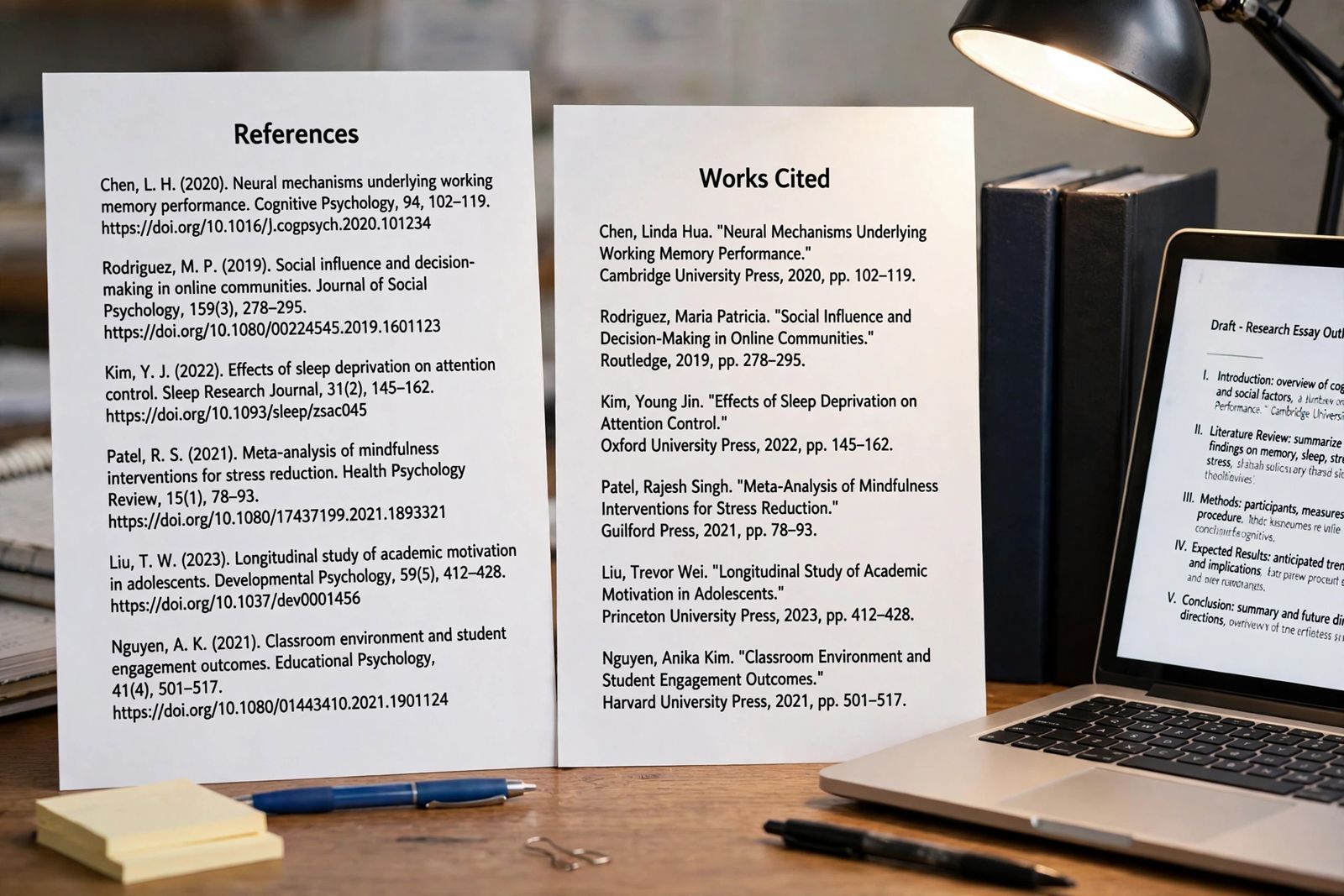
APA and MLA are both author-based citation styles — each one puts a short citation in your text and a full list of sources at the end — but they are built for different kinds of writing. APA (American Psychological Association, 7th edition, 2020) leads with the date: its in-text citations give the author and the year, as in (Sapolsky, 2017), because it serves the social sciences — psychology, education, sociology, nursing, business — where readers judge a source partly by how recent it is. MLA (Modern Language Association, 9th edition, 2021) leads with the author and the page, as in (Sapolsky 112), because it serves the humanities — literature, languages, philosophy, the arts — where the work is quoting and analysing texts closely and the reader needs the exact passage, not the year. Which one you use is not a preference: it is set by your subject, your department or your instructor, and the same source has to be re-formatted, not just re-labelled, when you switch. The differences that follow — the list name, where the date sits, how names and titles are written, how a DOI is shown — all grow out of that one split: APA asks when was this published?, MLA asks where exactly is it?
APA vs MLA at a glance
| APA (7th edition) | MLA (9th edition) | |
|---|---|---|
| Used for | Social sciences: psychology, education, sociology, nursing, business | Humanities: literature, languages, philosophy, arts, cultural studies |
| In-text citation, paraphrase | (Author, Year) — (Sapolsky, 2017) | (Author Page) — (Sapolsky 112) |
| In-text citation, direct quote | (Author, Year, p. X) — (Fried et al., 2022, p. 340) | (Author Page) — (Fried et al. 340) |
| End-of-paper list | References | Works Cited |
| Author names in the list | Surname and initials: Sapolsky, R. M. | Surname and full first name: Sapolsky, Robert M. |
| Date position in the list | Second, in parentheses, right after the author | Near the end of the entry |
| Title capitalisation in the list | Sentence case for article and book titles | Title case for all titles |
| Article titles in the list | Plain, no quotation marks | In quotation marks |
| Journal volume and issue | Journal, 10(2) — volume italic, issue in parentheses | Journal, vol. 10, no. 2 |
| DOI | As a link: https://doi.org/10.xxxx/xxxxx, no full stop after it | Preferred; shown as a DOI link or with a doi: prefix, full stop after it |
| First page of the paper | Separate title page for student papers | No title page — a four-line heading at the top left of page one |
| Page header | Page number only (student papers) | Your surname and the page number |
Every row is a consequence of the opening split. Because APA readers scan for currency, the year appears in every in-text citation and sits second in every list entry. Because MLA readers chase passages, the page number is the load-bearing detail and the year can wait until the end of the entry.
The same three sources, cited in APA and in MLA
This is the part students actually come to this page for: one book, one journal article and one web page, each cited fully in both styles. Every source below is real, and every entry was checked against the official style pages — the APA Style site’s own APA–MLA comparison guide, its author–date citation page, the MLA Style Center’s Works Cited quick guide, and the Purdue OWL’s APA reference list rules and MLA formatting and style guide. Copy the pattern, not just the punctuation.
1. A book — Robert M. Sapolsky, Behave (Penguin Press, 2017)
APA — References entry: Sapolsky, R. M. (2017). Behave: The biology of humans at our best and worst. Penguin Press.
MLA — Works Cited entry: Sapolsky, Robert M. Behave: The Biology of Humans at Our Best and Worst. Penguin Press, 2017.
In the text: APA cites a paraphrase as (Sapolsky, 2017), or names the author in the sentence — Sapolsky (2017) argues that… MLA cites the whole work as (Sapolsky) when no page is needed, and adds the page for a specific passage, (Sapolsky 112) — the same position where APA would write (Sapolsky, 2017, p. 112).
What changed between the two entries: the initials became a full name, the year moved from brackets at the front to the end, and the title’s capitalisation flipped from sentence case (The biology of humans…) to title case (The Biology of Humans…). The publisher and the italics stayed the same, and neither style prints the publisher’s city — guides that still show “New York: Penguin Press” are following APA 6th edition or MLA 8th-era habits.
2. A journal article — Fried, Papanikolaou and Epskamp (2022), Clinical Psychological Science
APA — References entry: Fried, E. I., Papanikolaou, F., & Epskamp, S. (2022). Mental health and social contact during the COVID-19 pandemic: An ecological momentary assessment study. Clinical Psychological Science, 10(2), 340–354. https://doi.org/10.1177/21677026211017839
MLA — Works Cited entry: Fried, Eiko I., et al. “Mental Health and Social Contact During the COVID-19 Pandemic: An Ecological Momentary Assessment Study.” Clinical Psychological Science, vol. 10, no. 2, 2022, pp. 340–54, https://doi.org/10.1177/21677026211017839.
In the text: the article’s abstract opens by saying that for many students the pandemic caused “once-in-a-lifetime disruptions of daily life.” Quoted in APA, that line is cited (Fried et al., 2022, p. 340). Quoted in MLA, it is (Fried et al. 340). Paraphrased, APA keeps the year — (Fried et al., 2022) — while MLA drops to the author alone when no page is being pointed to — (Fried et al.).
What changed: three authors are listed in full in the APA entry (surname, initials, ampersand before the last), while MLA shortens a three-author entry to the first author plus et al. The article title gains quotation marks and title case in MLA and loses them in APA — but the journal’s name is in title case and italics in both, because journal titles are titles of whole publications, and APA’s sentence-case rule applies to the article, not to the journal. The volume and issue are compressed in APA — 10(2) — and spelled out in MLA — vol. 10, no. 2. MLA also compresses the page range (340–54) where APA prints it in full (340–354). The DOI is the same string in both; APA presents it as an https://doi.org/ link with no full stop after it, while MLA ends the entry with a full stop, as it does every entry.
3. A web page — “What’s New in the Ninth Edition of the MLA Handbook,” MLA Style Center (April 2021)
APA — References entry: Modern Language Association of America. (2021, April). What’s new in the ninth edition of the MLA handbook. MLA Style Center. https://style.mla.org/ninth-edition-whats-new/
MLA — Works Cited entry: “What’s New in the Ninth Edition of the MLA Handbook.” MLA Style Center, Modern Language Association of America, Apr. 2021, style.mla.org/ninth-edition-whats-new/. Accessed 14 Nov. 2026.
In the text: APA cites the page by its organisation and year, (Modern Language Association of America, 2021). MLA, because the page has no named individual author, cites it by its shortened title, (“What’s New”).
What changed: APA treats the organisation as the author and puts the full date — year and month — in its usual second position; the page title is sentence case and italic, and the site name follows. MLA starts with the title because there is no author to start with, puts the site name in italics as the container, names the organisation as publisher, shortens the date to a month and year (Apr. 2021), and strips the https:// from the URL. Two conventions in this pair are worth knowing rather than copying blindly. The Accessed date at the end of the MLA entry is an optional element in MLA 9 — add it when the page is likely to change or has no publication date; here it is shown so you can see where it goes. APA takes the opposite route: it prints a “Retrieved [date] from” line only for pages designed to change over time, and this page carries a fixed publication date, so no retrieval date appears.
Which style should you use?
Work down this list and stop at the first answer you get:
- Your assignment sheet, syllabus or journal’s instructions. If a style is named, that settles it — instructors mark against the style they set, and a perfectly formatted paper in the wrong style loses marks for formatting throughout.
- Your subject’s convention. Psychology, education, sociology, nursing, social work and most business courses default to APA. English, literature, modern languages and most other humanities courses default to MLA. History often uses neither — it defaults to Chicago style — so a history brief that names no style is a reason to ask, not to guess.
- If genuinely nothing is named, ask. A one-line email before you write is cheaper than rebuilding every citation afterwards, because switching styles means rewriting each entry — the elements change order, not just punctuation.
One more practical point: you will probably use both before you graduate. A psychology major taking a literature elective is working in APA in one course and MLA in the other, in the same semester. That is also why citing sources correctly matters beyond formatting: the citation is the credit line that separates scholarship from plagiarism, whichever style carries it.
Paper formatting: the differences beyond citations
- Title page. APA student papers begin with a separate title page: paper title, your name, institution, course, instructor and due date, with the page number at the top right. MLA papers normally have no title page; page one opens with a four-line heading at the top left — your name, the instructor’s name, the course, and the date written day-first (14 November 2026).
- Running header. MLA puts your surname and the page number at the top right of every page (Smith 3). APA student papers put the page number alone; the shortened-title running head belongs to professional papers.
- Headings. APA defines five levels of heading with set formats, which is why APA papers read in labelled sections. MLA prescribes no heading system; essays usually run without them.
- Dates inside entries. APA writes fuller dates and never abbreviates the month: (2021, April). MLA abbreviates months longer than four letters and writes the day first: 14 Nov. 2026.
- What is the same. Both styles are double-spaced throughout, including the source list; both use 1-inch margins; and both lists are alphabetical by author surname with a half-inch hanging indent on every entry. Shared rules like these are why students assume the styles are interchangeable — the shared skeleton hides how different the entries on it are.
Common mistakes when switching between APA and MLA
- Leaving the year in an MLA citation, or dropping it from an APA one. (Smith, 2024) is not an MLA citation with extra detail; it is simply wrong in MLA, and (Smith 45) is missing the element APA exists to show.
- Commas and “p.” in MLA. MLA puts no comma and no “p.” between author and page: (Smith 45), never (Smith, p. 45). APA requires both for a quotation: (Smith, 2024, p. 45).
- Title case in an APA reference list. The instinct to capitalise every major word is MLA’s rule. In APA, article and book titles take sentence case — only the first word, the first word after a colon, and proper nouns are capitalised. Journal names are the exception in APA and stay in title case.
- Initials in MLA, full names in APA. The Works Cited list spells the first name out (Sapolsky, Robert M.); the References list reduces every author to initials (Sapolsky, R. M.).
- Calling the list by the other style’s name. An APA paper that ends with a page headed “Works Cited” announces the mix-up before the marker reads a single entry.
- Mixing the two in one paper — APA in-text citations over an MLA list is the most common version. Pick the style the brief names and apply it to every element, including the header and the title page.
- Trusting a generator’s edition. Citation tools and older library guides still produce APA 6 output — publisher locations, “Retrieved from,” DOIs written as doi:10.xxxx instead of the https://doi.org/ link. Check any generated entry against the current editions: APA 7th and MLA 9th. Some university LibGuides still show those older forms in their worked examples while claiming to cover the current editions, which is exactly how outdated citations get copied into new papers.
- Invented or placeholder examples copied as if real. Several comparison pages online illustrate the styles with made-up sources and placeholder DOIs (doi.org/10.xxxx). The pattern is copyable; the details are not — a placeholder DOI in a submitted paper is a reference that does not exist.
Frequently asked questions
What is the main difference between APA and MLA? APA is an author–date system: in-text citations carry the year, (Author, Year), and the end list is called References. MLA is an author–page system: in-text citations carry the page, (Author Page), and the end list is called Works Cited. APA serves the social sciences, MLA the humanities, and most other differences — date position, name forms, title capitalisation — follow from those two designs.
Is APA or MLA used for English classes? MLA, in almost all cases. English and literature courses analyse texts closely, which is the work MLA’s page-based citations are built for. Your instructor’s syllabus still outranks the general rule.
Do I need a page number in an APA citation? Only when you quote directly, or point to one specific part of a source: (Author, Year, p. X). An ordinary APA paraphrase citation is author and year alone. In MLA the page number is the default, present for quotations and paraphrases alike whenever the source has pages.
Can I use both APA and MLA in the same paper? No. One paper, one style, applied to the citations, the source list, the header and the title page alike. If a course genuinely lets you choose, choose once, at the start.
Which is easier, APA or MLA? Neither, in any way that survives contact with an actual paper. MLA’s in-text citations are shorter; APA’s entries follow a more rigid template, which some students find easier to apply mechanically. The style you have used before will feel easier, and the style your course requires is the one that counts.
What are the current editions? APA Style is in its 7th edition (Publication Manual, 2020). MLA style is in its 9th edition (MLA Handbook, 2021). Anything describing APA 6 or MLA 8 rules — publisher locations in APA, for example — is out of date, however official the page hosting it looks. The official homes of the two styles are the APA Style site and the MLA Style Center, and both publish free guidance there.
Where does citation style fit into the rest of college writing? It is one of the mechanical systems wrapped around the degree itself — the same family of rules as the credit hour that sizes your courses and the honours labels like cum laude that may sit on your degree at the end. And the college/university distinction explained in college vs university is a reminder that these conventions live inside institutions: departments, not students, set them.
This article compares APA Style (7th edition) and MLA style (9th edition) as published by the American Psychological Association and the Modern Language Association, checked November 2026. Your instructor’s or journal’s requirements override any general guide — where they differ from the styles as published, follow the instructions you were given.