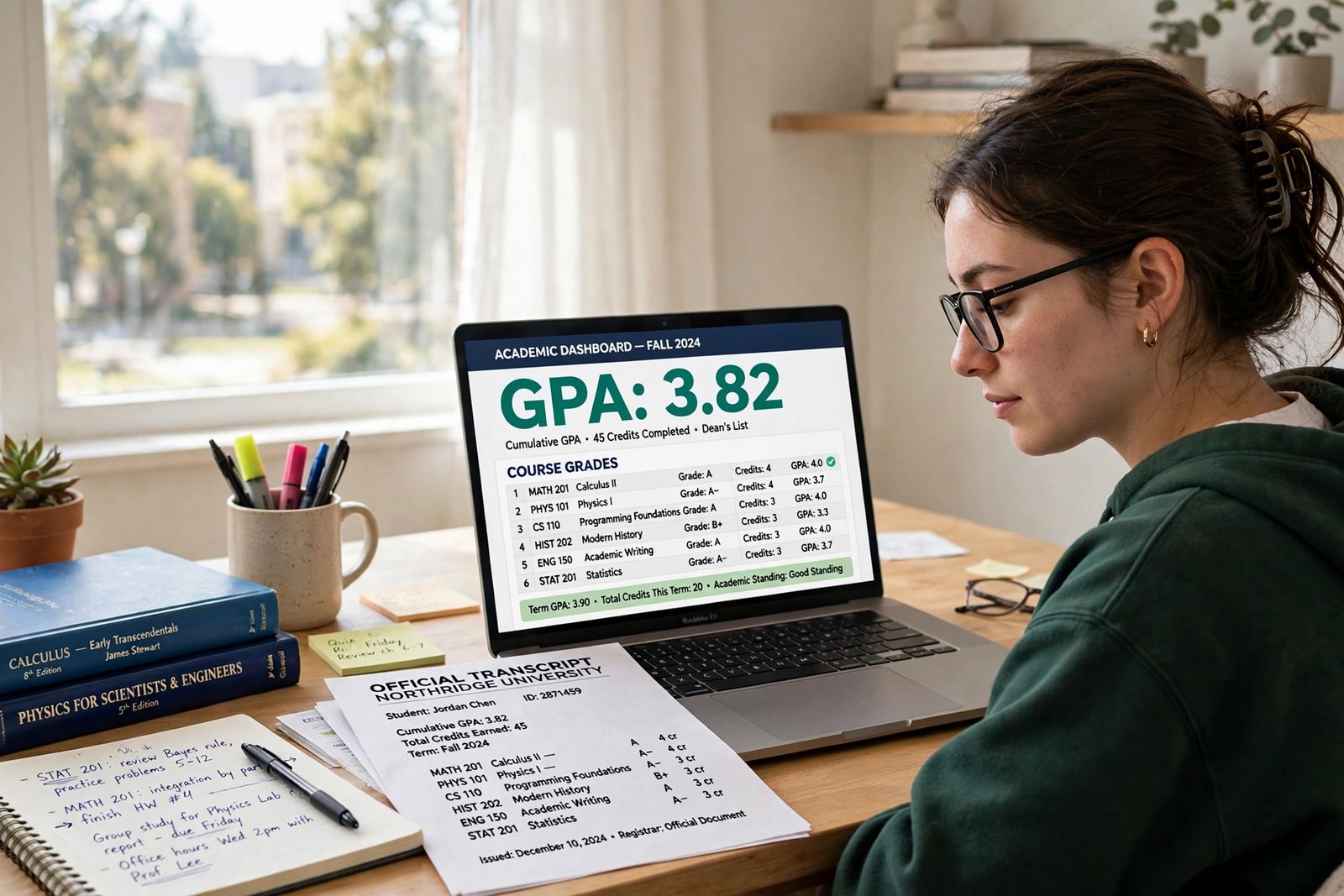
A good GPA is the one that clears the bar for your goal — there is no single number, but there are solid anchors. The average US high school graduate finishes with a 3.11 GPA, and the average bachelor’s graduate finishes college with a 3.26 (median 3.30). Against those averages: 3.0 is the line most often used for staying in good standing, keeping aid eligibility and applying to graduate school; 3.5 is where graduation honours usually begin and where a GPA starts to look strong rather than average; and at selective colleges the typical entering student sits near 3.8–3.9, far above the national average. Same scale, four different questions — this article separates them, with every average below tied to the study or university that published it.
The averages, with their sources attached
Most GPA guides quote averages without saying where they came from, and the numbers quietly disagree with each other. Here are the national figures that can actually be traced, compiled from the primary sources — no other page in the top results assembles them this way.
| Who | Average GPA | Who published it, and when |
|---|---|---|
| US high school graduates | 3.11 | NCES High School Transcript Study, class of 2019 (was 3.00 in 2009 and 2.68 in 1990) |
| US high school students (rounded) | 3.0 | College Board BigFuture summary figure |
| US college students (rounded) | 3.1 | College Board BigFuture summary figure |
| College students at four-year schools | ≈3.15 | Rojstaczer & Healy grade-distribution tracking, 2013, 87 four-year institutions — the series ends there; no agency publishes a current one |
| Bachelor’s graduates (mean) | 3.26 | NCES Baccalaureate and Beyond 2016/2020, class of 2015–16 |
| Bachelor’s graduates (median) | 3.30 | Same NCES study — half of graduates finished above 3.30, the middle half between 2.97 and 3.62, and the top 10% at 3.85 or higher |
| Bachelor’s graduates, by field | 3.05 to 3.44 | Same NCES study — general studies averaged lowest (3.05), education highest (3.44) |
| Bachelor’s graduates, by sector | 3.22 public / 3.34 private nonprofit | Same NCES study |
Two lessons hide in that table. First, the high school and college averages are close — roughly a B to B+ either way — so a 3.0 is not “below average” anywhere; it is a hair under the high school mean and a bit further under the graduate median. Second, every one of these figures describes a population, not a requirement. Nobody admits, employs or honours an average. What matters is the specific bar in front of you, which is what the rest of this article walks through. If you need the mechanics first, how to calculate GPA covers the formula itself.
What is a good GPA in high school?
Judge a high school GPA against three different yardsticks, in this order: the national average, the colleges you are actually applying to, and any scholarship rules you are counting on.
Against the national average, anything above 3.11 is above average by definition, and 3.5 or higher puts clear distance between you and the typical graduate. A 3.0 is an ordinary, respectable result — it is roughly the middle of the national distribution, not the bottom of it.
Against college admissions, the average stops being the right comparison, because applicants are not the average. Colleges publish the GPAs of their entering classes in a standard filing called the Common Data Set, and the spread across schools is wide:
- At Arizona State University, a large broad-access public university, entering students averaged about 3.52–3.53 — and the university’s own assured-admission route asks for a 3.00 in core competency courses (or a top-25% class rank).
- At Purdue University, entering students averaged 3.81 in its 2025–26 Common Data Set.
- At the University of Michigan, entering students averaged 3.9, and about 94% of them reported a GPA of 3.75 or higher.
So “good for college” can honestly mean 3.2 at one school and 3.9 at another. The useful habit is to look up the average for each college on your own list — search the college’s name plus “common data set” — and treat that average, not a generic internet range, as your target. Half of each entering class came in below its school’s average, so the average is a centre of gravity, not a cut-off.
For scholarships, read the programme’s own rule rather than a benchmark article. State and institutional awards set their own maintenance and entry GPAs, and they differ enough that no national figure can stand in for them.
One scale warning applies to everything above: these comparisons assume the standard unweighted 4.0 scale. If your school weights honours and AP courses, your GPA can run above 4.0 and is not directly comparable to any figure here — the difference is explained in weighted vs unweighted GPA.
What is a good GPA in college?
In college the question splits again, because four different bars apply at once.
To stay enrolled and keep federal aid: about 2.0. Colleges set their own academic-standing rules, and federal aid adds a floor on top: to keep receiving federal student aid you must meet your school’s Satisfactory Academic Progress standard, which at typical universities means a cumulative GPA of at least 2.0 for undergraduates (3.0 for graduate students at many schools) alongside a course-completion requirement — Penn State’s published SAP policy is a clear example of the standard shape. Private scholarships and merit awards often demand more than the federal floor, on their own terms. A 2.0 keeps you eligible; it does not make you competitive for anything else.
To be above the typical graduate: above 3.30. That is the median finishing GPA in the NCES bachelor’s data above. A 3.5 sits comfortably in the upper part of the distribution, and 3.85 or higher is top-decile territory nationally — useful context when a guide tells you a 3.4 is “low”. It is not; it is above the median graduate.
For honours: usually 3.5 and up — at your own school. Latin honours have no national cut-offs; each university sets its own, and the two systems in use give different answers for the same GPA. Texas A&M’s published rule (Student Rule 15) is the common fixed-cut-off pattern: cum laude 3.50–3.699, magna cum laude 3.70–3.899, summa cum laude 3.90 or above, with at least 60 semester hours completed at the university. Other universities instead award honours to a top slice of the class, which can push the effective cut-off well above 3.5 in a strong year. Guides that print “3.5–3.7 = cum laude” as a universal fact are describing one common scheme, not a rule — your catalog is the rule.
For graduate and professional school: 3.0 is the common minimum, not the competitive number. Many graduate programmes set 3.0 as their stated minimum for undergraduate GPA, which makes it the most repeated threshold in this whole topic. Competitive programmes admit well above their minimums, and professional programmes in fields like medicine and law sit at the demanding end. Treat 3.0 as “eligible to apply”, 3.5 as genuinely competitive for many programmes, and check the admitted-student profile of any specific programme you care about — the same Common Data Set habit as undergraduate admissions, one level up. How a GPA compares with a test score in an application is covered in what is a good SAT score.
Why the same GPA reads differently in different places
- Major. Graduating averages run from 3.05 in general studies to 3.44 in education in the national data — and within a single university the spread is wider still: UC Berkeley’s published major averages have run from the low 3.1s to about 3.8 depending on the department. A 3.3 can be below the middle of one department and above it in another, and admissions tutors and employers who know the field read it that way.
- Institution. Private nonprofit graduates averaged 3.34 against 3.22 at public institutions in the NCES data, and grading cultures differ school by school. A GPA is partly a measure of the place that issued it.
- Course rigour (high school). Colleges recalculate and contextualise: a slightly lower GPA earned in the hardest available courses routinely reads stronger than a perfect GPA in light ones, which is why selective colleges ask for your school profile alongside your transcript.
- Trend. A GPA that rose after a weak first year tells a different story from the same number drifting downward, and readers of transcripts notice the direction, not just the destination.
Frequently asked questions
Is a 3.0 GPA good? It is a solid, ordinary result: a B average, just under the national high school average of 3.11 and the most common minimum threshold for graduate programmes, many scholarships and employer screens. It keeps nearly every door open except the most selective ones.
Is a 3.5 GPA good? Yes — clearly above average at both levels. It is above the median finishing GPA of bachelor’s graduates (3.30), it is where Latin honours begin at fixed-cut-off universities such as Texas A&M, and it is competitive for many graduate programmes and selective employers. For the most selective undergraduate colleges, whose entering averages run 3.8–3.9, it is below their typical student.
Is a 2.5 GPA bad? It is below average — under the high school mean and under the college graduate median — and it will not meet a 3.0 programme minimum. It is not an endpoint: it sits above the 2.0 line that governs academic standing and federal aid progress at typical universities, and a rising trend plus strong recent semesters is exactly what transfer and graduate admissions readers look for.
What GPA do you need for the Ivy League? There is no published minimum. The honest evidence is the entering-class data at similarly selective universities — averages around 3.9, with the overwhelming majority of students at 3.75 or higher (Michigan’s Common Data Set is a public example of that shape). A GPA in that range makes you eligible to be considered; admission then turns on the rest of the application, and most applicants in that range are still refused. Any table of precise “average GPAs” for individual Ivy schools without a named source and year should be read with suspicion.
What is the highest GPA you can get? 4.0 on the standard unweighted scale. Figures above 4.0 come from weighted high school scales that add points for honours or AP courses — a different scale, not a better version of the same one. The College Board’s BigFuture guidance publishes the plain whole-letter conversion and warns that individual schools calculate GPA differently.
This article is general information, based on the NCES studies and university pages linked above and checked in November 2026. GPA thresholds for admission, aid and honours are set by each institution — where a specific programme’s published rule differs from a general figure here, that programme’s rule is the one that applies to you.