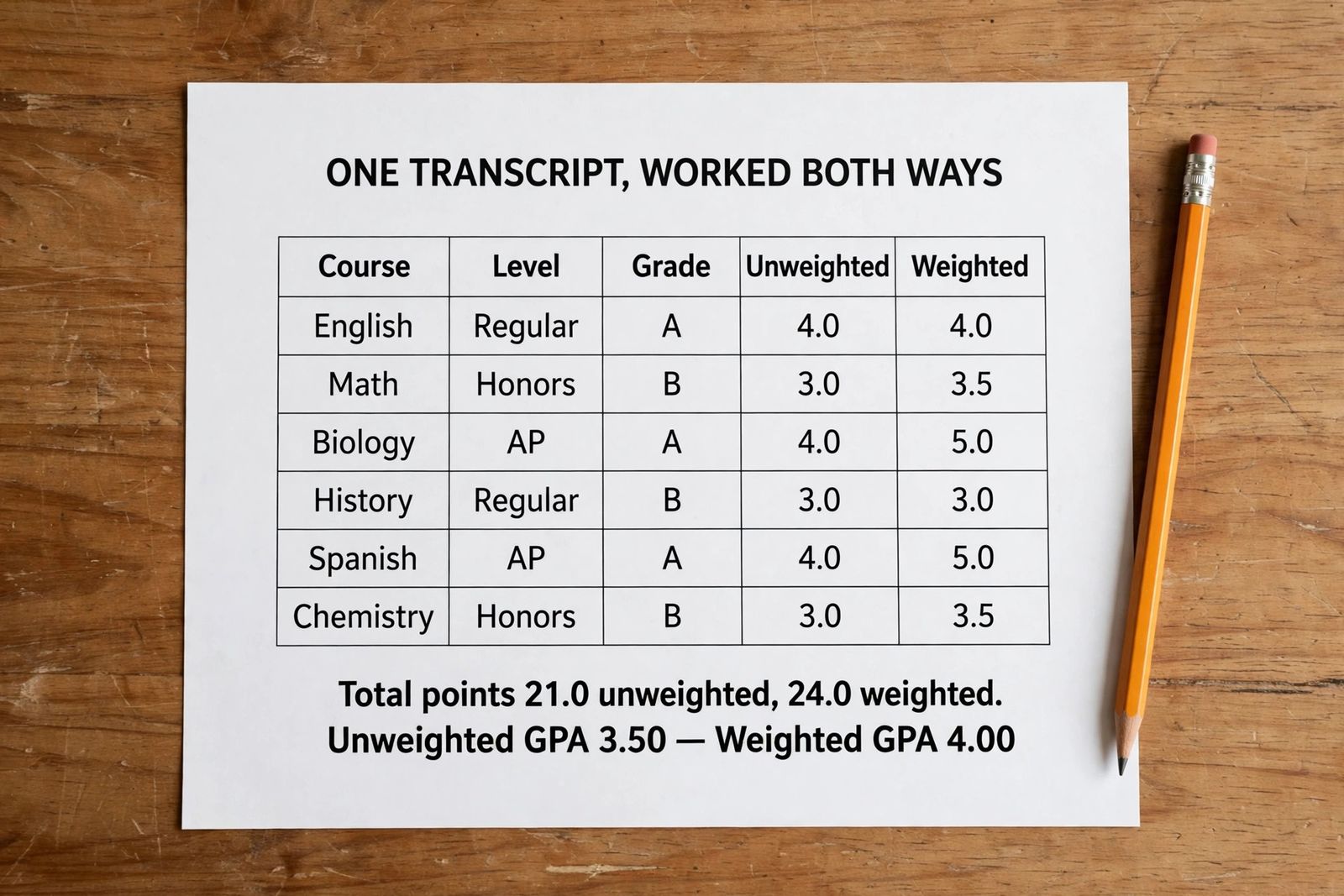
An unweighted GPA averages your grades on a flat 4.0 scale — an A is 4.0 in every course, easy or advanced — while a weighted GPA adds a bonus for harder courses, commonly +0.5 for Honors and +1.0 for AP or IB, so an A in an AP course counts as 5.0 and the average can rise above 4.0. Same student, same grades, two different numbers: the transcript worked in full below comes out at 3.50 unweighted and 4.00 weighted. Neither number is the “real” one — and most colleges recalculate both into a GPA of their own before they compare you with anyone else.
Weighted vs unweighted GPA at a glance
| Unweighted GPA | Weighted GPA | |
|---|---|---|
| Scale | 0.0 to 4.0 | Varies by school; commonly up to 5.0 |
| Course difficulty | Ignored — every course counts the same | Counted — advanced courses earn bonus points |
| An A in an AP course | 4.0 | Commonly 5.0 (+1.0) |
| An A in an Honors course | 4.0 | Commonly 4.5 (+0.5) |
| What it shows best | How strong your grades are | How strong your grades are and how hard your courses were |
| Can it exceed 4.0? | No | Yes |
| Set by | A near-universal 4.0 convention | Your own school — there is no national formula |
That last row is the one that causes most of the confusion. Unweighted GPA means roughly the same thing everywhere. Weighted GPA means whatever your school decided it means — which courses get a bonus, how big the bonus is, and whether there is a cap are all local rules. A 4.3 weighted GPA at one school and a 4.3 at another can describe quite different records.
How unweighted GPA is calculated
Convert each final grade to points on the 4.0 scale — A = 4.0, B = 3.0, C = 2.0, D = 1.0, F = 0.0 in the whole-letter version the College Board’s BigFuture guide publishes — add the points, and divide by the number of courses. If your courses carry different credits, multiply each course’s points by its credits first and divide by total credits instead; the step-by-step method is in how to calculate GPA.
Two properties follow from the flat scale. First, the ceiling is hard: straight A’s, however advanced the courses, give exactly 4.0. Second, the number is portable — because almost every school builds it the same way, it is the version that can be compared across schools, which is why benchmarks like what is a good GPA are almost always stated unweighted.
How weighted GPA is calculated
Start from the same base points, then add your school’s bonus to each advanced course before averaging. The most common scheme in the US is:
| Letter grade | Regular | Honors (+0.5) | AP / IB (+1.0) |
|---|---|---|---|
| A | 4.0 | 4.5 | 5.0 |
| B | 3.0 | 3.5 | 4.0 |
| C | 2.0 | 2.5 | 3.0 |
| D | 1.0 | 1.5 | 2.0 |
| F | 0.0 | 0.0 | 0.0 |
Treat this table as the common pattern, not a law. Some schools give Honors a full +1.0 as well, some weight dual-enrollment courses, some give no bonus for a D, some cap the final GPA, and some do not weight anything at all. The College Board notes that your school may calculate GPA differently — for weighted GPA that warning is not fine print, it is the whole story. Your transcript legend or school handbook is the only authoritative version of your school’s weights.
One transcript, worked both ways — the original example
Here is a single semester for one student: six courses, a mix of regular, Honors and AP, with the grades shown. Every figure below was calculated from these six rows and nothing else.
| Course | Level | Grade |
|---|---|---|
| English | Regular | A |
| Math | Honors | B |
| Biology | AP | A |
| History | Regular | B |
| Spanish | AP | A |
| Chemistry | Honors | B |
Step 1 — Unweighted. Ignore the level column completely. A = 4.0 and B = 3.0 everywhere:
| Course | Grade | Unweighted points |
|---|---|---|
| English (Regular) | A | 4.0 |
| Math (Honors) | B | 3.0 |
| Biology (AP) | A | 4.0 |
| History (Regular) | B | 3.0 |
| Spanish (AP) | A | 4.0 |
| Chemistry (Honors) | B | 3.0 |
| Total | 21.0 |
Unweighted GPA = 21.0 ÷ 6 = 3.50.
Step 2 — Weighted. Same grades, now add +0.5 to each Honors course and +1.0 to each AP course:
| Course | Grade | Base | Bonus | Weighted points |
|---|---|---|---|---|
| English (Regular) | A | 4.0 | — | 4.0 |
| Math (Honors) | B | 3.0 | +0.5 | 3.5 |
| Biology (AP) | A | 4.0 | +1.0 | 5.0 |
| History (Regular) | B | 3.0 | — | 3.0 |
| Spanish (AP) | A | 4.0 | +1.0 | 5.0 |
| Chemistry (Honors) | B | 3.0 | +0.5 | 3.5 |
| Total | 21.0 | +3.0 | 24.0 |
Weighted GPA = 24.0 ÷ 6 = 4.00.
Step 3 — Read what changed. The grades never moved. The entire gap between 3.50 and 4.00 is the 3.0 bonus points spread across six courses — an average bonus of exactly 0.50 per course. That is the conversion method in one line: weighted − unweighted = total bonus points ÷ number of courses, whenever every advanced course received its full bonus. It also shows why a weighted GPA cannot be converted back without knowing the course list: a weighted 4.00 built on different courses, or under a school that weights Honors at +1.0, would strip down to a different unweighted number. If you are deciding how many advanced courses to take on in the first place, the trade-offs are laid out in AP vs honors classes.
Which GPA do colleges actually use?
Both, neither, and often a third one they build themselves.
Colleges receive your transcript — every course, every grade — plus a school profile explaining your school’s scale and weighting. As the College Board’s class FAQ puts it, most colleges do not set a simple GPA requirement because high schools calculate GPA so differently, and many recalculate your GPA so applications can be compared consistently. BigFuture’s GPA guide describes what that recalculation typically does: it may drop non-core courses such as PE and electives, keep the core subjects (English, maths, science, social studies, world languages), and adjust or remove your school’s weighting.
The clearest published example is the University of California. UC ignores your school’s GPA entirely and computes its own from A–G college-preparatory courses taken from the summer after 9th grade through the summer after 11th grade: A = 4, B = 3, C = 2, D = 1, with pluses and minuses disregarded, plus one extra point per semester of UC-approved honors, AP or IB coursework graded C or better — capped at 8 points in total, no more than 4 of them from 10th grade, and no rounding. UC actually tracks three versions of that figure — unweighted, capped weighted (the one checked against its 3.0 minimum for California residents and 3.4 for nonresidents), and fully weighted. One applicant, three GPAs, all official.
Not every college recalculates, and those that do use different rules — which is why the honest answer to “which GPA matters more?” is that colleges read grades and rigor as two separate things: the unweighted signal (did you earn A’s and B’s?) and the rigor signal (in how hard a set of courses?). A weighted GPA is a school’s attempt to compress those two signals into one number; admissions offices routinely un-compress it.
Practical consequences:
- Report what is on your transcript, exactly. If your school reports both GPAs, report both where the application allows; do not convert one into the other yourself.
- Compare yourself on the unweighted scale. Published GPA ranges for admitted students are only meaningful if you know which scale they use — when in doubt, benchmark your unweighted figure and treat rigor separately.
- A B in an AP course is not a failed strategy. Weighted, it is commonly worth the same 4.0 as an A in a regular course, and the rigor is visible on the transcript either way. What hurts is a pattern of low grades, weighted or not.
- Class rank is where weighted GPA bites hardest. Many schools rank by weighted GPA, so weighting can matter a great deal inside your school even where a college recalculates it away.
How to find out which GPA you have
- Look at the transcript legend. It states the scale and whether the GPA is weighted. A figure above 4.0 is certainly weighted; a figure at or below 4.0 proves nothing either way.
- Check for both numbers. Many schools print a weighted and an unweighted GPA side by side.
- Ask the counselling office two specific questions: which courses earn extra weight at your school, and how much? With those two answers and your course list, you can reproduce either GPA yourself using the steps above — and you will know exactly which bonus scheme any conversion has to undo.
Frequently asked questions
Can a weighted GPA be higher than 5.0? Under the common +1.0 scheme, no — 5.0 is the ceiling, reached only with A’s in fully weighted courses. A GPA above 5.0 means a school using a larger bonus or a different scale entirely (some use 6.0). The number is uninterpretable without the school’s policy.
Is a 4.0 weighted GPA the same as a 4.0 unweighted GPA? No. An unweighted 4.0 means straight A’s. A weighted 4.0 — like the worked example above — can sit on top of a 3.50 unweighted record with a mix of A’s and B’s in advanced courses. Both are respectable; they are not the same record.
How do I convert a weighted GPA to an unweighted GPA? Subtract each advanced course’s bonus from its points, then re-average — equivalently, unweighted = weighted − (total bonus points ÷ number of courses), if every advanced course got its full bonus and no cap applied. In the worked example: 4.00 − (3.0 ÷ 6) = 4.00 − 0.50 = 3.50. If your school caps bonuses or withholds them for low grades, work course by course instead.
My school only reports a weighted GPA. Are colleges at a disadvantage reading it? No. The transcript still shows every individual grade, and the school profile explains the weighting, so a college can strip the bonuses out in seconds — many do exactly that when they recalculate.
Should I take an AP course mainly to raise my weighted GPA? Only if you can earn a strong grade in it without damaging the rest of your schedule. The bonus rewards a B in an AP course handsomely, but a D or F earns little or no bonus at many schools and drags the unweighted figure — the one that survives every recalculation — down with it.
This article is general information, based on the College Board and University of California pages linked above and checked in November 2026. Weighting schemes are set by each high school and recalculation rules by each college — where your school’s or a college’s published rule differs from a general pattern here, that published rule is the one that applies to you.