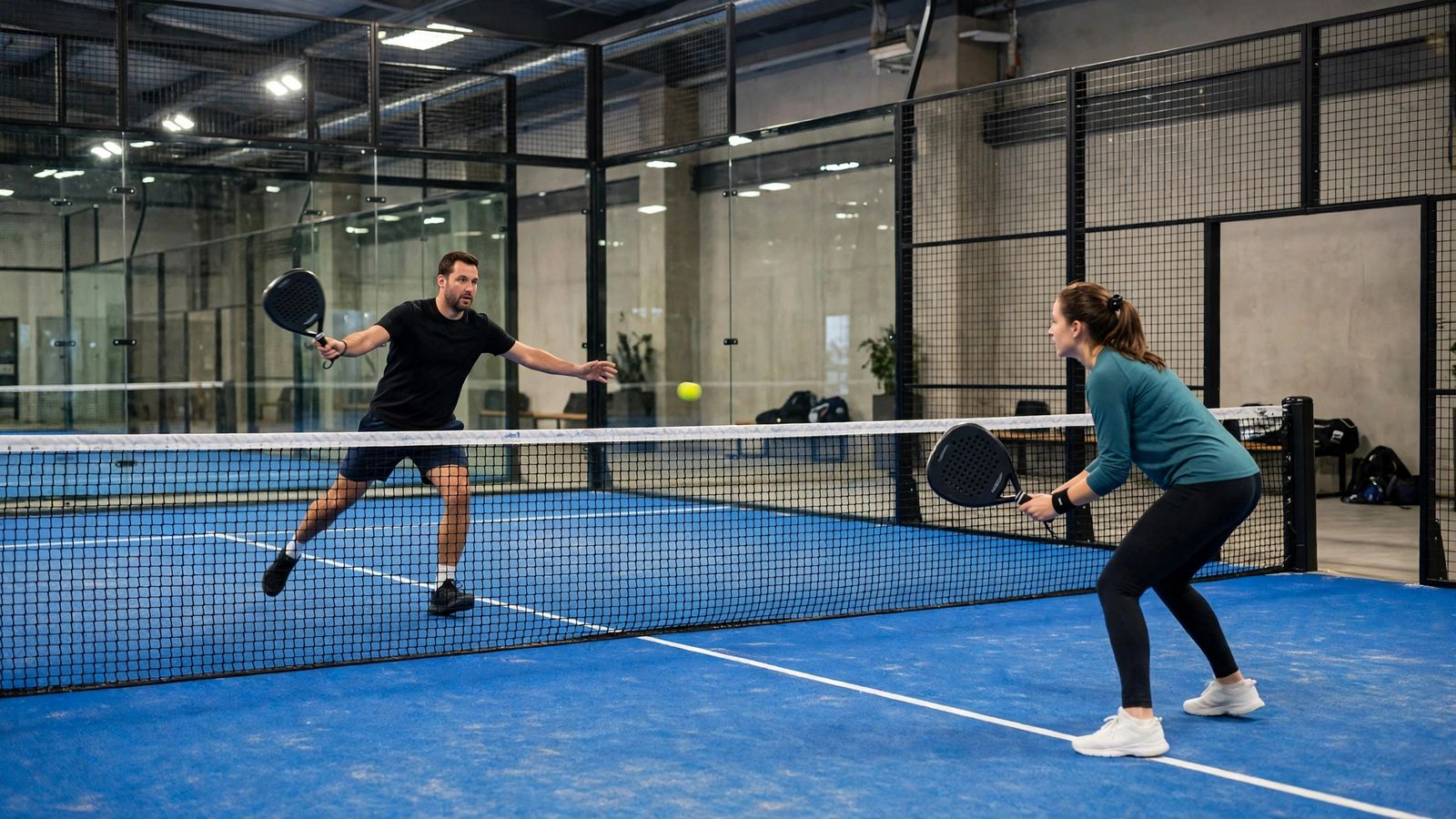
Padel is a doubles racket sport played by four players — two pairs — on an enclosed court 20 metres long by 10 metres wide, with glass walls and a metal mesh fence that are part of the game. The padel rules that shape every point are simple: each point starts with an underarm serve, bounced first and hit at or below waist height, diagonally into the opposite service box, with two attempts allowed; a shot is good only if it bounces in the opponents’ court before it touches their walls or fence, but after that bounce it can rebound off the glass and still be played; scoring is the tennis system of 15, 30, 40 and game, six games winning a set; and since 1 January 2026 the rulebook offers three ways to settle deuce, including the new Star Point. Everything below follows the International Padel Federation (FIP) Rules of Padel, in force from 1 January 2026.
Quick reference:
| Item | Rule |
|---|---|
| Players | 4 — two pairs, one pair on each side of the net |
| Court | 20 m long × 10 m wide, measured inside the walls |
| Net | 0.88 m high at the centre, 0.92 m at the ends |
| Service line | 6.95 m from the net on each side |
| Serve | Bounced first, underarm, at or below waist height, diagonal; two attempts |
| Walls | In play after a bounce in the court; never before it on the opponents’ side |
| Scoring | 15, 30, 40, game; six games win a set, tie-break at 6-6; best of three sets |
| Deuce (40-40) | Advantage, golden point or Star Point |
The court: 20 by 10 metres, fully enclosed
The court is a rectangle 10 metres wide by 20 metres long, measured inside the walls, divided in half by the net. On each side, a service line runs parallel to the net 6.95 metres from it, and a central service line splits the area between net and service line into two service boxes. The net is 0.88 metres high at the centre, rising to 0.92 metres at the ends.
What makes it a padel court is the enclosure. The ends are 4 metres high in total: a 3-metre wall — usually glass — topped by 1 metre of mesh fencing. The sides combine wall sections near the ends with mesh fencing, stepping down toward the middle.
You play with a solid, stringless racket (maximum 45.5 cm long, 26 cm wide, 38 mm thick) and a ball like a tennis ball but slightly softer and less pressurised: 6.35 to 6.77 cm across, 56.0 to 59.4 grams. The racket’s wrist cord is compulsory — dropping your racket or breaking the cord during a point costs you the point.
How to play padel: how a rally works
A point follows a fixed rhythm:
- The server bounces the ball inside their own service box and serves underarm, diagonally, into the opposite service box.
- The receiver lets the serve bounce in the box — the serve may not be volleyed — and returns it before a second bounce.
- From the return onward the rally is open: either pair may volley the ball or let it bounce once, and after that bounce it may come off the glass and still be returned.
- The point ends when one pair fails to return the ball before its second bounce, hits it into the net, or hits it out — usually into the opponents’ walls or fence before a bounce.
One rule surprises new players: only the server has a fixed place to stand. The receiver, the receiver’s partner and the server’s partner may stand anywhere on their own side — but the receiver still has to let the serve bounce, wherever they stand.
The padel rules for serving: bounced, underarm, below the waist
The serve starts the rally rather than winning it. Most of its rules concern where you stand and how you strike the ball:
- One foot behind the service line. Stand with one foot behind the service line, between the imaginary extension of the central service line and the side wall, and stay there until you have hit the ball. Your feet may not touch the service line or the imaginary central line, and at least one foot must stay on the ground. Note the wording: the current rules require one foot behind the line — older guides teaching “both feet” are giving the pre-2026 version.
- Bounce the ball first, inside your box. It may not cross the service line (or its imaginary extension) before you strike it.
- Contact at or below waist height. That single condition is why there is no overhead serve in padel.
- Diagonal, into the receiver’s box. Each game starts from the right-hand side; the server then alternates sides after every point. The lines count as good. Before each set, each pair chooses which partner serves first; that order cannot change until the next set.
You get two attempts, as in tennis. A serve is a fault if you break any condition above, swing and miss, land the ball outside the box, or hit yourself or your partner — or if the ball bounces in the box and then touches the metal fence before its second bounce. Glass is different: a serve bouncing in the correct box and then hitting the glass is good.
A serve clipping the net or posts and still landing in the correct box — without then touching the fence — is a let and is replayed: on the first serve the point restarts with two serves; on the second, only that serve. Serving before the receiver is ready is also replayed — but a receiver who tries to return it cannot then claim they were not ready.
The walls: glass helps you, the fence only sometimes
One sentence settles most padel arguments: your shot must bounce on the opponents’ ground before it touches anything on their side. A smash driven straight into their back glass, or a ball flying over their wall without bouncing in first, loses the point.
After that bounce, everything changes. The ball can hit the back glass, the side glass or the mesh and remain in play, and the receiving pair can play it before or after it comes off the walls, as long as it has not bounced a second time. Walls never reset the bounce count: the second ground bounce always ends the point.
On your own side you have one extra option: play the ball against your own glass so it rebounds over the net — a recognised defensive shot when out of position. You may not touch your own metal fence, or your own ground, with the ball you are sending over: either loses the point.
Out-of-court play — running through the gate to return a ball that bounced in and then left the court — is authorised only where each side has two access points and a clear safety area outside, at least 3 metres wide and 4 metres long. Without it, a ball leaving through the gate is dead.
The padel rules for scoring: tennis points, three ways to settle deuce
Padel scoring copies tennis. Points are called 15, 30, 40 and game, server’s score first. The first pair to win six games, with a lead of at least two, wins the set: at 5-5 the set continues to 7-5, and at 6-6 a tie-break decides it — first pair to 7 points with a two-point lead, serve rotating one point then two points per player. A match is the best of three sets; pairs change ends after the first, third and every following odd game.
At 40-40 the score is deuce — where the 2026 rules changed the game. The FIP rulebook now lists three options in Rule 1; the competition, league or club chooses:
- Advantage (Option 1). The traditional system. Win the point after deuce and you have advantage; win the next and the game is yours, lose it and the score returns to deuce, for as long as it takes.
- Star Point (Option 2). New for 2026, approved unanimously by the FIP General Assembly on 28 November 2025 and used from 2026 on the Premier Padel and CUPRA FIP Tours; the sequence is set out in the FIP rules linked above. Advantage is played, but only twice: deuce 1 gives advantage 1, losing it returns to deuce 2; advantage 2 follows, and losing that returns to deuce 3, where a single deciding point is played. The receiving pair chooses the side, its players cannot change positions, and in mixed matches the receiver must be the same sex as the server. A Star Point game lasts at most 11 points. The United States Padel Association’s 2026 season update confirms Star Point applies across USPA Circuit tournaments from 2026.
- Golden point (Option 3). No advantage at all: at the first deuce, one deciding point is played, with the same receiving-pair choice. Many social games still use it because it is fastest.
Ask which format your match uses before the first game, not at 40-40 in the third set: older guides describe only advantage, or present the golden point as the one modern rule, but all three are current options in the same rulebook.
How many players? Doubles, and the singles question
The FIP rules are written for pairs: a standard match needs four players, and every professional and sanctioned event is doubles.
Singles causes endless argument because both claims you will hear are half true. Two people can play casually, and dedicated singles courts exist — narrower, typically 20 metres by 6 metres — but singles is not the standard format, is not played on the pro tour, and most clubs book their 20-by-10 courts for doubles. (Team size differs in every sport; compare how many players are on a basketball team.) For padel, plan on finding three other players.
Padel vs pickleball and padel vs tennis
Padel and pickleball are the two racket sports Americans most often confuse — both use solid paddles, underarm serves and doubles. They are not the same game:
| Padel | Pickleball | |
|---|---|---|
| Court | 20 × 10 m, enclosed by glass and mesh | 44 × 20 ft (13.4 × 6.1 m), open |
| Walls | In play after a bounce | None |
| Ball | Low-pressure, tennis-style felt ball | Light plastic ball with holes |
| Racket/paddle | Solid, perforated, max 45.5 cm | Flat paddle, no holes |
| Scoring | Tennis scoring: 15, 30, 40, games and sets | To 11, win by 2; traditionally only the serving side scores |
| Signature rule | Play the ball off the walls | No volleying from the 7-foot kitchen |
The full pickleball system is set out in pickleball rules: pickleball keeps the ball in front of you on a small open court, while padel surrounds you with walls.
Against tennis, padel keeps the scoring and diagonal serve but changes almost everything else: a smaller court, an underarm serve, a solid racket rather than a strung one, a slightly softer ball, and walls that give you a second chance at balls that would be clean winners in tennis. Padel is also not the only fast-growing sport whose rulebook was settled only recently — flag football rules covers a game that received its first national rulebook in 2025 on its way to the Olympics.
Faults: how a point is lost
Your pair loses the point if:
- The ball bounces twice on your side before you return it.
- Your shot hits the opponents’ walls or fence before bouncing on their ground.
- Your shot touches the metal fence or the ground on your own side on its way over.
- You, your racket or anything you wear or carry touches the net or the net posts while the ball is in play.
- You hit the ball before it has crossed the net to your side (one exception: a ball that bounced on your side and spun back over may be reached over and finished, without touching the net).
- You hit the ball twice, or both partners strike it.
- The ball touches you or your partner — including an opponent’s shot hitting you before it bounces, even if it was heading out.
- You drop your racket, break its wrist cord, or hit the ball with a racket you are not holding.
- You serve two consecutive faults.
Almost every beginner point is lost to four habits: serving above the waist, volleying the serve, waiting for a ball off the glass until it bounces twice, and driving a shot straight into the opponents’ glass without a bounce.
Frequently asked questions
Can you serve overarm in padel? No. Both serves must be bounced and struck at or below waist height, so the serve is always underarm. An overhead serve is a fault.
Can you volley in padel? Yes — every shot except one. The return of serve must bounce first; volleying it, or the serve hitting you before it bounces, gives the point to the serving pair.
What is the Star Point in padel? The FIP’s new deuce format from 1 January 2026. Advantage is played up to twice; at the third deuce, one deciding point settles the game, the receiving pair choosing the side. It is used on the 2026 professional tours and in USPA-sanctioned US events, but your club may still play advantage or golden point — all three remain options, as the LTA’s 2026 referee and organiser guide also sets out.
Is a serve that hits the glass good? Yes, if it bounced in the correct service box first. A serve bouncing in the box and then hitting the metal fence is a fault. The same bounce-first logic applies in rallies — the opposite of a sport with no walls, covered in pickleball rules.
Do the lines count as in? Yes, including the lines of the correct service box. The tight call beginners meet is the corner where floor meets glass: a ball bouncing in the court and then into that corner is good.
This article is general information, based on the International Padel Federation’s Rules of Padel in force from 1 January 2026, checked in November 2026. Clubs and leagues choose their own deuce format and sometimes local variations — for a sanctioned tournament, the current official FIP rulebook is the authority.