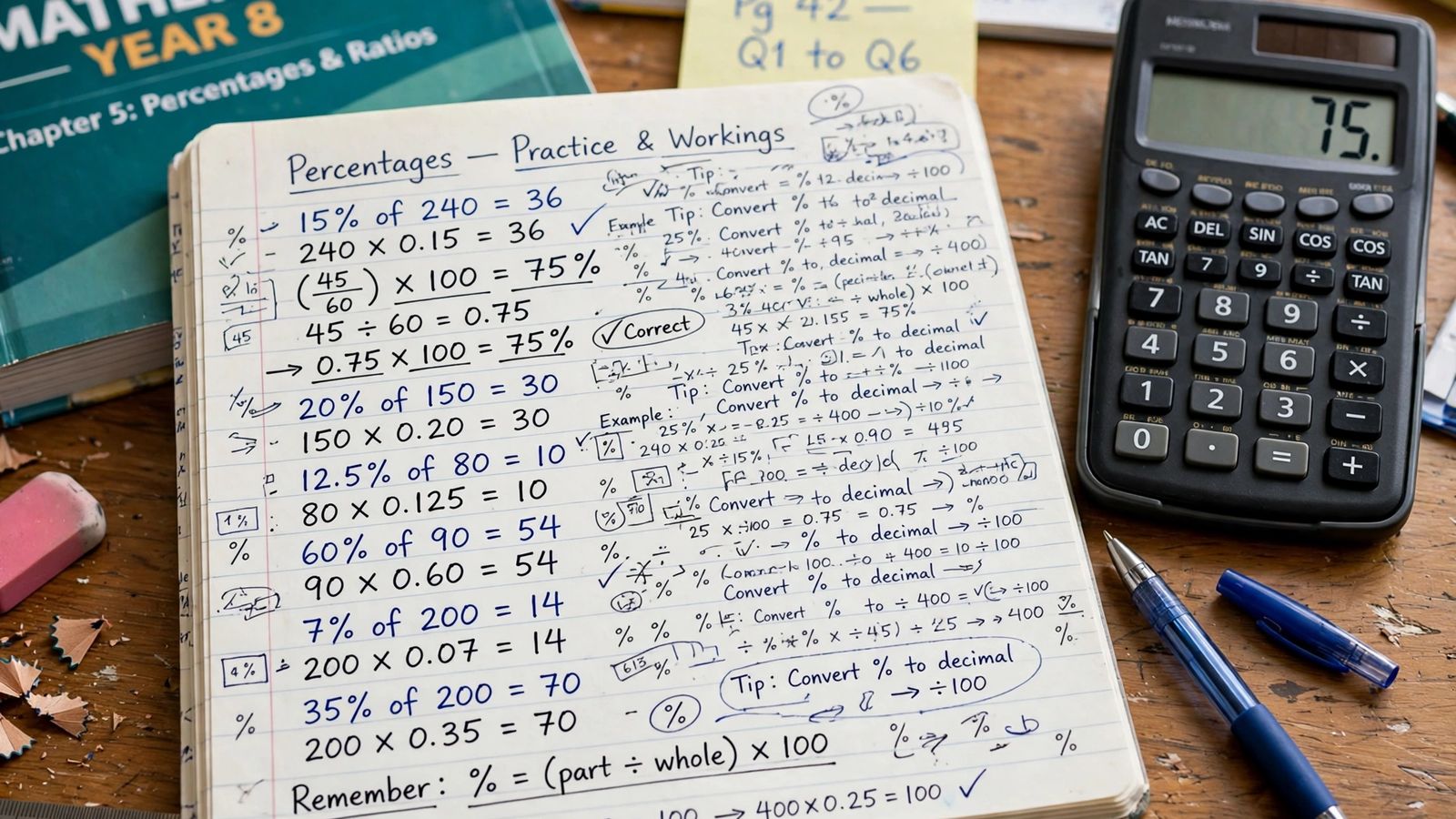
To calculate a percentage, divide the part by the whole and multiply by 100: percentage = (part ÷ whole) × 100. That is how to calculate a percentage in its basic form, and every other percentage calculation — a percentage of a number, an increase, a decrease, a discount, a test score — is this one formula rearranged. Scored 45 out of 60? That is (45 ÷ 60) × 100 = 75%. Want 15% of 240 instead? Rearrange: (15 ÷ 100) × 240 = 36. Learn the one formula and its three rearrangements below, and no standard percentage problem needs a different method.
What a percentage actually is
A percentage is a fraction with 100 as its denominator — any proportion stated as “so many out of a hundred.” The word says it: per cent means per hundred, from the Latin per centum, and % is the shorthand. Khan Academy’s introduction to percents builds it visually: split a whole into 100 equal pieces, and 20% is 20 of them shaded.
Three quantities appear in every percentage problem; naming them first prevents most errors:
- The whole (the base or total) — what you compare against. This is the 100%.
- The part — the share of the whole you are measuring.
- The percentage — the part expressed per hundred.
Knowing any two gives you the third, which is why one formula covers everything:
- Percentage = (part ÷ whole) × 100
- Part = (percentage ÷ 100) × whole
- Whole = part ÷ (percentage ÷ 100)
One warning: a percentage alone says nothing about size — 10% of 50 is 5; 10% of 500 is 50. It is always a percentage of something, and identifying that something, the whole, is the real skill (Newcastle University maths support).
How to calculate a percentage of a number
The most common form of the question: you know the percentage and the whole, and want the part. Two steps:
- Convert the percentage to a decimal by dividing by 100 (move the decimal point two places left). 15% becomes 0.15.
- Multiply by the number. 0.15 × 240 = 36.
Worked examples: 15% of 240 = 0.15 × 240 = 36 (a service charge, a tip, a tax amount); 18% of 350 = 0.18 × 350 = 63; a 15% tip on a bill of 86 = 0.15 × 86 = 12.90.
The mental-math version: build from 10%, 5% and 1%
Outside a classroom you rarely need a calculator, because three building blocks combine into almost any percentage:
- 10% of a number is the number divided by 10 — move the decimal point one place left.
- 5% is half of 10%.
- 1% is the number divided by 100 — the point moved two places left.
So 17% of 240: 10% is 24, 5% is 12, 1% is 2.4, so 2% is 4.8. Add them: 24 + 12 + 4.8 = 40.8 — matching the decimal method, 0.17 × 240 = 40.8. The blocks also make the common ones instant: 25% is half of a half (divide by 4), 50% is half, 75% is 50% plus 25%.
One related trick: percentages commute when they are “of” each other. 18% of 50 is awkward; 50% of 18 is obviously 9 — and they are the same calculation, since both simplify to (18 × 50) ÷ 100. Swap whenever the swapped version is easier.
What percentage is one number of another?
Now the unknown is the percentage itself. Divide the part by the whole, then multiply by 100:
- 45 out of 60 (a test score): 45 ÷ 60 = 0.75, × 100 = 75%.
- 120 out of 150 (marks): 120 ÷ 150 = 0.80, × 100 = 80% — the first step in how to calculate GPA from percentage grades, before the percentage becomes grade points.
- 38 out of 50 students passed: 38 ÷ 50 = 0.76, × 100 = 76%.
Before dividing, ask: which number is the whole — the total the part belongs to (maximum marks, the full class, the entire budget)? Swapping the two is the most common error here: 60 ÷ 45 × 100 = 133% is possible arithmetic, but as a test score it is nonsense, and the nonsense is your clue.
Percentages above 100% are not errors in themselves: sales of 150 against a target of 100 are legitimately 150%. But in a part-of-a-total context, an answer above 100% should make you re-check that you picked the right whole.
How to calculate a percentage increase and decrease
When a value changes, the percentage change compares the change with the original value — never the new one. Florida State University’s maths materials state both versions in exactly this form (FSU percent increase and decrease):
- Percentage increase = ((new − original) ÷ original) × 100
- Percentage decrease = ((original − new) ÷ original) × 100
Worked examples: a price rising from 80 to 100 changes by 20, and 20 ÷ 80 × 100 = 25% increase. A salary rising from 52,000 to 56,000 changes by 4,000, and 4,000 ÷ 52,000 × 100 = 7.69% increase. A value falling from 200 to 150 changes by 50, and 50 ÷ 200 × 100 = 25% decrease.
The denominator is where this goes wrong. Divide the salary change by the new salary and you get 4,000 ÷ 56,000 × 100 = 7.14% — plausible-looking and wrong, because a change is measured against where it started. The Open Oregon Technical Mathematics textbook drills the same rule: “we always use the original number for the base, the number that occurred earlier in time” (Open Oregon Pressbooks).
Applying an increase or decrease to a number
The reverse job — starting value and percentage known, final value wanted — is one multiplication, using a multiplier:
- Increase by P%: multiply by (1 + P ÷ 100). 200 up by 15% = 200 × 1.15 = 230.
- Decrease by P%: multiply by (1 − P ÷ 100). An 80 coat at 25% off = 80 × 0.75 = 60.
The multiplier agrees with the two-step method (find the percentage, then add or subtract it): 15% of 200 is 30, and 200 + 30 = 230. It is faster, and it is the form you need for reverse percentages and chained changes below.
Percentage change: one formula, and the asymmetry trap
Increase and decrease are really one formula with a sign:
Percentage change = ((new − original) ÷ original) × 100
A positive result is an increase, a negative result a decrease. From 125 to 150: (150 − 125) ÷ 125 × 100 = +20% — total change divided by the original amount, as the St John Fisher College maths text also defines it (SJFC definitions and formulas).
Two consequences of that “divide by the original” rule surprise people every time:
Going up and coming back are not mirror images. From 150 back to 125 is (125 − 150) ÷ 150 × 100 = −16.67%, not −20% — on the way back, the same change of 25 is measured against a larger starting value. The extreme version: 100 rising 50% becomes 150; falling 50% from there lands at 75, not 100. A 50% loss needs a 100% gain to undo it — the compounding logic of compound interest, running against you.
Successive percentages multiply; they do not add. 20% off followed by 10% off is not 30% off. Start at 100: after 20% off you pay 80; 10% off 80 is 8, so you pay 72 — a total discount of 28%. Each percentage applies to the value current when it arrives.
Finding the original number: reverse percentages
Two “work backwards” questions come up constantly, and they are different calculations.
The whole from a part and a percentage. Divide the part by the percentage as a decimal:
- 30 is 15% of what number? 30 ÷ 0.15 = 200. Check: 15% of 200 = 30. ✓
- 60 is 30% of what number? 60 ÷ 0.30 = 200.
The original before a percentage change. Divide the final value by the multiplier:
- A jacket costs 72 after a 20% discount. Original price? After 20% off you pay 80% of the original, so original = 72 ÷ 0.80 = 90. Check: 20% of 90 is 18, and 90 − 18 = 72. ✓
- A bill of 230 includes a 15% increase. What was it before? 230 ÷ 1.15 = 200.
The classic mistake is applying the percentage to the final value: 20% of 72 is 14.40, and adding it back gives 86.40, not 90. The percentage came off the original, so the way back divides by the multiplier. Always close a reverse calculation by running it forwards again, as in the checks above — five seconds, and it catches this error every time.
Converting fractions and decimals to percentages
Fractions, decimals and percentages are three spellings of the same number; converting is mechanical:
| To convert | Do this | Example |
|---|---|---|
| Decimal → percentage | Multiply by 100 | 0.87 → 87% |
| Percentage → decimal | Divide by 100 | 7.5% → 0.075 |
| Fraction → percentage | Divide top by bottom, then × 100 | 3/8 = 0.375 → 37.5% |
| Percentage → fraction | Write over 100, then simplify | 25% = 25/100 = 1/4 |
Worth memorising cold: 1/2 = 50%, 1/4 = 25%, 3/4 = 75%, 1/5 = 20%, 1/10 = 10%, 1/8 = 12.5%, 1/3 ≈ 33.3%. Khan Academy’s percents unit drills these conversions, which are also the mechanism behind test-score percentages — a raw score becomes comparable only once expressed per hundred, the idea behind questions like what a good SAT score is.
One caution: scaling a fraction to a denominator of 100 (4/25 = 16/100 = 16%) only works neatly when the denominator divides into 100. For everything else — 3/8, 120/150 — divide first, then multiply by 100.
Percentage points vs percent: the mistake that changes headlines
When the thing changing is itself a percentage — an interest rate, an inflation rate, a pass rate — there are two ways to describe the change, and mixing them up is the most consequential percentage error in everyday reading:
- Percentage points are the plain arithmetic difference between the two percentages.
- Percent is that difference relative to the starting one.
An interest rate rising from 4% to 5% has risen by 1 percentage point (5 − 4 = 1) — and by 25 percent ((5 − 4) ÷ 4 × 100). Both are true; they answer different questions. The trap in reverse: if a rate of 10% “falls by 1%,” it falls to 9.9%, because 1% of 10 is 0.1. A fall of one percentage point takes it to 9%. One word is a tenfold difference there.
When writing, report changes to a rate in percentage points unless you mean the relative change. When reading, if a report says a rate “rose 2%,” ask: 2 points, or 2 percent relative? On a small base rate the two describe very different events — why rates like APR are quoted so precisely: a quarter-point move is real money.
Common mistakes that produce wrong answers
- Dividing by the new value instead of the original. Change is always measured against the starting value (salary example above: 7.69% right, 7.14% wrong).
- Forgetting the ÷ 100. 20% of 250 is not 20 × 250 = 5,000. Convert to 0.20 first.
- Adding successive percentages. 20% off then 10% off is 28% off in total, not 30% — percentages chain by multiplication.
- Assuming equal percentages cancel. Up 50% then down 50% leaves you at 75% of where you started; the second percentage acts on a different base.
- Reversing a change by adding the percentage of the final value. A sale price of 72 after 20% off came from 90, not from 72 + 20% of 72.
- Confusing percentage points with percent. 4% to 5% is 1 point — a 25% relative rise.
- Averaging percentages from different wholes. 80% on a 50-mark quiz and 60% on a 150-mark exam do not average to 70%: combined, (40 + 90) ÷ 200 = 65%. Add parts and wholes instead.
- Mixing markup and margin. Buying at 80, selling at 100: a 25% markup on cost (20 ÷ 80), a 20% margin on price (20 ÷ 100). Same money, different whole.
Frequently asked questions
What is the formula for a percentage? Percentage = (part ÷ whole) × 100. Rearranged, it also gives the part — (percentage ÷ 100) × whole — and the whole — part ÷ (percentage ÷ 100). Identify which two of the three you know.
How do I calculate a percentage of a number without a calculator? Build it from blocks: 10% (decimal point one place left), half of that for 5%, and 1% (two places left), then combine. 17% of 240 is 24 + 12 + 4.8 = 40.8. Or swap where it helps: 18% of 50 is 50% of 18, which is 9.
How do I calculate percentage increase? Subtract the original from the new value, divide by the original value, multiply by 100. From 80 to 100: (100 − 80) ÷ 80 × 100 = 25% increase. Decrease uses the identical formula — the result comes out negative.
Can a percentage be more than 100%? Yes: it means the part exceeds the whole it is compared with — 150 against a target of 100 is 150%. In a score-out-of-a-total context, though, it usually means the wrong number was used as the whole.
What is the difference between percentage points and percent? Percentage points are the direct difference between two percentages: 4% to 5% is a rise of 1 percentage point. Percent is the relative change: that same move is a 25% increase relative to the starting 4%. Points for the gap, percent for the relative size.
This article is general educational information, based on the university maths-support and open-textbook sources linked above, checked November 2026. The methods are standard arithmetic; any scale a percentage is converted into afterwards — grades, bands, ratings — is set by each institution.