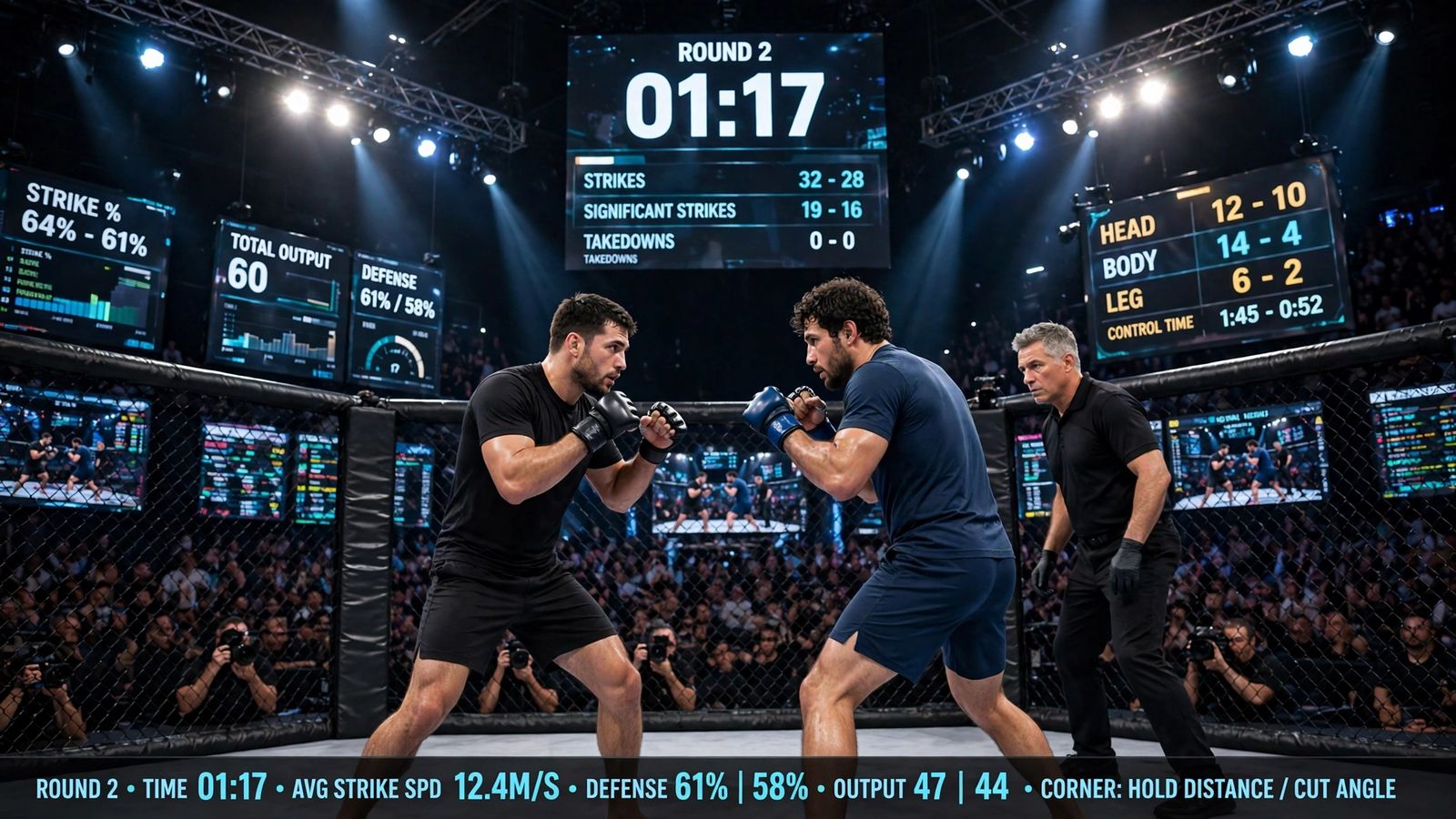
How many rounds are in a UFC fight depends on the bout: a standard fight has 3 rounds, and a championship fight or a main event has 5 rounds. Every round lasts 5 minutes, with a 1-minute rest between rounds, so a three-round fight holds 15 minutes of fighting and a five-round fight holds 25. Count the rests and a fight that goes the full distance runs 17 minutes in the three-round format and 29 minutes in the five-round format, before walkouts, introductions and the decision announcement. That is the whole answer for almost every bout on a card. The rest of this page covers the exceptions that confuse people — co-main events that stay at three rounds, rare five-round fights with no belt and no headline slot, and main events that were booked short — plus why there is no overtime round waiting if the judges cannot split the fighters.
The quick version:
| Bout type | Rounds | Fighting time | Total with rests |
|---|---|---|---|
| Ordinary non-title bout (prelims and most of the main card) | 3 | 15 minutes | 17 minutes |
| Championship fight (including interim titles) | 5 | 25 minutes | 29 minutes |
| Main event, title or not | 5 | 25 minutes | 29 minutes |
| Co-main event, no title | Usually 3 | 15 minutes | 17 minutes |
| Specially announced five-round bout | 5 | 25 minutes | 29 minutes |
How many rounds are in a UFC fight for each bout type?
The split is decided by what the bout is, not by who is in it. Weight class makes no difference: a heavyweight fight low on the prelims is three rounds, and a flyweight title fight is five. Men’s and women’s fights follow the same formats. What matters is the bout’s place and status when it is signed.
Three rounds is the default for professional UFC competition. Preliminary fights, undercard fights and most main-card fights are scheduled for three rounds. If nothing special is said about a fight — no belt, no headline — assume three.
Five rounds applies in two regular situations. The first is a championship fight: every title fight is scheduled for five rounds, in every division, and that includes interim title fights, which carry the same format as undisputed ones. The second is the main event. Since 2011, the UFC has signed its headline fight for five rounds whether or not a championship is on the line, so the last fight of the night is a five-rounder even when both fighters are simply highly ranked contenders.
Everything between those poles is where the mistakes happen, and the next sections deal with them one at a time.
What the Unified Rules actually allow
The round structure does not come from a UFC rulebook written for the promotion alone. UFC states that all of its bouts are governed by the Unified Rules of Mixed Martial Arts, the framework proposed by athletic commissions in the 2000s and unanimously adopted by the Association of Boxing Commissions (ABC) on July 30, 2009. The UFC says it adopted those rules in November 2000 and continues to support commissions as they update them.
The opening clause of the ABC’s Unified Rules document sets the clock for all professional MMA under it, in one short passage:
- Each professional round lasts five minutes, with a one-minute rest between rounds.
- No contest may exceed five rounds or 25 minutes of fighting.
- A bout may consist of one, two, three, four or five rounds.
- No fighter may compete in more than five rounds or 25 minutes of fighting in a 24-hour period.
Two things follow. First, five rounds is a ceiling, not a championship invention: no UFC fight is ever scheduled for six or seven rounds, whatever some guides claim. Second, the Unified Rules do not themselves say “three normally, five for titles.” They allow anything from one to five. The three-and-five pattern is the UFC’s scheduling practice built inside that ceiling, agreed bout by bout with the sanctioning commission. The same timing clause appears in the 2022 edition of the Unified Rules: commissions adopt new editions at different speeds, but the five-minute round and one-minute rest have stayed constant across versions.
The arithmetic: 15 or 25 minutes of fighting, 17 or 29 on the clock
A round is five minutes of fighting time. The rest period is separate: the clock that matters for the result measures the rounds, and the minute in the corner sits outside them. A rest only happens when another round is still to come, so a three-round fight contains two rests, not three, and a five-round fight contains four.
- Three rounds: 3 × 5 minutes = 15 minutes of fighting, plus 2 × 1 minute of rest = 17 minutes from the first horn to the last.
- Five rounds: 5 × 5 minutes = 25 minutes of fighting, plus 4 × 1 minute of rest = 29 minutes from the first horn to the last.
Those are scheduled totals, not broadcast times. A televised segment also contains walkouts, introductions, the referee’s instructions, any pause while a doctor examines a cut or a foul is dealt with, and the gathering of the scorecards. None of that adds or extends a round. And 17 and 29 minutes are ceilings: a knockout, submission or stoppage ends the fight on the spot, and the rest of the schedule is never used.
That also explains how to read an official result. A finish listed at 2:30 of round 3 did not last two and a half minutes. It lasted two full rounds plus 2:30 of the third — 12 minutes 30 seconds of fighting, plus the two completed rests. The time in a result always means time elapsed inside the finishing round.
Timed formats work very differently elsewhere in sport. For a contrast, how long is a soccer game shows a sport where the clock never stops at all and lost time is added on at the end, instead of the action being divided into fixed rounds with rests. Golf fixes its format by count rather than by time or rounds — how many holes are in a golf round is 18, settled in advance the same way.
Main card, co-main event, main event: three different things
The most common wrong answer to how many rounds are in a UFC fight comes from mixing up three labels that sound alike.
A main card is simply the featured broadcast portion of an event, usually five or six fights. Being on it changes nothing about a bout’s length. Most main-card fights are ordinary three-round bouts.
A co-main event is the second-to-last fight of the night. On its own, that slot does not earn five rounds either. A non-title co-main event is normally scheduled for three rounds. It becomes five rounds only if a championship is at stake in it, or if it has been specifically booked and announced as a five-round fight.
A main event is the headline fight, and it is the one label that does carry the longer format: five rounds, title or not, under the policy the UFC announced in June 2011. Before that change, five rounds belonged to championship fights alone. Bouts already signed when the policy changed kept their original three-round agreements rather than being rewritten mid-camp — which is why older fans correctly remember three-round main events.
So the working rule is: read the announced format of the individual bout, not its position on the poster. The billing tells you what is usual; the bout agreement tells you what is scheduled.
The exceptions, in both directions
Because the format is set bout by bout, exceptions exist on both sides of the pattern, and both kinds are announced in advance rather than sprung on the night.
Five rounds without a title and without the main event. The best-known case is Leon Edwards against Nate Diaz at UFC 263 in 2021, described at the time as the first non-title, non-main-event bout in UFC history scheduled for five rounds. The fighters wanted the longer distance, the promotion agreed, and the format was public long before fight night. It remains rare — a deliberate designation for a featured attraction — but it proves the headline slot is not a legal requirement for five rounds. The commission’s ceiling is the only hard limit.
A main event scheduled for three rounds. This is the exception most guides deny exists, usually by printing “all main events are five rounds” as an absolute. At UFC 234, after the original title-fight main event fell through on the day, the bout between Israel Adesanya and Anderson Silva headlined the card as a three-round fight, because that was the distance it had been signed and trained for. A fighter cannot fairly be moved from a three-round camp to a five-round fight at a day’s notice, and commissions approve the format that was actually agreed. The lesson is the same as with the co-main: “main event” is a strong guide to five rounds, not a guarantee. Check the announced distance for the specific fight — short-notice replacement bouts, too, are set at a distance both athletes have prepared for, which is one more reason the official bout listing outranks any general article, including this one.
Is there overtime in UFC fights?
No. A standard UFC bout has no overtime, no sudden-death round and no extra period of any kind. If all the scheduled rounds are completed, the result comes from the judges’ scorecards for those rounds. If the totals are level, the fight is a draw — unanimous, majority or split, depending on how the three cards combine, all of which are outcomes the Unified Rules define and recognise. The draw simply stands. Nobody adds a sixth round to a five-round title fight, and nobody adds a fourth to a three-round fight.
That point needs stating plainly because some widely ranking guides get it wrong, claiming the UFC brings in a sudden-victory round when a championship fight is drawn. It does not, in standard competition. Sudden-victory rounds belong to tournament formats: the UFC’s own reality series The Ultimate Fighter has used two-round exhibition bouts with a sudden-victory overtime round available if the fighters are deadlocked, precisely because an elimination show cannot use a draw. A pay-per-view or Fight Night card is not an elimination bracket, so it can — and a drawn title fight is sorted out with a rematch, not an extra round on the night.
How many rounds are in an MMA fight outside the UFC?
Mostly, the same — because the Unified Rules are a sport-wide framework for professional MMA in North America, not a UFC invention. The five-minute round, the one-minute rest and the five-round ceiling travel with the rules, and promotions differ mainly in which bouts they choose to schedule long.
Bellator, while it operated as a separate promotion, used the same split as the UFC: three rounds for ordinary bouts and five for championship fights, under the same Unified Rules. The PFL acquired Bellator in 2023 and later folded its roster into its own, so Bellator’s format now survives as shared history rather than a separate current schedule.
The PFL is the interesting variation, because its tournament structure changes when the five rounds arrive. Under the PFL’s official 2025 World Tournament rules, first-round and semifinal bouts are three rounds of five minutes with one-minute rests, and the finals are five rounds of five minutes with the same rests. A fighter can win two tournament bouts at three rounds each before ever facing a five-round fight. Older PFL season formats differed again, which is why PFL round counts in general guides contradict each other so often — several describe a season structure the promotion no longer uses. For any PFL event, that year’s tournament rules are the document that settles it.
Amateur MMA sits outside all of this: separate commission rules, shorter rounds — commonly three minutes — and added safety restrictions. A local card advertised as MMA is not necessarily using the professional format described here.
The same “which number do you actually mean” problem appears in team sports, as how many players are on a basketball team shows for on-court players, game-night actives and full rosters.
Frequently asked questions
How many rounds are in a UFC title fight? Five rounds of five minutes each, with a one-minute rest between rounds — 25 minutes of fighting, 29 minutes including rests. Interim title fights use the same five-round format.
Are all UFC main events five rounds? Almost always, since the UFC’s 2011 policy made five rounds standard for headliners, title or not. Not absolutely always: a bout promoted to headline status at very short notice can keep the three-round distance it was signed for, as Adesanya vs Silva did at UFC 234. Check the announced format.
How long is one UFC round? Five minutes, in every professional UFC bout, whether the fight is scheduled for three rounds or five. The one-minute rest between rounds is not part of the round.
Do women’s UFC fights have fewer rounds? No. Women’s bouts use the same formats as men’s: three rounds ordinarily, five for title fights and main events.
Do heavyweight fights have shorter rounds or fewer of them? No. Round length and round count are set by bout type, not weight class. A non-title heavyweight fight is three five-minute rounds; a heavyweight title fight is five.
Is there overtime in a UFC fight if it is a draw? No. Standard UFC bouts add no overtime or sudden-victory round. A level result on the scorecards is recorded as a draw.
Can a UFC fight end before all its rounds? Yes — that is the norm rather than the exception in the sense that the schedule is a maximum. Knockouts, submissions and referee, doctor or corner stoppages all end a fight immediately, and the un-fought rounds and rests simply never happen.
This article is general information based on the Unified Rules of Mixed Martial Arts published by the Association of Boxing Commissions and the UFC’s own rules page, plus the PFL’s published 2025 World Tournament rules, checked in November 2026. Individual bout formats are set by the bout agreement and the sanctioning commission — the announced distance for a specific fight always outranks the general pattern described here.