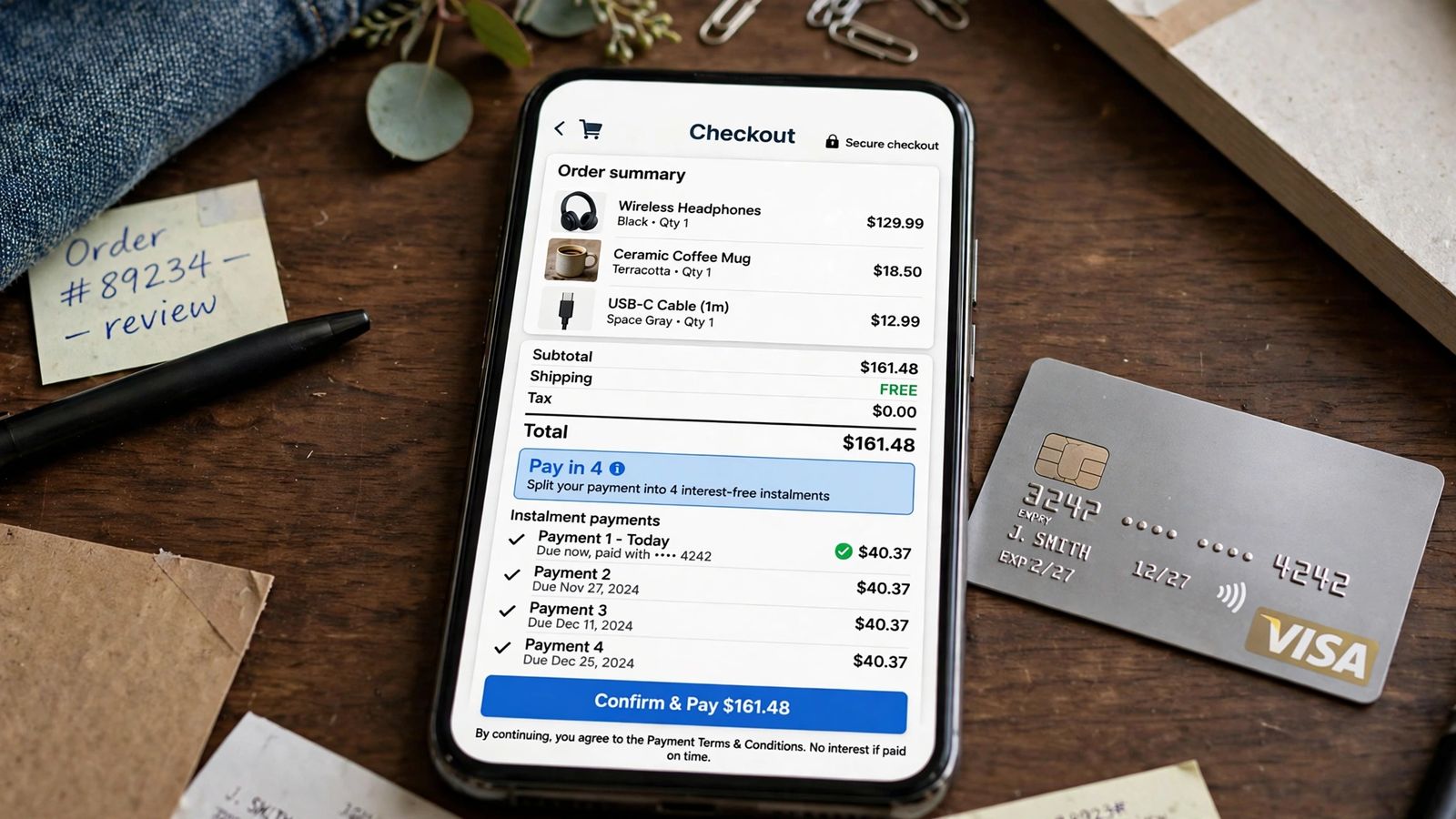
Does buy now pay later affect your credit score? Yes — but only in one of the two cases hiding under that one label. A short pay-in-4 plan — four interest-free payments over about six weeks — is usually never reported to the credit bureaus when you pay on time, so it normally neither helps nor hurts your score. A longer, interest-bearing BNPL loan, repaid monthly over six months or more, is a different product: it is commonly reported like any other installment loan, so on-time payments sit in your file and late ones damage it. And both cases share one back door: fall far enough behind on any plan and the debt can go to a collection agency — and a collection account hurts a score no matter how the loan started.
That split — pay-in-4 versus financing — is the whole answer, and it is the part most explanations blur. “Buy now, pay later” is one marketing label stretched over two kinds of borrowing with opposite credit-reporting habits.
What “buy now, pay later” actually covers
The Consumer Financial Protection Bureau defines a BNPL loan as an installment loan that typically lets you buy something immediately, with little or no initial payment, and pay the balance off over four or fewer payments. That is pay-in-4: a quarter of the price at checkout, then three more equal payments, usually every two weeks, at 0% interest if you pay on schedule — the plan offered by Klarna, Afterpay, Affirm and PayPal at seemingly every online checkout.
Sitting next to it at the same checkouts, often from the same companies, is the second product: a monthly financing loan for a larger purchase — a sofa, a laptop, a phone — repaid over 6 to 48 months, frequently with interest, at an APR that can rival a credit card’s. Providers market both under the same “pay later” banner. For credit reporting, they do not work the same way at all.
This is now mass-market borrowing. The Federal Reserve’s household survey found that 16% of US adults used BNPL in the year covered by its 2025 survey, up from 10% in 2021 — and 11% of users had a BNPL payment trigger an overdraft or insufficient-funds fee in the prior year: “interest-free” is not the same as cost-free.
Case 1: pay-in-4 — usually invisible, in both directions
A credit score can only react to information that reaches a credit report, and a loan never sent to Equifax, Experian or TransUnion is, to the scoring models, a loan that never happened. Pay-in-4 plans usually live in that blind spot. In its January 2025 matched-sample research, the CFPB stated the position plainly: BNPL lenders do not typically report these loans to the nationwide consumer reporting companies — which is why the bureau had to obtain the data directly from six large firms to study it.
The application leaves no mark either, in the usual case. Pay-in-4 approval is typically based on a soft credit check — or the provider’s own record of your past plans — and a soft inquiry does not affect a score. The CFPB notes your creditworthiness may be re-evaluated each time you start a new purchase, but an evaluation is not an inquiry on your report.
So for a standard pay-in-4 plan paid on time, the honest summary is symmetrical:
- It does not build your credit. A year of flawless pay-in-4 payments adds nothing to your payment history, because that history was never furnished — the routes that do build one are in how to build credit.
- It does not hurt your credit either. No hard inquiry, no new-account effect, no balance feeding a utilisation calculation.
There is one large, growing exception: Affirm. From April 1, 2025, Affirm began furnishing all its US loans — pay-in-4 included — to Experian, and from May 2025 to TransUnion. An Affirm plan opened since then may appear on those reports. What happens there is covered below — appearing on a report and moving a score have become two different events.
Case 2: longer BNPL financing — reported like the loan it is
Stretch the term, add interest, and the reporting changes with the structure. Monthly point-of-sale financing is underwritten more like a conventional loan: the provider may run a hard inquiry — recorded on your report, and able to shave a few points off a score temporarily — and it commonly furnishes the account and its payment history to one or more bureaus, where it sits as an installment tradeline like a personal loan.
Once a loan is furnished, the ordinary rules of what a good credit score is built from apply in full:
- Payment history does the heavy lifting. It is the largest factor in a FICO Score, so a payment that reaches 30 days past due on a reported BNPL loan is a late payment like any other, and it can stay on your report for up to seven years.
- On-time payments count the same way. A reported financing loan paid on schedule adds positive history — the one BNPL form that can genuinely contribute to a file.
- The balance is visible debt. A furnished loan shows lenders what you owe, and lenders weigh total obligations when they decide.
Klarna illustrates the split inside a single company: its Pay in 4 and Pay in 30 products are not furnished to US bureaus, while its longer monthly financing is shared with TransUnion and Experian, including late payments and defaults. Same app, opposite credit consequences. The name on the checkout button tells you nothing; the term length and the reporting disclosure in the agreement tell you everything.
Reported is not the same as scored: the bureau holding pattern
Here is the wrinkle that makes 2026 answers sound contradictory. Even where BNPL data now reaches a bureau, the mainstream scores most lenders pull were not built to read it — many small, short, frequently opened and closed loans look, to a traditional model, like behaviour it would normally punish. So the bureaus hold the data at arm’s length from the scores:
- Experian accepts BNPL reporting and marks the accounts clearly as BNPL — but states in its BNPL FAQ that the information “won’t be factored into existing traditional credit scores at this time.” It also confirms the back door: an unpaid account sent to a collection agency can be reported as a collection and negatively affect scores.
- TransUnion, in its consumer guide to BNPL loans, says BNPL information on its reports “does not currently impact credit scores provided by TransUnion” and does not affect credit utilisation — though since 2026 some BNPL history can be seen by lenders and may affect a credit decision, which is not the same as affecting the score.
- FICO itself states the mechanism cleanly: BNPL information must be in your bureau file and fed into a FICO Score calculation by the bureau — and, in myFICO’s words, “none of the three major CRAs will feed BNPL account information reported to the CRA into the calculation of a FICO Score” at this time.
Together: a BNPL loan can sit on your report, visible in some cases to lenders, and still move no mainstream score — until it goes wrong through collections, or until the new scores below reach your lender.
What changed in late 2025: FICO’s BNPL scores
The scoring side now has an exit, dated precisely. On June 23, 2025, FICO announced FICO Score 10 BNPL and FICO Score 10 T BNPL — the first scores from a major provider built to incorporate buy now, pay later data — available to lenders from fall 2025, offered alongside the existing FICO Scores at no additional fee, not as a replacement. Two design choices matter. First, the new scores aggregate a consumer’s multiple BNPL loans when calculating certain variables, instead of treating every six-week plan as a fresh red flag — recognition of the loan-stacking pattern in the CFPB’s research, where most BNPL borrowers held several pay-in-four loans at once. Second, the expected effect is modest: FICO’s joint study with Affirm, covering more than 500,000 consumers, simulated that including BNPL data would move scores by 10 points or less for over 85% of people.
Hold the announcement at its true size. A new score existing is not the same as your lender using it: FICO Score 8 and other established versions, which do not read BNPL data, remain the scores most lenders pull, and a BNPL score can only score data a provider furnished. So — does buy now pay later affect your credit score through FICO’s BNPL models? It can, from fall 2025 onward, where your provider reports and your lender has adopted one of the two BNPL scores. For most borrowers today, neither condition is yet met.
One more 2025 change runs the other way. The CFPB’s May 2024 interpretive rule, which would have treated BNPL lenders as credit card issuers with card-style dispute and refund rights, was withdrawn on May 12, 2025. Your dispute rights on a BNPL purchase now rest on the provider’s own terms and your state’s law.
The ways BNPL hurts a score today
Strip away the future tense and four present-tense harms remain:
- Collections — the main one. Any plan, reported or not, can end with the unpaid balance assigned to a debt collector. A collection account is furnished in the ordinary way, is visible to every score, and can remain on your report for up to seven years from the original delinquency. This is how the “invisible” pay-in-4 loan does its real damage: not gradually, but once, at the end.
- A late payment on a reported loan. If your provider furnishes the account — longer financing routinely, Affirm plans increasingly — a payment 30 or more days late is recorded and weighed as a delinquency.
- A hard inquiry on longer financing. Larger monthly loans may be preceded by a hard check, with the small, temporary cost hard inquiries carry.
- Loan stacking that ends in missed payments. Several simultaneous plans, each trivial alone, add up to a schedule that is easy to lose track of — and the CFPB’s research found heavy use concentrated among borrowers already carrying high credit balances.
What is not on that list, despite frequent claims: opening a pay-in-4 plan does not by itself cut your score, and paying one off early does not raise it.
Does buy now pay later build credit?
Mostly, no. Pay-in-4 cannot build a score it never touches. Longer reported financing can add payment history, but it is an expensive, fragile way to do it: interest on the loan, a possible hard inquiry, and a short account life. A secured credit card or credit-builder loan reports to all three bureaus from the first month and costs less — the route in how to build credit. Treat any BNPL credit-building claim as two questions — is this plan furnished, and does any score my future lenders use read it? — and in November 2026 the answer to the second is still usually no.
How to check what your BNPL has done
Pull your three reports free at AnnualCreditReport.com — the federally authorised source, where weekly reports are now permanently free — and look for small installment accounts you do not recognise; a reported BNPL loan appears as its own account, marked as BNPL at Experian. Check all three files: a provider may furnish to Experian and TransUnion and not to Equifax, so one clean report proves nothing about the others. If a plan you paid on time is absent, that is the system working as described, not an error. If a late mark or collection is wrong — a returned item you were still billed for is the classic case — dispute it with the bureau and keep the provider’s paperwork.
Frequently asked questions
Does Klarna affect your credit score? Its Pay in 4 and Pay in 30 plans are not furnished to US bureaus, so on-time use has no score effect; unpaid debt can still reach collections. Klarna’s longer monthly financing is reported to TransUnion and Experian, so that product behaves like Case 2 above.
Does Affirm affect your credit score? More than any other major provider. Affirm furnishes all its US loans, pay-in-4 included since spring 2025, to Experian and TransUnion. The bureaus currently keep that data out of traditional score calculations — but the accounts are on the reports, and Affirm’s longer loans have the full reported-loan behaviour of Case 2.
Does Afterpay affect your credit score? Afterpay states that it does not report to US credit bureaus, so its pay-in-4 plans neither build nor damage a score through reporting. The residual risks are late fees, a frozen account, and collections if a balance goes unpaid.
Does buy now pay later show up on your credit report? Only if the provider furnishes that product to that bureau. Expect: nothing for most pay-in-4 plans; an Affirm plan on Experian and TransUnion if opened since spring 2025; and a visible installment account for longer financing from providers that report — most of them.
Does BNPL affect a mortgage application? A score is not the whole application. Lenders reviewing a full report can see reported BNPL accounts — TransUnion began sharing select BNPL data with lenders in 2026 — and an underwriter will count a visible BNPL payment among your monthly obligations whether or not a model scored it. Unreported pay-in-4 plans do not appear, though bank statements may still show the payments.
Can BNPL lower your score if you always pay on time? No — not through pay-in-4, which is unreported or unscored, and not through a reported loan in good standing. The on-time risk is prospective: if a lender adopts a BNPL-aware score, a file crowded with simultaneous plans is data that model will read — one more reason to run one plan at a time.
This article is general information about how BNPL reporting and scoring work in the United States, checked in November 2026 against CFPB, Federal Reserve, FICO, Experian and TransUnion publications — not financial advice. Providers change reporting policies without much notice; the disclosure in your own plan’s agreement is the final word for that plan.