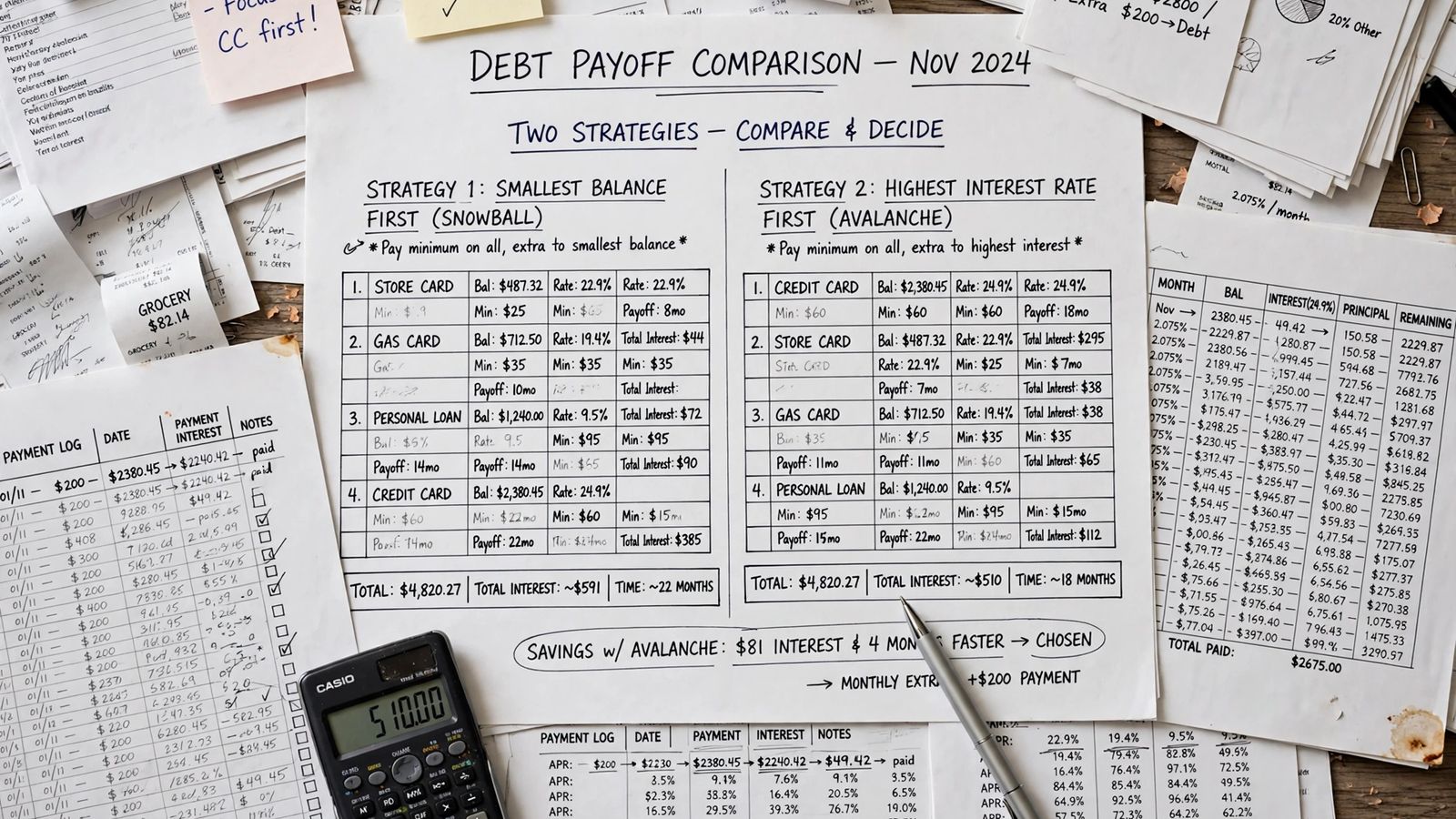
Debt snowball vs avalanche is a choice about one thing only: which debt gets your extra money first. The snowball sends it to your smallest balance, whatever its interest rate. The avalanche sends it to your highest interest rate, whatever its balance. Everything else — paying the minimum on every debt, then rolling each cleared debt’s payment onto the next one — is identical. On cost, the avalanche always wins or ties: it can never produce more total interest than the snowball on the same debts and budget, because every extra dollar goes where interest grows fastest. The snowball’s counter-argument is behavioural, and it has real research behind it: people who close whole accounts early are more likely to finish paying off their debt at all. Which method is “better” depends on the interest gap in your specific debts — often surprisingly small, as the worked example below shows — and on which plan you will still be following in month ten.
Debt snowball vs avalanche at a glance
| Debt snowball | Debt avalanche | |
|---|---|---|
| Extra money goes to | The smallest balance | The highest interest rate (APR) |
| Debts are listed by | Balance, smallest to largest | Rate, highest to lowest |
| Total interest paid | Equal to, or more than, the avalanche | The lowest possible for your budget |
| First debt cleared | Usually soonest | Often much later, if the priciest debt is large |
| Debt-free date | The same or later | The same or sooner |
| Main strength | Early wins that keep the plan alive | Lowest cost, every time |
| Main weakness | Costs extra interest when small debts are cheap debts | A long wait for the first finished debt |
One point deserves emphasis: the two methods produce the identical plan whenever your smallest balance also carries your highest rate — and store cards and overdrafts are often both small and expensive. They only part company when a small debt is a cheap debt: a low-rate loan or a 0% promotional balance in front of an expensive card.
The part both methods share: minimums first, then roll
Strip away the ordering rule and the debt snowball vs avalanche question disappears, because the engine underneath is the same:
- List every debt with its balance, interest rate and minimum payment.
- Pay the minimum on every debt, every month, without exception. A missed minimum brings late fees and a mark on your credit record; both methods assume every account stays current.
- Send every spare dollar to one target debt — the only step where the methods differ.
- When the target reaches zero, roll its whole payment — minimum plus extra — onto the next target. Your total monthly payment never changes; it just concentrates on fewer debts. This rollover, not the ordering, is what makes either plan fast. The University of Wisconsin–Madison Extension’s guide to getting out of debt describes the same structure, plus the standing rule both methods need: no new debt while the plan runs.
How the debt snowball works
List your debts from the smallest balance to the largest, ignore the interest rates completely, and aim everything extra at the smallest. When it is gone, roll its payment onto the next-smallest, and so on.
The point is the speed of the first win. A debt list with one line crossed off is a different psychological object from the same list with every line slightly shorter. The Alabama Cooperative Extension System puts it plainly in its comparison of the snowball and avalanche methods: the snowball offers quicker reward in seeing accounts reach zero, which some people need to stay committed to a multi-year process.
The cost is real and specific: while your extra money clears a small, cheap debt, your most expensive debt still charges its full rate on a barely shrinking balance. How much that costs depends on how far apart your rates are — hence the worked example below.
How the debt avalanche works
List your debts from the highest interest rate to the lowest, ignore the balances, and aim everything extra at the most expensive debt. When it is gone, roll its payment onto the next-highest rate.
The logic is arithmetic, not psychology. Interest is charged on what you still owe, at the rate attached to that debt. A dollar of balance at 24% APR costs you 2 cents a month; a dollar at 8% costs about two-thirds of a cent. Every extra dollar against the 24% debt therefore stops three times as much future interest as the same dollar against the 8% debt. No other ordering of the same payments can beat that, which is why the avalanche’s total interest is a floor the snowball can match but never undercut. For the rate itself — how APR differs from the bare interest rate — see what APR is.
The avalanche’s weakness mirrors the snowball’s strength: if your highest-rate debt is also a large one, you may pay for a year or more before any single debt reaches zero — a long wait for a finish line.
Worked example: the same three debts, both ways
Here is one debt list, run both ways, with the assumptions stated so you can check the arithmetic.
| Debt | Balance | APR | Minimum payment | Interest in month 1 |
|---|---|---|---|---|
| Small loan | $600 | 8% | $25 | $600 × 8% ÷ 12 = $4.00 |
| Credit card | $4,200 | 24% | $80 | $4,200 × 24% ÷ 12 = $84.00 |
| Personal loan | $4,500 | 11% | $95 | $4,500 × 11% ÷ 12 = $41.25 |
| Total | $9,300 | $200 | $129.25 |
The budget is $400 a month: the $200 of minimums plus $200 extra. Assumptions, the same for both runs: interest charged monthly at APR ÷ 12; minimums fixed as shown (real card minimums usually shrink as the balance falls, which would stretch both plans); no new charges, fees or rate changes; leftover money moves to the next target in the same month a debt clears.
Note the methods disagree about the first target here — deliberately: the smallest debt is the cheapest debt, the case where the choice actually costs something.
Snowball run — smallest balance first. The $200 extra goes to the $600 loan, which receives $225 a month and is gone in month 3. Its $225 rolls onto the credit card, which now gets $305 a month and clears in month 20. Everything then lands on the personal loan, cleared in month 28. Total interest: about $1,851.
Avalanche run — highest rate first. The $200 extra goes to the 24% credit card, which receives $280 a month and is cleared in month 19. The personal loan is next in rate order; the small loan, shrinking slowly on its $25 minimum all along, is finished in month 27, and the personal loan — the last debt standing — in month 28. Total interest: about $1,734.
| Result | Snowball | Avalanche |
|---|---|---|
| Monthly payment | $400 | $400 |
| First debt cleared | Month 3 | Month 19 |
| Debt-free | Month 28 | Month 28 |
| Total interest | ≈ $1,851 | ≈ $1,734 |
| Difference | Avalanche saves ≈ $117 |
That table contains the whole honest answer to debt snowball vs avalanche. The avalanche saved about $117 on $9,300 of debt — real money, roughly 1.3% of the amount owed. In exchange, the snowball delivered a finished debt in month 3 instead of month 19: sixteen months of visible proof the plan works, bought for about $7 a month. Whether $117 is a fair price for that proof is not a maths question.
Two things move that $117 a lot. Rate spread: a 24% card waiting behind a 0% promotional balance is a far more expensive wait than the 8% loan above. Size of the cheap small debts: one $600 loan in front of the card costs little; three small low-rate debts totalling $4,000 would cost far more. One analysis cited by the University of Illinois Extension puts the snowball’s typical extra cost at about 1.8% to 4.3% more in interest charges than the avalanche on the same debts — a range our example sits inside, at the gentle end.
What the research actually says about finishing
The snowball’s case rests on evidence, not just motivational speaking. David Gal and Blakeley McShane, publishing in the Journal of Marketing Research in 2012, analysed records from a debt settlement programme covering about 6,000 people and asked what predicted actually eliminating debt. Their answer, summarised by Northwestern’s Kellogg School: closing debt accounts predicted successful debt elimination — independent of the dollar balances of the accounts closed. Finishing a debt, any debt, was the signal that someone would finish them all; paying a large sum off one big balance without closing anything was a weaker signal. The paper — “Can Small Victories Help Win the War?” — is the origin of the “small victories” phrase nearly every snowball article repeats.
Two honest limits. First, the sample is people in a debt settlement programme — a specific, already-distressed group; the study shows what predicted success there, not a guaranteed effect for everyone with three cards. Second, it does not say the snowball is free: the finding is that the extra interest often buys follow-through, not that it vanishes.
When each method wins
Choose the avalanche when:
- One debt’s rate towers over the rest — a card above 25%, an overdraft, or any high-cost short-term borrowing. For scale, the Federal Reserve’s G.19 release put the average rate on card accounts actually charged interest at 22.36% in August 2026; a debt well above that deserves no queue in front of it.
- Your rates are spread widely apart (roughly 10 or more percentage points between highest and lowest).
- You will stick to a plan for its own sake, and watching total interest fall is motivation enough.
Choose the snowball when:
- Your rates are fairly close together, so the computed gap — run your own numbers the way the example above does — comes out small.
- You have started payoff plans before and drifted off them. A finished snowball beats an abandoned avalanche, which saves nothing at all.
- The sheer number of payments is part of the burden. Each closure is one fewer minimum to track and one fewer account that can be missed.
Either works when your smallest debt is also your most expensive — take the shared order and stop deliberating. A hybrid is also legitimate: clear one genuinely small debt for the first win, then switch to strict rate order, keeping most of the avalanche’s saving.
Debts that jump the queue, and debts that wait
Neither ordering rule is a complete priority list; three exceptions matter more than the choice itself:
- Anything already overdue or in collections comes before optimisation: a debt gathering fees and damaging your credit record now outranks an ordering question about current debts. The Consumer Financial Protection Bureau’s guide to getting a handle on debt covers working with creditors and nonprofit credit counsellors, and warns about for-profit debt settlement companies that charge fees up front — illegal for most of them before settling a debt.
- Very high-cost debt — payday-style loans and similar — goes first under either method, whatever its size.
- Low-rate, structured debts usually wait. A mortgage or low-rate car loan is normally last in either queue, and federal student loans carry repayment and forgiveness options that extra payments can work against; check those first.
A small starter emergency fund also belongs ahead of aggressive extra payments: without one, the next car repair goes straight back onto a card at 24% and quietly refunds the plan.
Frequently asked questions
Does the debt snowball or the debt avalanche pay off debt faster? The avalanche finishes the same or sooner — never later — on identical debts and budget, because less interest means more of each payment reaches principal. In the worked example both finished in month 28; the edge showed up as $117 less interest rather than an earlier finish.
Can I switch from snowball to avalanche halfway through? Yes, at no cost — the method is just the rule that picks next month’s target. A common pattern is snowball until one or two small debts are gone, then avalanche for the expensive remainder. Just do not switch so often that no debt stays the target long enough to clear.
What if two debts have the same interest rate, or the same balance? Break the tie with the other method’s rule: same rate, pay the smaller balance first (the avalanche is indifferent on cost, so the earlier win is free); same balance, pay the higher rate first.
Should I close a credit card once I have paid it off? Not automatically. Closing a card removes its credit limit from your file, which can raise your credit utilisation — the share of available credit you are using — and work against your score, a mechanism covered in how to build credit. Keeping it open and unused preserves the limit; but if an empty card would tempt you back into the balance you just cleared, close it anyway — slightly higher utilisation is cheaper than a rebuilt balance at 24%.
What if I cannot afford all the minimum payments? Then neither method applies yet — both are built on minimums being covered. Contact the creditors, and talk to a nonprofit credit counsellor (the CFPB lists the Financial Counseling Association of America and the National Foundation for Credit Counseling as starting points) about a debt management plan, before fees make the arithmetic worse.
This article is general information, checked in November 2026. The worked example uses fixed, hypothetical rates and minimums, calculated as described; your statements will differ, because real card minimums change and interest is usually calculated daily. It is not personal financial advice.